What it is
Woodpecker CI is a continuous integration and continuous delivery engine written in Go and released under the Apache-2.0 license. It lives in the developer tooling ecosystem around build and deployment automation, and it is distributed as a self-hostable server plus one or more agents that execute pipeline work. The project describes itself as a simple, yet powerful CI/CD engine with great extensibility, and it is catalogued under topics such as automation, ci, cicd, devops, docker, and kubernetes. Its documentation and plugin directory are hosted at woodpecker-ci.org.
The concrete problem it solves is the ownership and operation of build and deployment pipelines without depending on a hosted vendor. A team points Woodpecker at its Git repositories, defines pipelines, and runs them on infrastructure the team controls. Because the engine is extensible through plugins, the same core can be adapted to different build, test, and release workflows. The README notes that Woodpecker is used as the main CI/CD engine at Codeberg, a Git hosting platform focused on privacy and free software development, which shows the project operating at production scale rather than only as a hobby tool.
Key capabilities
- Runs as a server plus agent architecture, with the server and agent deployed as separate components.
- Uses SQLite as the default database, so no external database server is required for a basic installation.
- Consumes roughly 100 MB of RAM for the server and 30 MB for the agent at runtime in idle mode.
- Extends through plugins, with a plugin overview website that combines core-team and community-maintained plugins.
- Supports installation in various ways, as documented in the project's installation instructions.
- Ships with a self-hosted Weblate instance for translations, with a public overview of translation state.
- Targets container-oriented environments, reflected in the docker and kubernetes topics.
Who uses it and how
- Codeberg runs Woodpecker as its main CI/CD engine, making it the pipeline system behind a public Git hosting platform.
- Self-hosting teams deploy the server and agents on their own infrastructure and connect them to their repositories.
- Operators who want a minimal footprint run it with the default SQLite database instead of provisioning a separate database service.
- Teams that need behaviour beyond the core install pipelines through plugins, browsing the plugin overview site to find core or community options.
- Contributors and translators work through the self-hosted Weblate instance to localise the interface.
Getting started
The README points to the installation instructions at woodpecker-ci.org/docs/administration/general, which cover the various supported installation methods. A default setup runs with SQLite as the database and separates the server from the agent.
When to use it — and when not to
Woodpecker suits teams that want to own their CI/CD stack and are comfortable running a server and at least one agent themselves, with SQLite keeping the initial database burden low. The project carries 371 open issues, so prospective adopters should expect an active backlog and should check whether the specific integrations they need are already covered by plugins. No paid product comparison is offered in the available facts, so the decision rests on self-hosting effort and plugin coverage rather than on a documented migration path.
project readme (upstream, from github) — read inline
Woodpecker











Woodpecker is a simple, yet powerful CI/CD engine with great extensibility.
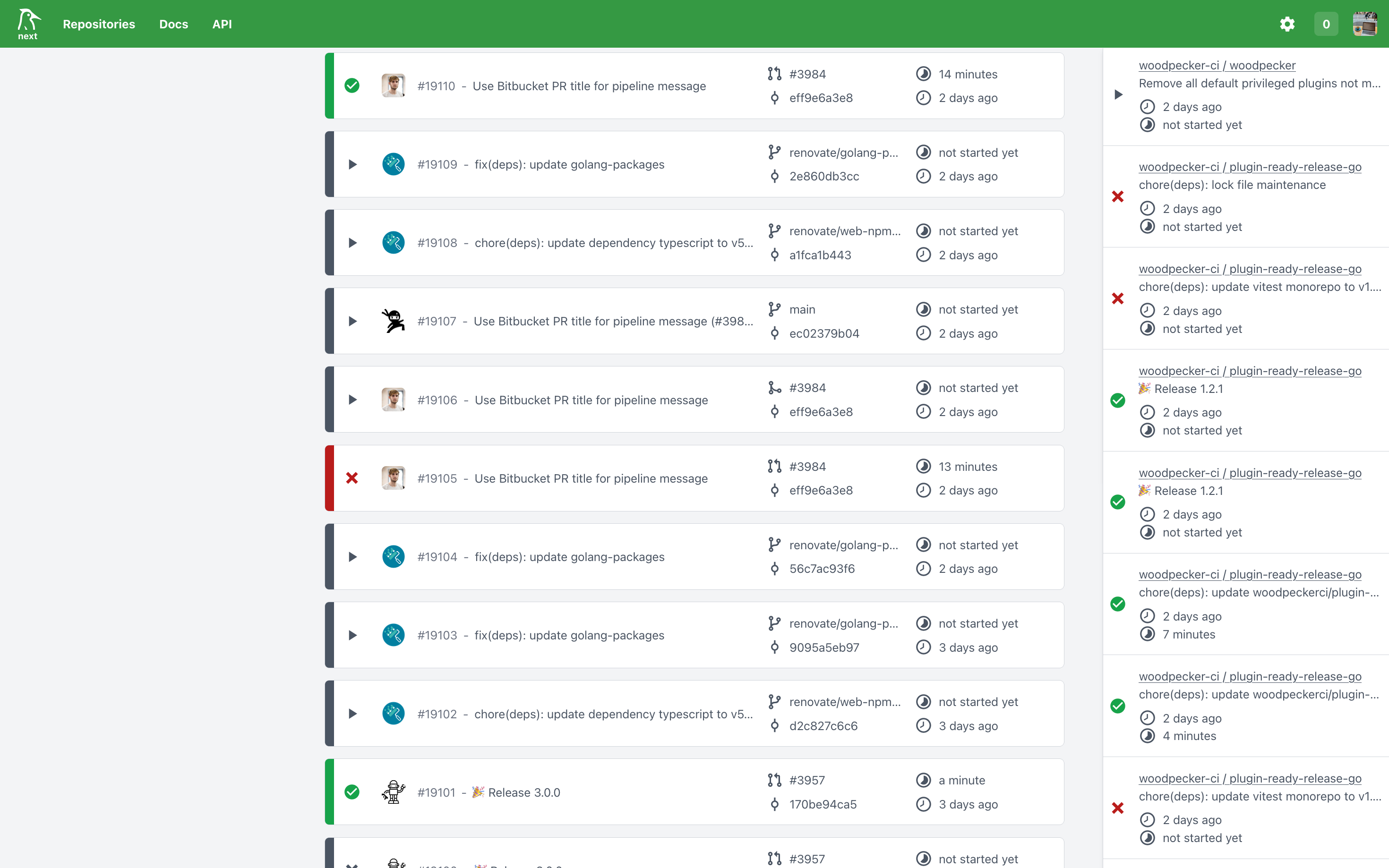
Installation & Resources
Woodpecker can be installed in various ways (see the Installation Instructions) and runs with SQLite as database by default.
It requires around 100 MB of RAM (Server) and 30 MB (Agent) at runtime in idle mode.
Support
You can support the project by becoming a backer on Open Collective or via GitHub Sponsors.
Documentation
Our documentation can be found at .
Translation
We have a self-hosted Weblate instance at translate.woodpecker-ci.org.
An overview of the current translation state is available at .
Public Woodpecker Instances
Woodpecker is used as the main CI/CD engine at Codeberg, an alternative Git hosting platform with a focus on privacy and free software development.
Plugins
Woodpecker can be extended via plugins.
The plugin overview website helps browsing available plugins.
It combines both plugins by the Woodpecker core team and community-maintained ones.
License
Woodpecker is Apache 2.0 licensed.
The source files have a header indicating which license they are under and what copyrights apply.
Everything in docs/ is licensed under the Creative Commons Attribution-ShareAlike 4.0 International Public License.