Oxigraph








Oxigraph is both a graph database and a RDF and SPARQL toolkit.
Its goal is to provide a compliant, safe, and fast graph database based on the RocksDB key-value store. It also provides a set of utilities for RDF basic manipulation (parsing, serialization, canonicalization) and building SPARQL implementations (SPARQL results parsers/serializers, SPARQL parser...).
Oxigraph is in heavy development and SPARQL query evaluation has not been optimized yet. Oxigraph internal design is described on the wiki.
Oxigraph implements the following specifications:
- SPARQL Query, SPARQL Update, and SPARQL Federated Query.
- Turtle, TriG, N-Triples, N-Quads, RDF/XML and JSON-LD RDF serialization formats for both data ingestion and retrieval.
- SPARQL Query Results XML Format, SPARQL Query Results JSON Format and SPARQL Query Results CSV and TSV Formats.
- RDF Dataset Canonicalization.
Most implementations are nearly fully conformant with the latest recommendations (1.1 for RDF, SPARQL and JSON-LD) with preliminary support for 1.2 RDF and SPARQL drafts.
It is split into multiple parts:
- The database written as a Rust library. Its source code is in the
libdirectory.
pyoxigraphthat exposes Oxigraph to the Python world. Its source code is in thepythondirectory.- JavaScript bindings for Oxigraph. WebAssembly is used to package Oxigraph into a NodeJS compatible NPM package. Its source code is in the
jsdirectory. - Oxigraph binary that provides a standalone command-line tool allowing to manipulate RDF data and spawn a web server implementing the SPARQL 1.1 Protocol and the SPARQL 1.1 Graph Store Protocol. Its source code and instructions (including Docker) are in the
clidirectory. Note that it was previously named Oxigraph server.
Also, some parts of Oxigraph are available as standalone Rust crates to be reused in other Rust projects:
oxrdf, datastructures encoding RDF basic concepts (theoxigraph::modelmodule).oxrdfio, a unified parser and serializer API for RDF formats (theoxigraph::iomodule). It itself relies on:spareval, a SPARQL evaluator.spargebra, a SPARQL parser.sparesults, parsers and serializers for SPARQL result formats.sparopt, a SPARQL optimizer.oxsdatatypes, an implementation of some XML Schema datatypes.spargeo, a partial implementation of GeoSPARQL.
The library layers in Oxigraph. The elements above depend on the elements below:
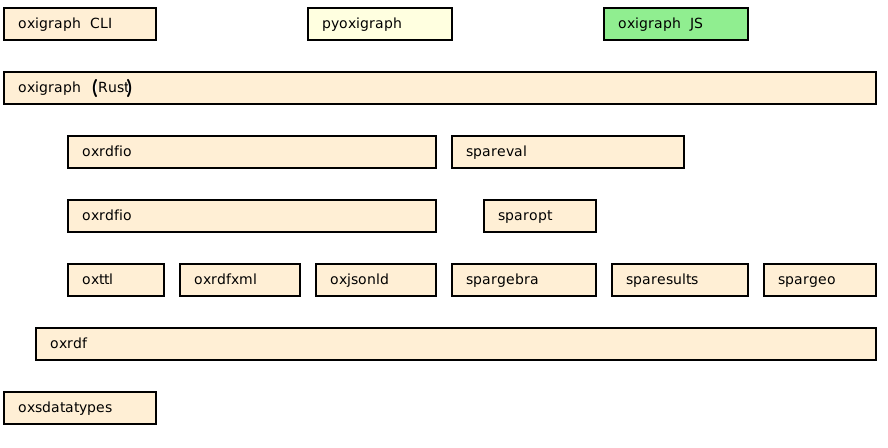
A preliminary benchmark is provided. There is also a document describing Oxigraph technical architecture.
Help
Feel free to use GitHub discussions or the Gitter chat to ask questions or talk about Oxigraph. Bug reports are also very welcome.
If you need advanced support or are willing to pay to get some extra features, feel free to reach out to Tpt.
License
This project is licensed under either of
- Apache License, Version 2.0, (LICENSE-APACHE or http://www.apache.org/licenses/LICENSE-2.0)
- MIT license (LICENSE-MIT or http://opensource.org/licenses/MIT)
at your option.
Contribution
When cloning this codebase, clone the submodules using
git clone --recursive https://github.com/oxigraph/oxigraph.git to clone the repository including submodules or
git submodule update --init to add the submodules to the already cloned repository.
Unless you explicitly state otherwise, any contribution intentionally submitted for inclusion in Oxigraph by you, as defined in the Apache-2.0 license, shall be dual licensed as above, without any additional terms or conditions.
Sponsors
- Zazuko, a knowledge graph consulting company.
- RelationLabs that is building Relation-Graph, a SPARQL database module for the Substrate blockchain platform based on Oxigraph.
- Field 33 that was building an ontology management platform.
- Magnus Bakken who is building Data Treehouse, a time-series + RDF datalake platform, and chrontext, a SPARQL query endpoint on top of joint RDF and time series databases.
- DeciSym.AI a cybersecurity consulting company providing RDF-based software.
- ACE IoT Solutions, a building IOT platform.
- Albin Larsson who is building GovDirectory, a directory of public agencies based on Wikidata.
And others. Many thanks to them!