
OpenScreen
A free, open-source desktop app for recording your screen and turning the result into polished product demos and walkthroughs.
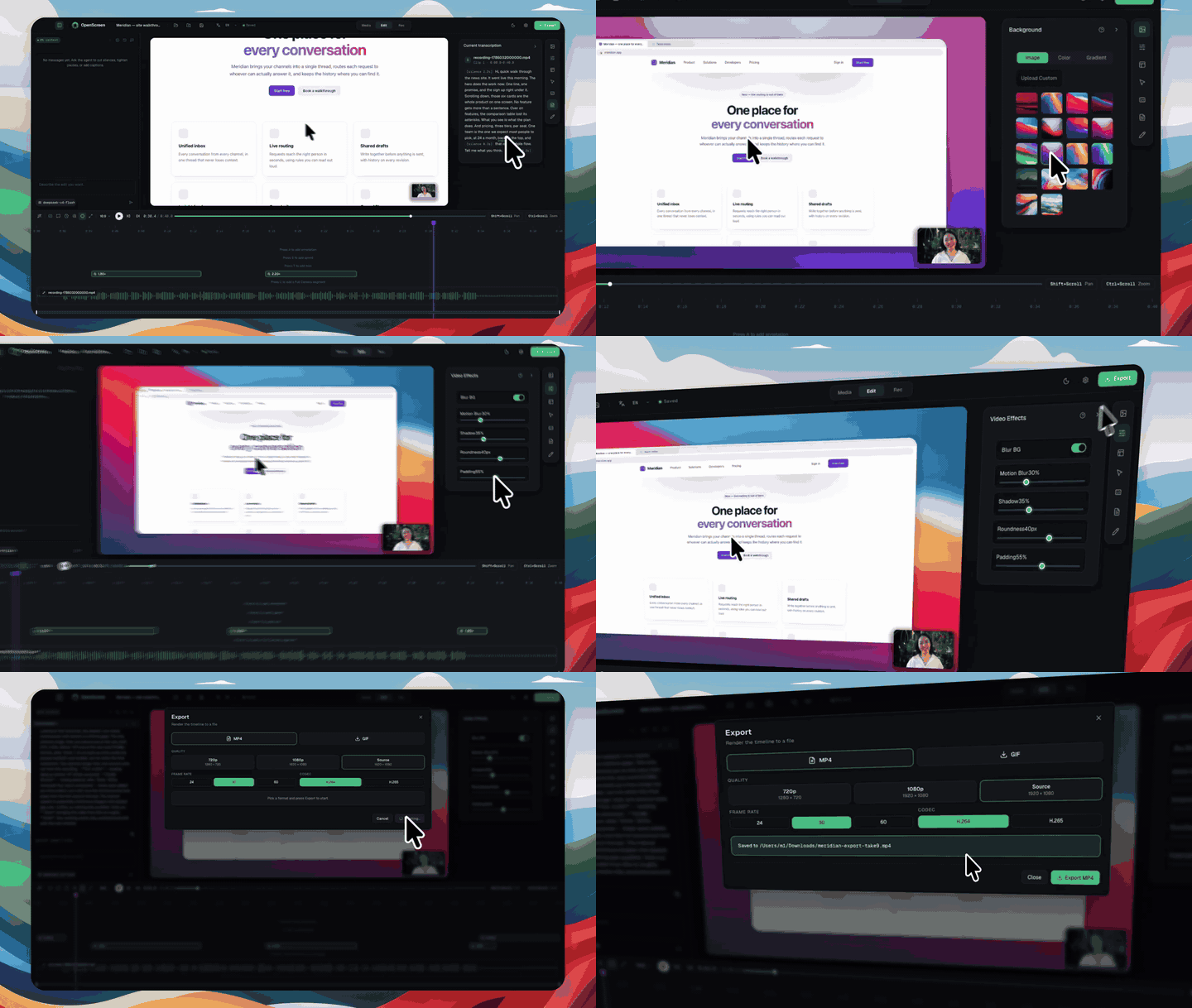






[!NOTE] This is OpenScreen, continued. Siddharth Vaddem created the project and archived the original repository after v1.5.0. Development moved here with his approval, under the same name and the same MIT license.
A raw capture goes in and comes out ready to post — on X, Reddit, YouTube, a docs page, or a landing page. That is the category Screen Studio defined; OpenScreen is the open-source entry in it, and not a clone.
100% free for personal and commercial use, with nothing held behind a paywall.
Project status. OpenScreen is under active development — expect rough edges and occasional breaking changes, including to the .openscreen project format and the CLI. Bug reports are welcome: open an issue.
Core Features
- Record a specific window, or your whole screen.
- Record microphone and system audio.
- Webcam overlay with picture-in-picture, drag-to-position, mirroring, and shape options.
- Auto or manual zooms with adjustable depth, duration, easing, and pixel-precise position; auto-zoom follows your cursor as you work.
- Custom cursor size, smoothing, and click effects, with cursor themes and post-recording path smoothing.
- Automatic captions for voiceovers, transcribed on-device with no upload (works offline), with an editable transcript you can cut from and optional subtitle translation.
- AI editing assistant: describe the edit you want in chat and it applies to the timeline — cuts, zooms, speed ramps, annotations, camera framing. Bring your own key (Claude, OpenAI, Gemini, Mistral, OpenRouter, MiniMax, or any OpenAI-compatible endpoint); nothing is enabled by default.
- Wallpapers, solid colors, gradients, or your own background image.
- Motion blur.
- Crop, trim, and per-segment speed control on the timeline.
- Text, arrow, and image annotations, with text animation presets.
- Timeline snapping guides and an audio waveform to make trimming easier.
- Customizable keyboard shortcuts.
- Export to MP4 or GIF in multiple aspect ratios and resolutions, rendered and encoded on the GPU (Metal on macOS, D3D11 on Windows, Vulkan on Linux) with an automatic CPU fallback.
- Languages supported: Arabic, Czech, English, Spanish, French, German, Italian, Japanese, Korean, Portuguese (Brazil), Russian, Turkish, Vietnamese, Simplified Chinese, and Traditional Chinese.
Command-line interface (headless)
OpenScreen ships a CLI for scripts, CI, and AI coding agents: record the screen
headlessly, edit the .openscreen project JSON programmatically (zooms,
annotations, trims), and render MP4/GIF with the full export pipeline — no
visible windows, NDJSON output with --json.
openscreen record --duration 20 --project demo.openscreen --json
openscreen export demo.openscreen -o demo.mp4 --json
See the CLI reference.
Installation
Every platform has a recommended route below. On Windows that is the Microsoft Store; everywhere else it is the installer from the GitHub Releases page.
System requirements
- Windows: version 1903+ (build 18362) with Intel 8th Gen / AMD Ryzen 2000 series or newer minimum; Windows 11 with Intel 12th Gen / Ryzen 4000 series or newer recommended
- macOS: 13 (Ventura) or later — required by ScreenCaptureKit for capture
- Linux:
xdg-desktop-portaland PipeWire for native capture and system audio; recording still works without them through the browser-capture fallback, with fewer capabilities (see Platform differences) - RAM: 8 GB minimum, 16 GB recommended
Full table and notes on older integrated graphics: system requirements.
macOS
Download the .dmg installer directly from the Releases page and drag OpenScreen into your Applications folder. Builds from 1.9.0 onward are signed with a Developer ID certificate and notarized by Apple, so Gatekeeper does not block them and no terminal step is needed.
On first launch, open System Settings > Privacy & Security and grant the two permissions OpenScreen needs: Screen Recording and Accessibility. Recording cannot start until both are granted.
[!NOTE] macOS 15 and later re-ask for screen-recording permission periodically. That prompt comes from macOS itself and applies to every third-party screen recorder — it is not a sign that anything is wrong with your install or that an update broke something. Grant it again when asked.
[!NOTE] Upgrading from a version older than 1.9.0? Those builds were not signed with a Developer ID certificate, and macOS ties Screen Recording and Accessibility grants to an app's signature — so it cannot tell the new build is the same app, and the permissions you granted the old one do not carry over. If the new version won't record even after you grant them, remove OpenScreen's existing entries under System Settings > Privacy & Security (both Screen Recording and Accessibility), then launch it again and grant them when prompted.
Windows
Recommended — Microsoft Store
Get OpenScreen from the Microsoft Store, or from a terminal:
winget install --source msstore OpenScreen
Microsoft signs the Store package during certification, so it installs with no security warning and updates itself.
Alternative — standalone installer
Download the .exe from the Releases page. Use this if you can't reach the Store — Windows LTSC, a locked-down work machine, an offline install, or if you want a specific older version.
[!NOTE] The
.exeis not code-signed, so Windows SmartScreen shows "Windows protected your PC" and reports an unknown publisher. Choose More info → Run anyway to continue.This is not a sign that something is wrong with the download: an unsigned installer earns SmartScreen's trust per file, so a brand-new build always starts out untrusted no matter how many people installed the previous one. Verifying the signature isn't an option here — there is nothing to verify. If you want the checked path, use the Store build above. If you use the
.exe, download it only from the Releases page linked here.
Linux
Four packages are published to the Releases page for each version. Pick the one that matches your distro:
Debian / Ubuntu / Pop!_OS (.deb)
sudo apt install ./Openscreen-Linux-*.deb
Fedora / RHEL / CentOS (.rpm)
sudo dnf install ./Openscreen-Linux-*.rpm
Arch / Manjaro (.pacman)
sudo pacman -U Openscreen-Linux-*.pacman
**Any distro