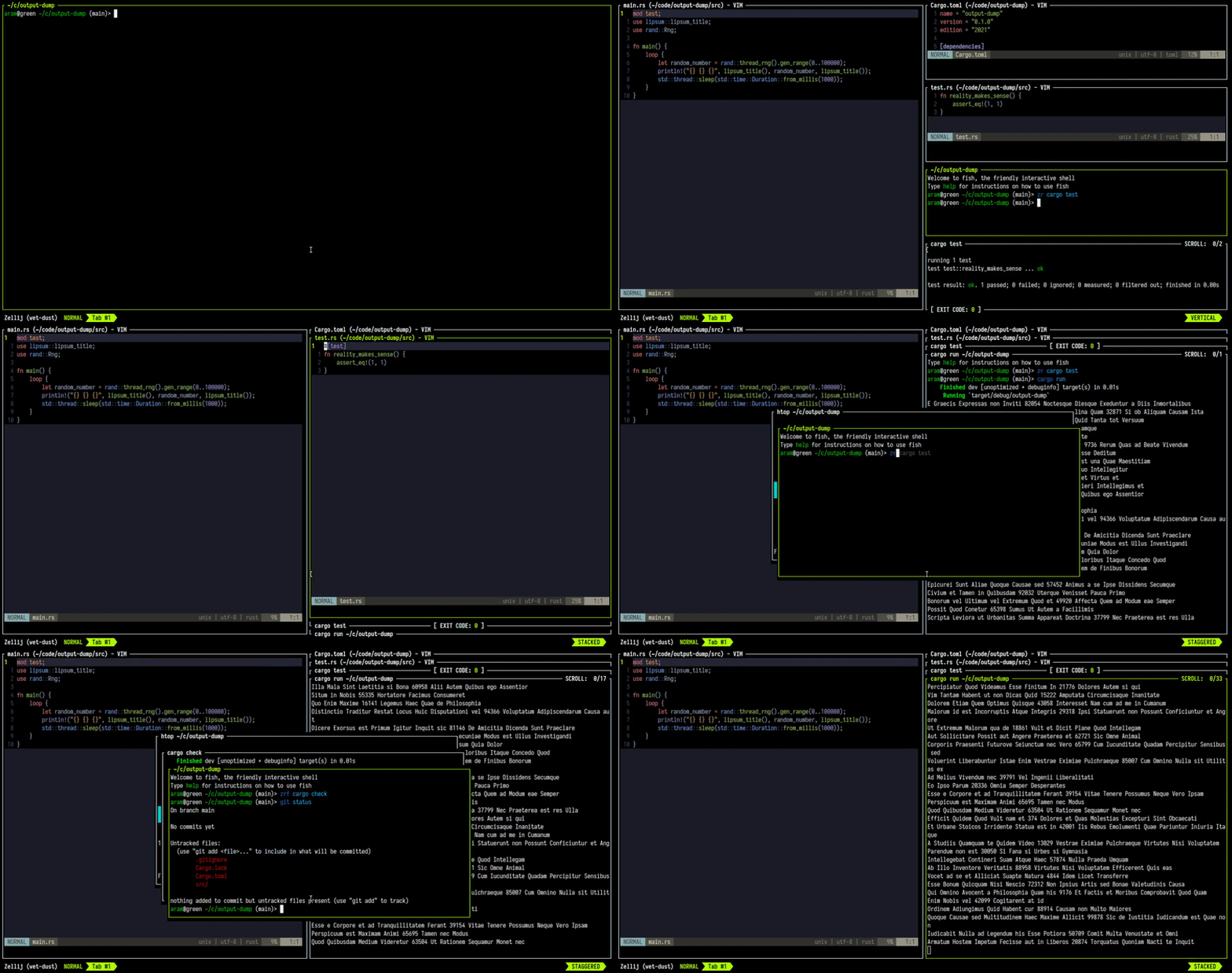
Zellij is a free, open source terminals project written in Rust and released under MIT. It has 35,445 GitHub stars, 1,452 forks and 1,915 open issues, and was last pushed 3 days ago. On this registry it ranks #4 of 8 tracked projects in Terminals, with 5 head-to-head comparisons available. It gained 53 stars over the last 6 tracked days.

What is Zellij?

Zellij is a terminal workspace and multiplexer written in Rust that gives developers, operations engineers, and anyone who loves the terminal built-in layouts, tabs, panes, and a WebAssembly plugin system, built so that simplicity and power do not have to be traded against each other.

What it is

Zellij is a terminal multiplexer and workspace written in Rust and released under the MIT licence, with 35,443 stars and 1,452 forks on GitHub. It lives in the terminal-multiplexer ecosystem, the class of programs the README notes are sometimes called "Terminal Multiplexers", and it is designed around the position that one must not sacrifice simplicity for power. It ships a strong out-of-the-box experience while still offering deep customizability, layouts for personal automation, true multiplayer collaboration, floating and stacked panes, a plugin system for plugins written in any language that compiles to WebAssembly, and a built-in web-client. It is aimed at developers, ops-oriented people, and beginner and power users alike.

The problem it solves is the manual arrangement of terminal work. Rather than placing panes by hand and rebuilding a working environment from scratch, users define layouts and reuse them; rather than treating the terminal as a single-user surface, it supports true multiplayer collaboration; and rather than requiring a terminal at all, its web-client makes one optional. That combination targets the everyday friction of running several long-lived tasks side by side and of sharing that work with other people.

Key capabilities

  • Layouts for personal automation, documented at zellij.dev/documentation/layouts.html, defining panes, tabs, and their arrangement for reuse.
  • Floating and stacked panes, presented as unique UX features beyond ordinary tiling.
  • A plugin system in which plugins can be written in any language that compiles to WebAssembly.
  • A built-in web-client, documented at zellij.dev/tutorials/web-client/, which makes a terminal optional.
  • True multiplayer collaboration, letting more than one person share the workspace.
  • Installation through an OS package, a prebuilt binary from the latest release placed in $PATH, or cargo install --locked zellij.
  • A try-before-installing path for bash and zsh users.

Who uses it and how

  • Developers and ops-oriented people, the two audiences the README names first, running several panes and tabs inside one workspace.
  • Beginners who want a working setup out of the box, and power users who want deep customizability and personal automation through layouts.
  • Teams that need true multiplayer collaboration in a shared terminal session.
  • Users without a convenient terminal, who reach Zellij through the built-in web-client.
  • Plugin authors working in any language that compiles to WebAssembly, extending the workspace itself.

Getting started

Install through a package for your OS (see docs/THIRD_PARTY_INSTALL.md), download a prebuilt binary from the latest release and place it in $PATH, or compile with cargo install --locked zellij. Bash and zsh users can also try Zellij without installing.

How it compares

The facts provided name no competing products, no paid products that Zellij replaces, and no similar tools by name. On the record available here, Zellij stands alone in this registry.

When to use it — and when not to

The project carries 1,915 open issues, so prospective users should expect a busy tracker rather than a small, quiet codebase. Anyone who wants a minimal single-purpose tool may find a full workspace with plugins, layouts, and a web-client to be more surface than they need, and the README excerpt is thin on operational detail such as resource use and release cadence. The licence itself is clear at MIT, and the last push date of 14 September 2026 indicates recent activity.

project readme (upstream, from github) — read inline


logo
Zellij

demo

[Installation] [Screencasts & Tutorials] [Configuration] [Layouts] [FAQ]

Discord Chat Matrix Chat Zellij documentation


Sponsored by


gresearch logo
</a>

What is this?

Zellij is a workspace aimed at developers, ops-oriented people and anyone who loves the terminal. Similar programs are sometimes called "Terminal Multiplexers".

Zellij is designed around the philosophy that one must not sacrifice simplicity for power, taking pride in its great experience out of the box as well as the advanced features it places at its users' fingertips.

Zellij is geared toward beginner and power users alike - allowing deep customizability, personal automation through layouts, true multiplayer collaboration, unique UX features such as floating and stacked panes, and a plugin system allowing one to create plugins in any language that compiles to WebAssembly.

Zellij includes a built-in web-client, making a terminal optional.

You can get started by installing Zellij and checking out the Screencasts & Tutorials.

For more details about our future plans, read about upcoming features in our roadmap.

How do I install it?

The easiest way to install Zellij is through a package for your OS.

If one is not available for your OS, you could download a prebuilt binary from the latest release and place it in your $PATH. If you'd like, we could automatically choose one for you.

You can also install (compile) with cargo:

cargo install --locked zellij
Try Zellij without installing

bash/zsh:

bash <(curl -L https://zellij.dev/launch)

fish/xonsh:

bash -c 'bash <(curl -L https://zellij.dev/launch)'
Installing from main

Installing Zellij from the main branch is not recommended. This branch represents pre-release code, is constantly being worked on and may contain broken or unusable features. In addition, using it may corrupt the cache for future versions, forcing users to clear it before they can use the officially released version.

That being said - no-one will stop you from using it (and bug reports involving new features are greatly appreciated), but please consider using the latest release instead as detailed at the top of this section.

How do I start a development environment?

  • Clone the project
  • In the project folder, for debug builds run: cargo xtask run
  • To run all tests: cargo xtask test

For more build commands, see CONTRIBUTING.md.

Configuration

For configuring Zellij, please see the Configuration Documentation.

About issues in this repository

Issues in this repository, whether open or closed, do not necessarily indicate a problem or a bug in the software. They only indicate that the reporter wanted to communicate their experiences or thoughts to the maintainers. The Zellij maintainers do their best to go over and reply to all issue reports, but unfortunately cannot promise these will always be dealt with or even read. Your understanding is appreciated.

Roadmap

Presented here is the project roadmap, divided into three main sections.

These are issues that are either being actively worked on or are planned for the near future.

If you'll click on the image, you'll be led to an SVG version of it on the website where you can directly click on every issue

roadmap

Origin of the Name

From Wikipedia, the free encyclopedia

Zellij (Arabic: الزليج, romanized: zillīj; also spelled zillij or zellige) is a style of mosaic tilework made from individually hand-chiseled tile pieces. The pieces were typically of different colours and fitted together to form various patterns on the basis of tessellations, most notably elaborate Islamic geometric motifs such as radiating star patterns composed of various polygons. This form of Islamic art is one of the main characteristics of architecture in the western Islamic world. It is found in the architecture of Morocco, the architecture of Algeria, early Islamic sites in Tunisia, and in the historic monuments of al-Andalus (in the Iberian Peninsula).

License

MIT

Sponsored by

Frequently asked questions

Is Zellij free to use?

Zellij is open source under the MIT licence. There is no licence fee and no seat count — you can self-host it or, where the project offers one, pay a vendor for a managed version instead.

What does Zellij do?

Organize terminal sessions with built-in layouts, tabs, and panes

What is Zellij written in?

Zellij is primarily written in Rust. Its source is publicly available at https://github.com/zellij-org/zellij, and it has 35,445 GitHub stars.

