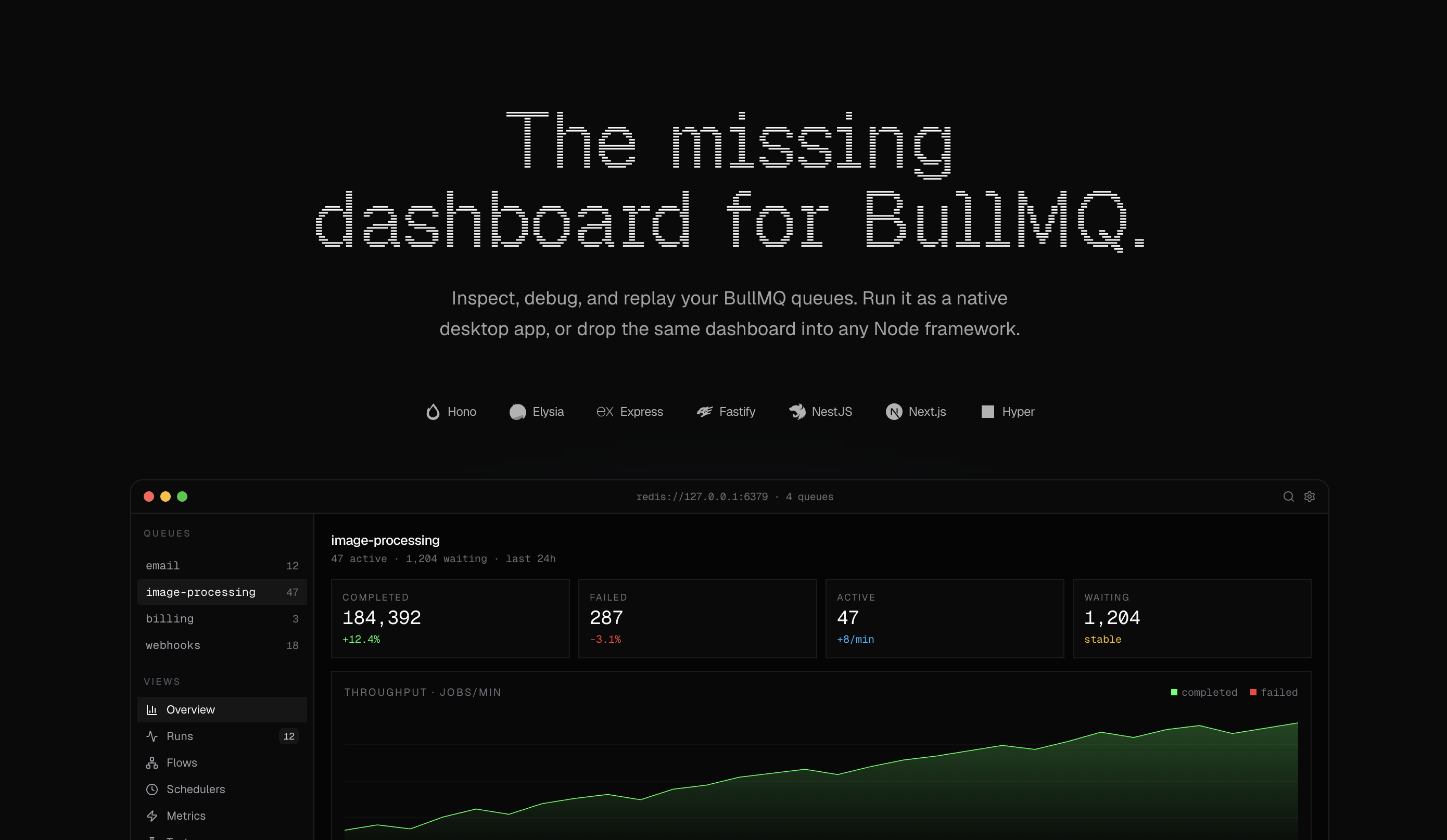
Workbench
Open-source BullMQ dashboard. Drop-in for any Node or Bun backend.
Workbench is a modern dashboard for BullMQ. Runs jobs, flows, schedulers and metrics, all served from your own backend behind your own auth.
- Zero infrastructure — mounts as a route in your existing app, or run as a standalone Docker container
- Adapters for Hono, Elysia, Express, Fastify, Koa, NestJS, AdonisJS, Next.js, TanStack Start, Astro, Nuxt, Bun.serve, and h3
- Standalone image on GHCR (
ghcr.io//workbench-standalone) for Docker / Kubernetes deployments - MCP server for Cursor, Claude Desktop, Zed, and Continue.dev — drive your queues from your editor's chat
- Flows & DAG view, metrics, schedulers, search
- Dark-mode UI, basic-auth-protected by default
- MIT licensed
Website: getworkbench.dev · Documentation
Migrating from bull-board?
Workbench is a drop-in alternative with thirteen first-party framework adapters, FlowProducer DAGs, error triage, and a keyboard-driven UI.
| bull-board | Workbench |
|---|---|
@bull-board/express |
@getworkbench/express |
@bull-board/fastify |
@getworkbench/fastify |
@bull-board/koa |
@getworkbench/koa |
@bull-board/nestjs |
@getworkbench/nestjs |
@bull-board/hono |
@getworkbench/hono |
@bull-board/h3 |
@getworkbench/h3 |
@bull-board/elysia |
@getworkbench/elysia |
Run npx @getworkbench/cli init to swap the mount in one command. Full comparison: getworkbench.dev/blog/workbench-vs-bull-board
Quick start
npx @getworkbench/cli init
The CLI detects your framework, installs the matching @getworkbench/ package, injects the mount (or scaffolds a route file for Next.js), writes .env.example entries, and optionally drops a docker-compose.yml for Redis.
Manual setup
Pick the adapter that matches your stack:
Hono
npm i @getworkbench/hono bullmq hono
import { Hono } from "hono";
import { Queue } from "bullmq";
import { workbench } from "@getworkbench/hono";

const app = new Hono();
const emailQueue = new Queue("email", { connection: { url: process.env.REDIS_URL! } });

app.route("/jobs", workbench({ queues: [emailQueue] }));

export default app;
Elysia
bun add @getworkbench/elysia bullmq elysia
import { Elysia } from "elysia";
import { Queue } from "bullmq";
import { workbench } from "@getworkbench/elysia";

const emailQueue = new Queue("email", { connection: { url: process.env.REDIS_URL! } });

new Elysia()
  .mount("/jobs", workbench({ queues: [emailQueue], basePath: "/jobs" }))
  .listen(3000);
Express
npm i @getworkbench/express bullmq express
import express from "express";
import { Queue } from "bullmq";
import { workbench } from "@getworkbench/express";

const app = express();
const emailQueue = new Queue("email", { connection: { url: process.env.REDIS_URL! } });

app.use("/jobs", workbench({ queues: [emailQueue] }));
app.listen(3000);
Fastify
npm i @getworkbench/fastify bullmq fastify
import Fastify from "fastify";
import { Queue } from "bullmq";
import { workbench } from "@getworkbench/fastify";

const app = Fastify();
const emailQueue = new Queue("email", { connection: { url: process.env.REDIS_URL! } });

await app.register(workbench({ queues: [emailQueue] }), { prefix: "/jobs" });
await app.listen({ port: 3000 });
NestJS
npm i @getworkbench/nestjs bullmq
import { NestFactory } from "@nestjs/core";
import { Queue } from "bullmq";
import { workbench } from "@getworkbench/nestjs";
import { AppModule } from "./app.module";

async function bootstrap() {
  const app = await NestFactory.create(AppModule);

  const emailQueue = new Queue("email", { connection: { url: process.env.REDIS_URL! } });

  await workbench(app, "/jobs", { queues: [emailQueue] });

  await app.listen(3000);
}
bootstrap();
Works on both the Express (default) and Fastify NestJS platforms.
AdonisJS
npm i @getworkbench/adonis bullmq @adonisjs/core
// start/routes.ts
import router from "@adonisjs/core/services/router";
import { Queue } from "bullmq";
import { mountWorkbench } from "@getworkbench/adonis";

const emailQueue = new Queue("email", { connection: { url: process.env.REDIS_URL! } });

mountWorkbench(router, "/jobs", { queues: [emailQueue] });
Works with AdonisJS 6 and 7. See examples/with-adonis.
Next.js (App Router)
npm i @getworkbench/next bullmq
// app/jobs/[[...workbench]]/route.ts
import { Queue } from "bullmq";
import { workbench } from "@getworkbench/next";

const emailQueue = new Queue("email", { connection: { url: process.env.REDIS_URL! } });

export const { GET, POST, PUT, PATCH, DELETE } = workbench({
  queues: [emailQueue],
  basePath: "/jobs",
});
Next doesn't host BullMQ workers itself — run them in a sibling process. See examples/with-next.
TanStack Start
npm i @getworkbench/tanstack-start bullmq @tanstack/react-start
// src/lib/workbench-handlers.ts
import { Queue } from "bullmq";
import { workbench } from "@getworkbench/tanstack-start";

const emailQueue = new Queue("email", { connection: { url: process.env.REDIS_URL! } });

export const workbenchHandlers = workbench({
  queues: [emailQueue],
  basePath: "/jobs",
});
// src/routes/jobs.ts
import { createFileRoute } from "@tanstack/react-router";
import { workbenchHandlers } from "../lib/workbench-handlers";

export const Route = createFileRoute("/jobs")({
  server: { handlers: workbenchHandlers },
});
// src/routes/jobs/$.ts
import { createFileRoute } from "@tanstack/react-router";
import { workbenchHandlers } from "../../lib/workbench-handlers";

export const Route = createFileRoute("/jobs/$")({
  server: { handlers: workbenchHandlers },
});
Register handlers on both
/jobsand/jobs/$so the bare mount and nested paths work. TanStack Start doesn't host BullMQ workers itself — run them in a sibling process. See examples/with-tanstack-start.
Koa
npm i @getworkbench/koa bullmq koa
import Koa from "koa";
import { Queue } from "bullmq";
import { workbench } from "@getworkbench/koa";

const app = new Koa();
const emailQueue = new Queue("email", { connection: { url: process.env.REDIS_URL! } });

app.use(workbench({ queues: [emailQueue], basePath: "/jobs" }));
app.listen(3000);
Koa has no built-in mount helper — pass
basePathso the middleware can match its own prefix and forward everything else to the next middleware.
Astro
npm i @getworkbench/astro bullmq
// src/pages/jobs/[...workbench].ts
import { Queue } from "bullmq";
import { workbench } from "@getworkbench/astro";

const emailQueue = new Queue("email", { connection: { url: process.env.REDIS_URL! } });

export const { GET, POST, PUT, PATCH, DELETE, prerender } = workbench({
  queues: [emailQueue],
  basePath: "/jobs",
});
Astro must be in server output mode (
output: "server"or"hybrid"). Astro doesn't host BullMQ workers itself — run them in a sibling process. See examples/with-astro.
Nuxt
npm i @getworkbench/nuxt bullmq
// server/routes/jobs/[...].ts
import { Queue } from "bullmq";
import { workbench } from "@getworkbench/nuxt";

const emailQueue = new Queue("email", { connection: { url: process.env.REDIS_URL! } });

export default workbench({
  queues: [emailQueue],
  basePath: "/jobs",
});
Nuxt's server runtime (Nitro / h3) doesn't host BullMQ workers itself — run them in a sibling process. See examples/with-nuxt.
Bun.serve
bun add @getworkbench/bun bullmq
import { Queue } from "bullmq";
import { workbench } from "@getworkbench/bun";

const emailQueue = new Queue("email", { connection: { url: process.env.REDIS_URL! } });