
Stealth Browser MCP
Stealth browser automation for MCP-compatible AI agents.
Navigate Cloudflare challenges, anti-bot checks, and login walls with real Chrome-family browser instances powered by nodriver, Chrome DevTools Protocol, and FastMCP.



Sponsors
|
|
NodeMaven — The most efficient proxy provider for Web Scraping and Automation with the Highest Quality IP on the market. Why NodeMaven?
| RapidProxy powers scraping and automation with 90M+ residential IPs across 200+ countries, supporting rotation, geo-targeting, and high concurrency to improve success rates and reduce bans. Get 500MB of free trial traffic, non-expiring bandwidth, and pricing as low as $0.55/GB. Why RapidProxy?
Special offer Use promo code |
Sponsored placement. NodeMaven and RapidProxy are paid sponsors of this project.
Table of Contents
- Sponsors
- Demo
- Features
- Quickstart
- Agent Skill
- Trust Model
- Modular Architecture
- Server Configuration
- Toolbox
- Stealth vs Playwright MCP
- Troubleshooting
- Examples
- Showcase
- Roadmap
- Contributing
- Support
- License
Demo
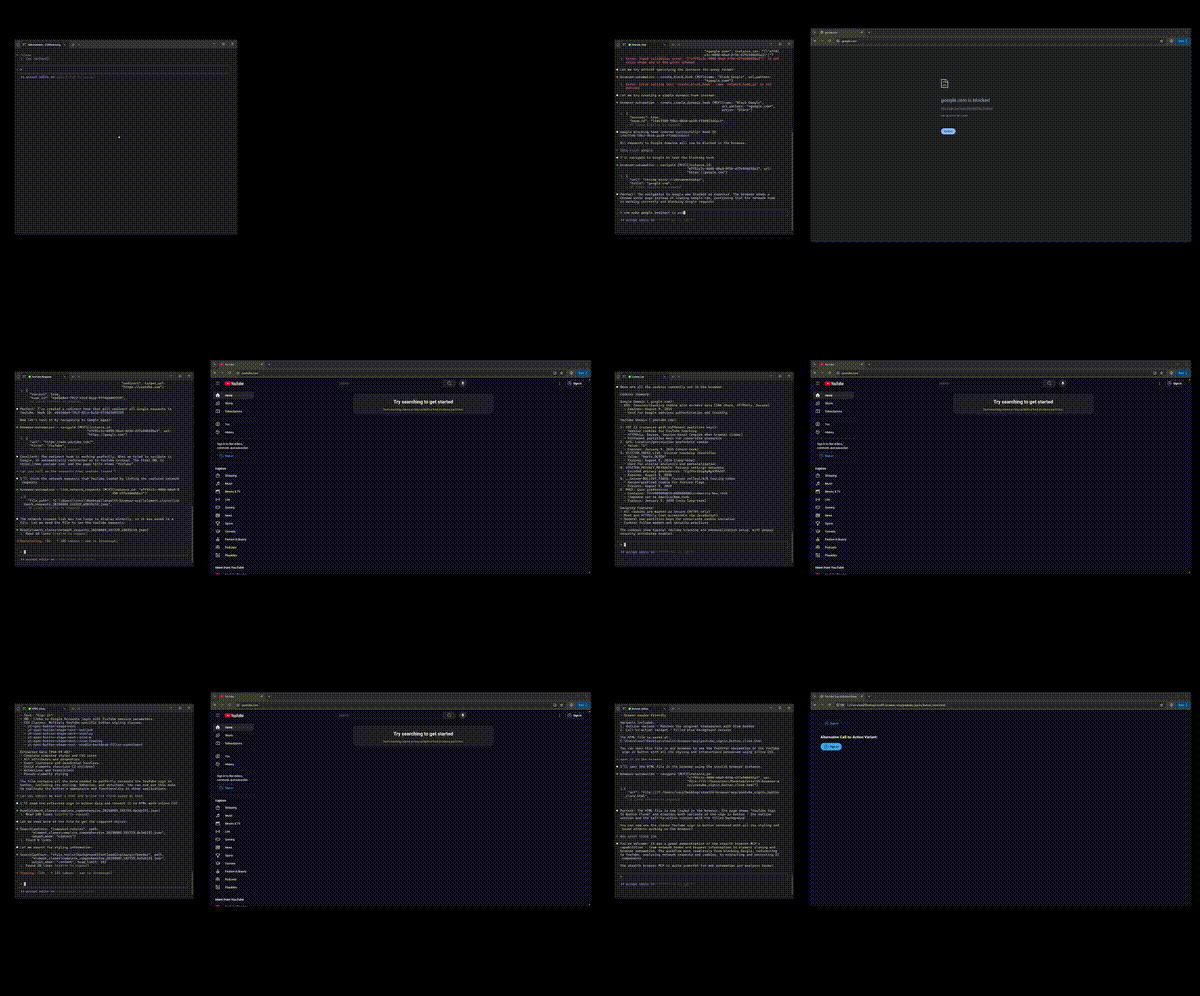

Stealth Browser MCP passing a Cloudflare challenge, cloning UI elements, and inspecting network traffic through AI chat commands.
Features
- Anti-bot resistance - Has passed Cloudflare and Queue-It style challenges in testing; results vary by site, region, browser version, and detector version.
- 97 tools across 11 sections - From basic navigation to advanced CDP function execution.
- Modular loading - Run the full 97-tool surface or a minimal 20-tool core; disable sections you do not need.
- Pixel-accurate element cloning - Extract complete elements with CSS, DOM structure, events, animations, and assets via CDP.
- Network inspection - Inspect requests, responses, headers, payloads, and captured bodies through your AI agent.
- Dynamic hook system - Restricted Python hooks can intercept, block, redirect, fulfill, or modify request/response flows.
- CDP execution - Run JavaScript, direct CDP commands, and pre-document scripts through trusted local MCP clients.
- Instant text input - Paste large content via CDP or type with human-like keystrokes and newline support.
- Cross-platform - Windows, macOS, Linux, Docker, and CI environments with automatic browser/platform detection.
- Browser support - Chrome, Chromium, and Microsoft Edge with automatic executable discovery.
- Clean MCP integration - Works through standard MCP clients without custom brokers.
Quickstart
1. Clone and install
Requires Python 3.10+ and Chrome, Chromium, or Microsoft Edge.
git clone https://github.com/vibheksoni/stealth-browser-mcp.git
cd stealth-browser-mcp
python -m venv venv

# Windows
venv\Scripts\activate

# macOS / Linux
source venv/bin/activate

pip install -r requirements.txt
2. Add to your MCP client
Claude Code CLI (recommended):
Windows:
claude mcp add-json stealth-browser-mcp "{\"type\":\"stdio\",\"command\":\"C:\\path\\to\\stealth-browser-mcp\\venv\\Scripts\\python.exe\",\"args\":[\"C:\\path\\to\\stealth-browser-mcp\\src\\server.py\"]}"
macOS / Linux:
claude mcp add-json stealth-browser-mcp '{
  "type": "stdio",
  "command": "/path/to/stealth-browser-mcp/venv/bin/python",
  "args": ["/path/to/stealth-browser-mcp/src/server.py"]
}'
Replace the example path with your real clone path.
Manual JSON configuration (Claude Desktop, Cursor, etc.)
Windows (%APPDATA%\Claude\claude_desktop_config.json):
{
  "mcpServers": {
    "stealth-browser-mcp": {
      "command": "C:\\path\\to\\stealth-browser-mcp\\venv\\Scripts\\python.exe",
      "args": ["C:\\path\\to\\stealth-browser-mcp\\src\\server.py"],
      "env": {}
    }
  }
}
macOS / Linux (~/Library/Application Support/Claude/claude_desktop_config.json):
{
  "mcpServers": {
    "stealth-browser-mcp": {
      "command": "/path/to/stealth-browser-mcp/venv/bin/python",
      "args": ["/path/to/stealth-browser-mcp/src/server.py"],
      "env": {}
    }
  }
}
Experimental FastMCP CLI install
These commands are provided for users who prefer FastMCP's installer. The stdio JSON setup above is the recommended path.
pip install fastmcp
fastmcp install claude-desktop src/server.py --with-requirements requirements.txt
fastmcp install claude-code src/server.py --with-requirements requirements.txt
fastmcp install cursor src/server.py --with-requirements requirements.txt
3. Test it
Restart your MCP client and ask your agent:
Use stealth-browser to navigate to https://example.com and take a screenshot.
Agent Skill
This repo includes an agent skill at skills/stealth-browser-mcp for clients that support Codex-style skills. It teaches agents the recommended tool order, state checks, pre-document CDP script usage, network debugging flow, and browser cleanup rules.
Use the skill when an LLM struggles to choose the right MCP tool or forgets to verify browser state after actions. If your client does not load repo-local skills automatically, add or symlink skills/stealth-browser-mcp into your client skills directory.
Trust Model
This server exposes powerful local browser-control primitives: CDP execution, page JavaScript execution, cookie/storage access, network interception, dynamic hooks, header mutation, navigation, and file uploads from allowlisted local paths.
Treat the MCP client or agent as the security principal. The recommended deployment is local stdio transport with a trusted desktop MCP client. If you use HTTP transport, set STEALTH_BROWSER_MCP_AUTH_TOKEN and do not expose unauthenticated HTTP outside trusted local or private networks.
Modular Architecture
Choose exactly what functionality you need. Run the full 97-tool suite or strip it down to the 20-tool core.
| Mode | Tools | Use Case |
|---|---|---|
| Full (default) | 97 | Complete browser automation and debugging |
Minimal (--minimal) |
20 | Core browser automation and interaction |
Custom (--disable-*) |
Your choice | Disable specific sections |
| **X |