


What is Spinifex? · Platform · Deploy · AWS Compatibility · Live Demo · Components · Architecture · Installation · Docs
Spinifex: the open, AWS-compatible cloud you run yourself
Spinifex, built by Mulga, recreates the AWS services your software already uses (EC2, EBS, S3, VPC, IAM) on infrastructure you control. Move workloads off the hyperscalers, run AI at a fraction of the cost, or take the cloud to the edge, without rewriting a line. The exact build you ship to AWS, Spinifex serves on your own hardware: same APIs, same Terraform, same SDKs.
What is Spinifex?
Spinifex is an open-source infrastructure platform that recreates the AWS service surface (EC2, EBS, S3, VPC, IAM) on bare-metal, edge, and on-premises environments. Run cloud-native software without a hyperscaler.
Built for teams that need:
- The AWS tooling you already use (AWS CLI, SDKs, Terraform), with nothing to rewrite
- Full control of the stack: your hardware, your network, your data, your keys
- A cloud that keeps running offline, through disconnection, with no external control plane
- An open core (AGPL-3.0), auditable and yours to keep, with no lock-in
You change where your software runs, not what it is.
The Platform
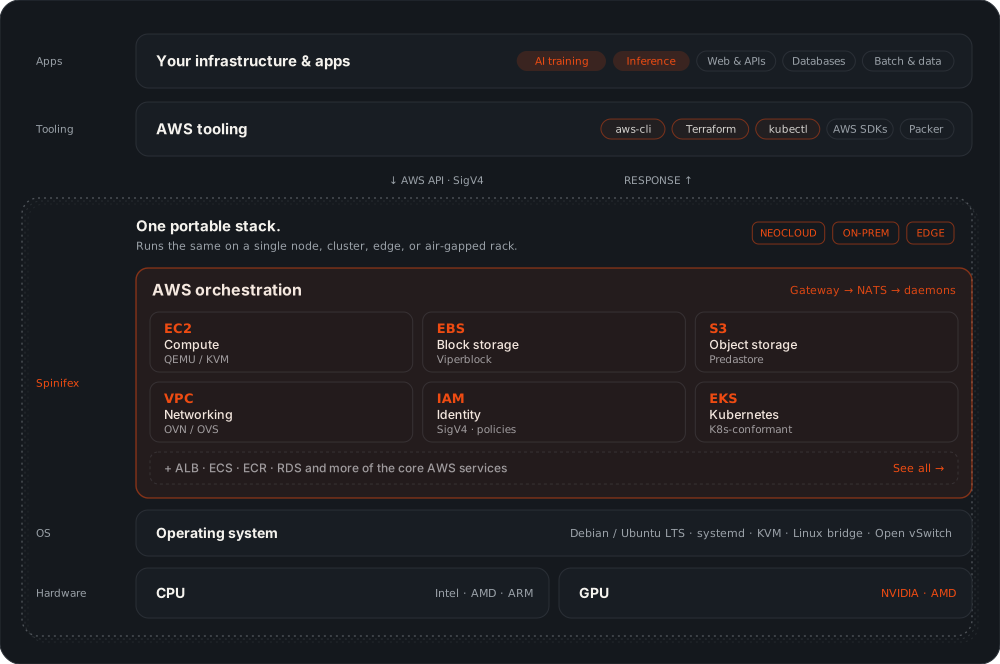
From commodity hardware up to unmodified AWS tooling, every layer is replaceable and yours to own.
Three Ways To Deploy
The same AWS-compatible platform runs in three shapes. Pick the one that matches your hardware.
Neocloud
Lift and shift onto a partner Neocloud without rewriting workloads. GPU capacity (H100 / H200 / B200), cheaper, available now. Change an endpoint, keep the software.
On-premise
Host Spinifex on your own hardware in your own data centre. You get a multi-node HA cluster integrated with your storage and networking, so the stack, the data, and the jurisdiction stay yours.
Edge
Cloud where the cloud can't reach. Air-gapped sites, vehicles, vessels, factories, and clinics. Compute next to the data, running through disconnection, on hardware you own. The same AWS APIs your software already uses.
AWS Compatibility
Spinifex speaks the AWS API surface. The AWS SDKs, AWS CLI, and Terraform all work unchanged, whether you deploy at the edge, on-premise, or on a partner Neocloud.
| Service | What it is | Status |
|---|---|---|
| EC2 | Compute | Available |
| EBS | Block Storage | Available |
| S3 | Object Storage | Available |
| VPC | Networking | Available |
| IAM | Identity & Auth | Available |
| ALB / NLB | Load Balancers | Available |
| EKS | Kubernetes | Available |
| ECR | Container Registry | Available |
| ECS | Container Service | Available |
| RDS | Databases | Available |
| Bedrock | AI Deployment | Q3 2026 |
Roadmap items ship under the same AWS API surface. Code written for AWS today keeps working the moment they land. Track what's shipped in the release notes.
Live Demo
Create a live sandbox in under a minute. The fastest way to experience the stack. Try Spinifex against one of your own workloads on infrastructure we run for you.
- Live in under a minute. No card, no install.
- Yours for 72 hours to test and experiment.
- Real AWS-compatible endpoint, access keys and console.
- EC2, EBS, S3, VPC, IAM, EKS and RDS, ready to call.
- Point your existing AWS CLI or Terraform straight at it.
Sign up at https://mulgadc.com/signup
Core Components
Spinifex (Compute and Platform Services – EC2, EKS, ECS, RDS)
Spinifex is a minimal VM orchestration layer built on top of QEMU, exposing an EC2 compatible API. It manages lifecycle operations like start, stop, and terminate through QEMU's QMP interface. Designed to be straightforward and scriptable, Spinifex lets you launch VMs with the AWS CLI, SDKs, or Terraform, without Kubernetes or a heavyweight orchestrator.
The managed services build on that same instance layer. An EKS node group, an ECS container instance, and an RDS database are Spinifex VMs on your own hardware, each driven through its own AWS API.
- EC2 – VM lifecycle on bare metal, cloud-init and IMDS metadata, key pairs, tags, spot instances, capacity reservations, and GPU passthrough
- EKS – Managed Kubernetes on k3s, with HA control planes, managed node groups, cluster add-ons, an OIDC provider, and IAM access ent