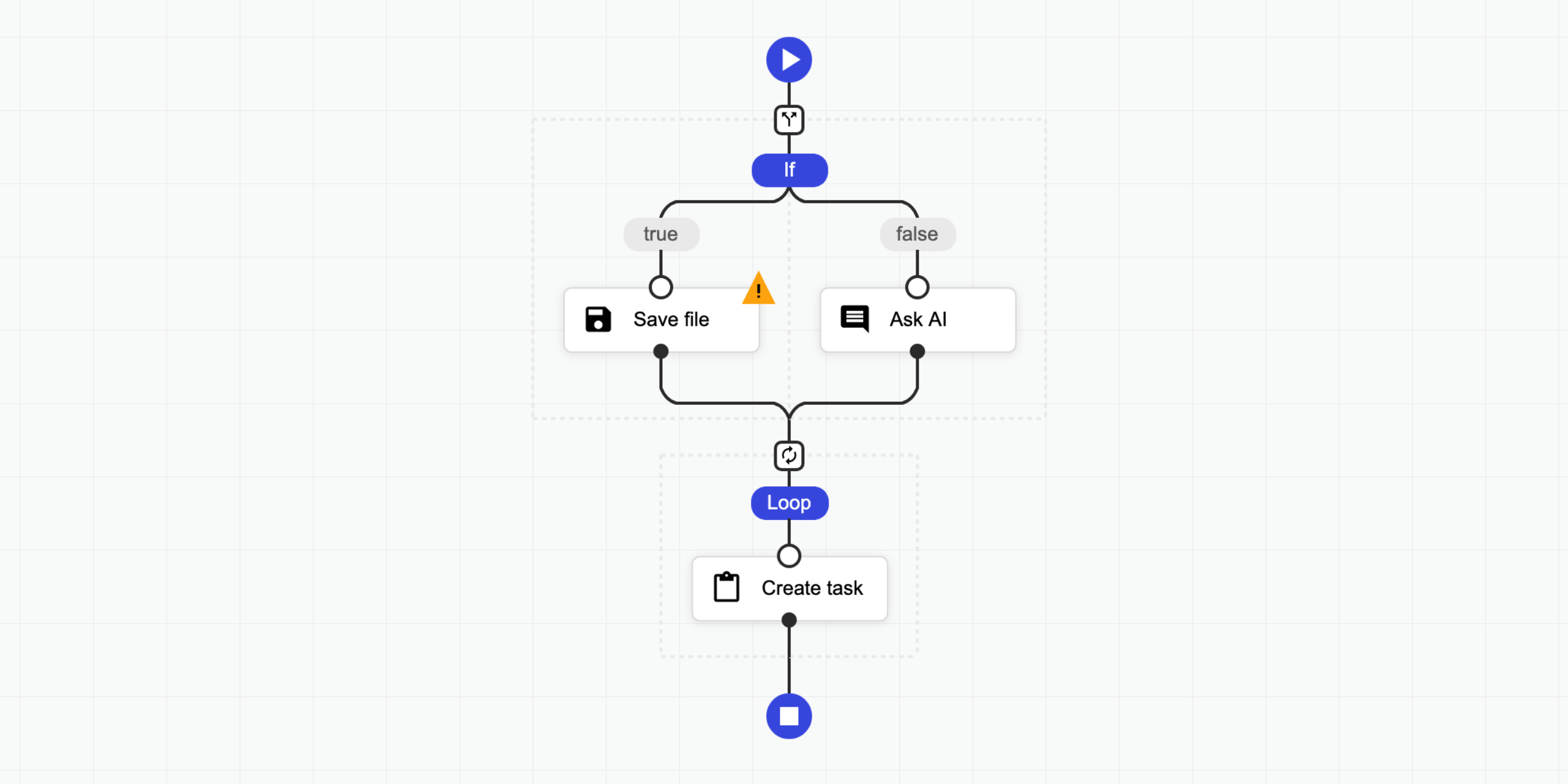
sequential-workflow-designer is a free, open source automation project written in TypeScript and released under MIT. It has 1,472 GitHub stars, 150 forks and 1 open issues, and was last pushed 13 days ago. On this registry it ranks #48 of 54 tracked projects in Automation, with 5 head-to-head comparisons available.

What is sequential-workflow-designer?

Sequential Workflow Designer is an MIT-licensed, dependency-free TypeScript component that embeds a customizable, flowchart-style workflow editor into web applications, built for developers creating no-code, low-code, agent-builder, or flow-based programming tools.

What it is

Sequential Workflow Designer is a front-end component, published in the Productivity & Utilities / Automation category, that renders an editable sequential workflow diagram inside a web application. It is written in pure TypeScript and draws with SVG. It has no external dependencies, and it is not tied to any workflow engine: the README states plainly that the designer is fully generic, so it can back anything from a graphical programming language to a workflow builder. Definitions are stored as JSON, and the component ships with bindings for Angular, React, and Svelte.

The concrete problem it solves is the cost of writing a workflow editor from scratch. Teams that need an end user to arrange ordered steps, branches, and conditions normally have to build drag-and-drop canvas logic, selection state, theming, and serialization themselves before writing a single line of their actual product. This component replaces that bespoke editor layer. It lives in the JavaScript and TypeScript ecosystem on npm as sequential-workflow-designer, and it deliberately stops at editing — what the JSON definition means, and what executes it, stays with the application.

Key capabilities

  • Zero external dependencies, written in pure TypeScript and rendered with SVG.
  • Engine-agnostic and fully generic: the README describes it as not associated with any workflow engine.
  • Workflow definitions are stored as JSON, so they can be persisted, diffed, or sent to a backend.
  • Ships with light, dark, and soft themes, with customization supported.
  • Framework bindings provided for Angular, React, and Svelte.
  • Runs in modern browsers and on mobile devices.
  • Working examples cover triggers, fullscreen mode, image filter, particles, internationalization (i18n), light/dark switching, code generator, rendering test, stress test, editing restrictions, scrollable page, multi-conditional switch, auto-select, and step changes detection.

Who uses it and how

  • Product teams building no-code or low-code platforms that let non-developers assemble ordered processes, using the editing-restrictions example to control what end users may change.
  • Developers building agent builders and AI design tools, matching the agent-builder, agentflow, and ai-designer topics.
  • Front-end teams embedding the designer in an existing Angular, React, or Svelte application rather than a standalone product, using the published bindings.
  • Products shipping to multiple locales, which the i18n example addresses directly.
  • Applications that must handle large diagrams, validated by the stress test and rendering test examples.

Getting started

Install the npm package sequential-workflow-designer and follow the documentation at nocode-js.com/docs, which covers the category for this designer. Demo applications for Angular, React, and Svelte, plus a live testing example, are linked from the README.

How it compares

No comparable or competing tools are named in the facts provided, so this project stands alone in this registry. The only related paid offering named is the project's own pro version, which provides additional components such as custom step types, a popup editor, copy paste, collapsible regions, goto, and custom themes.

When to use it — and when not to

Choose it when the hard part is the editor itself and the application already owns the execution model, since the component performs no execution, scheduling, or retry logic and leaves persistence of the JSON definitions to the host application. Do not choose it if you want a workflow engine, a scheduler, or a hosted backend out of the box, because none of those are part of this package. Also note the split licensing: several advanced components sit behind the paid pro version, so a project needing custom step types, popup editing, or copy paste must budget for that tier.

project readme (upstream, from github) — read inline

Sequential Workflow Designer

Sequential Workflow Designer

Build Status License: MIT View this project on NPM

A sequential workflow designer with no external dependencies for web applications. It is written in pure TypeScript and uses SVG for rendering. This designer is not associated with any workflow engine; it is fully generic. You can use it to create any kind of application, from graphical programming languages to workflow builders.

Features:

  • No external dependencies
  • Fully generic and configurable
  • Supports light, dark, and soft themes, with easy customization
  • Compatible with modern browsers and mobile devices
  • Definitions are stored as JSON
  • Supports Angular, React and Svelte.

📝 Check the documentation for more details.

🤩 Don't miss the pro version.

👀 Examples

Pro:

👩‍💻 Integrations

🚀 Installation

To use the designer, add the JS/TS and CSS files to your project.

NPM

Install this package with the NPM command:

npm i sequential-workflow-designer

To import the package:

import { Designer } from 'sequential-workflow-designer';

If you use css-loader or similar, you can add CSS files to your bundle:

import 'sequential-workflow-designer/css/designer.css';
import 'sequential-workflow-designer/css/designer-light.css';
import 'sequential-workflow-designer/css/designer-soft.css';
import 'sequential-workflow-designer/css/designer-dark.css';

To create the designer, write the code below:

// ...
Designer.create(placeholder, definition, configuration);

CDN

Add the code below to the head section of your HTML document.

<head>
  ...
  <link href="https://cdn.jsdelivr.net/npm/[email protected]/css/designer.css" rel="stylesheet" />
  <link href="https://cdn.jsdelivr.net/npm/[email protected]/css/designer-light.css" rel="stylesheet" />
  <link href="https://cdn.jsdelivr.net/npm/[email protected]/css/designer-dark.css" rel="stylesheet" />
  <script src="https://cdn.jsdelivr.net/npm/[email protected]/dist/index.umd.js"></script>
</head>

Create the designer with:

sequentialWorkflowDesigner.Designer.create(placeholder, definition, configuration);

🎬 Usage

Check the examples directory.

import { Designer } from 'sequential-workflow-designer';

const placeholder = document.getElementById('placeholder');

const definition = {
  properties: {
    myProperty: 'my-value',
    // root properties...
  },
  sequence: [
    // steps...
  ],
};

const configuration = {
  theme: 'light', // optional, default: 'light'
  isReadonly: false, // optional, default: false
  undoStackSize: 10, // optional, default: 0 - disabled, 1+ - enabled

  steps: {
    // all properties in this section are optional

    iconUrlProvider: (componentType, type) => {
      return `icon-${componentType}-${type}.svg`;
    },

    isDraggable: (step, parentSequence) => {
      return step.name !== 'y';
    },
    isDeletable: (step, parentSequence) => {
      return step.properties['isDeletable'];
    },
    isDuplicable: (step, parentSequence) => {
      return true;
    },
    canInsertStep: (step, targetSequence, targetIndex) => {
      return targetSequence.length  {
      return !step.properties['isLocked'];
    },
    canDeleteStep: (step, parentS

readme truncated — read the full docs on github

Frequently asked questions

Is sequential-workflow-designer free to use?

sequential-workflow-designer is open source under the MIT licence. There is no licence fee and no seat count — you can self-host it or, where the project offers one, pay a vendor for a managed version instead.

What does sequential-workflow-designer do?

Customizable no-code component for building flow-based programming applications or workflow automation. 0 external dependencies. Check out https://nocode-js.com

What is sequential-workflow-designer written in?

sequential-workflow-designer is primarily written in TypeScript. Its source is publicly available at https://github.com/nocode-js/sequential-workflow-designer, and it has 1,472 GitHub stars.