





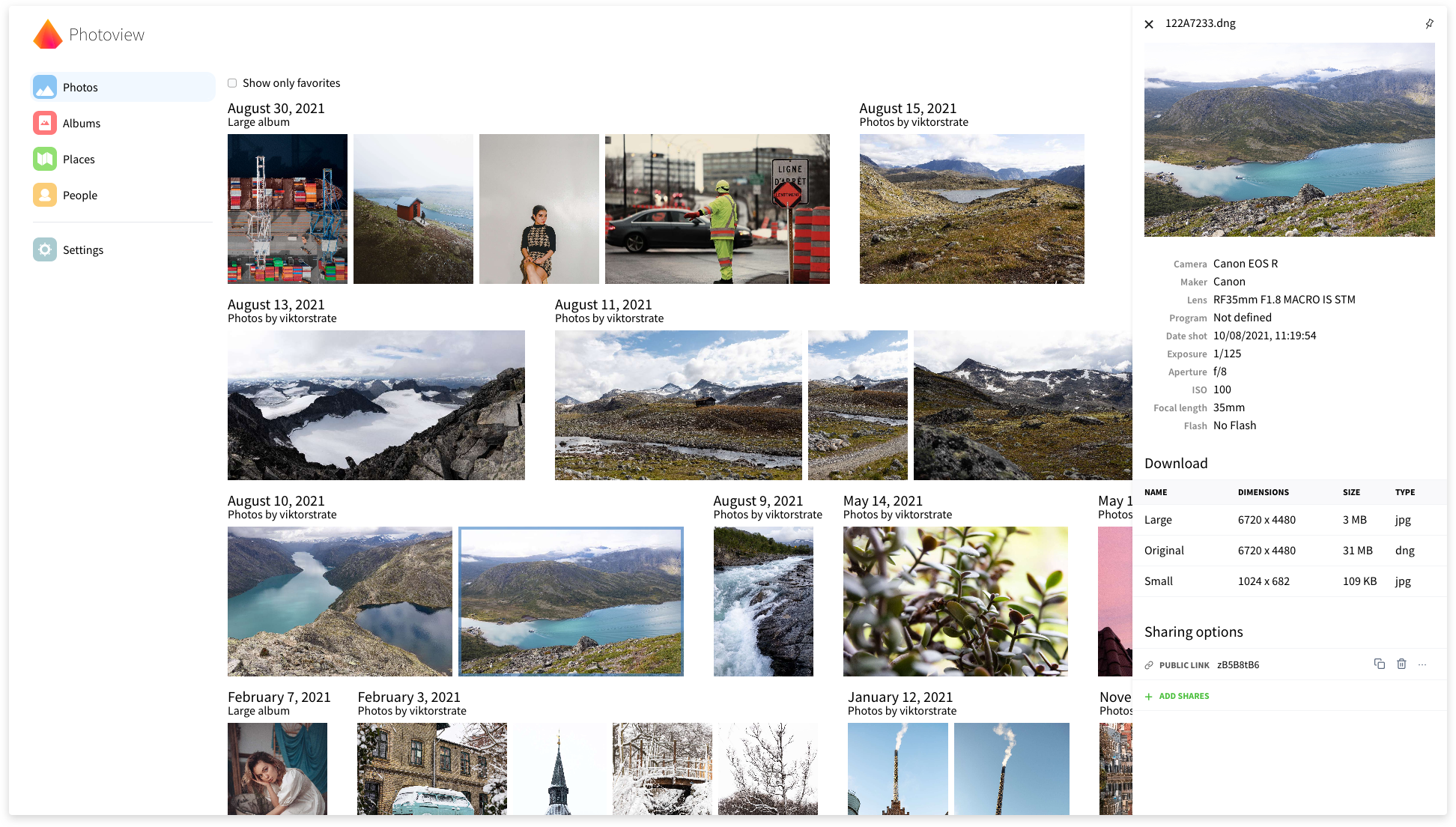
Photoview is a simple and user-friendly photo gallery that's made for photographers and aims to provide an easy and fast way to navigate directories, with thousands of high-resolution photos.
You configure Photoview to look for photos and videos within a directory on your file system. The scanner automatically picks up your media and starts to generate thumbnail images to make browsing super fast.
When your media has been scanned, they show up on the website, organised in the same way as on the filesystem.
If you have questions regarding setup or development, feel free to join the Discord server https://discord.gg/jQ392948u9
ATTENTION to Docker users !!!
We migrated to the new Docker registry , and all new images for the
master tag as well as future releases will be published there instead of the previously used registry. Old images
will still be accessible in the old registry , so if you want to
use one of those older images, revert to the old registry.
Please update your docker-compose.yml file to use the new registry for the photoview image, as shown in the
corresponding example of the compose file:
ATTENTION to PostgreSQL users !!!
We switched to PostgreSQL 18 on the master branch. PostgreSQL 18 will be the default recommended version
for the next release (PostgreSQL 17 remains supported). If you follow master, please check the
official PostgreSQL upgrade guide, and:
- For Docker users: please update your
docker-compose.ymlto match docker-compose.example.yml. - Please pay attention to the DB volume mount point change inside the container: starting from version 18, the DB is mounted to the
/var/lib/postgresql, while in earlier versions it was the/var/lib/postgresql/data. - For direct host installations or external/shared PostgreSQL instances: please upgrade your PostgreSQL server and database manually to version 18 following PostgreSQL guidance.
Don't forget to back up your database before upgrading.
Demo site
Visit https://photos.qpqp.dk/
Username: demo
Password: demo
Contents
- ATTENTION to Docker users !!!
- ATTENTION to PostgreSQL users !!!
Main features
- Closely tied to the file system. The website presents the images found on the local filesystem of the server; directories are mapped to albums.
- User management. Each user is created along with a path on the local filesystem, photos within that path can be accessed by that user.
- Sharing. Albums, as well as individual media, can easily be shared with a public link, the link can optionally be password protected.
- Made for photography. Photoview is built with photographers in mind, and thus supports RAW file formats, and EXIF parsing.
- Video support. Many common video formats are supported. Videos will automatically be optimized for web.
- Face recognition. Faces will automatically be detected in photos, and photos of the same person will be grouped together.
- Performant. Thumbnails are automatically generated and photos first load when they are visible on the screen. In full screen, thumbnails are displayed until the high-resolution image has been fully loaded.
- Secure. All media resources are protected with a cookie-token, all passwords are properly hashed, and the API uses a strict CORS policy.
Supported platforms
- Docker (Docker Engine released within the last year and a major version not older than the previous one).
[!NOTE] We don’t support Portainer or other abstraction layers on top of Docker Compose. If you encounter an issue, please reproduce it on the setup with plain Docker Compose before reporting.
- Debian Linux 12 and 13, Ubuntu Linux LTS and newer short-term releases
- Arch Linux AUR
- NixOS (PR, Nixpkgs, NixOS options)
- Unraid
- EmbassyOS: announcement, repo
- YunoHost
- TrueNAS
We provide limited support for the standard deployment scenarios on the platforms above. The project team has no testing environments for all of them, so assistance is based on user-provided logs and traces. Highly customized setups may further limit our ability to help.
Supported databases
- SQLite: built-in DBMS, no additional service or maintenance required; lowest performance and no scalability.
- MariaDB LTS version: default choice. Runs as an additional service; good balance between performance and maintenance effort.
- PostgreSQL 18 and 17: typically the best performance. Runs as an additional service; requires slightly more maintenance.
We support running Photoview with one of these DBMSs when used as a dedicated instance for Photoview only. If you share a DBMS among multiple services, our support is limited to SQL issues. DB management and connection-related issues are the user’s responsibility due to the variability of shared configurations.
Why yet another self-hosted photo gallery
There exists a lot of open-source self-hosted photo galleries already. Here are some, just to mention a few.
So why another one? I love taking photos, and I store all of them on my local fileserver. This is great because I can organize my photos directly on the filesystem, so it's easy to move them or take backups. I want to be able to control where and how the photos are stored.
The problem is, however, that RAW images are extremely tedious to navigate from a fileserver, even over the local network.
My server holds a lot of old family pictures that I would like my family to have access to as well. And some of the pictures I would like to easily be able to share with other people without the hassle of them having to make an account first.
Thus, I need a solution that can do the following:
- A scan-