Peergos
Peergos is building the next web - the private web, where end users are in control. Imagine web apps being secure by default and unable to track you. Imagine being able to control exactly what personal data each web app can see. Imagine never having to log in to an app ever again. You own your data and decide where it is stored and who can see it. At Peergos, we believe that privacy is a fundamental human right and we want to make it easy for everyone to interact online in ways that respect this right.
The foundation of Peergos is a peer-to-peer encrypted global filesystem with fine-grained access control designed to be resistant to surveillance of data content or friendship graphs. It has a secure messenger, an encrypted email client and bridge, and a totally private and secure social network, where users are in control of who sees what (executed cryptographically). Our motto at Peergos is, "Control your data, control your destiny."
The name Peergos comes from the Greek word Πύργος (Pyrgos), which means stronghold or tower, but phonetically spelt with the nice connection to being peer-to-peer. Pronunciation: peer-goss (as in gossip).
Screenshots

See more screenshots in the web-ui repository https://github.com/Peergos/web-ui.
Try it now!
Want to try it out now? Here's a read-only secret link to a folder;
Sign-up
We run a paid server at https://peergos.net/.
Tech book
You can read more detail about our features and architecture in our tech book.
Recent progress
To see recent developments read the latest release notes or see our web-ui repo releases.
Media
The slides of a talk introducing Peergos are here
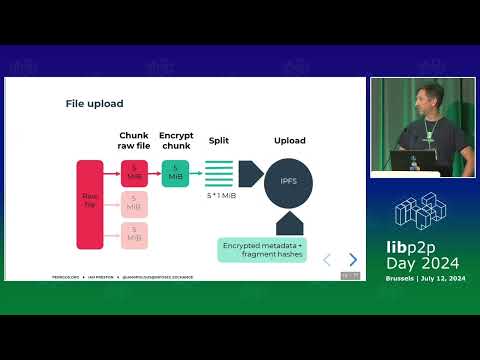
Deep dive at IPFS Camp 2024
Deep dive at Devstaff Crete:
Overview at IPFS Thing:

Applications on Peergos:
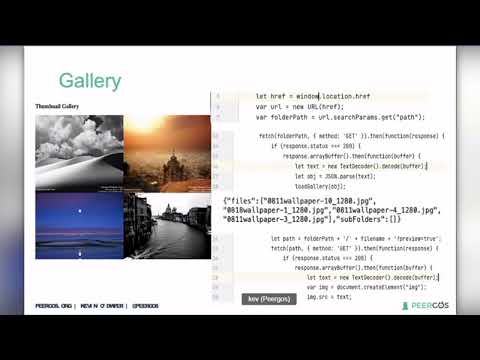
Applications deep dive:
Architecture talk at IPFS Lab Day:
Introduction and 2020 update:
Introduction:

Support
If you would like to support Peergos development, then please make a
recurring donation less than 100 EUR per week
or a
Audits
2024
https://peergos.org/posts/security-audit-2024
2019
https://peergos.org/posts/security-audit
All audit reports
https://github.com/Peergos/Peergos/tree/master/audits
Chat room
There is a public chat room for Peergos on Matrix.
Peergos aims
- Allow individuals to securely and privately store files in a peer to peer network which has no central node and is generally difficult to disrupt or surveil
- Allow secure sharing of files with other users of the network without visible meta-data (who shares with who)
- Allow web apps to be loaded and run directly from Peergos in a sandbox that prevents data exfiltration and with user granted permissions
- Have a beautiful user interface that any computer or mobile user can understand
- Be independent of the central TLS Certificate Authority trust architecture
- Be self-hostable - A user should be able to easily run Peergos on a machine in their home and get their own Peergos storage space, and social communication platform from it.
- Have a secure web interface
Project anti-aims
- Peergos does not provide anonymity, yet. Anonymity can be achieved by creating and only ever accessing a User account over Tor
Architecture
1.0 Layers of architecture
- 1: Peer-to-peer and data layer - IPFS provides the data storage, routing and retrieval. A User must have at least one Peergos instance storing their data for it to be available.
- 2: Authorization Layer - a key pair controls who is able to modify parts of the file system (every write is signed)
- 3: Data storage - controlled by a given public key there is a merkle-champ of encrypted chunks under random labels, without any cross links visible to the server (the server can't deduce the size of files)
- 4: Encryption - Strong encryption is done on the user's machine using TweetNaCl, with each 5MiB chunk of a file being encrypted independently.
- 5: Social layer implementing the concept of following or being friends with another user, without exposing the friend network to anyone.
- 6: Sharing - Secure cryptographic sharing of files with friends.
2.0 Language
- The IPFS layer is coded in Java - we have a minimal ipfs implementation - Nabu
- The Peergos server is coded to run on JVM to get portability and speed, predominantly Java
- The web interface is mostly coded in Java and cross compiled to JavaScript, with the exception of the Tweetnacl and scrypt libraries, and a small amount of GUI code in JS for Vue.js.
- Apps are written in HTML5
3.0 Nodes
- There is a pki node which ensures unique usernames using a structure similar to certificate transparency. This data is mirrored on every peergos server.
- A new node contacts any public Peergos server to join the network
4.0 Trust
- New versions of the software will be delivered through Peergos itself. (Able to be turned off by the user if desired)
- A user who trusts a public Peergos server (and the SSL Certificate authority chain) can use the web interface over TLS
- A less trusting user can run a Peergos server/proxy on their own machine and use the web interface over localhost
- A more paranoid user can run a Peergos server on their own machine and use the CLI or the fuse/webdav binding
- Servers are trustless - your data and metadata cannot be exposed even if your server is compromised (assuming your client is not compromised)
- IPFS itself is not trusted and all data stored or retrieved from it is self-certifying.
- The data store (which may not be ipfs directly, but S3 compatible service for example) is also not trusted
4.0 Logging in
- A user's username is used along with a random salt and the hash of their password and run through scrypt (with parameters 17, 8, 1, 96, though users can choose harder parameters if desired) to generate a symmetric key and a signing keypair. The signing keypair is then used to auth and retrieve encrypted login data. This login data is then decrypted using the symmetric key to obtain the identity key pair, social keypair and root directory capability. This means that a user can log in from any machine without transferring any keys, and also that their keys are protected from a brute force attack (see slides mentioned above for a cost estimate).
5.0 Encryption
- Private keys never leave the client node. Two random symmetric keys are generated for every file or directory (explicitly not convergent encryption, which leaks information)
5.1 Post-quantum encryption
- Files that haven't been shared with another user are already resistant to quantum computer based attacks. This is because the operations to decrypt them from logging in, to seeing plain-text, include only hashing and symmetric encryption, both of which are currently believed to not be significantly weakened with a quantum computer.
- Files that have been shared between users are, currentl