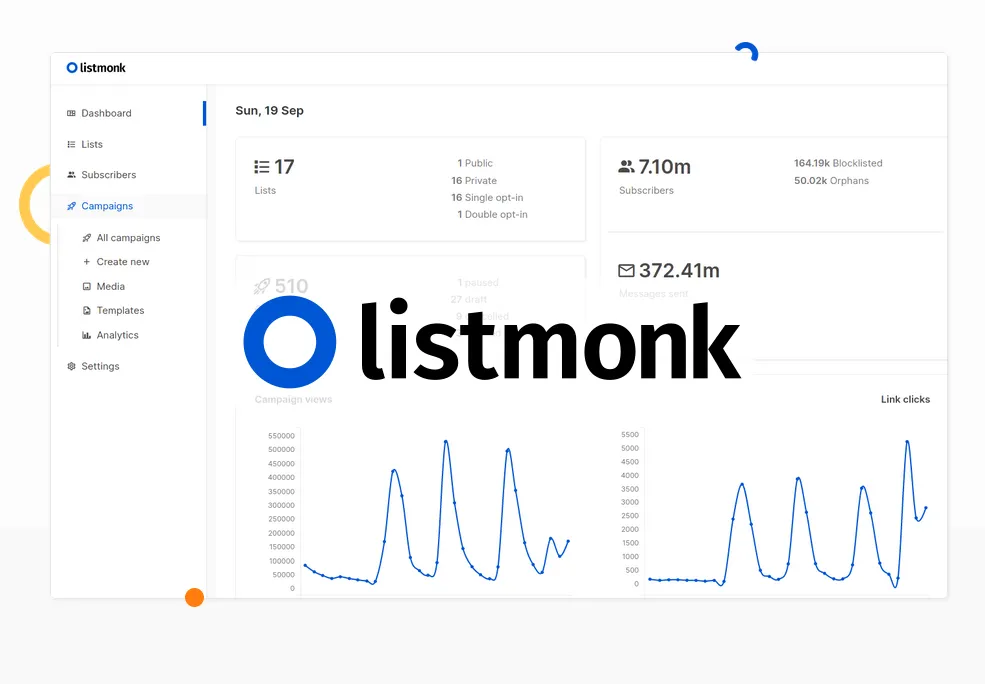
What it is
Listmonk is a standalone, self-hosted newsletter and mailing list manager in the open-source business software and marketing customer engagement ecosystem. It packages campaign management, subscriber management, and email delivery controls into a single binary application with a modern dashboard, and it uses PostgreSQL as its data store.
The project solves the problem of needing a hosted service to store subscriber lists, send campaigns, and manage email subscriptions. It positions itself as an open alternative to Mailchimp and SendGrid, and it lets operators run the application on their own infrastructure while connecting to SMTP or SMS gateway services.
Key capabilities
- It manages newsletters, mailing lists, campaigns, and subscriber subscriptions through a dashboard.
- It supports email marketing and email subscription workflows, as indicated by its topics.
- It uses SMTP for sending email, which is listed among its topics.
- It supports SMS gateway integrations, which are listed as a project topic.
- It runs as a single binary application, reducing deployed application components.
- It stores data in PostgreSQL, which is the database backend named in the README.
- It is licensed under AGPL-3.0, with a Go backend and a Vue with Buefy frontend.
Who uses it and how
- Newsletter publishers and marketing teams can self-host Listmonk instead of using Mailchimp or SendGrid.
- Operators can deploy it with Docker Compose using the listmonk/listmonk:latest image.
- Administrators can run it as a binary, generate config.toml, install or upgrade PostgreSQL, and start the application.
- Developers can contribute to the Go backend and Vue with Buefy frontend under AGPL-3.0.
- Teams can combine email and SMS campaign operations through SMTP and SMS gateway integrations.
Getting started
Docker users download the sample docker-compose.yml file, run docker compose up -d, and visit http://localhost:9000. Binary users download the latest release, run ./listmonk --new-config, edit config.toml, run ./listmonk --install or ./listmonk --upgrade, and then run ./listmonk.
When to use it — and when not to
Use Listmonk when an operator wants a self-hosted alternative to Mailchimp or SendGrid for newsletters, mailing lists, campaigns, SMTP-based email delivery, and SMS gateway integrations. The self-hoster must still operate PostgreSQL, provide SMTP or SMS gateway access, manage upgrades, and handle AGPL-3.0 license obligations. The provided repository data shows 0 contributors and 111 open issues, and the application still depends on external database and delivery services.
project readme (upstream, from github) — read inline


listmonk is a standalone, self-hosted, newsletter and mailing list manager. It is fast, feature-rich, and packed into a single binary. It uses a PostgreSQL database as its data store.

Visit listmonk.app for more info. Check out the live demo.
Installation
Docker
The latest image is available on DockerHub at listmonk/listmonk:latest.
Download and use the sample docker-compose.yml.
# Download the compose file to the current directory.
curl -LO https://github.com/knadh/listmonk/raw/master/docker-compose.yml

# Run the services in the background.
docker compose up -d
Visit http://localhost:9000
See installation docs
Binary
- Download the latest release and extract the listmonk binary.
./listmonk --new-config to generate config.toml. Edit it../listmonk --install to setup the Postgres DB (or --upgrade to upgrade an existing DB. Upgrades are idempotent and running them multiple times have no side effects).- Run
./listmonk and visit http://localhost:9000
See installation docs
Developers
listmonk is free and open source software licensed under AGPLv3. If you are interested in contributing, refer to the developer setup. The backend is written in Go and the frontend is Vue with Buefy for UI.
License
listmonk is licensed under the AGPL v3 license.