
Kittysploit-framework is a free, open source collaboration & communication project written in Python and released under MIT. It has 631 GitHub stars, 100 forks and 9 open issues, and was last pushed 24 hours ago. On this registry it ranks #55 of 62 tracked projects in Collaboration & Communication, with 5 head-to-head comparisons available. It gained 7 stars over the last 30 tracked days.

What is Kittysploit-framework?

Kittysploit-framework is a Python exploitation framework for authorized penetration testing and red-team work that keeps scanning, exploits, command-and-control, proxy interception, and post-exploitation inside one console, aimed at security engineers and offensive-security operators who run web and API engagements.

What it is

Kittysploit-framework is an offensive-security console written in Python 3.9+ and released under the MIT licence. It bundles a modular exploitation console, a built-in command-and-control server, a proxy interceptor, workspaces with engagement scope, post-exploitation tooling, and an autonomous agent driven by a local large language model, with 8,000+ scanners, exploits, and post modules available from the same prompt. The project describes its own scope as "From recon to shell — in one console," and lists CLI, RPC, REST API, and MCP as automation surfaces alongside its marketplace of extensions for proxy, OSINT, GUI, and protocol work.

The concrete problem it solves is tool fragmentation. Most stacks force an operator to jump between a separate scanner, an exploit framework, a C2, a proxy, and a notebook, carrying scope and findings between them by hand. Kittysploit-framework replaces that chain by holding modules, sessions, scope, and agent plans in a single console, so an engagement's boundaries, hosts, and findings stay organised per job rather than scattered across five tools. It lives in the Python offensive-security ecosystem and is distributed from source, with documentation in the repository README and USAGE.md and a project site at kittysploit.com.

Key capabilities

  • Modular console with search, use, set, and run across scanner, exploit, auxiliary, and post modules, covering 8,000+ modules.
  • Built-in C2 with listeners, payloads, live sessions, pivots, and post-exploitation in the same console as the modules.
  • Autonomous agent run against a local Ollama model, configured with --llm-local and --llm-model llama3.1:8b, requiring no cloud API key.
  • Mission profiles such as safe-web, owasp-web-parallel, internal-lab, and bug-bounty-safe.
  • Risk gates that block intrusive action unless explicitly approved: --approve-risk intrusive is required to run exploits, while --plan-only and --dry-run preview without live actions, and --approve-post-exploit enables optional read-only collection after a session.
  • Evidence-gated exploit handoff and parallel specialists split by OWASP class, including injection, XSS, SSRF, auth, and authz.
  • Workspaces and scope per engagement, plus repeatable workflows and playbooks, and a marketplace of extensions delivered through proxy, OSINT, GUI, and protocol add-ons.

Who uses it and how

  • Bug-bounty hunters running the bug-bounty-safe profile, where the safe and scope-aware defaults suit externally hosted targets.
  • Internal red teams working authorised lab networks, for example agent http://192.168.56.10 --profile internal-lab --goal obtain-shell --shell-hunter.
  • Web and API testers who want OWASP-class coverage in parallel rather than sequentially, using --profile owasp-web-parallel.
  • Automation and CI-style operators who drive the framework from CLI, RPC, REST API, or MCP instead of an interactive console.
  • Post-exploitation operators who escalate from an interactive session into pivoting and collection using --approve-post-exploit.

Getting started

Clone the repository and run ./install/install.sh on Linux or macOS, then python3 kittyconsole.py; Windows users run install\install.bat followed by python kittyconsole.py. A one-line installer is also published: curl -fsSL https://raw.githubusercontent.com/SIA-IOTechnology/kittysploit-framework/main/install/install-standalone.sh | bash.

How it compares

No paid product and no comparable tool is named in the facts for this entry, so the framework stands alone in this registry. The README positions it against a general stack of separate scanner, exploit framework, C2, proxy, and notebook rather than against any named alternative.

When to use it — and when not to

A self-hoster must operate the Python 3.9+ environment, install the framework from source or the one-line installer, and run a local Ollama model to use the autonomous agent, since no hosted or managed option is described. Teams that want a fully managed service, or that cannot run a local LLM, should look elsewhere; intrusive and post-exploitation actions are deliberately gated behind explicit approval flags, which makes the tool a poor fit for anyone expecting unattended exploitation. Documentation is limited to the README and USAGE.md, and the repository shows 9 open issues against 624 stars and 98 forks, so operators should expect to read source and community channels such as the project Discord.

project readme (upstream, from github) — read inline

KittySploit

From recon to shell — in one console.

Autonomous agent for web/API testing. 8,000+ modules. Built-in C2. Local LLM. Scope-aware. Automation-ready.

Python License Discord GitHub stars

Quick start · Docs · Website · Discord
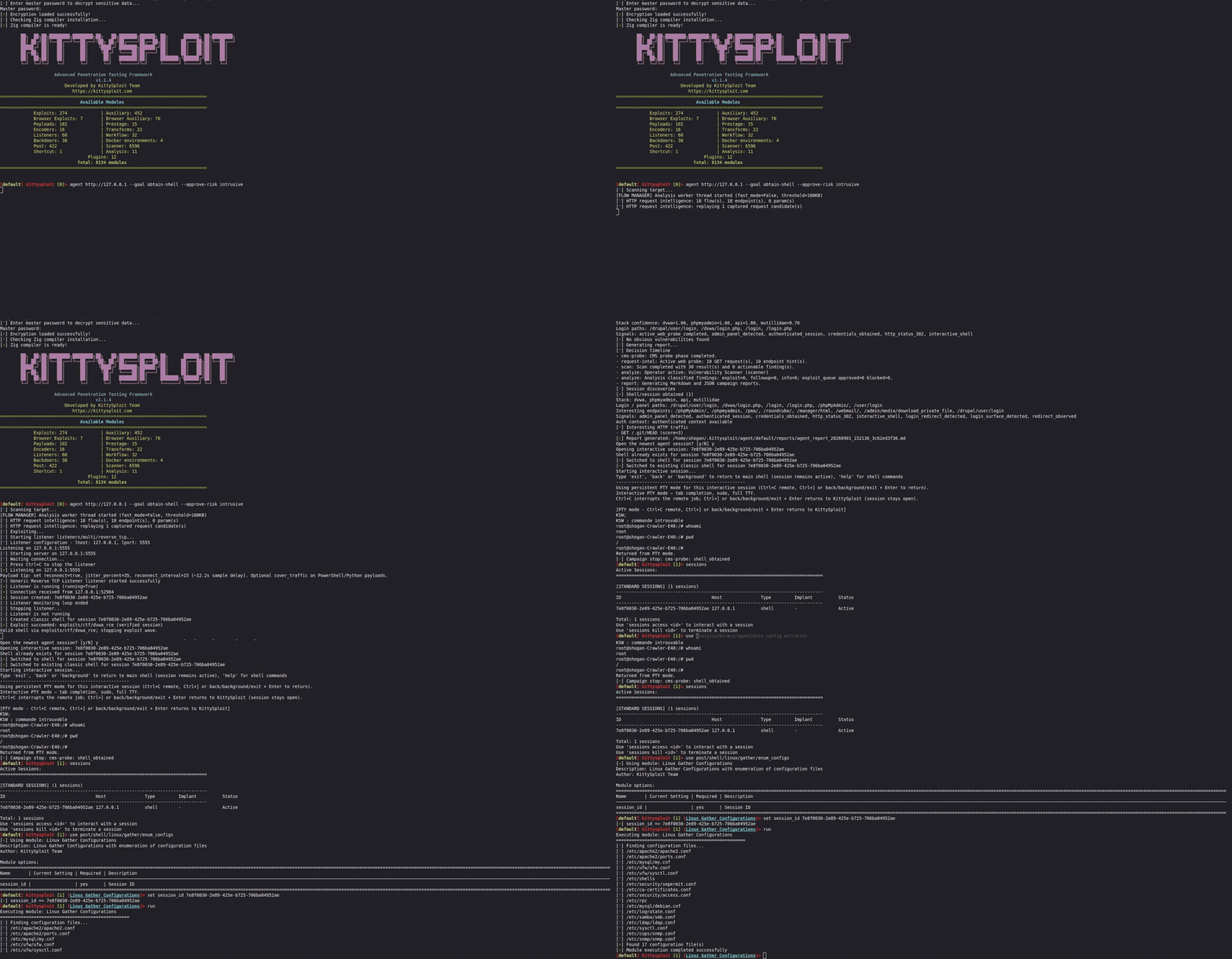
# Web/API mission (lab)
kittysploit> agent https://lab.local --profile owasp-web-parallel

# Go for a shell (authorized lab only)
kittysploit> agent http://192.168.56.10 \
  --profile internal-lab \
  --goal obtain-shell \
  --approve-risk intrusive \
  --shell-hunter

Why KittySploit?

Most stacks force you to jump between a scanner, an exploit framework, a C2, a proxy, and a notebook.

KittySploit keeps the engagement in one place — modules, sessions, scope, and an autonomous agent that plans and executes against authorized targets.

Agent Local LLM (Ollama) plans and drives missions with safety profiles, evidence gates, and parallel web specialists
Modules + C2 8,000+ scanners/exploits/post modules, listeners, payloads, and live sessions in the same console
Automation CLI, RPC, REST API, and MCP for IDE / CI-style operators

Quick Start

Linux and macOS

git clone https://github.com/SIA-IOTechnology/Kittysploit-framework.git
cd Kittysploit-framework
./install/install.sh
python3 kittyconsole.py

One-line installer:

curl -fsSL https://raw.githubusercontent.com/SIA-IOTechnology/kittysploit-framework/main/install/install-standalone.sh | bash

Windows

git clone https://github.com/SIA-IOTechnology/Kittysploit-framework.git
cd Kittysploit-framework
install\install.bat
python kittyconsole.py

First 60 seconds

kittysploit> doctor
kittysploit> scanner -u http://192.168.56.10
kittysploit> search wordpress
kittysploit> agent https://lab.local --profile owasp-web-parallel --plan-only
kittysploit> agent http://192.168.56.10 --profile internal-lab --goal obtain-shell --approve-risk intrusive --shell-hunter

Use --plan-only / --dry-run until you are ready for live actions. Always test against systems you own or are authorized to assess.
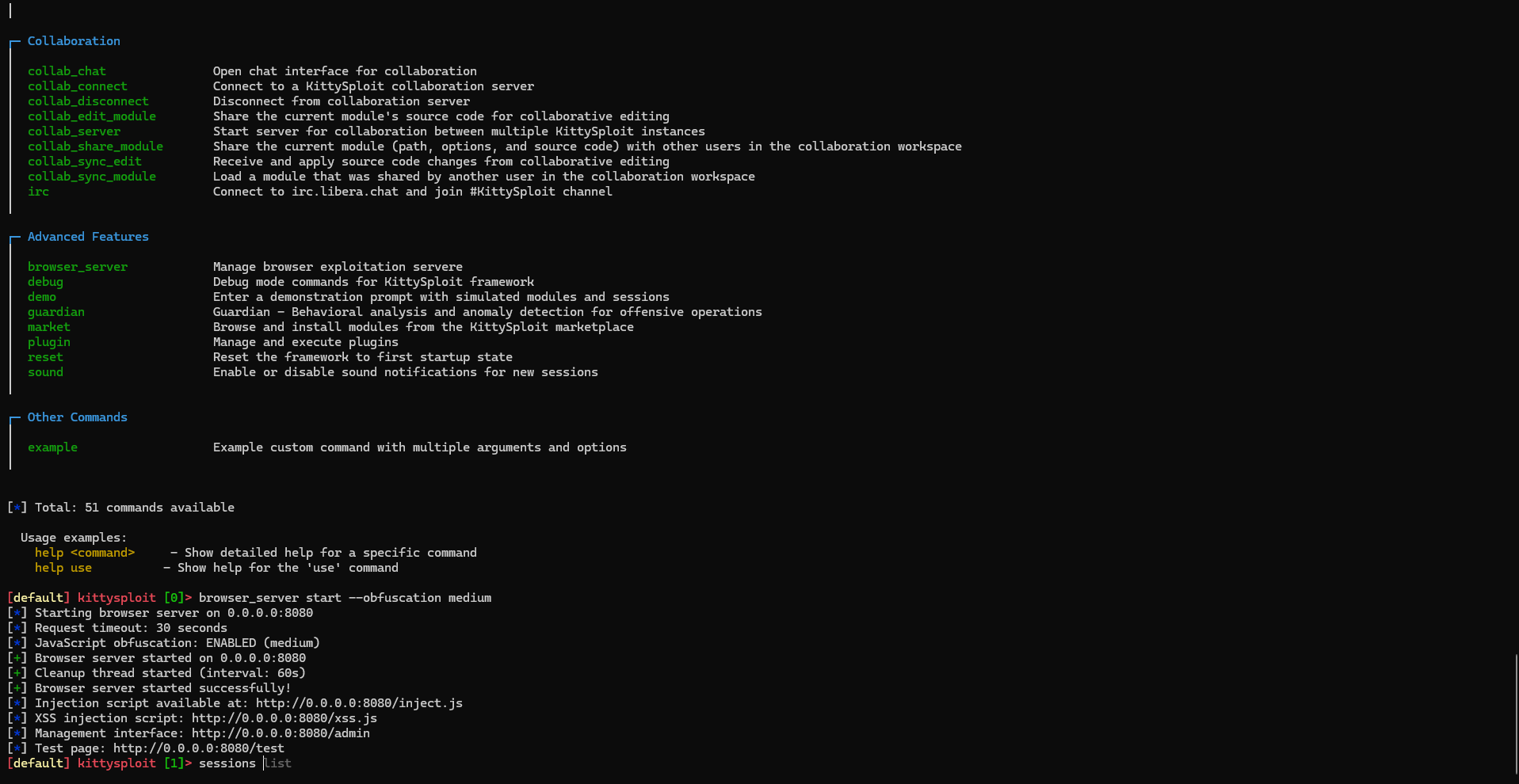
Autonomous agent

Drive a mission with a local model — no cloud key required:

# Plan only (safe preview)
kittysploit> agent lab.local \
  --llm-local \
  --llm-model llama3.1:8b \
  --profile owasp-web-parallel \
  --plan-only

# Obtain a shell (lab / authorized targets only)
kittysploit> agent http://192.168.56.10 \
  --profile internal-lab \
  --goal obtain-shell \
  --approve-risk intrusive \
  --shell-hunter \
  --llm-local \
  --llm-model llama3.1:8b
Flag Role
--goal obtain-shell Campaign objective is an interactive session
--approve-risk intrusive Required to run exploits (blocked otherwise)
--shell-hunter Push harder toward a shell
--approve-post-exploit Optional read-only collection after a session
--plan-only / --dry-run Preview without live intrusive actions
  • Mission profiles (safe-web, owasp-web-parallel, internal-lab, bug-bounty-safe, …)
  • Evidence-gated exploit handoff (reduce speculative false positives)
  • Parallel specialists by OWASP class (injection, XSS, SSRF, auth, authz)
  • Scope, budgets, and risk approvals stay under operator control

Core platform

  • Modular console — search / use / set / run across scanners, exploits, auxiliary, and post modules
  • Built-in C2 — listeners, payloads, sessions, pivots, and post-exploitation
  • Workspaces & scope — engagement boundaries, hosts, and findings organized per job
  • Workflows & playbooks — repeatable recon and attack chains
  • Extensions — proxy, OSINT, GUI, protocols via the marketplace
  • Mobile companion — QR pair for read-only engagement monitoring

Ecosystem

Project Purpose
KittyProxy Web traffic capture and analysis
KittyCosmic Graphical interface and marketplace
KittyOsint Visual OSINT investigation
KittyProtocol Protocol analysis
KittyV8Debugger V8 debugging and analysis

Demo video · More screenshots · Full usage guide

Documentation

Project status

KittySploit 1.x is the foundation of a broader offensive platform and is still evolving. Validate new releases in a lab before using them on an engagement.

Community

  • Star the repo to help others discover it
  • Join Discord
  • Open an issue for bugs or ideas
  • Support development on Liberapay

Acknowledgments

Thanks to Woody for their contributions.

License

KittySploit is released under the MIT License.

Frequently asked questions

Is Kittysploit-framework free to use?

Kittysploit-framework is open source under the MIT licence. There is no licence fee and no seat count — you can self-host it or, where the project offers one, pay a vendor for a managed version instead.

What does Kittysploit-framework do?

Python Exploitation Framework, V8 Engine Debugger, Proxy interceptor, marketplace, post-exploitation, backdoor generator,....

What is Kittysploit-framework written in?

Kittysploit-framework is primarily written in Python. Its source is publicly available at https://github.com/SIA-IOTechnology/Kittysploit-framework, and it has 631 GitHub stars.