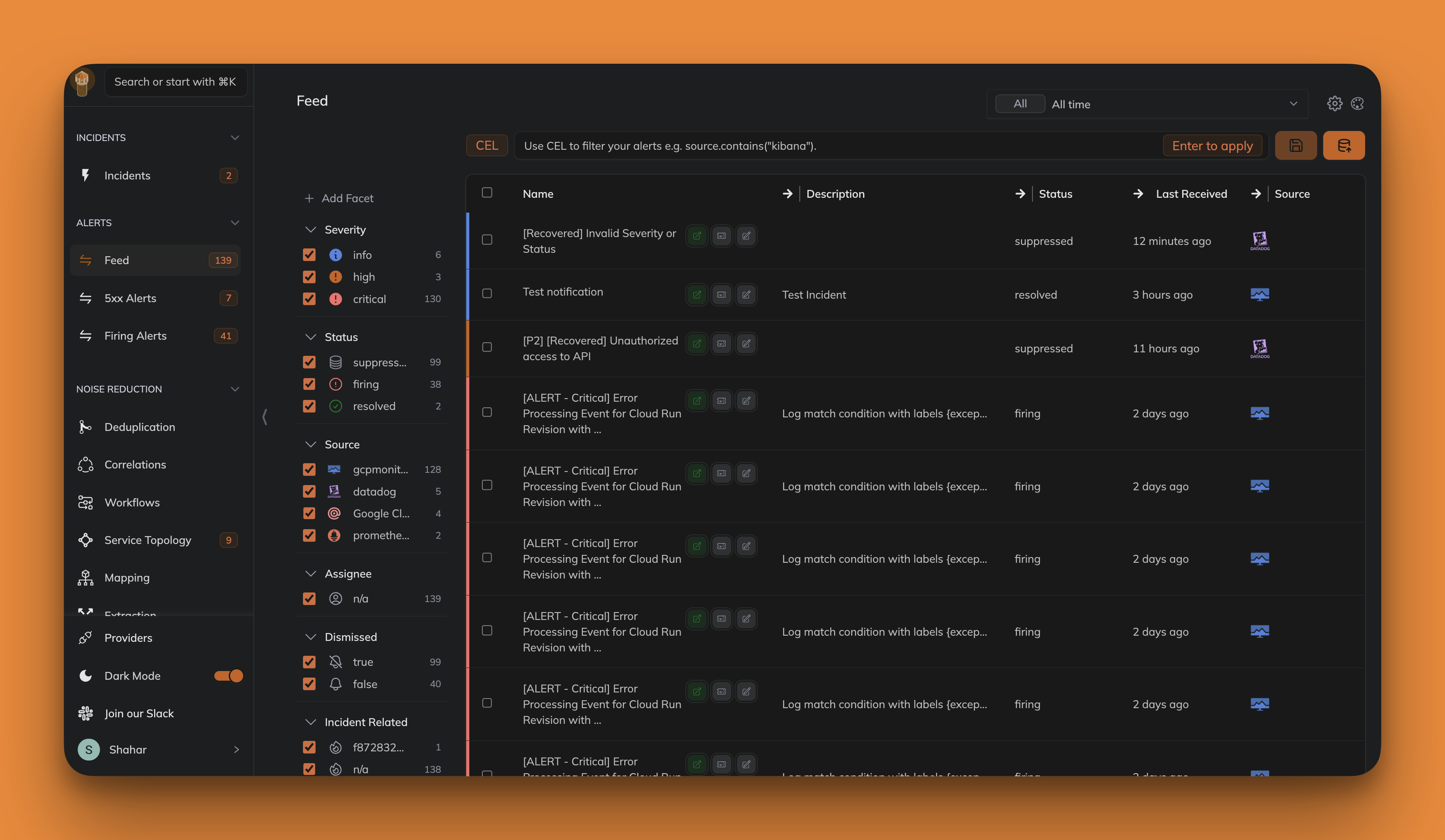
Keep is the open-source AIOps and alert management platform: a Python-based single pane of glass that unifies alerts and incidents, deduplicates and enriches them, and automates response through declarative YAML workflows, aimed at the SRE, platform and on-call teams that operate many monitoring tools at once.
What it is
Keep describes itself as the open-source AIOps and alert management platform, and it sits in the Infrastructure & Operations / Monitoring & Observability category. It is written in Python and presents a single pane of glass: one customizable UI for every alert and incident, backed by bi-directional integrations with monitoring tools and a declarative workflow engine that the README calls "GitHub Actions for your monitoring tools."
The problem it solves is alert sprawl. Each observability tool has its own interface, severity vocabulary and deduplication rules, so responders triage the same incident in several places. Keep replaces that with centralised deduplication, correlation, filtering and enrichment, then acts on the result by creating tickets, sending notifications or restarting servers. An AIOps 2.0 layer adds AI-powered correlation and summarisation.
Key capabilities
- Single pane of glass: one customizable UI covering all alerts and incidents.
- Alert handling: deduplication, correlation, filtering and enrichment in one place.
- Bi-directional integrations with observability tools including Datadog, Dynatrace, Grafana, Prometheus, Sentry, Splunk, Zabbix, New Relic and CloudWatch.
- Declarative YAML workflows built from triggers (alert, incident, schedule, manual), steps that read or fetch data, and actions that update tickets, send notifications or restart servers.
- AIOps 2.0 with selectable AI backends: Anthropic, OpenAI, DeepSeek, Ollama, LlamaCPP, Grok and Gemini.
- Incident and ticketing integrations covering PagerDuty, OpsGenie, Incident.io, Jira, Linear, ServiceNow, GitHub, GitLab and Monday.
- Enrichment via Bash, Python, SSH, Webhook and QuickChart, with Airflow orchestration, Amazon SQS or Kafka queues, and storage on BigQuery, ClickHouse, MongoDB, MySQL, PostgreSQL or Snowflake.
Who uses it and how
- SRE and platform teams consolidating alerts from many observability tools into one UI and one triage queue.
- On-call groups routing alerts to Slack, Teams, Telegram, Mattermost, SMTP, SendGrid, Twilio, Pushover or Ntfy.sh.
- Kubernetes, OpenShift, GKE or AKS operators using ArgoCD or Flux who want alert automation wired into cluster tooling.
- The README example workflow creates a Jira ticket for every critical Sentry alert on the payments or ftp services, and Slacks the payments team when the affected service is payments.
- Organisations needing private AI enrichment can point AIOps at Ollama or LlamaCPP instead of a hosted model.
Getting started
The README excerpt here does not name a package, Docker image or compose file; it directs readers to installation documentation at docs.keephq.dev, a "Try it out" link, the website at keephq.dev, and a demo booking for the hosted path.
How it compares
No list of paid products that Keep replaces is given, and no peer tools are named in the facts. It therefore stands alone in this registry as the AIOps and alert management platform described here, and comparisons with commercial incident-management suites are not supported by the material supplied.
When to use it — and when not to
A self-hoster must run the backing services: a database such as PostgreSQL, MySQL, MongoDB, ClickHouse or a warehouse, queues if used, and credentials for every connected communication and ticketing provider. The reported licence is NOASSERTION, so terms should be reviewed before adoption, and the repository carries 609 open issues. Teams unwilling to run data infrastructure or wire up many third-party providers should look elsewhere.