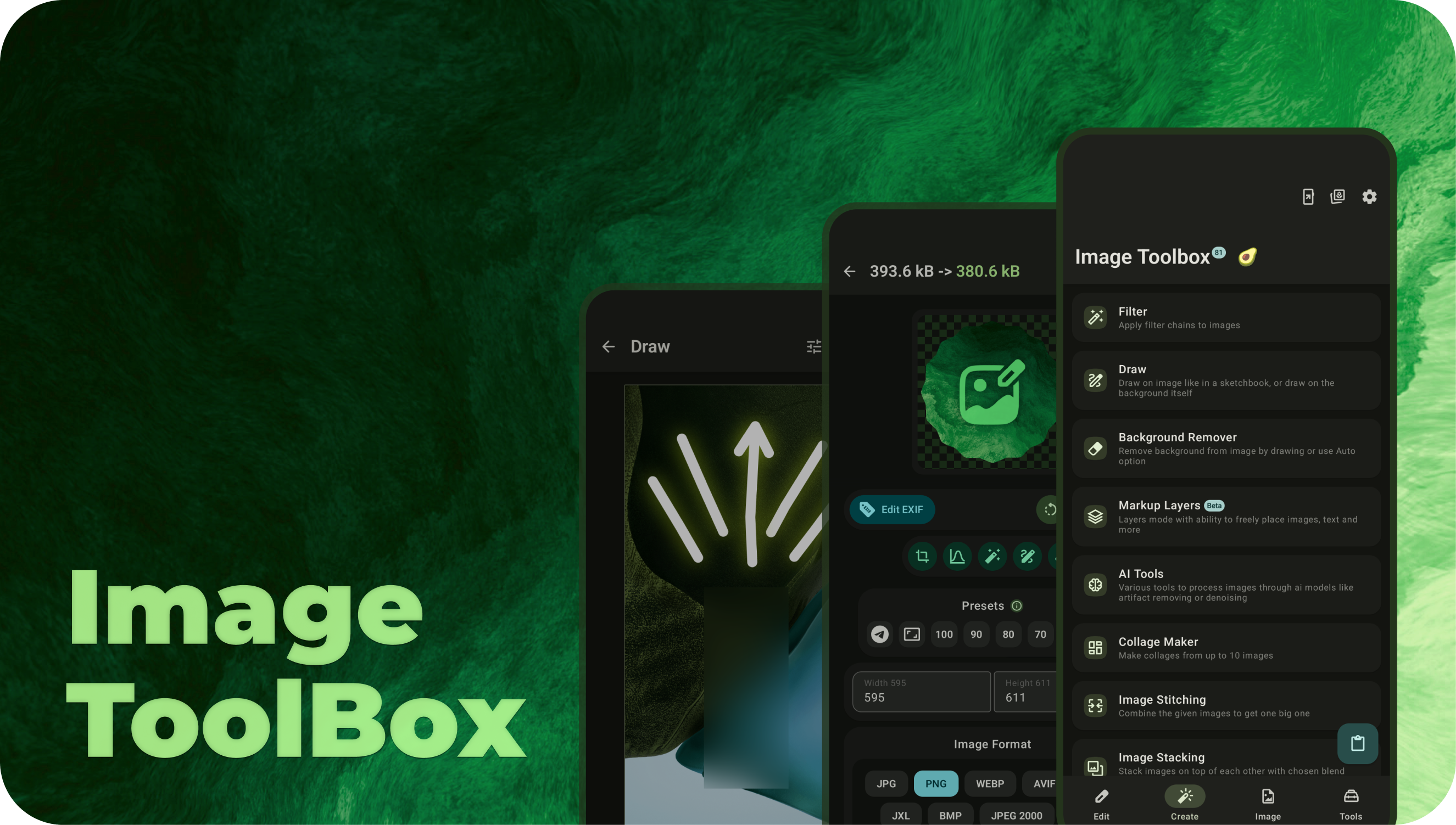
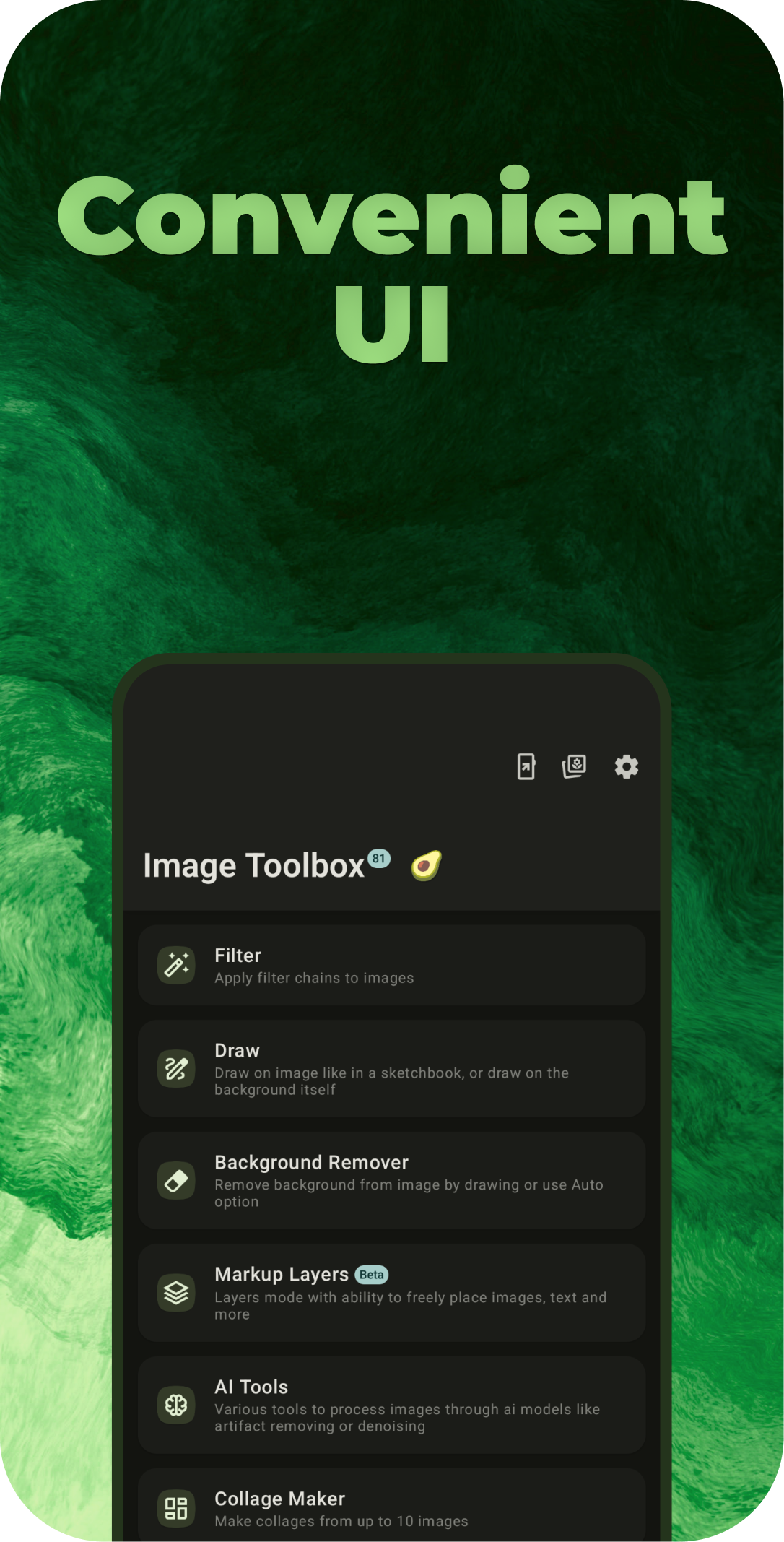
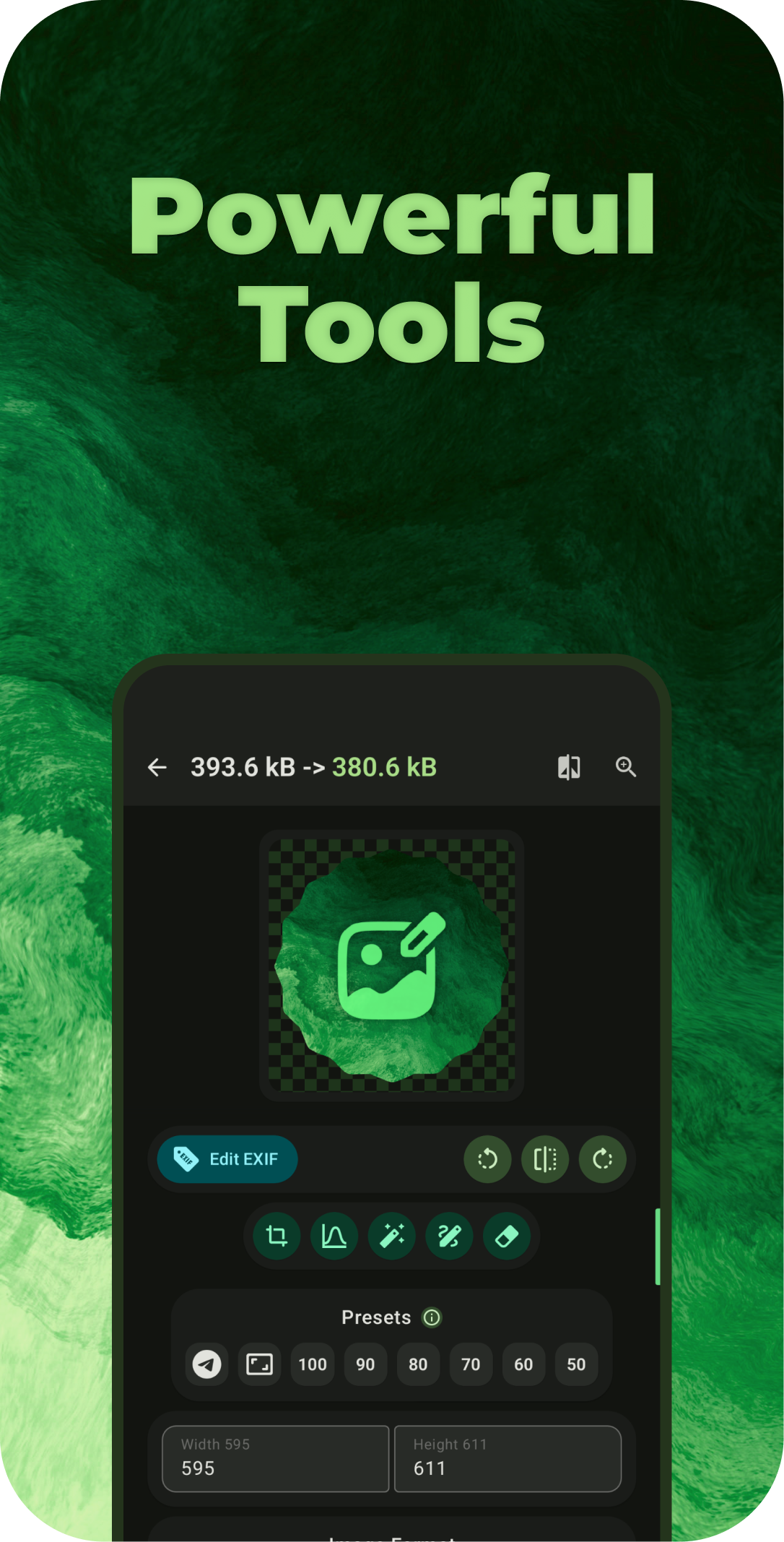
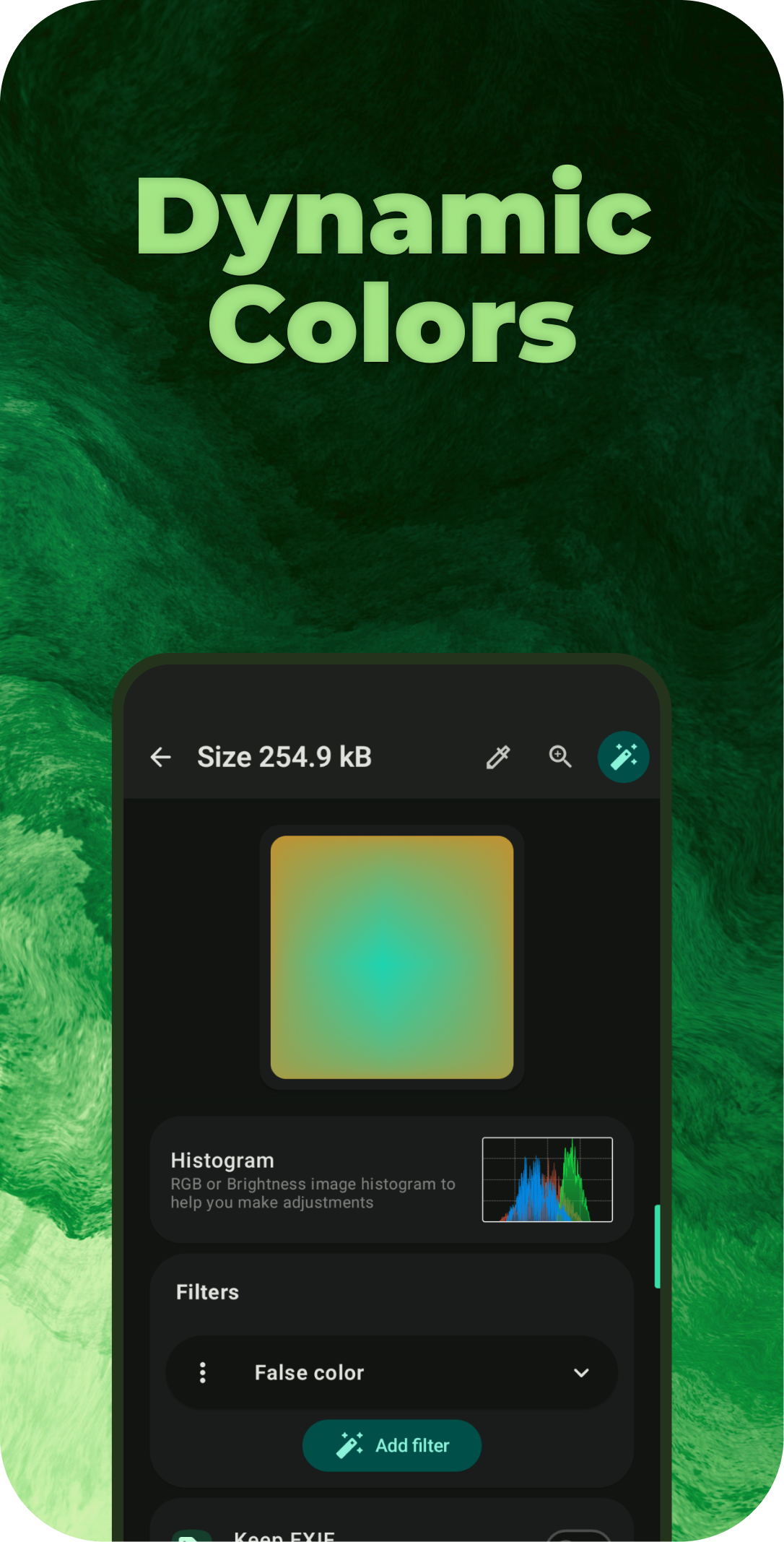
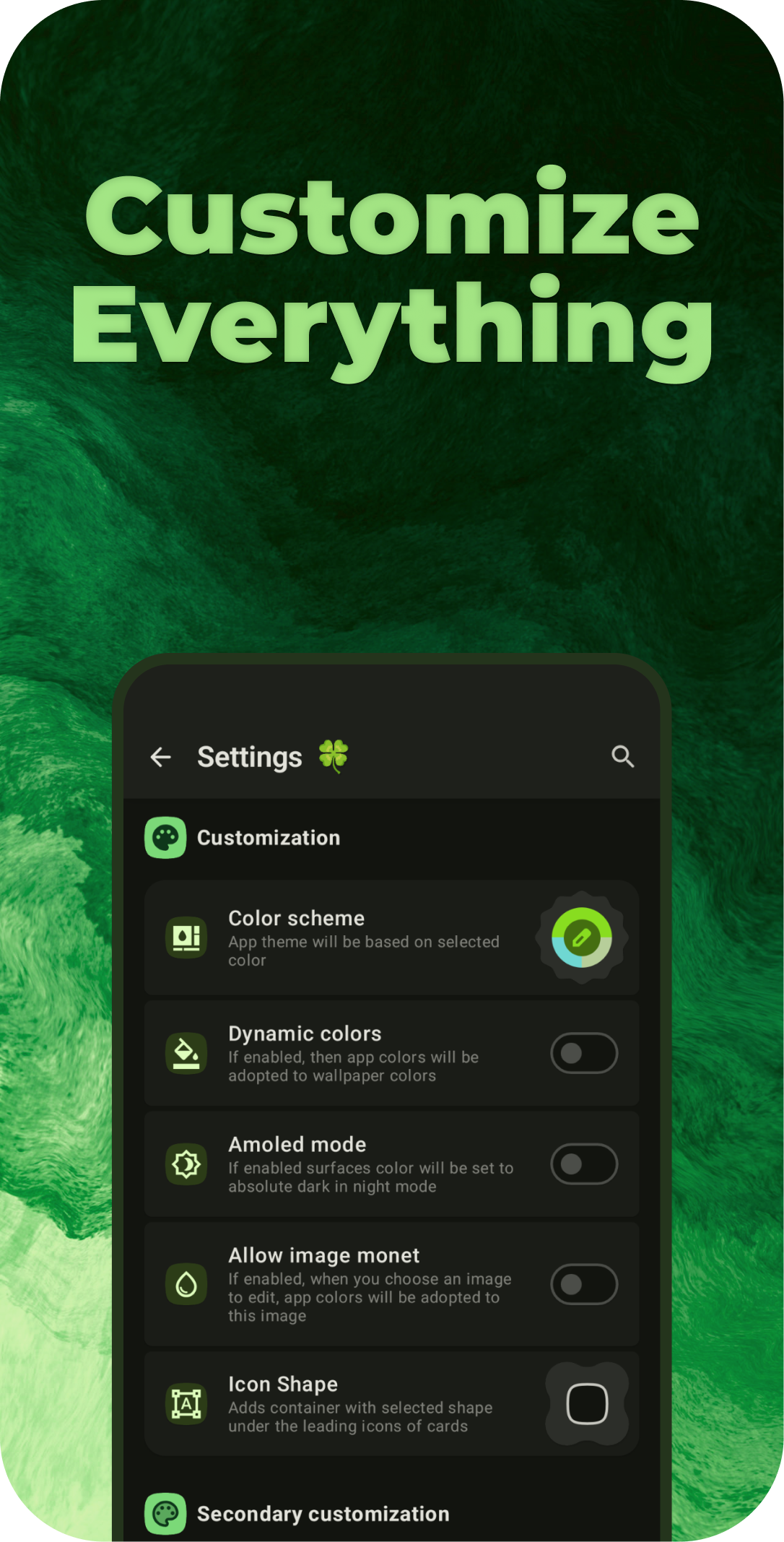
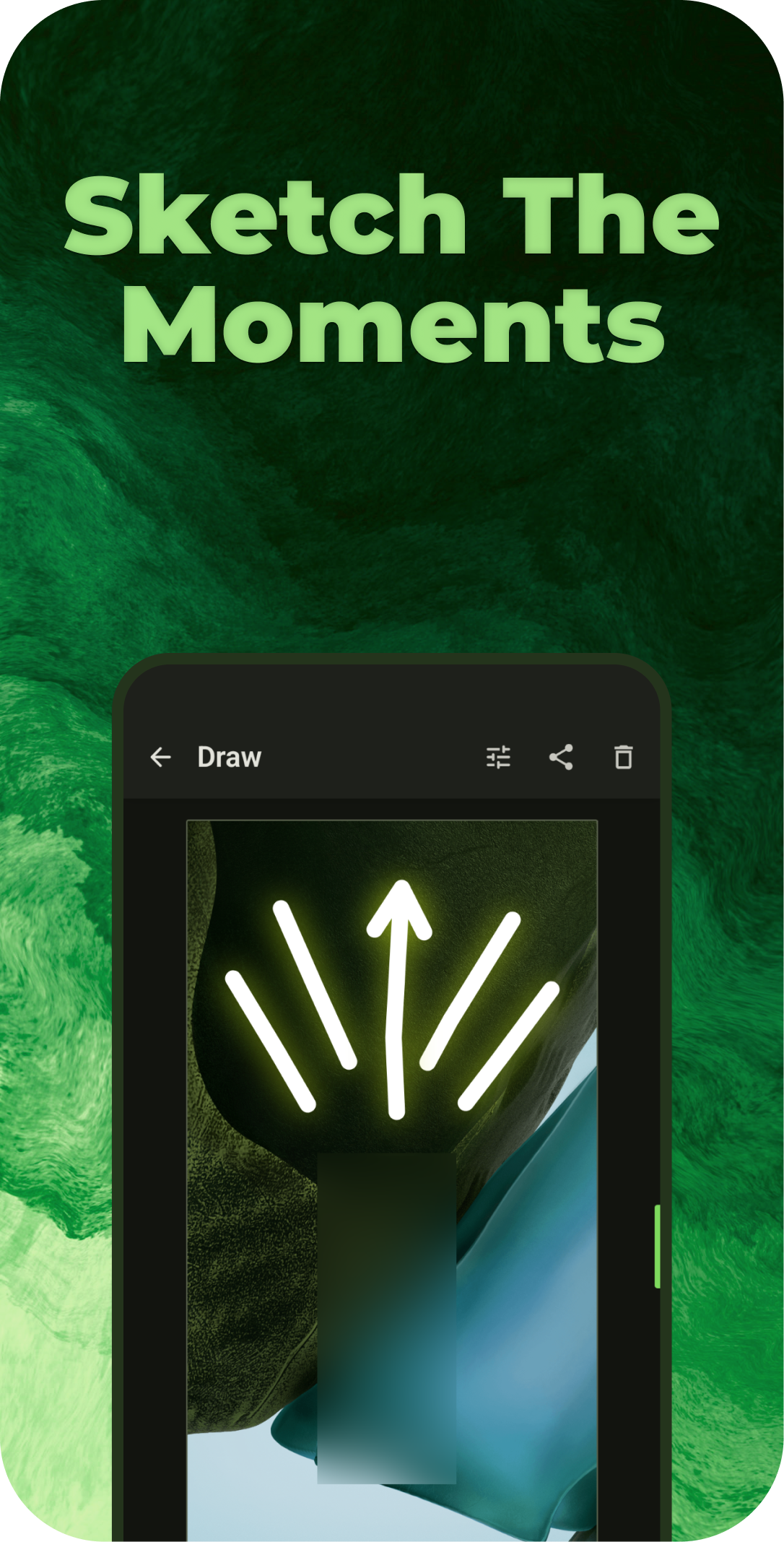
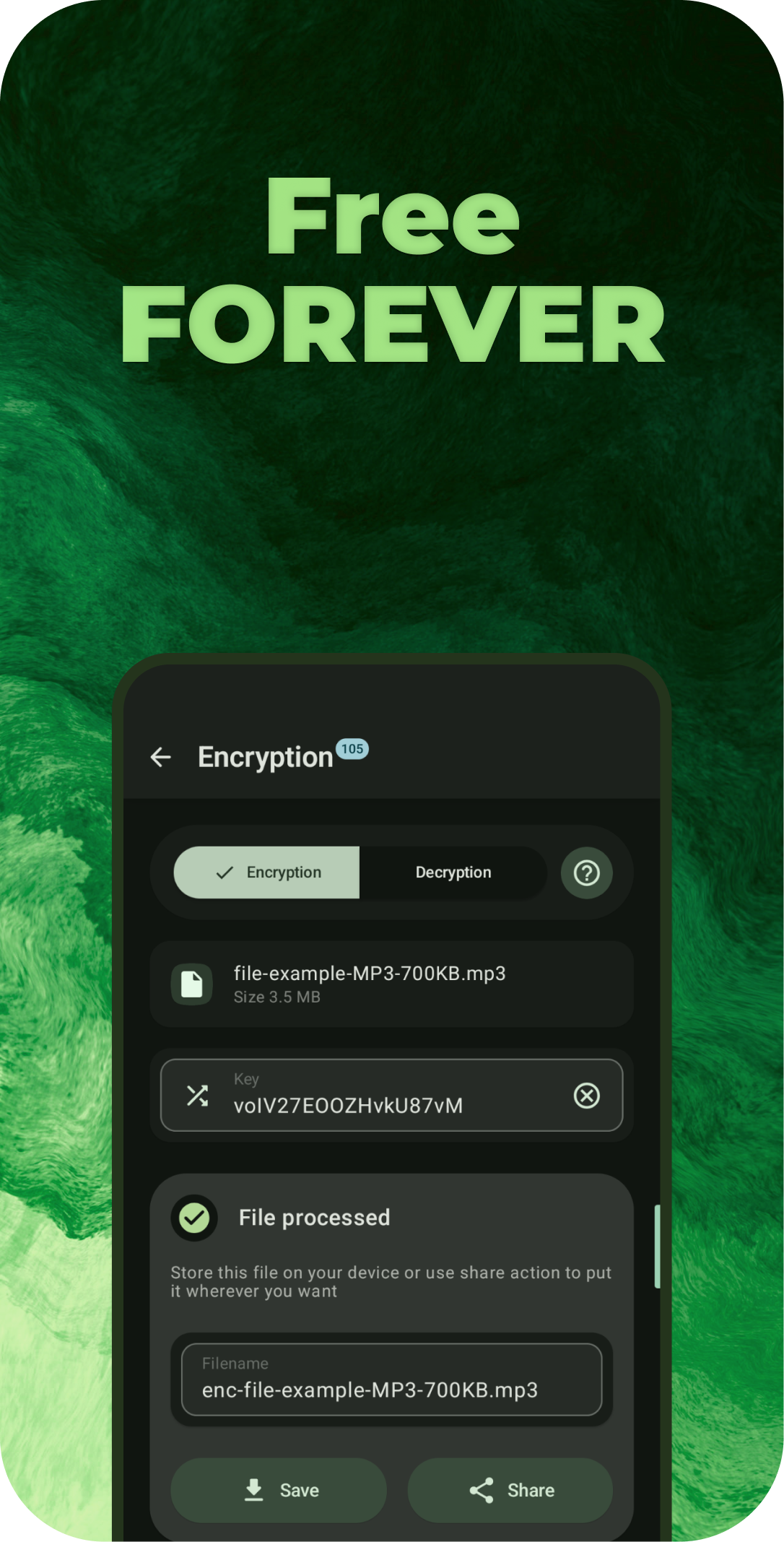
ImageToolbox is a free and open-source Android image editor written in Kotlin with Jetpack Compose and released under Apache-2.0, aimed at photographers, developers, and everyday Android users who need deep photo manipulation — crop, draw, filter chains, EXIF editing, background removal, and AI-assisted enhancement — without analytics or crash-reporting dependencies.
What it is
ImageToolbox is a native Android application for advanced image manipulation, built in Kotlin on Jetpack Compose and published under the Apache-2.0 licence. It lives in the Android and F-Droid ecosystem, and its feature set spans basic editing tools such as crop and draw, a filter engine with more than 500 filters, EXIF metadata editing, automatic background removal, and AI-based image enhancement. The project carries the topics ai, android, background-removal, crop, edit-photo, exif, f-droid, filter-image, image-manipulation, jetpack-compose, jxl, and kotlin, which map directly onto the features described in the README.
The concrete problem it solves is dependency and telemetry load. The project maintains two build flavours, documented in a "FOSS vs MARKET" table: the FOSS build replaces Google ML Kit components with Zxing for QR scanning, ONNX for automatic background removal, and OpenCV for document scanning, and it ships with no Analytics and no Crashlytics. The Market build keeps MlKit and the Google dependencies, and is the only build with RAR decryption through Junrar. For users who want the same editing pipeline without Google service dependencies, the FOSS build is the specific replacement.
Key capabilities
- Batch processing of multiple images in a single pass.
- Filter chains built from more than 500 filters, including saturation, contrast, brightness, exposure, RGB, hue, white balance, monochrome, sepia tone, vignette, Gaussian blur, box blur, stack blur, fast blur, bilateral blur, zoom blur, median blur, Sobel edge detection, sketch, toon, SmoothToon, Kuwahara, convolution 3x3, color matrix 4x4, lookup, color replacement, and Bayer two, three, and four dithering.
- Pixelation and distortion families, including enhanced pixelation, stroke pixelation, circle pixelation, diamond pixelation, and swirl, bulge, sphere refraction, and glass sphere refraction distortions.
- EXIF data editing alongside the visual editing tools.
- Automatic background removal using ONNX in the FOSS build and ML Kit in the Market build.
- Document scanning through OpenCV and QR scanning through Zxing in the FOSS build.
- Support for the
jxl (JPEG XL) image format, indicated in the project topics.
Who uses it and how
- Android users install the latest APK from the project Releases page, or obtain the app through F-Droid given the
f-droid topic.
- Photographers use batch processing and filter chains to apply a consistent look across sets of images rather than editing one file at a time.
- Privacy-conscious users and developers build the FOSS flavour from source to get Zxing, ONNX, and OpenCV in place of ML Kit, and to avoid Analytics and Crashlytics entirely.
- Contributors and testers follow the Telegram chat and the separate CI Telegram channel where betas and announcements are posted.
- The repository shows 14,666 stars, 631 forks, and no open issues, which suggests a widely used project with a narrow active maintainer surface.
Getting started
Download the latest APK from the Releases page, or build the project from source by cloning the repository and running ./gradlew build, then ./gradlew run to launch it.
How it compares
No list of paid products that this project replaces is provided in the facts, and no directly comparable tools are named either, so ImageToolbox stands alone in this registry. The closest contrast available is internal: the FOSS build versus the Market build, which differ on Zxing versus ML Kit, ONNX versus ML Kit, OpenCV versus ML Kit, RAR decryption, analytics, and crash reporting.
When to use it — and when not to
A self-hoster or builder needs a working Android toolchain and Gradle, because installation from source is the documented path; there is no server component, database, or SMTP dependency to operate. Anyone who needs RAR decryption should note that it exists only in the Market build, not the FOSS one. The README is also thin: the build instructions are generic, the download link points at a t8rin/imageresizer releases path, and no release or version information is stated, so users should verify the current release rather than rely on the documentation alone.