hunk
Hunk is a review-first terminal diff viewer for agent-authored changesets, built on OpenTUI and Pierre diffs.




- multi-file review stream with sidebar navigation
- inline AI and agent annotations beside the code
- split, unified, and responsive auto layouts
- watch mode for auto-reloading file and Git-backed reviews
- keyboard, mouse, pager, and Git difftool support
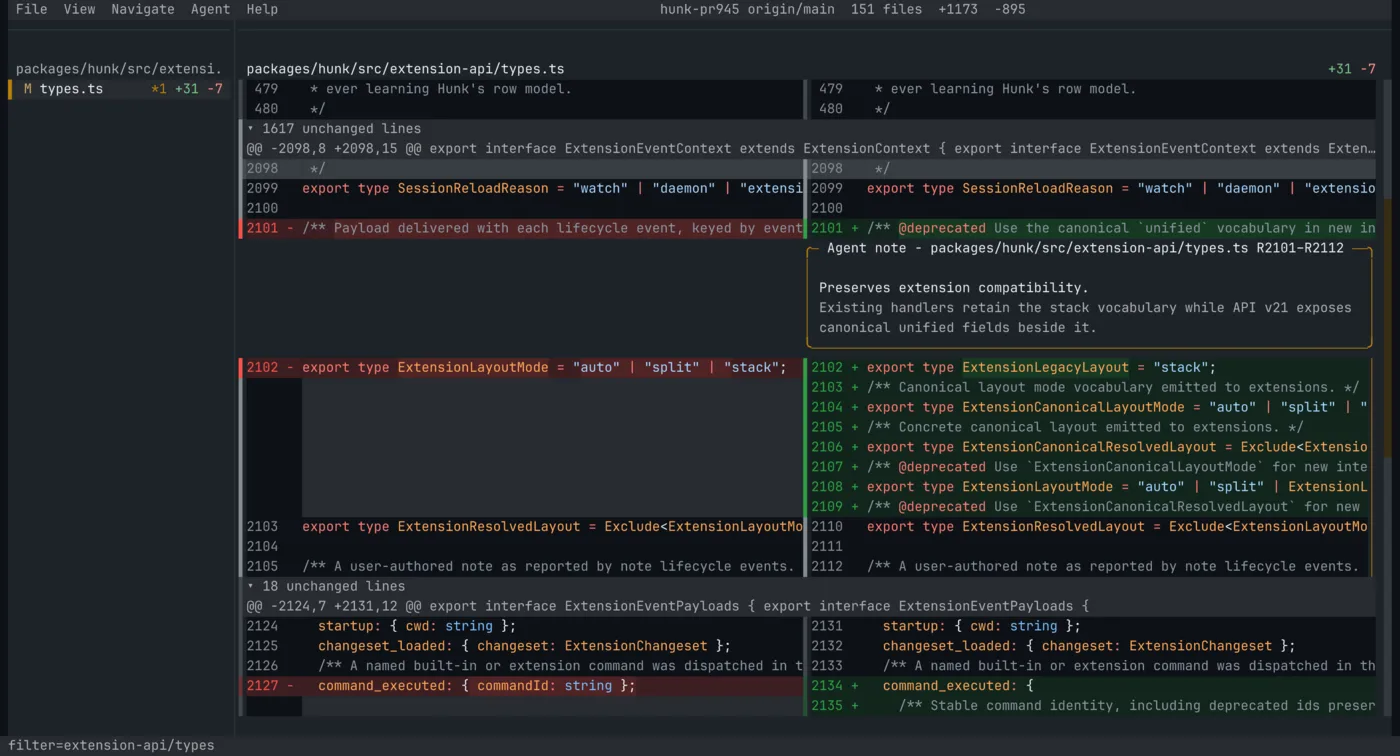
Split view with sidebar and inline AI notes |
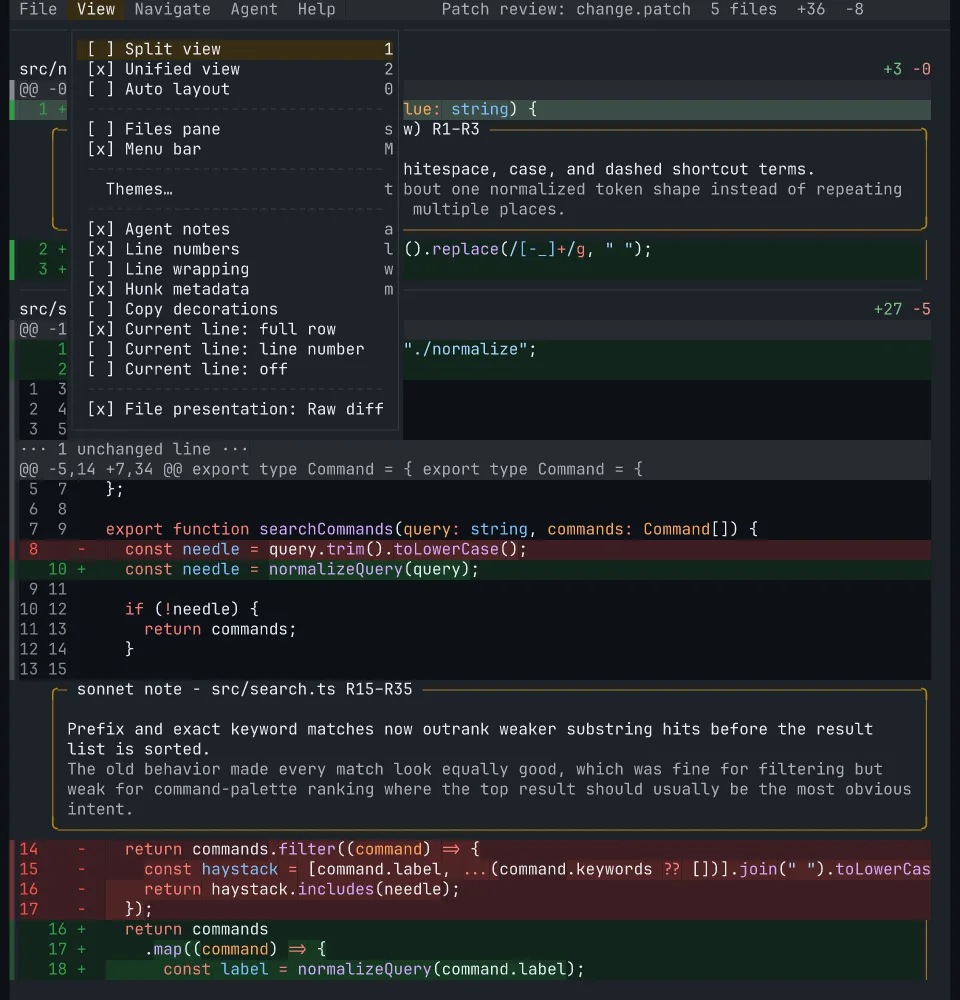
Unified view and mouse-selectable menus |
Install
The default installation method on macOS and Linux downloads a standalone binary and installs it into ~/.hunk. It checks the archive against the release checksum when both SHA256SUMS and a supported checksum tool are available, and warns otherwise. Release discovery uses Hunk's anonymous aggregate endpoint with direct GitHub fallback:
curl -fsSL https://hunk.dev/install.sh | sh
Windows users can install with npm or mise. Other installation methods are also available:
npm i -g hunkdiff                    # macOS, Linux, or Windows; requires Node.js 22+
brew install hunk                    # macOS or Linux
mise use -g hunk                     # macOS, Linux, or Windows
[!NOTE] If you previously installed hunk via
modem-dev/tap, be sure to uninstall it first withbrew uninstall modem-dev/tap/hunk.
Windows requires mise 2026.8.6 or newer. Nix users can use the default package exported in flake.nix; see the Nix guide for details. Hunk also ships as a default tool in Omarchy, installed through mise.
Requirements:
- macOS, Linux, or Windows
- On x86-64, a CPU with SSE4.2 (Intel Nehalem 2008+, AMD Bulldozer 2011+); arm64 has no CPU feature floor
- Node.js 22+ for the npm install; the install script, Homebrew, mise, and Nix ship a standalone binary that does not require Node.js
- Git recommended for most workflows
Update Hunk
Starting with Hunk 0.20, npm, Homebrew, and default install-script installs use Hunk’s canonical update command:
hunk update          # install the newest release
hunk update --check  # check without installing
hunk update 0.20.0   # select an exact npm or default install-script release
On an older release, update once with the installer or package manager that installed Hunk, then use hunk update going forward. Custom HUNK_INSTALL_DIR installs must re-run the installer with the same directory; mise, Nix, and source installs use their owning tools instead.
Quick start
hunk           # show help
hunk --version # print the installed version
Working with Git
Hunk mirrors Git's diff-style commands, but opens the changeset in a review UI instead of plain text.
hunk diff                      # review current repo changes, including untracked files
hunk --fast                    # experimentally offload eligible syntax highlighting
hunk diff --watch              # auto-reload as the working tree changes
hunk show                      # review the latest commit
hunk show HEAD~1               # review an earlier commit
hunk log                       # browse history on a terminal; print when redirected
hunk log --static              # force static output, paging when needed
hunk log is one auto-responsive, read-only history surface, not a repository manager. On a
terminal it opens the desktop history browser; pipes and redirects receive shell-native static
records automatically, and --static forces static output that pages only when needed. The selected VCS adapter
owns traversal, filtering, refs, and how a history item opens for review; the bundled Git and
Jujutsu adapters both implement that public capability. Static output keeps full commit, author,
date, message, branch/bookmark, remote, and tag details; --oneline provides compact records, and
--theme uses the same palette as Hunk review. Interactive history groups commits by local-calendar
day with account-like author handles and relative times, while keeping commit ids right-aligned and
clickable. Enable Graph view from the View menu to replace day groups with commit-topology lanes.
Press v and move with Up/Down or k/j to select a contiguous range. Shift+Up/Shift+Down, uppercase K/J, and Shift-click extend directly. Escape collapses the selection; opening the range
reviews the inclusive cumulative change from the oldest commit's parent through the newest commit.
History also shares review's b/f full-page and u/d half-page movement keys.
Range selection is disabled with --all or author, message, date, and path filters because traversal can interleave or hide commits.
After opening a commit or range, quit its normal Hunk review to return to the same selection.
History controls are configurable through canonical hunk.history.* keybindings.
Working with Jujutsu and Sapling
Hunk auto-detects Jujutsu and Sapling checkouts, so hunk diff [revset] and hunk show [revset] use native revsets inside jj or Sapling workspaces. hunk log --vcs jj also reads JJ history directly, including in a non-colocated workspace. To override VCS detection, set vcs = "git" or vcs = "jj" or vcs = "sl" in config.
Working with raw files and patches
hunk diff --files before.ts after.ts        # compare two files directly
hunk diff --files before.ts after.ts --watch # auto-reload when either file changes
git diff --no-color | hunk patch -          # review a patch from stdin
Watch mode remains continuous. Direct-file and Git-backed reviews normally use filesystem observation to refresh promptly, with periodic polling retained as a fallback for missed events or unavailable watchers. Jujutsu and Sapling reviews currently use polling rather than filesystem observation.
Working with agents
- Open Hunk in another terminal with
hunk difforhunk show. - Tell your agent to add the skill file returned by
hunk skill path. - Ask your agent to use the skill against the live Hunk session.
A good generic prompt is:
Load the Hunk skill and use it for this review. Run `hunk skill path` to get the skill path.
For the full live-session and --agent-context workflow guide, see the agent workflow guide. Experimental rich STML note bodies require starting the review with --experimental; plain agent notes remain the default.
Feature comparison
| Capability | hunk | lumen | difftastic | delta | diff-so-fancy | diff |
|---|---|---|---|---|---|---|
| Review-first interactive UI | ✅ | ✅ | ❌ | ❌ | ❌ | ❌ |
| Multi-file review stream + sidebar | ✅ | ✅ | ❌ |