🦊 ruyiJS
Run any site's JavaScript from Python — with the real Firefox engine.
A new-generation, minimalist browser purpose-built for AI-driven automation.
The authentic Firefox JavaScript engine and networking stack, with no window and no renderer —
made for web scraping, JS reverse engineering, data collection, and getting past bot checks.








Sponsored by



Contributors




Install · Features · Verification systems · Examples · FAQ · Contact · LinuxDO · English · 简体中文
⚠️ Disclaimer: This project is for researching next-generation AI browsers. Any form of brute-force reverse engineering is strictly rejected. The source code is open source under the AGPL-3.0; closed-source or proprietary use requires a commercial license.
Is ruyiJS for you?
Headless Chrome and Playwright hand you a whole browser: a GPU-rendering, window-managing, memory-hungry process that anti-bot vendors have spent years learning to detect. ruyiJS takes the opposite path — it embeds only the Firefox internals that matter for automation and leaves the rest behind:
- The real engine, not an impersonation. Genuine SpiderMonkey (Firefox 159) and the Necko network stack execute a site's JavaScript, challenges, signatures, and fingerprints exactly as Firefox would.
- Truly headless. No window, no layout, no renderer. A pure JavaScript + Web API environment that starts fast and stays light.
- Isolated and reproducible. Each
Contextis its own process with a persistent JavaScript world and its own proxy, so sessions never leak into each other. - Offline when you need it. Serve scripts and responses yourself and replay a whole captured flow with no network.
If you scrape, reverse-engineer web JavaScript, or collect data behind a challenge, it's for you. If a plain HTTP client already gets your pages, you don't need it.
Wheels for Windows x64, macOS arm64 and Linux x86_64 are on PyPI for Python 3.10+. GitHub Actions builds each of them from the official Firefox 159.0 source (build from source).
📦 Installation
python -m pip install ruyijs
Requirements: 64-bit Python 3.10+ on Windows x64, on macOS 26 or later (Apple Silicon), or on Linux x86_64 with glibc 2.39 or later (Ubuntu 24.04, Debian 13, Fedora 40 and newer).
The Windows wheel ships the SHA256-pinned SpiderMonkey + Necko runtime (~42 MB). Local scripts run offline right after install — no browser download, no external dependencies.
macOS arm64: the macosx_26_0_arm64 wheel loads pages over direct HTTPS through libnecko_core.dylib and libnecko_quic.dylib, linked against the NSS of the same Firefox source. It has no xpcshell. Context(proxy=...) uses an HTTP CONNECT tunnel into libnecko_core when that binary is absent. The Necko helper runs on the Python that installed ruyijs; its packages are dependencies of the macOS wheel. Details and the remaining gaps are in docs/macos.md.
Linux x86_64: the manylinux_2_39_x86_64 wheel is a native ELF build, contributed by @Starktomy in #5. Text uses fontconfig, FreeType and HarfBuzz with the fonts installed on the machine, WebCrypto uses OpenSSL 3, and the Necko helper (NSS 3.131, Neqo for HTTP/3) brings its own Python. See docs/linux.md.
To upgrade:
python -m pip install --upgrade ruyijs
To verify the installation:
import ruyijs
print(ruyijs.__version__)   # 0.3.1
Build from source
git clone --recurse-submodules https://github.com/cutetailbud/ff-ruyijs
The firefox/ submodule is the official Firefox 159.0 release (mozilla-firefox/firefox at FIREFOX_159_0_RELEASE, a shallow clone). The workflows that build the PyPI wheels are the reference for a local build: .github/workflows/wheels.yml runs ci/firefox/build.sh js|browser|toolchain and tools/build.py on Windows and macOS, and the steps of ci/linux/build.sh on Linux.
🚀 Quick start
1 · Open a context and run JavaScript. Variables and functions persist across eval calls within the same context.
from ruyijs import Context

with Context() as context:
    context.eval("let count = 40")
    print(context.eval("count += 2"))        # 42
    print(context.eval("navigator.userAgent"))
3 · Point it at a real target. Configure the environment, load the page, and let the site's own JavaScript mint whatever token it demands.
with Context(proxy="http://127.0.0.1:7890") as context:
    context.configure_fingerprint({
        "navigator": {"language": "zh-CN", "hardwareConcurrency": 8},
        "locale": {"timezone": "Asia/Shanghai"},
    })
    context.load_page("https://target.example/", html)
    token = context.eval("window.__sign(payload)")   # run the page's signer
    print(token)
🏗️ How it fits together
Python  ──►  ruyiJS Context (isolated process)  ──►  Target site
                 ├─ SpiderMonkey — Firefox 159 JS engine
                 ├─ 38 browser contexts — DOM · Canvas · Workers · iframes · …
                 ├─ Skia — Firefox 159 2D graphics behind Canvas
                 └─ Necko — HTTP/1.1 · 2 · 3, per-context proxy
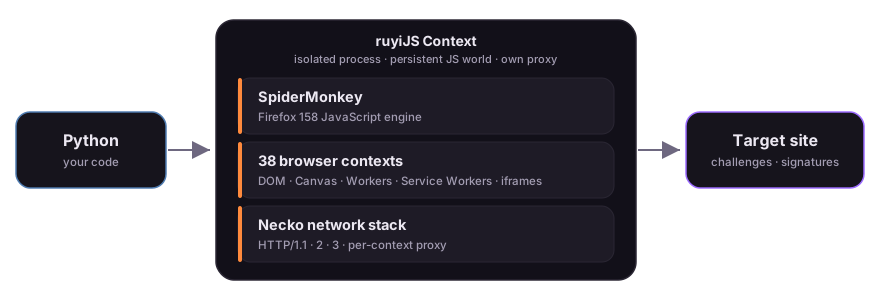
Your Python code drives a Context. Inside it, the genuine SpiderMonkey engine runs the page's scripts against a real DOM and 38 bounded browser subsystems, while in-page fetch/XHR ride the Necko transport. The implementation lives under src/ (domain, application, and every browser subsystem) and python/ruyijs/ (the binding).
✨ Features
Run a site's JavaScript
Execute scripts in a persistent context, load real HTML with iframes and classic scripts, and query the resulting DOM. References to live JS objects come back as JSObject / JSFunction you can call from Python.
| Capability | How |
|---|---|
| Execute JS, keep state | context.eval(src) — variables and functions persist |
| Get a callable back | context.eval(src, to_py=False) → JSFunction |
| Load a page | context.load_page(url, html) — relative URLs resolve against url |
| Top-level navigation | context.navigate(url) — no Referer, Sec-Fetch-Site: none |
| Query the DOM | context.eval("document.querySelector('#x').textContent") |
with Context() as context:
    context.set("config", {"offset": 2})
    add = context.eval("(value) => value + config.offset", to_py=False)
    print(add(40))  # 42
Configure the browser environment
Set Navigator, Screen, viewport, timezone, and locale through one validated profile surface. Commit it before the first page script runs.
with Context() as context:
    context.configure_fingerprint({
        "navigator": {"language": "zh-CN", "hardwareConcurrency": 8},
        "screen": {"width": 1920, "height": 1080},
        "viewport": {"width": 1280, "height": 720},
        "locale": {"timezone": "Asia/Shanghai"},
    })
    print(context.eval("[navigator.language, screen.width]"))  # ['zh-CN', 1920]
Native network over Necko
In-page fetch and XHR ride real HTTP/1.1, 2, and 3, through a proxy scoped to the context. Serve responses yourself with put_resource() to replay an entire captured flow offline. Inspect every request with net_log(). On macOS, pages load over direct HTTPS. A proxy uses the donor xpcshell when it is present, and an HTTP CONNECT tunnel into libnecko_core when it is not (docs/macos.md).
Native TLS fingerprint — switchable across Firefox 100 – 159
The network stack is Firefox's own Necko + NSS (the same TLS library real Firefox uses). The TLS ClientHello — cipher suites, extensions, ALPN, key shares, and their ordering — is produced by the real NSS library, not an emulation, so bot-detection systems that inspect TLS cannot distinguish ruyiJS traffic from a genuine Firefox session.
The Necko transport can freely switch between Firefox 100 – 159 TLS profiles. Each profile reproduces that version's exact ClientHello, giving you a different JA3 / JA4 fingerprint on the wire — useful for rotating browser identities, evading per-version blocks, or testing how a site reacts to different Firefox releases.
Choose the release per context with tls= ("100"–"159"; default 159). On Windows this sets the TLS ClientHello, HTTP/2 settings and HTTP/3 priorities of that context's Necko transport; set a matching user agent with configure_fingerprint when the page should agree. On macOS, direct HTTPS uses arm64 libnecko_core.dylib when that library reports NSS 3.131. The shell prefers dist/necko_tls/libnecko_core.dylib, then the staged dist/necko copy. An existing NECKO_CORE_LIBRARY wins. Context() and Context(tls="100") both opened https://example.com/ at status 200 and protocol h2. The measured handshake was 15 ciphers, 5 groups, and 3 key shares for 159, and 17, 6, and 2 for 100. Library GETs at the cluster boundaries 100, 119, 132, 135, 151, 154, 156, and 159 also returned 200 and h2, and the counts matched the profile table. The other versions were not each opened as a page. Omitted request headers and the HTTP/2 settings follow the 0.2.1 product table for that tls= value. A header the caller sets wins. HTTP/3 fields in that table are unused, and HTTP/3 is unchanged. A proxy, a missing library, or a different NSS build stays on the donor xpcshell. The proxy was not retested in this run. Plain HTTP still returns necko 804b0033 from that donor (docs/tls-profile.md). The PyPI macOS wheel has no xpcshell, so the proxy case is not available there.
with Context(proxy="http://127.0.0.1:7890", timeout=30, tls="120") as context:
    context.load_page("https://example.com/", "")
    context.eval("globalThis.r = null; fetch('/api').then(x => x.json()).then(v => r = v)")
    context.advance(25)               # drive the event loop until it settles
    print(context.eval("r"))
Canvas on Firefox's native Skia
Canvas 2D draws through Firefox's own official Skia (gfx/skia from the Firefox 159 release), not a re-implementation.
Python ↔ JavaScript bridge
Pass data in with set(), get callable JS functions out, and expose Python functions to the running script. Workers, Service Workers, and iframes are included.
with Context() as context:
    context.expose(lambda a, b: a + b, "add")
    print(context.eval("add(20, 22)"))  # 42
Many independent sessions in one process
A Context starts its own process. An Engine runs many Contexts as sessions of one process instead, each on its own thread with its own heap, page, clock, cookies, storage, proxy and TLS profile, in parallel. prewarm and network= trim the Necko helper processes, which are most of a Context's memory: four sessions measured 219 MiB in 5 processes against 385 MiB in 12 for four Contexts, and 151 MiB in 3 when they share one network (docs/engine.md).
from ruyijs import Context, Engine, use_engine

with Engine() as engine:
    a = engine.context(proxy="http://127.0.0.1:7890")
    b = engine.context(tls="120")
    with use_engine(engine):
        c = Context()          # code that creates its own Contexts joins the engine too
Deterministic clock
Drive timers with a logical clock for perfectly reproducible runs, or use the system clock for live work. The host advances time explicitly.
with Context() as context:
    context.configure_clock("logical", epoch_ms=1700000000000)
    context.eval("globalThis.result = 0; setTimeout(() => { result = 42 }, 10)")
    context.advance(10)
    print(context.eval("result"))  # 42
Errors and logs
JavaScript exceptions surface as JSError with name, message, and stack. console_log() and net_log() return the captured console and network records.
from ruyijs import Context, JSError

with Context(timeout=10) as context:
    try:
        context.eval("throw new TypeError('bad input')", filename="demo.js")
    except JSError as error:
        print(error.name, error.message)  # TypeError bad input
        print(error.stack)
🛡️ Verification systems it defeats
Each example drives the site's own JavaScript to produce the parameters it demands, then completes the flow end to end. All ship runnable in the package: python -m ruyijs.examples .
| System | Category | Example |
|---|---|---|
| Akamai Bot Manager 3.x | sensor_data + sbsd challenge | akamai |
| DataDome | Interstitial device-check (plv2 + plv3) | datadome |
| CreepJS | Fingerprint audit — passes every section | creepjs |
🔒 Strictly prohibited for any unlawful use. ruyiJS is provided solely for research into a new generation of AI browsers. Live results depend on current network conditions and each site's present responses.
🧪 Examples
Examples ship inside the package — no need to clone the repo:
python -m ruyijs.examples                      # list every example and its install path
python -m ruyijs.examples akamai               # Akamai Bot Manager 3.x
python -m ruyijs.examples datadome             # DataDome interstitial device-check
python -m ruyijs.examples creepjs              # CreepJS fingerprint audit
python -m ruyijs.examples --shared akamai datadome creepjs   # several at once, one shared engine
Every example supports --direct (direct connection) and --proxy http://127.0.0.1:7890. Add --help after a name for all options, and --output result.json to save results. Each example directory ships its own README.
📚 Documentation & API
Context.eval / set / expose |
Execute JS, pass data in, expose Python callbacks |
load_page / navigate / put_resource |
Load HTML, top-level navigation, serve resources offline |
configure_fingerprint / configure_environment |
Navigator, Screen, viewport, timezone, locale |
configure_clock / advance / tick |
Logical vs. system clock, drive the event loop |
JSError / console_log / net_log |
Errors as exceptions, console and network records |
JSObject / JSFunction / get_runtime_path |
Live JS handles, bundled-runtime path |
Engine / engine.context / use_engine |
Many independent Contexts as sessions of one process |
📏 Scope & limitations
ruyiJS provides JavaScript execution and a broad Web API environment on Windows x64, macOS arm64 and Linux x86_64. It has no browser window and no full page layout or rendering — it is a tool for automation, analysis, and research. Use it in compliance with the terms of service of any site you interact with and with applicable law. The platform differences are in docs/macos.md and docs/linux.md.
Related: ruyiHttp — a Requests-style Python HTTP library built on Firefox's native networking components.
❓ FAQ / Troubleshooting
What Python versions are supported?
64-bit Python 3.10 and above on every platform, tested up to Python 3.14. On macOS the Necko helper runs on the interpreter that installed ruyijs; the Linux wheel brings its own Python 3.14 for it.
Does it work on macOS or Linux?
Yes. PyPI has a macosx_26_0_arm64 wheel (macOS 26 or later) and a manylinux_2_39_x86_64 wheel (glibc 2.39 or later). The macOS wheel has no xpcshell; since 0.3.1 Context(proxy=...) uses an HTTP CONNECT tunnel there. See docs/macos.md and docs/linux.md.
The JS engine is Mozilla's official SpiderMonkey and the networking stack is Mozilla's official Necko — both are built from the official Firefox source, referenced as the firefox/ submodule.
Do I need to download a browser?
No. Every wheel bundles the SpiderMonkey + Necko runtime built from the Firefox 159.0 source, and pip install ruyijs needs no browser. On macOS, pip also installs the Python packages of the Necko helper.
Context hangs or doesn't respond
- Make sure you use the
withstatement (with Context() as ctx:) so the process is cleaned up properly. - If using a proxy, verify it is reachable:
context = Context(proxy="http://127.0.0.1:7890"). - Increase the timeout:
Context(timeout=60). - On Wine, upgrade to ≥ 0.1.5 which fixes a known navigate deadlock.
JSError: script error
The site's JavaScript threw an exception. Inspect error.name, error.message, and error.stack to locate the cause. If the page relies on APIs not yet implemented, the stack trace will point to the missing call.
How do I use a proxy?
with Context(proxy="http://127.0.0.1:7890") as ctx:
    ctx.navigate("https://example.com/")
HTTP, HTTPS, and SOCKS5 proxies are supported per-context.
How do I run examples?
python -m ruyijs.examples              # list all examples
python -m ruyijs.examples akamai --proxy http://127.0.0.1:7890
python -m ruyijs.examples creepjs
💬 Contact
Questions, permission requests, commercial licensing, or just to talk shop — add the author on WeChat, or scan to join the discussion group.
 WeChat: 如意 |
 Group: AI浏览器ruyijs过检测交流群3 |
The group QR refreshes periodically; if it has expired, add the author on WeChat (如意) for an invite.
📄 License
ff-ruyijs is dual-licensed:
- AGPL-3.0 — free for any use, commercial included, as long as you comply: if you distribute ff-ruyijs or a modified version, or offer it to users over a network (a hosted service or API), you must publish the complete source of your version under the AGPL-3.0.
- Commercial license — required to use ff-ruyijs in closed-source products or services, or to keep your modifications private.
For a commercial license, contact via WeChat (ID: 如意) or open an issue on GitHub titled "Commercial license".
Mozilla-derived code (SpiderMonkey, Necko) stays under the MPL-2.0. Releases up to 0.2.1 keep the license they shipped with.
See NOTICE for third-party attributions.
If ff-ruyijs saved you from reimplementing a browser, a ⭐ helps others find it.