
databuff is a free, open source monitoring & observability project written in Java and released under AGPL-3.0. It has 720 GitHub stars, 144 forks and 11 open issues, and was last pushed 27 days ago. On this registry it ranks #245 of 270 tracked projects in Monitoring & Observability, with 5 head-to-head comparisons available. It gained 31 stars over the last 30 tracked days.

What is databuff?

DataBuff is an AI-native APM backend built on OpenTelemetry that ingests traces, metrics and logs over OTLP and ships with multi-agent AI troubleshooting out of the box, aimed at teams that self-host observability for microservices.

What it is

DataBuff is an application performance monitoring backend written in Java and released under the AGPL-3.0 licence. It ingests telemetry through OTLP — gRPC on 4317 and HTTP on 4318 — covering traces, metrics and logs, and supports dual-protocol ingestion with SkyWalking native gRPC on 11800, so an existing exporter can be pointed at DataBuff by changing the exporter address. On top of that ingestion layer it provides full-stack monitoring, service call-graph topology, RED metrics, threshold alerting with scheduled evaluation and alert event history, and an eBPF APM collection path that gathers call chains and performance data at kernel level without code changes. The repository is listed on the OpenTelemetry official Vendors page as a Native OTLP backend and on the CNCF Landscape, and the project's stated mission is to build the strongest OpenTelemetry APM backend rather than another observability UI.

The concrete problem it solves is the separation between telemetry storage and AI assistance. DataBuff puts the model on the live telemetry path: LLMs query traces, metrics, topology and alerts directly, so the flow from natural-language query through multi-agent inspection to root-cause analysis and operations remediation sits inside the same deployment. The README is explicit that this is not a chat box bolted onto a dashboard, and that the AI answers from real telemetry rather than generated content. Because it is OTLP-native, existing instrumentation is used as-is, and the SkyWalking compatibility path gives teams a migration route off an existing SkyWalking deployment rather than a parallel stack.

Key capabilities

  • OTLP-native ingestion for traces, metrics and logs on gRPC 4317 and HTTP 4318, with SkyWalking native gRPC on 11800 as a second protocol.
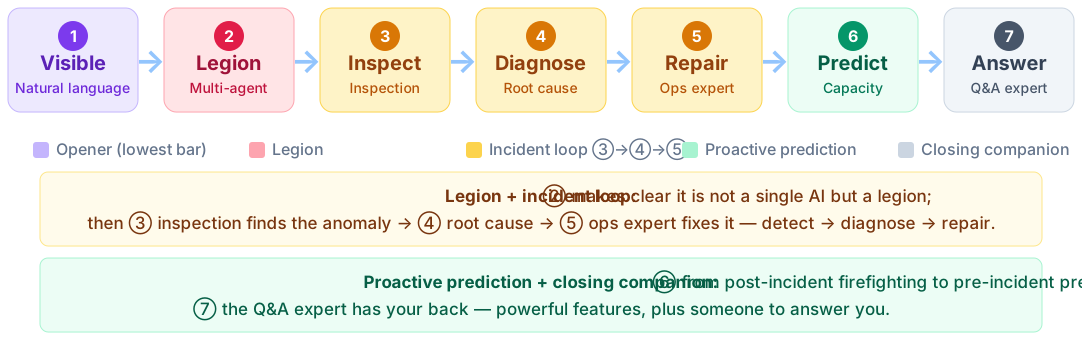
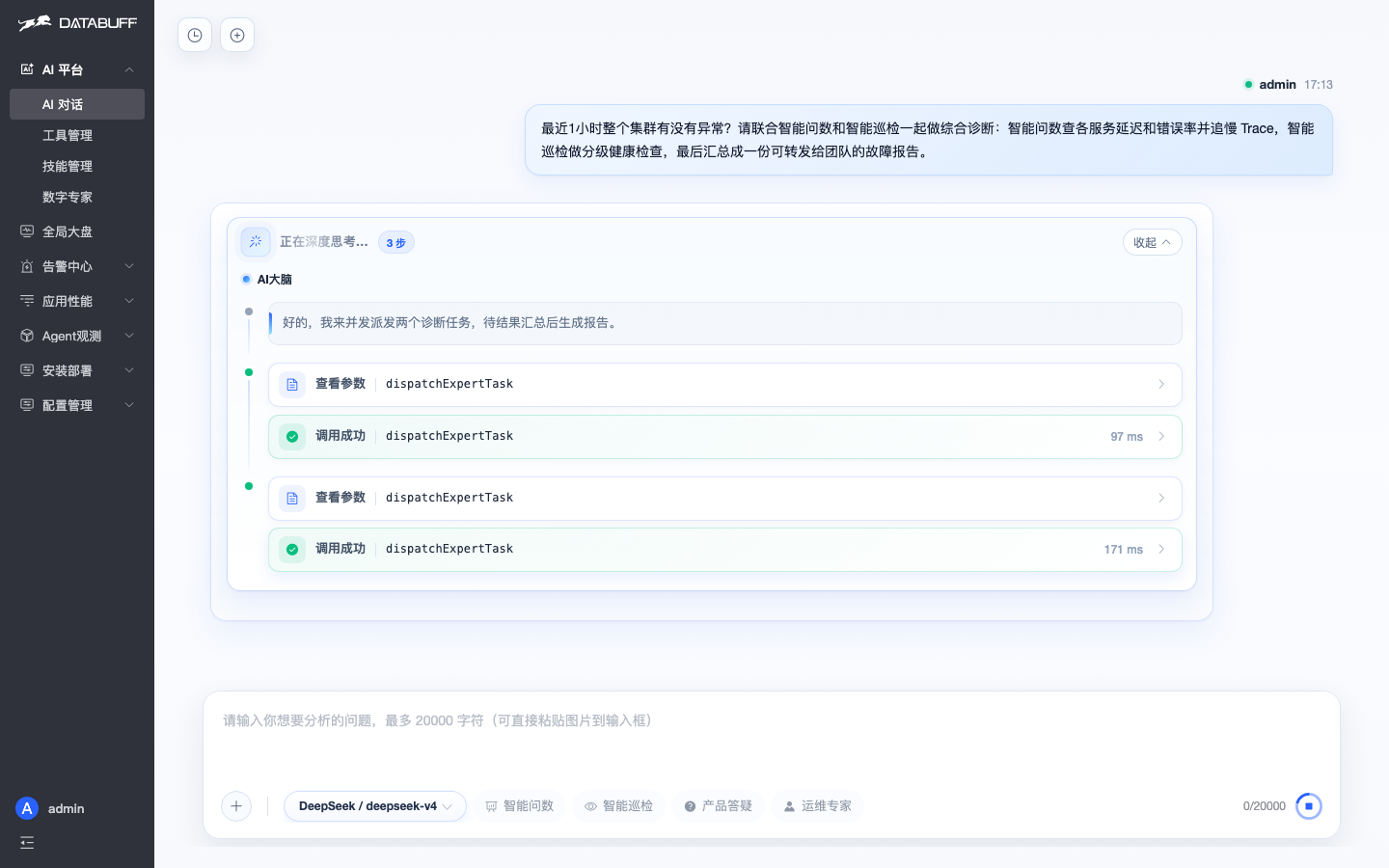
  • Multi-agent collaboration out of the box, where an AI Brain orchestrates query, inspection, ops and Q&A experts, dispatching complex tasks in parallel and synthesising an incident report.
  • Bring-your-own-model support for Kimi, DeepSeek, GLM, Ollama and other OpenAI-compatible APIs, configured by adding an API key after installation.
  • MCP in both directions: DataBuff exposes its capabilities to Cursor and Claude, and can ingest external MCPs such as Prometheus.
  • eBPF APM collection at kernel level, producing call chains and performance data without code changes.
  • Alerting loop with threshold detection, scheduled evaluation and alert event history.
  • Skill extensibility for custom digital experts without modifying core code.

Who uses it and how

  • Platform and SRE teams running microservices that already emit OTLP and want a self-hosted APM backend rather than a hosted vendor.
  • Teams migrating from SkyWalking, which can switch export to DataBuff's gRPC endpoint on 11800 without reinstrumenting services.
  • Incident responders who need a forwardable report: topology pulled, metrics ranked, bottlenecks attributed by share for the post-mortem.
  • Engineering organisations that want AI troubleshooting but cannot send telemetry to a separate AI platform, since the model is configured in-place with an API key.
  • Teams tracking AI application observability, for whom LLM call chains, token analytics, agent topology and skill/tool/model tracing are documented as a roadmap direction rather than a shipped feature.

Getting started

The stack is three components — Ingest, Doris and Web — with no middleware sprawl, and the README states that one Docker command runs it. A live demo is available at demo.databuff.ai, and setup is documented in docs/README_en.md.

How it compares

Among the tools named in the facts, the closest comparison is Apache SkyWalking, which DataBuff supports as a native gRPC ingestion protocol on 11800, positioning itself as a compatible destination for a SkyWalking migration rather than a replacement that requires new instrumentation. Beyond that, DataBuff distinguishes itself from a plain OpenTelemetry backend by treating natural-language querying and multi-agent inspection as part of the product instead of an external AI platform.

When to use it — and when not to

A self-hoster operates three components — Ingest, Doris and Web — and supplies an API key and budget for an OpenAI-compatible model provider, so the operational surface includes a database (Doris) alongside the application. Teams that cannot run a stateful analytical database, or that require a fully hosted, managed service, should look elsewhere, and organisations that would embed the code in a closed-source product need to weigh the AGPL-3.0 licence. The honest constraints in the current facts are the roadmap status of AI application observability and the small contributor base implied by 683 stars, 136 forks and 11 open issues.

project readme (upstream, from github) — read inline
  

DataBuff — AI-Native APM Built On Opentelemetry

Mission: build the strongest OpenTelemetry APM backend

AI-native · OTLP-native · multi-agent out of the box · self-hosted traces, metrics, topology

Live Demo  ·  Documentation  ·  Open Source APM  ·  简体中文  ·  Community

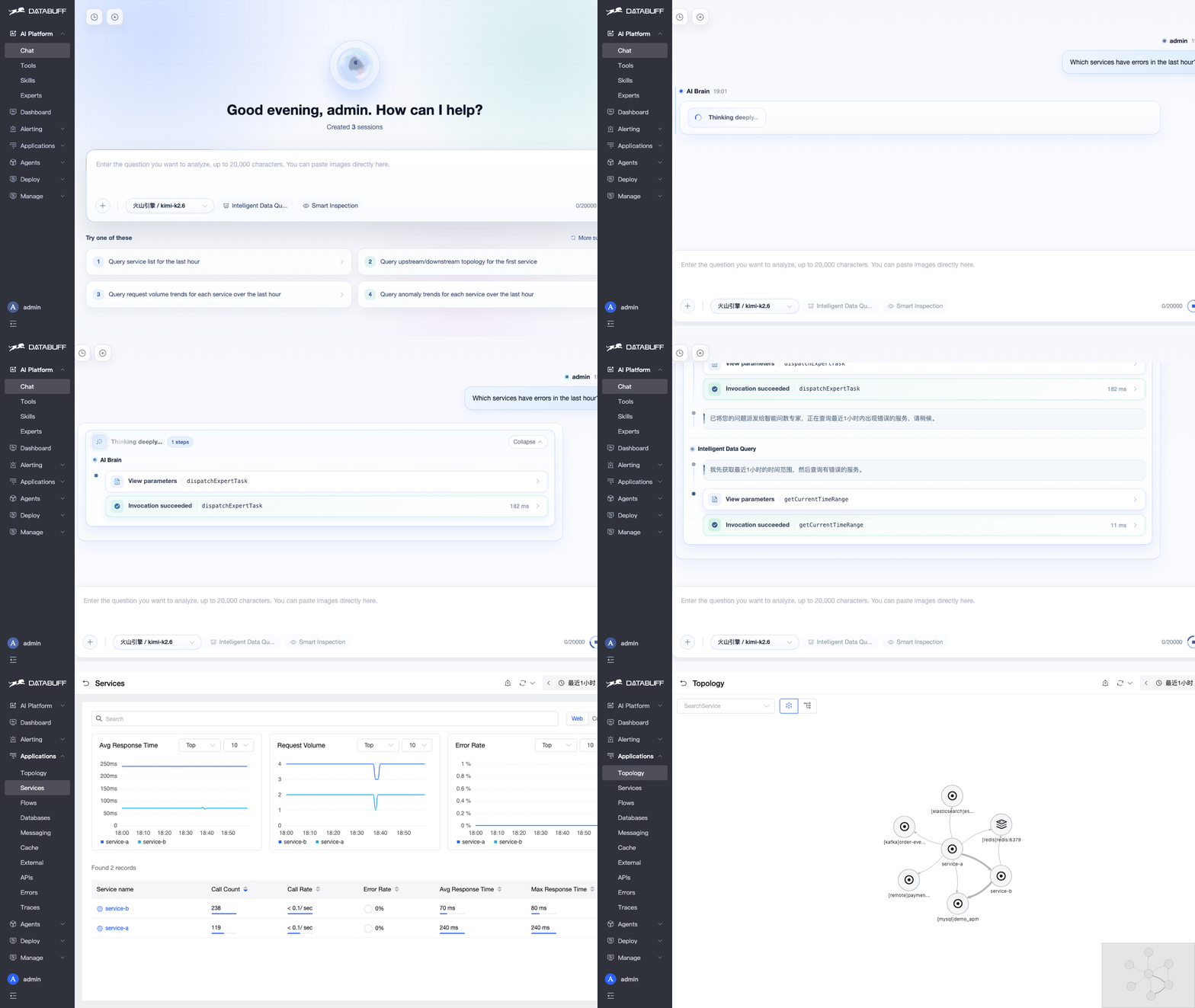
AI multi-agent troubleshooting · Service health · Call graph topology

Keywords: AI-Native APM · OpenTelemetry APM · OTLP Backend · Multi-Agent · Distributed Tracing · AIOps · Open Source APM · MCP · Self-Hosted Observability


What is DataBuff

DataBuff is an AI-native APM backend built on Opentelemetry — ingest traces, metrics, and logs via OTLP, with full-stack monitoring, service topology, RED metrics, and out-of-the-box multi-agent AI troubleshooting.

The goal is not "yet another observability UI," but to build the strongest OpenTelemetry APM backend — letting LLMs query live telemetry directly, from natural-language query → multi-agent inspection → root-cause analysis → ops remediation.

Listed on OpenTelemetry official Vendors (Native OTLP) and CNCF Landscape.

⭐ Star the project · Live Demo · Documentation


Why DataBuff

If you are evaluating an OpenTelemetry APM backend, or want AI that actually closes the troubleshooting loop, DataBuff is built for you:

  • AI-native, not bolted on — LLMs query traces, metrics, topology, and alerts directly; add an API key after install, no separate AI platform needed
  • Multi-agent out of the box — AI Brain orchestrates query, inspection, ops, and Q&A experts in parallel
  • Fully embrace OpenTelemetry — OTLP-native ingestion with existing instrumentation as-is; SkyWalking compatible for smooth migration
  • Clear mission — build the strongest OpenTelemetry APM backend: self-hosted, production-grade, extensible
  • Minimal deployment — Ingest + Doris + Web, one Docker command to run

Key Features

🤖 AI-Native

  • Not a bolt-on chat box — LLM answers from real telemetry, not hallucination
  • Multi-agent collaboration out of the box — AI Brain orchestrates query, inspection, ops, and Q&A experts
  • AI application observability (Roadmap) — LLM call chains · token analytics · agent topology · skill/tool/model tracing
  • MCP both ways — expose capabilities to Cursor / Claude; ingest external MCPs like Prometheus
  • Bring your own model — Kimi, DeepSeek, GLM, Ollama, and other OpenAI-compatible APIs

📊 OpenTelemetry-Native

  • OTLP-native ingestion — gRPC 4317 / HTTP 4318 for Traces + Metrics + Logs
  • eBPF APM — kernel-level, non-intrusive collection; call chains and performance data without code changes
  • Dual-protocol support — OTLP native + SkyWalking native gRPC (11800); switch by changing exporter address
  • Alerting loop — threshold detection, scheduled evaluation, alert event history

🐳 Engineering Foundation

  • 3-component stack — Ingest + Doris + Web, no middleware sprawl
  • Skill extensibility — custom digital experts without touching core code

Feature Gallery

Out-of-the-box multi-agent AI on top of a full OpenTelemetry APM.
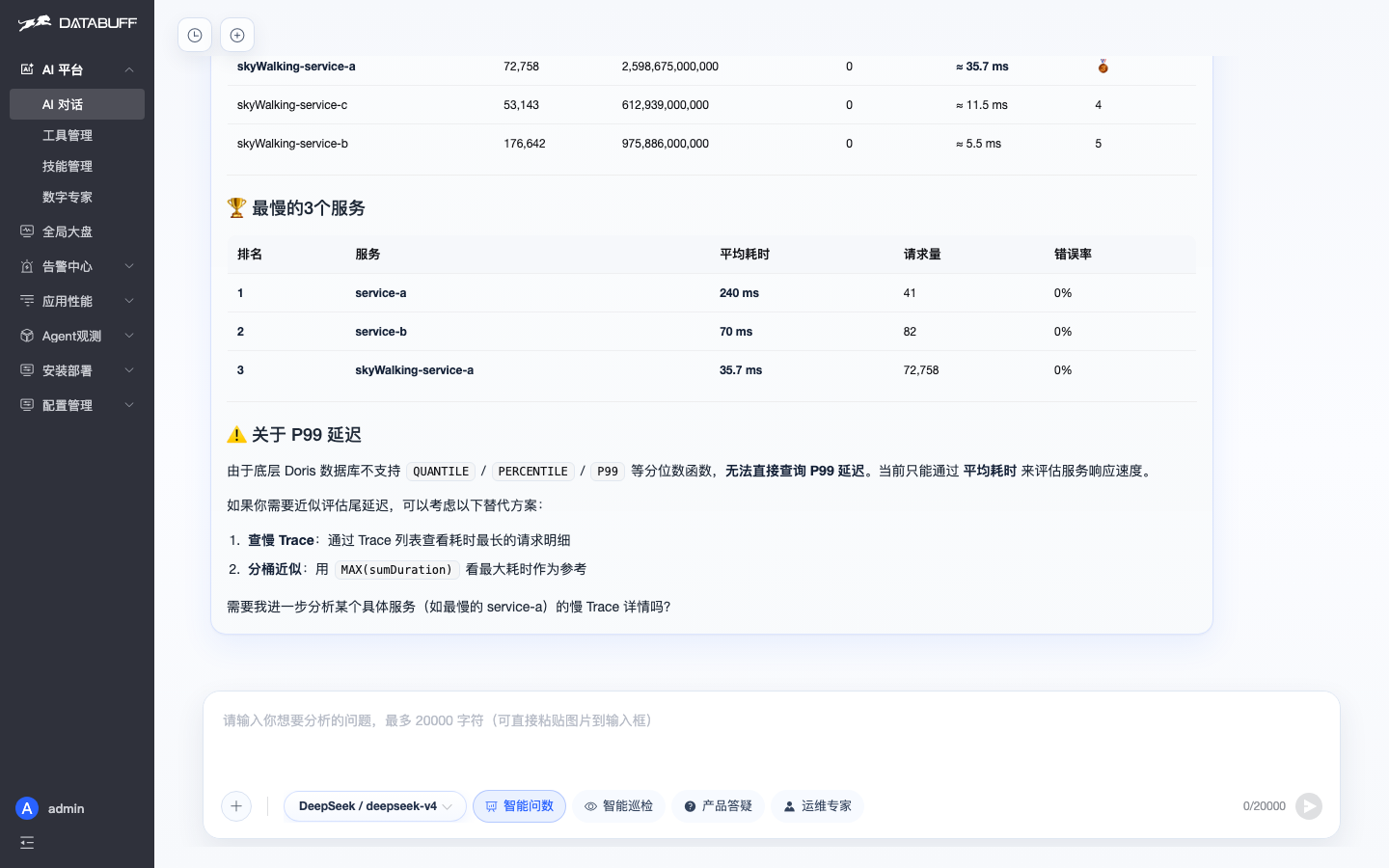
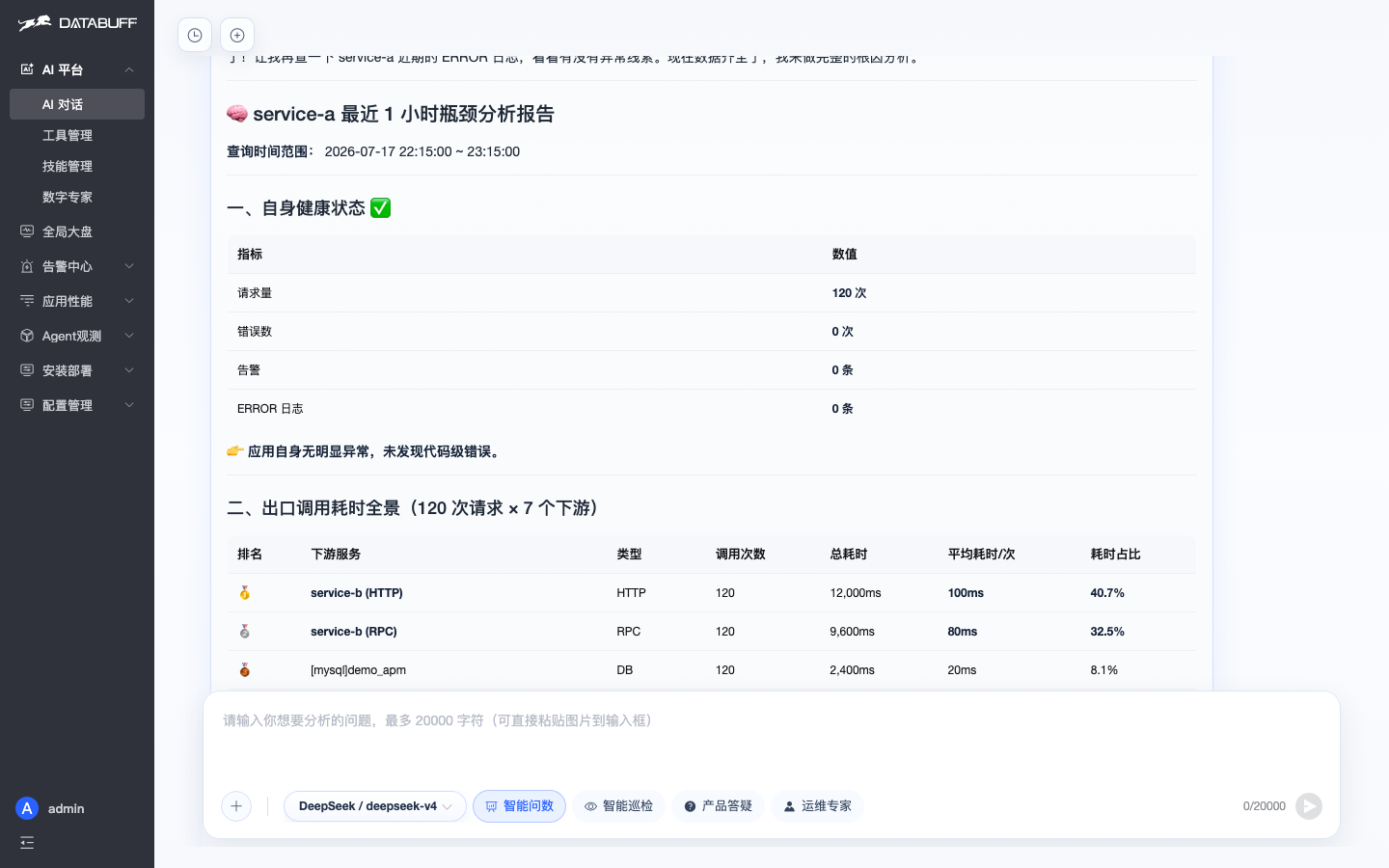
Natural Language Query

Ask "which service was slowest" in plain language — AI ranks results, no query language required.
Multi-Agent Collaboration

Complex tasks dispatched to multiple experts in parallel, synthesized into a forwardable incident report.
Root Cause Analysis

Pull topology, rank metrics, attribute bottlenecks by share — conclusions ready for your incident report.
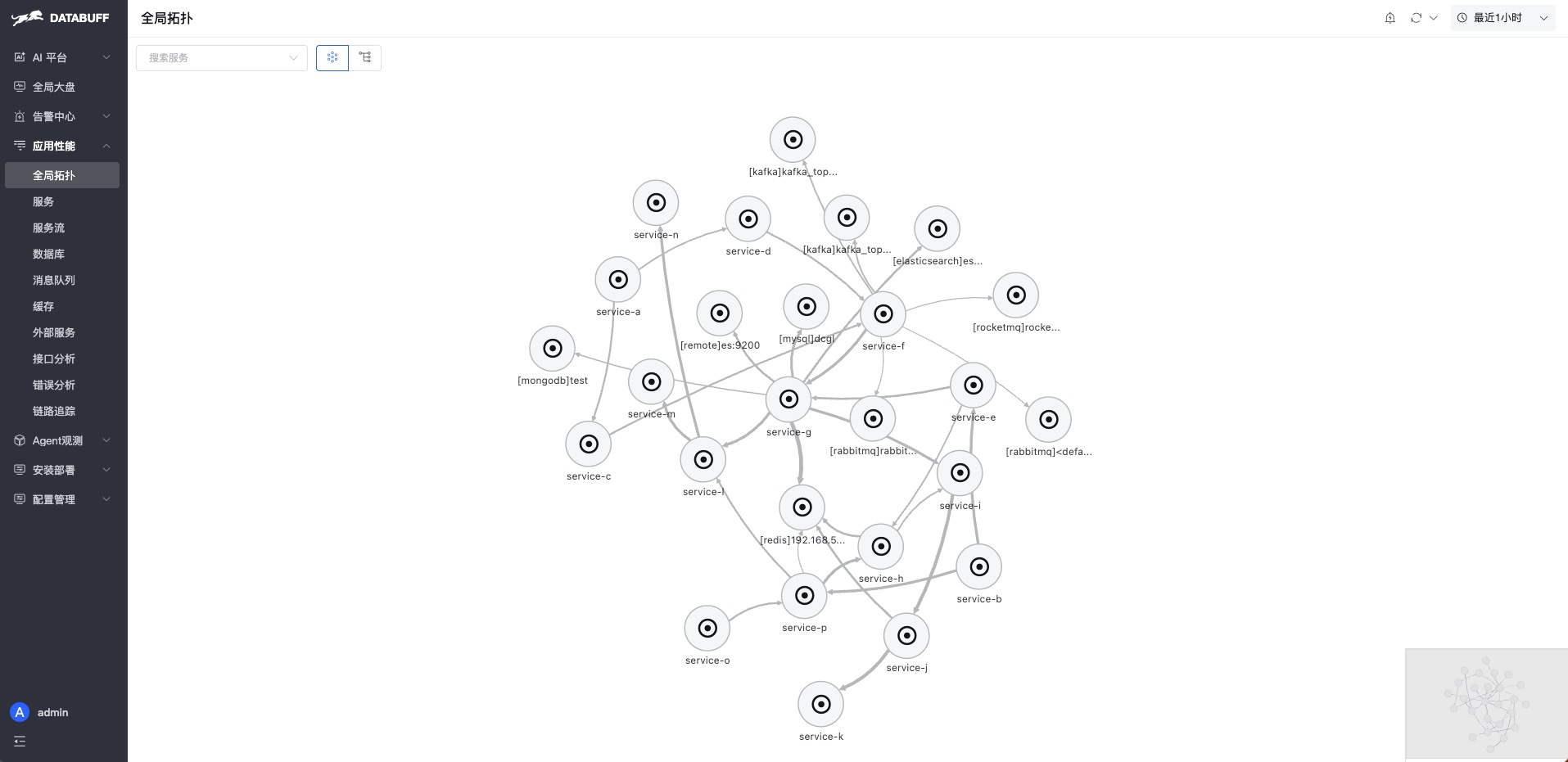
APM UI

Global topology, service list, and trace drill-down — AI reads the data, the UI confirms it.
More capabilities in Documentation


Architecture & Ingestion
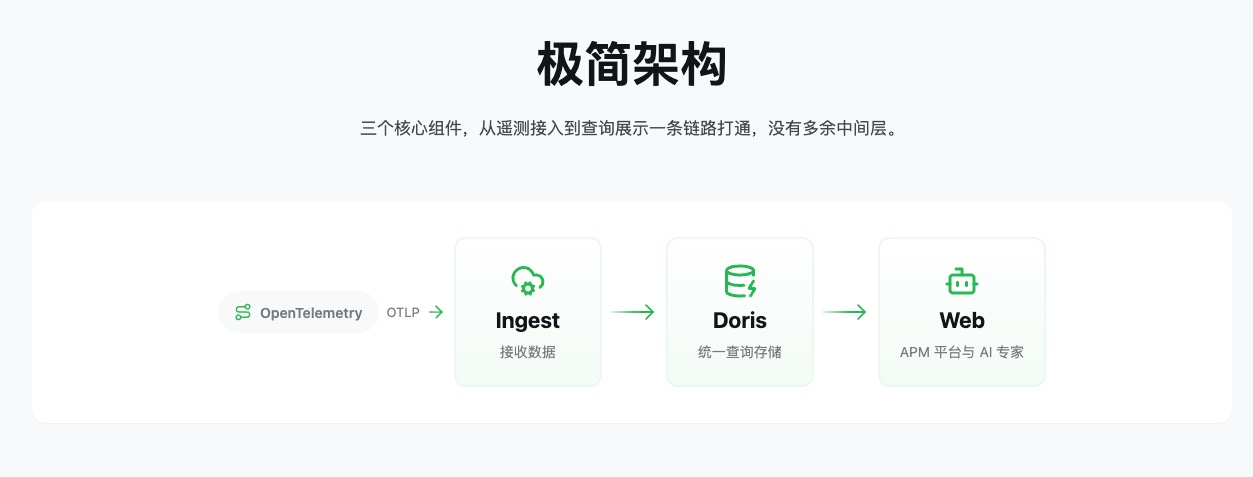
Protocol Port / Endpoint Signals
OTLP (OpenTelemetry native) gRPC 4317 · HTTP 4318 Traces + Metrics + Logs
SkyWalking native gRPC gRPC 11800 Trace + JVM metrics + Logs

Quick Start in 5 Minutes

  1. Install platform — one command to launch Ingest + Doris + Web
curl -fsSL https://databuff.ai/databuff/ai-apm-install.sh | bash
  1. Install demo (optional) — auto-report traces and see topology quickly
curl -fsSL https://databuff.ai/databuff/ai-apm-demo-install.sh | bash
  1. Connect a model → start troubleshooting — open http://YOUR_HOST:27403, login admin / Databuff@123, add API key to enable AI
Offline install / Kubernetes install

Offline install — download the bundle from the install page:

tar -zxvf databuff-ai-apm-offline-<version>-<arch>.tar.gz
cd databuff-ai-apm-offline-<version>-<arch> && sudo ./install.sh

Kubernetes install

curl -fsSL https://databuff.ai/databuff/ai-apm-k8s-install.sh | bash
curl -fsSL https://databuff.ai/databuff/ai-apm-demo-k8s-install.sh | bash  # demo optional

Documentation

Doc Description
Documentation Product overview, user guides, ops reference
OTLP ingestion guide OpenTelemetry SDK / Collector setup
eBPF ingestion OBI DaemonSet, zero-instrumentation HTTP / gRPC
Nginx ingestion ngx_otel_module entry traces
Competitive comparison vs Jaeger, SigNoz, SkyWalking, and more
Migration guide Migrate from other APM tools

Contributing

If you are building AI-native APM / OpenTelemetry observability, help make the strongest OpenTelemetry APM backend a real, usable open-source foundation:


Scan to join the DataBuff community


License

This repository is licensed under AGPL-3.0.

Frequently asked questions

Is databuff free to use?

databuff is open source under the AGPL-3.0 licence. There is no licence fee and no seat count — you can self-host it or, where the project offers one, pay a vendor for a managed version instead.

What does databuff do?

DataBuff is an AI-native APM built on Opentelemetry,with multi-agent troubleshooting out of the box.

What is databuff written in?

databuff is primarily written in Java. Its source is publicly available at https://github.com/databufflabs/databuff, and it has 720 GitHub stars.