CCS - Claude Codex Switch

The multi-provider profile and runtime manager for Claude Code and compatible CLIs
Run Claude, Codex, Droid-routed profiles, GLM, local models, and Anthropic-compatible APIs without config thrash.



Website | Documentation | Product Tour | CLI Reference
[Docker]
ghcr.io/kaitranntt/ccs-dashboard:latestis deprecated. Useghcr.io/kaitranntt/ccs:latestinstead. See #1251 and docker/README.md for migration details. To wire a sibling container to CLIProxy, see Connect your app to CLIProxy.
Quick Start (Docker)
With Docker installed:
curl -fsSL https://ccs.kaitran.ca/docker-compose.yaml -o docker-compose.yaml
docker compose up -d
Dashboard at http://localhost:3000 · CLIProxy at http://localhost:8317.
Need a corporate-proxy alternative? Download directly:
https://raw.githubusercontent.com/kaitranntt/ccs/main/docker/compose.yaml
Install on Host (npm)
npm install -g @kaitranntt/ccs
ccs config
Then launch whatever runtime fits the task:
ccs
ccs codex
ccs xai              # Alias: ccs grok
ccs --target droid glm
ccs glm
ccs ollama
Why CCS
CCS gives you one stable command surface while letting you switch between:
- multiple runtimes such as Claude Code, Factory Droid, and Codex CLI
- multiple Claude subscriptions and isolated account contexts
- OAuth providers like Codex, xAI/Grok, Kiro, Claude, Kimi, and more, with legacy Copilot compatibility for existing setups
- API and local-model profiles like GLM, Kimi, OpenRouter, OrcaRouter, Ollama, llama.cpp, Novita, Fireworks AI, and Alibaba Coding Plan
Qwen Code account linking is not available in the bundled CLIProxy runtime yet; use an API-key Qwen profile such as Alibaba Coding Plan for Qwen models.
The goal is simple: stop rewriting config files, stop breaking active sessions, and move between providers in seconds.
OpenAI-Compatible Routing
CCS can now bridge Claude Code into OpenAI-compatible providers through a local Anthropic-compatible proxy instead of requiring a native Anthropic upstream.
ccs api create --preset hf
ccs hf
Need to manage the proxy manually?
ccs proxy start hf
eval "$(ccs proxy activate)"
The proxy also supports request-time profile:model selectors, scenario-based
model routing through proxy.routing, and explicit activation helpers such as
ccs proxy activate --fish.
Guide: OpenAI-Compatible Provider Routing.
Related Project: claude-code-router
claude-code-router is an excellent standalone tool for routing Claude Code requests to OpenAI-compatible providers. CCS's local proxy and SSE transformation work was directly informed by CCR's transformer architecture.
Use CCR when you want a standalone router without CCS profile management.
Use CCS when you want the routing flow integrated with CCS profiles, runtime
bridges, and the existing ccs command surface.
Need the full setup path instead of the short version?
| Need | Start here |
|---|---|
| Install and verify CCS | /getting-started/installation |
| First successful session | /getting-started/first-session |
| Visual walkthrough | /getting-started/product-tour |
| Provider selection | /providers/concepts/overview |
| Full command reference | /reference/cli-commands |
| Troubleshooting | /reference/troubleshooting |
See CCS In Action
CCS Bar For macOS
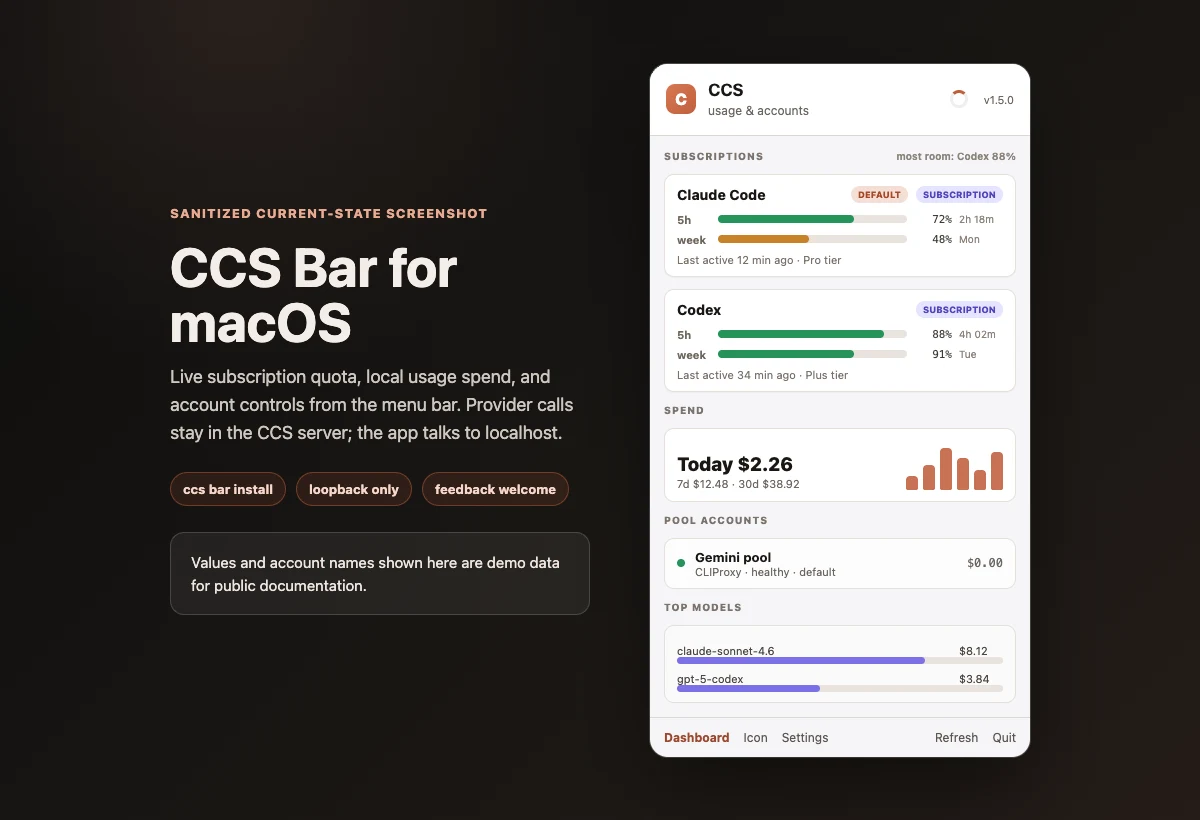
CCS Bar puts live subscription quota, daily spend, and account controls in the
macOS menu bar. Install it with ccs bar install, launch it with ccs bar, and
tell us what would make it more useful: issues and ideas are welcome in
GitHub Issues.
Deep dive: CCS Bar.
Usage Analytics
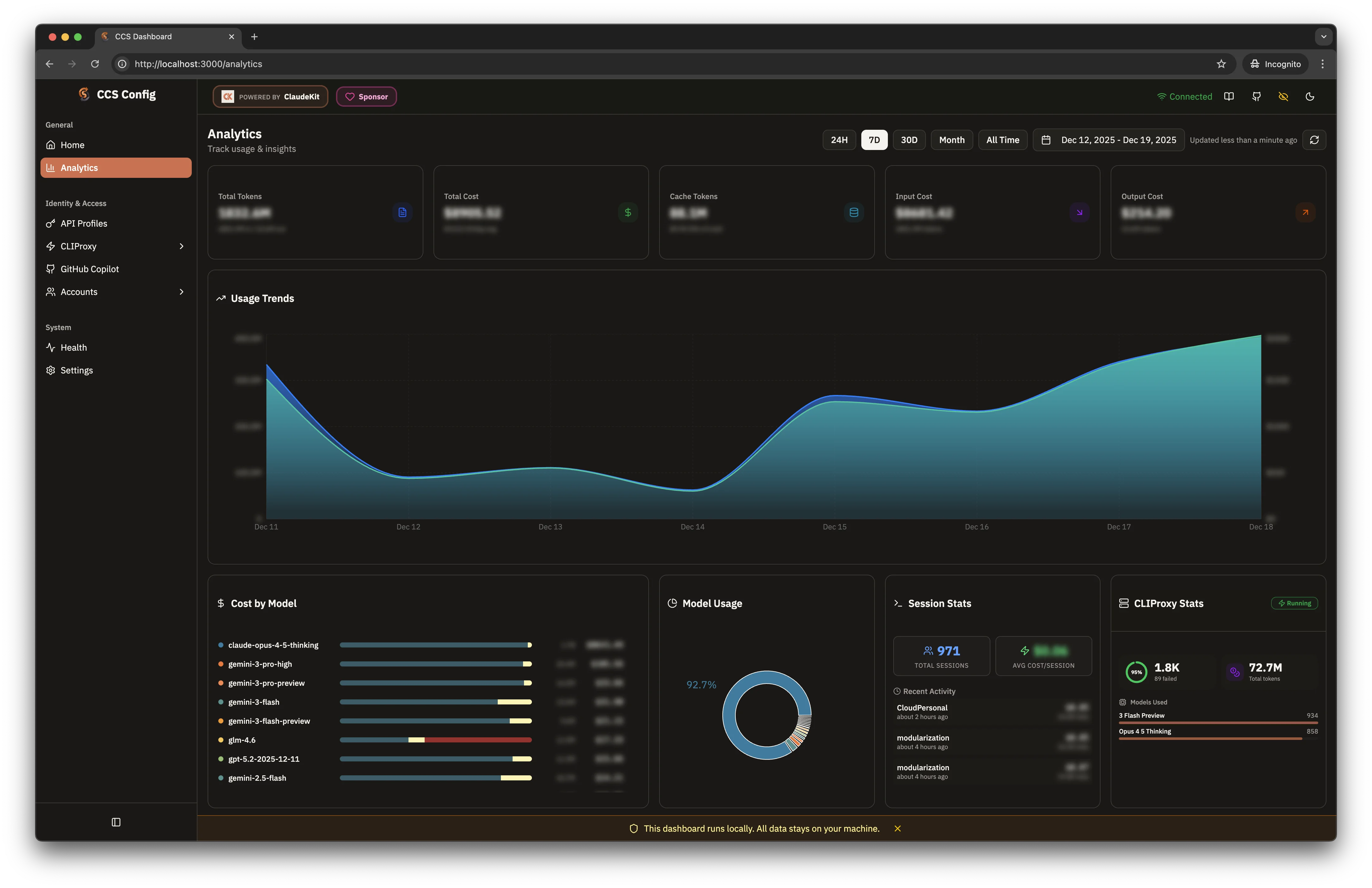
Track usage, costs, and session patterns across profiles. Deep dive: Dashboard Analytics.
Live Auth And Health Monitoring
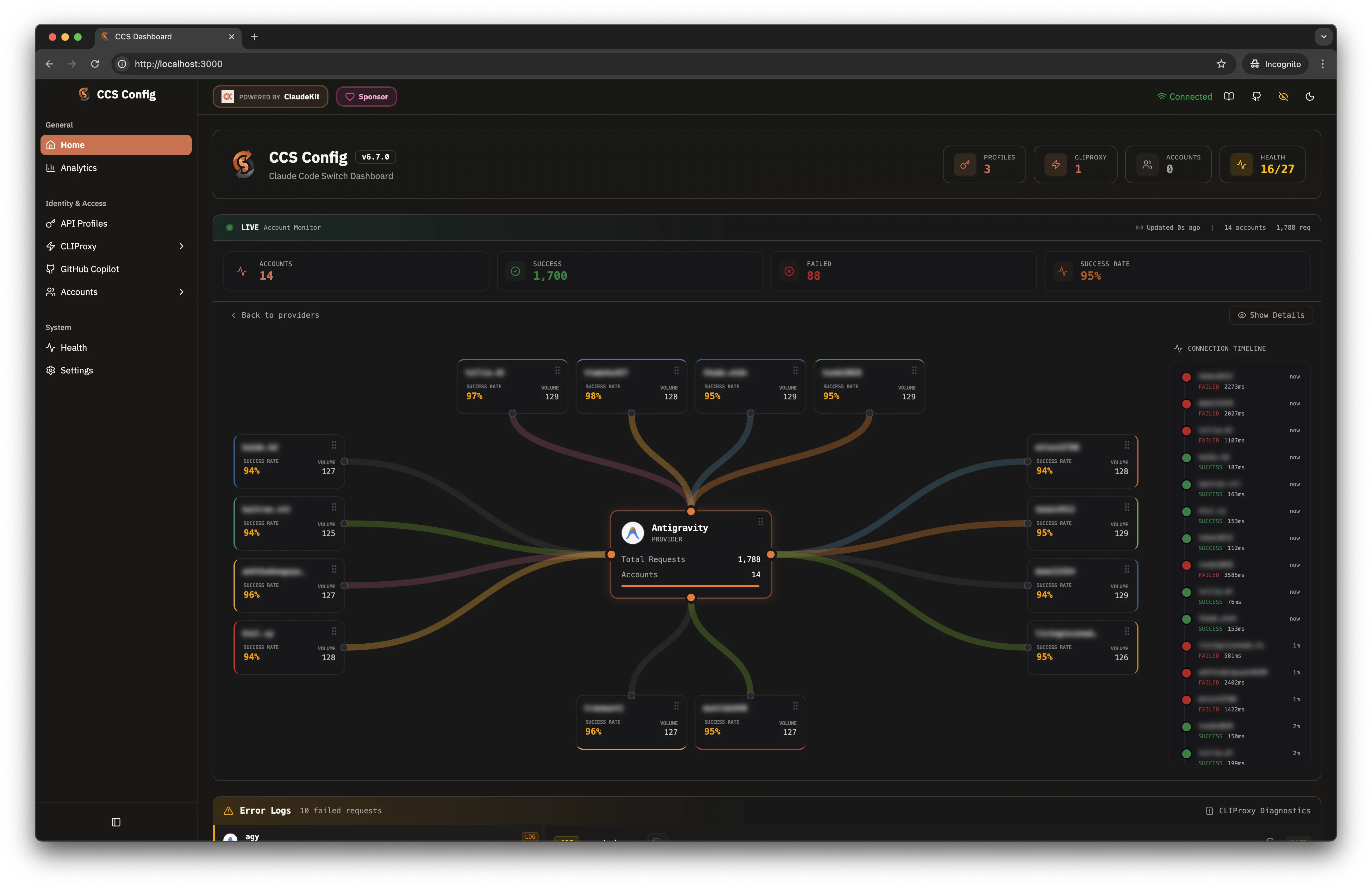
See auth state, account health, and provider readiness without dropping into raw config. Deep dive: Live Auth Monitor.
OAuth Provider Control Center
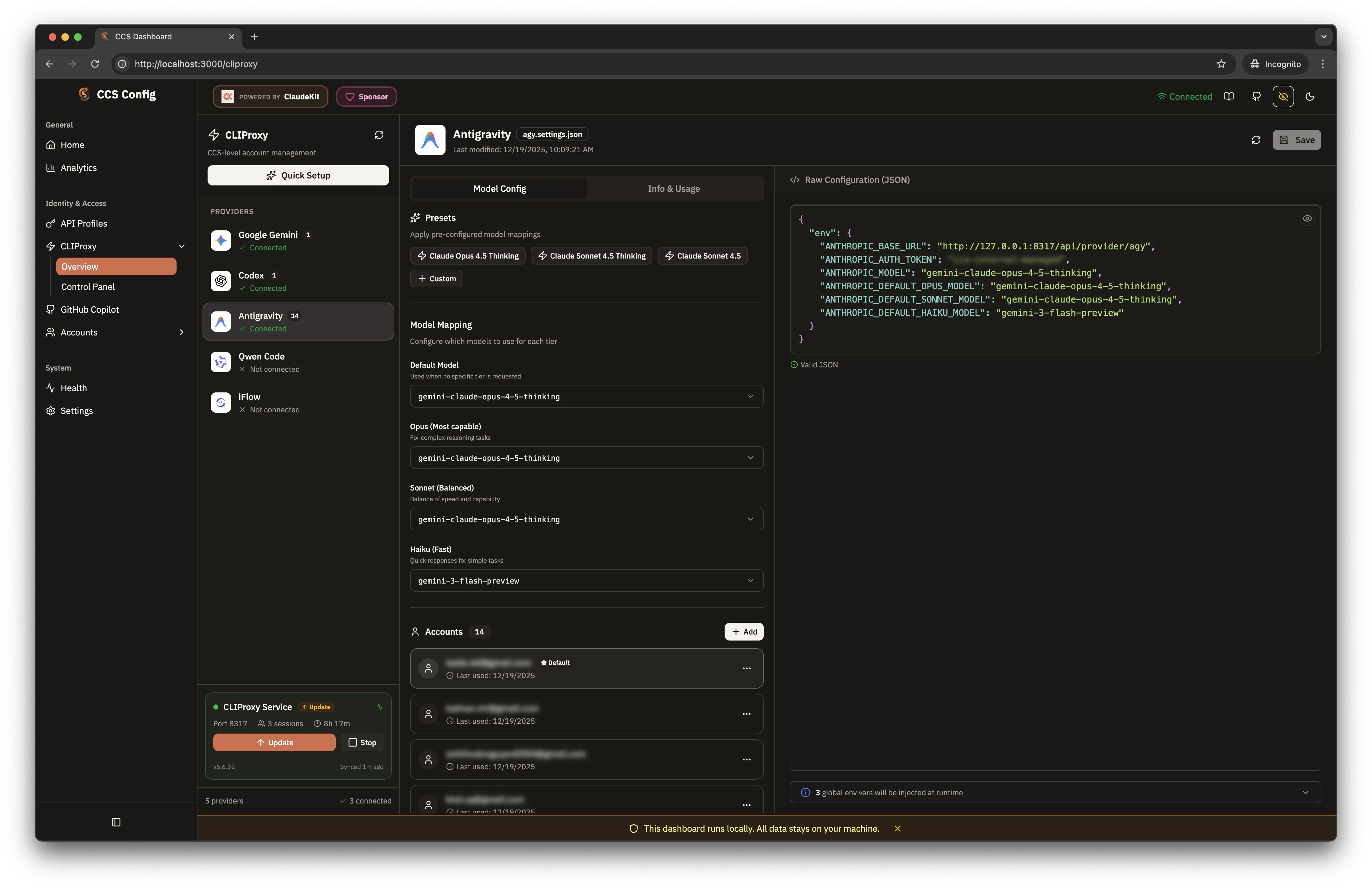
Manage OAuth-backed providers, quota visibility, and proxy-wide routing from one place. CCS now surfaces round-robin vs fill-first natively in both CLI and dashboard flows instead of hiding that choice inside raw upstream controls. The original CLIProxyAPI backend remains the default; the community-maintained CLIProxyAPIPlus fork is opt-in for plus-only providers. When Plus is selected, CCS points the embedded management panel at the maintained CPAMC dashboard fork by default. Deep dive: CLIProxy API.
Managed Tooling And Fallbacks
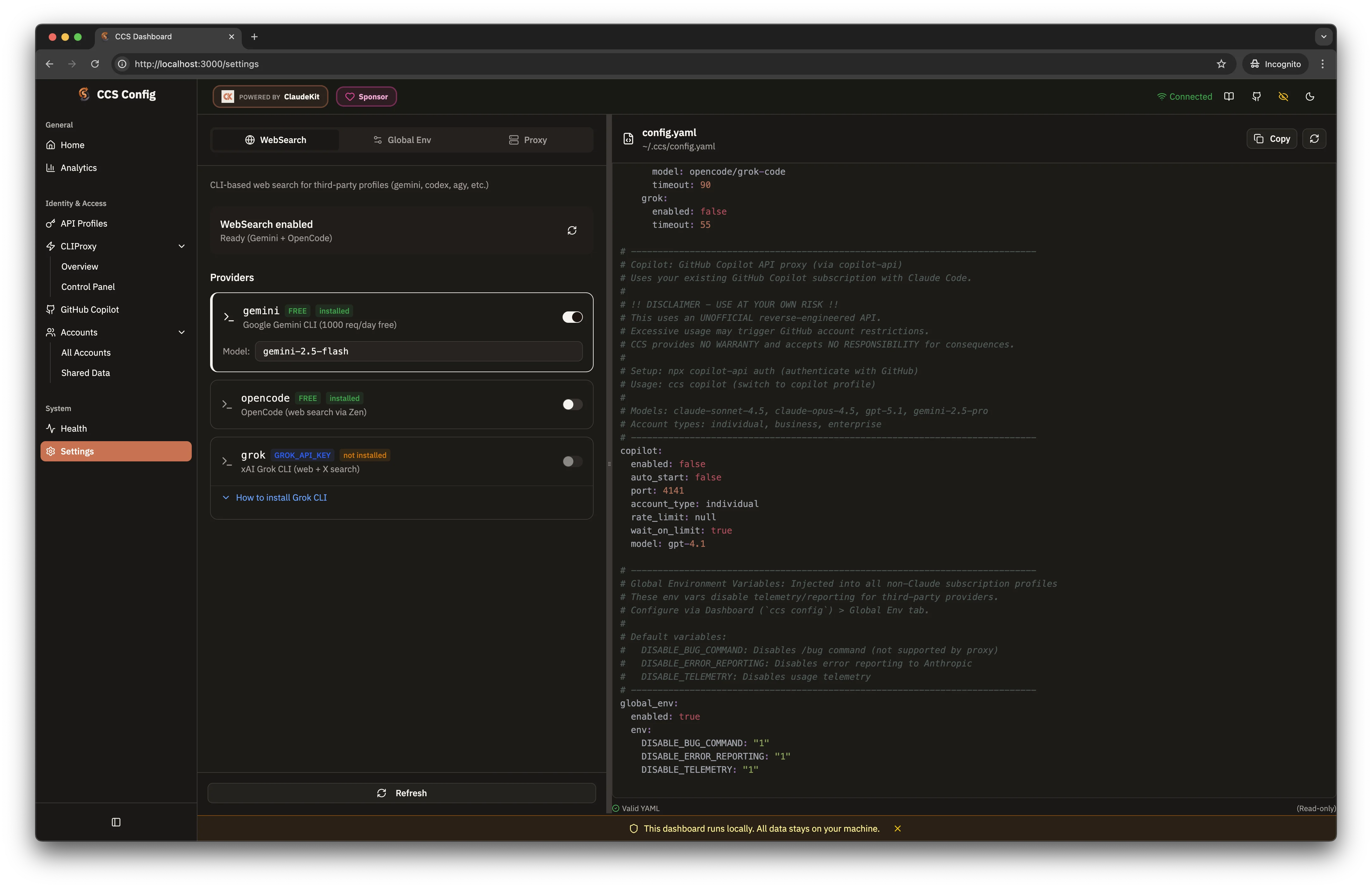
CCS can provision first-class local tools like WebSearch and image analysis for third-party launches instead of leaving you to wire them by hand. Browser automation now has a first-class setup path as well. Deep dive: WebSearch | Browser Automation.
Docs Matrix
The README stays short on purpose. The docs site owns the detailed guides and reference material.
| If you want to... | Read this |
|---|---|
| Understand what CCS is and how the pieces fit together | Introduction |
| Install CCS cleanly on a new machine | Installation |
| Go from install to a successful first run | Your First CCS Session |
| See the dashboard and workflow surfaces before setup | Product Tour |
| Install the native macOS menu-bar companion | CCS Bar |
| Compare OAuth providers, Claude accounts, and API profiles | Provider Overview |
| Learn the dashboard structure and feature pages | Dashboard Overview |
| Configure profiles, paths, and environment variables | Configuration |
| Understand browser attach vs Codex browser tooling | Browser Automation |
| Keep OpenCode aligned with your live CCS setup | OpenCode Sync Plugin |
| Browse every command and flag | CLI Commands |
| Recover from install, auth, or provider failures | Troubleshooting |
| Understand storage, config, and architecture details | Reference |
Example Workflow
# Design with default Claude
ccs "design the auth flow"

# Implement with a different provider
ccs codex "implement the user service"

# Use a cheaper API profile for routine work
ccs glm "clean up tests and docs"

# Run a local model when you need privacy or offline access
ccs ollama "summarize these logs"
Community Projects
| Project | Author | Description |
|---|---|---|
| [ope |