Calibre-Web Automated (formerly Calibre-Web Automator)
Making Calibre-Web your dream, all-in-one self-hosted digital library solution.




Supporting the Project ❤️
CWA is and always will be free and open source. If it makes your library life easier and you're able to support development, contributions go directly to:
- Testing hardware (ereader devices & tablets ect.)
- Development tools and infrastructure
- Coffee ☕ (lots of coffee)

Quick Access
- Features 🪄
- Releases 🆕
- Roadmap 🛣️
- How to Install: 📖
- Usage 🔧
- For Developers 🚀
- Further Development 🏗️
Why does it exist? 🔓
Calibre, while a fantastic tool for its age, has several problems when containerised, including its reliance on a KasmVNC server instance for the UI, which is near impossible to use on mobile and is relatively resource-heavy if you're running a small, lower power server like I am.
For many, Calibre-Web has really swooped in to save the day, offering an alternative to a containerised Calibre instance that's resource-light and with a much more modern UI to boot.
However, when compared to full-fat Calibre, it unfortunately lacks a few core features leading many to run both services in parallel, each serving to fill in where the other lacks, resulting in an often clunky, imperfect solution.
Goal of the Project 🎯
Calibre-Web Automated aims to be an all-in-one solution, combining the modern lightweight web UI from Calibre-Web with the robust, versatile feature set of Calibre, with a slew of extra features and automations thrown in on top.


CWA allows you to keep your ebook library accessible & organised and looks good while doing it 😎🦚
Affiliated Projects 👬
Shelfmark: Book Downloader
- An intuitive web interface for searching and requesting book downloads, designed to work seamlessly with Calibre-Web-Automated. This project streamlines the process of downloading books and preparing them for integration into your Calibre library
[!IMPORTANT]
CWA does not approve of or support piracy of copyrighted materials and is not responsible for user behaviour
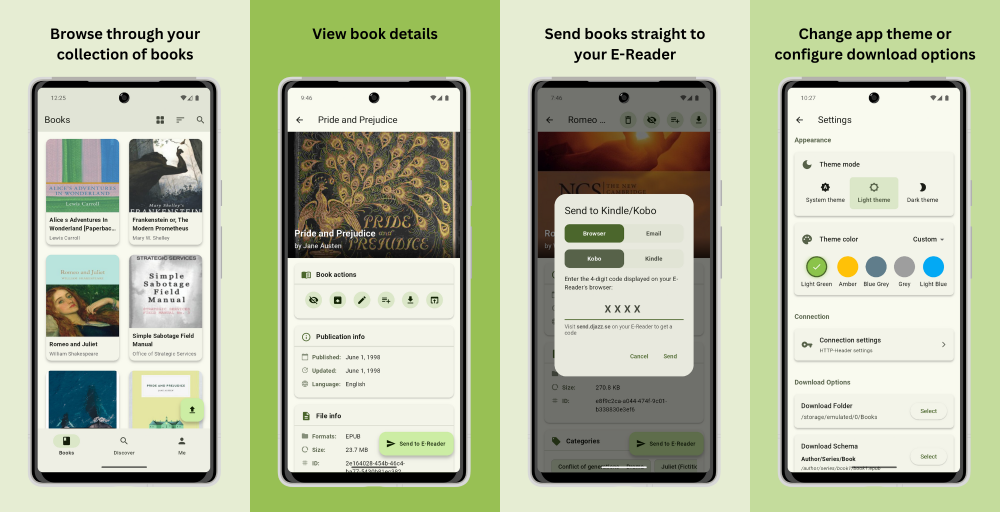
Calibre-Web Companion
- Built with Flutter and using Material You, Calibre Web Companion is an unofficial companion application for Calibre Web & Calibre Web Automated that allows you to browse your book collection and download books directly on your device, providing a much more modern, mobile-friendly UX than either service can currently provide on its own

Join our Community! ❤️
I want to say a big thanks 🙏 to all the members of this community that have taken the time to participate in the testing and development of this project and we encourage anyone who would like to to contribute in some way. Anyone of any level is welcome and every little helps!
For anyone that wish to contribute to this project in some way, please reach out on our Discord Server and see how you can best get involved:
Or alternatively make your own companion project, come hang out and or come get help if you're facing issues :)
🚨 Deploying on Network Shares (NFS/SMB) 🚨
- CWA now supports network-share deployments via
NETWORK_SHARE_MODE=true- This disables SQLite WAL on
metadata.dbandapp.dbto prevent locking issues - Skips recursive ownership changes that often fail on NFS/SMB
- Switches ingest/metadata watchers to a polling-based watcher for reliability
- This disables SQLite WAL on
- Network shares are still slower than local disks, but are now fully supported with this mode enabled
Network shares and SQLite WAL mode
CWA optimizes SQLite concurrency by enabling Write-Ahead Logging (WAL) on local disks.
Some network filesystems (NFS/SMB) do not fully support WAL or reliable file locking, which can cause intermittent "database is locked" errors or corruption risks.
If you are deploying on a network share, set the following environment variable to disable WAL:
NETWORK_SHARE_MODE=true
This tells CWA to avoid enabling WAL on the Calibre metadata.db and the app.db settings database. It also disables recursive ownership changes (chown) performed by init/maintenance scripts to avoid permission issues on network filesystems. Default is false (WAL enabled) for better performance on local disks.
File watching on network shares
- By default, CWA uses Linux
inotify(viainotifywait) to detect new files in the ingest folder with minimal latency and overhead. - On network shares (NFS/SMB), filesystem events can be unreliable or unavailable. When
NETWORK_SHARE_MODE=trueis set, CWA switches the ingest and metadata watcher services to a polling-based watcher that periodically scans for changes. This improves reliability on NAS/network mounts at the cost of slightly higher I/O and up to a few seconds of latency. - On Docker Desktop (Windows/macOS), the container runs on a LinuxKit/WSL2 VM and host-mounted paths may not propagate
inotifyevents reliably. CWA auto-detects Docker Desktop at startup and prefers the same polling watcher for reliability. - Advanced: You can also force polling regardless of share mode by setting
CWA_WATCH_MODE=poll.
Running behind multiple proxies (Cloudflare Tunnel, reverse proxy)
CWA uses Werkzeug's ProxyFix middleware to properly handle
X-Forwarded-For,X-Forwarded-Proto, and other proxy headers.By default, it trusts 1 proxy in the chain. If you have multiple proxies (e.g., Cloudflare Tunnel → nginx → CWA), set:
TRUSTED_PROXY_COUNT=2(or the total number of proxies in your chain)
Why this matters: Session protection validates requests based on the client's IP address. If ProxyFix doesn't trust enough proxies, it may see different IPs between requests, causing "Session protection triggered" warnings and forcing re-login.
Troubleshooting: If you see frequent session protection warnings in logs, check your proxy chain depth and adjust this variable accordingly.
Features:
CWA supports all Stock CW Features:
| Modern & responsive Bootstrap 3 HTML5 interface | Comprehensive user management with per-user permissions | OPDS feed for ereader apps |
| eBook metadata editing and deletion support | Metadata download from various sources (exten |