
Azimutt is a free, open source databases project written in Elm and released under MIT. It has 2,181 GitHub stars, 141 forks and 83 open issues, and was last pushed 23 days ago. On this registry it ranks #69 of 81 tracked projects in Databases, with 5 head-to-head comparisons available. It gained 4 stars over the last 6 tracked days.

What is Azimutt ?

What it is

Azimutt is a full-stack database exploration tool built in Elm and released under the MIT license. It presents itself as a next-generation entity-relationship diagram application for designing, exploring, documenting, and analyzing database schemas and data. The project lives in the database tooling ecosystem, positioned between ERD tools, data catalogs, and database clients.

The concrete problem it addresses is the lack of a single tool that helps people understand real-world databases. The README says ERDs provide a diagram interface but fall short when schemas grow, data catalogs focus on governance and lineage while missing relational database knowledge, and database clients emphasize querying and object lists without visual help. Azimutt targets databases with hundreds of tables and messy schemas, combining visual structure, search, navigation, documentation, and analysis.

Key capabilities

  • Design database schemas with AML, the tool's diagramming format, for fast visual creation and iteration.
  • Explore large schemas with search everywhere, selective table and column display, and relation following.
  • Query data while following foreign keys and displaying related entities inside the diagram.
  • Document tables and columns with notes, tags, layouts, and memos scoped to use cases, features, or teams.
  • Analyze whole databases to discover inconsistencies and suggest best practices.
  • Load public SQL files through URL parameters, enabling repository badges that let visitors browse a schema online.
  • Supports database technologies named in the topics and badges, including PostgreSQL, MySQL, MariaDB, Oracle, SQL Server, SQLite, MongoDB, and Couchbase.

Who uses it and how

  • Database developers and architects use it to understand large or messy schemas without relying only on table lists or static diagrams.
  • Teams use it to document schema decisions, feature scopes, and use cases through notes, tags, layouts, and memos.
  • Repository owners publish public SQL files and add an Azimutt badge so visitors can explore the schema through a hosted URL.

Getting started

Azimutt is available through its hosted site at azimutt.app, and the README shows loading a public SQL file by adding it as a URL parameter. A common starting workflow is to publish a schema file such as structure.sql and link it to Azimutt for online exploration.

When to use it — and when not to

Use Azimutt when the main need is understanding, documenting, and navigating a database schema, especially when standard ERD tools struggle with large or messy databases. The README does not describe a self-hosted installation, Docker image, package manager, SMTP requirement, or database storage setup, so teams that need a local-only or air-gapped deployment may need to look elsewhere. Its strengths are visual exploration and documentation, but the README does not confirm a full data governance, lineage, or production client feature set, so it should not be assumed to replace specialized catalogs or query tools without evaluation.

project readme (upstream, from github) — read inline

</a>

Next-Gen ERD: Design, Explore, Document and Analyze your database schema and data

azimutt.approadmap@azimuttapp

Explore database with Azimutt

Azimutt - Easily explore and analyze your database with your team | Product Hunt

Azimutt is a full-stack database exploration tool.
From modern ERD made for real world databases (big & messy), to fast data navigation, but also documentation everywhere and whole database analysis.
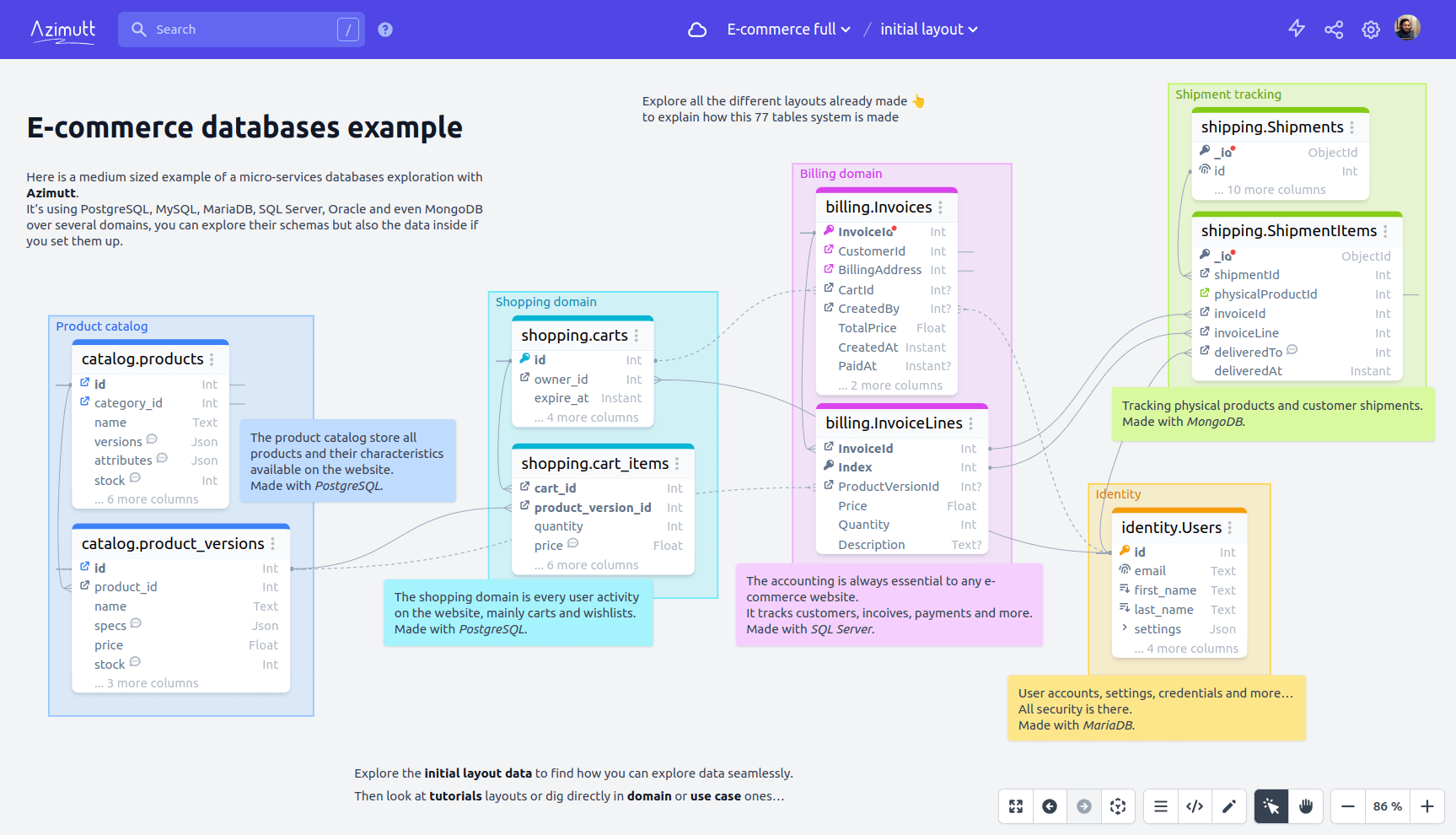
Azimutt screenshot

Why building Azimutt?

Databases existed for more than 40 years and despite a lot of tool around them, we couldn't find any providing a great exploration experience.

  • ERDs have a great diagram UI, but fall short when schema is growing (real-world use cases)
  • Data catalogs are focused on data governance and lineage, missing relational db knowledge
  • Database clients focus on querying with auto-completion and table/column lists, but no visual help

So we decided to build the missing tool 💪

We started with schema exploration for databases with hundreds of tables, but now, it has grown a lot:

  • Design your schema using AML for a fast diagramming
  • Explore your schema using search everywhere, display only useful tables/columns and follow relations
  • Query your data like never before, follow foreign keys and display entities in diagram
  • Document using table/column notes and tags, layouts and memos for use cases, features or team scopes
  • Analyze it to discover inconsistencies and best practices to apply

Azimutt goal is to be your ultimate tool to understand your database.

Azimutt badge

You can load any public SQL file in Azimutt with just an url parameter. So if you have a SQL file in your repo, like structure.sql, you can add a badge allowing your visitors to easily explore it:

[![Explore database with Azimutt](https://img.shields.io/badge/PostgreSQL-browse_online-gray?labelColor=4169E1&logo=postgresql&logoColor=fff&style=flat)](https://azimutt.app/create?sql=https://raw.githubusercontent.com/azimuttapp/azimutt/refs/heads/main/backend/priv/repo/structure.sql&name=Azimutt)

Here are some examples:

Explore database with Azimutt Explore database with Azimutt Explore database with Azimutt Explore database with Azimutt Explore database with Azimutt Explore database with Azimutt Explore database with Azimutt Explore database with Azimutt Explore database with Azimutt Explore database with Azimutt Explore database with Azimutt

Use Simple Icons to find other icon/color if needed or use our custom button image:

Explore database with Azimutt

More details on Azimutt documentation

Self-hosted

You can use our Docker image to easily deploy it. Here is the full guide.

Deploy on Heroku

You can use our Heroku template which includes Azimutt web app, a Postgres database, Stackhero S3 storage and Mailgun.

Deploy

After succeed deployment, you will need to configure config vars

# Replace with your app-name
HEROKU_APP=<app-name>

# Set PHX_HOST with the URL of the app
heroku config:set PHX_HOST=$(heroku info -s | grep "web_url" | sed 's|web_url=https://||; s|/$||')

# Copy Stackhero access key to S3_KEY_ID
heroku config:set S3_KEY_ID=$(heroku config:get S3_ROOT_ACCESS_KEY)

# Copy Stackhero secret key to S3_KEY_SECRET
heroku config:set S3_KEY_SECRET=$(heroku config:get S3_ROOT_SECRET_KEY)

Finally, you will need to create the azimutt bucket on Stackhero:

  • connect to Stackhero from your Heroku dashboard
  • use values of S3_ROOT_ACCESS_KEY and S3_ROOT_SECRET_KEY to log in
  • create a bucket named azimutt

Deploy on Kubernetes

Please read this guide

Local development

Azimutt is built with Elixir/[Phoe

readme truncated — read the full docs on github

Frequently asked questions

Is Azimutt free to use?

Azimutt is open source under the MIT licence. There is no licence fee and no seat count — you can self-host it or, where the project offers one, pay a vendor for a managed version instead.

What does Azimutt do?

Next-Gen ERD: Design, Explore, Document and Analyze your database.

What is Azimutt written in?

Azimutt is primarily written in Elm. Its source is publicly available at https://github.com/azimuttapp/azimutt, and it has 2,181 GitHub stars.