Timeline Studio — Browser AI Video Editor
English | 中文 | 日本語 | 한국어 | Español | Français | Deutsch | Português | ไทย | Tiếng Việt | Русский




Responsible use of deep synthesis
This tool uses deep-synthesis technology and is intended solely for technical research and learning.
Users must ensure that they:
- use only facial images or videos of themselves or people who have provided lawful authorization;
- do not create or distribute any illegal, infringing, false, or misleading content;
- do not present generated content as authentic footage or impersonate another person without their consent.
Users are solely responsible for any legal liability arising from violations of these requirements.
Project updates
- 2026-09-21 — Remove pauses: Smart now detects long speech pauses locally with Silero VAD, lets you review and select cuts, and trims the selected main-track video with its source audio. Adjustable pause thresholds, retained gaps, ripple editing, cancellation and undo are included, with direct UI copy in all 13 languages.
- 2026-09-20 — Playhead marker snapping: Dragging the white playhead previews the picture live and snaps to markers and range edges, with a shared alignment guide and time readout. Hold Alt to scrub freely. Marker details show Done until edited, then Apply changes.
- 2026-09-17 — WebMCP finishing and review: 21 browser tools now cover 26 reviewed edits, including timed-clip movement and source trimming, overlay transforms, caption style/position and project framing. Agents can request rendered frame/audio samples, run browser-local voiceover or transcription with progress and cancellation, and review results before timeline insertion. New controls and messages support all 13 interface languages.
- 2026-09-15 — Edited audio export: exporting an audio clip now renders its trimmed range with playback speed, volume, fades and space effects applied. Clips and the complete timeline mix can be exported as WAV or MP3; audio-only export is available alongside video export.
- 2026-09-14 — Export reliability: clips with solid-color backgrounds and opacity keyframes now export correctly without a person mask. Failed exports keep the error visible and can be retried with the same settings.
See the public Roadmap for planned work, Releases for shipped changes, and Issues for focused tasks and bugs.
What can it produce?
Explore reproducible before/after examples and editing recipes:
→ AI Video Editing Skills Handbook
Timeline Studio is a local-first AI video editor that runs in the browser. It combines a CapCut-style multi-track timeline with WebGPU AI music and repair, multilingual voiceovers, automatic captions, talking-avatar generation, and deterministic offline export.
Open the editor · Watch on YouTube · Hugging Face Space
Video demo
Auto Edit
Visual analysis, keyframes, captions, and export.
https://github.com/user-attachments/assets/e8327caa-429e-40ff-a7fe-a59e6cf7a464
AI Repair
Timed watermark removal with before/after review.
https://github.com/user-attachments/assets/aea9f5b4-c720-4b0c-9067-5ec124eef982
AI Voiceover
https://github.com/user-attachments/assets/304a744e-d620-4380-9c17-19af3726f5a4
AI capabilities
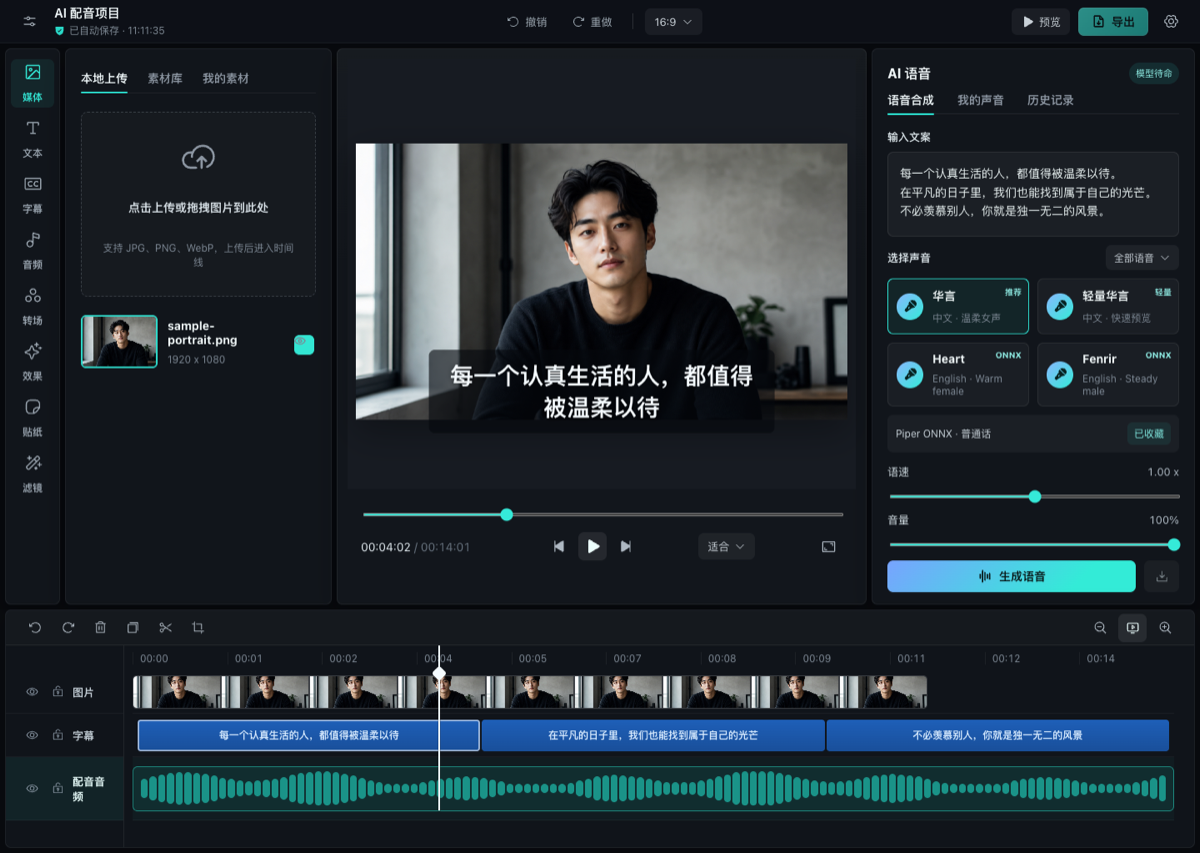
- Multilingual voiceover: Chinese and mixed Chinese/English Hojo TTS Light 80M FP16 reference voices (晴岚 and 若溪), with autoregressive generation on WebGPU and stable waveform decoding on WASM; English Kokoro 82M; and browser Piper voices for German, Spanish, French, Italian, and Brazilian Portuguese.
- Local AI music: Stable Audio 3 Small Q4 ONNX runs through WebGPU with translated free-form prompts, 30/60/90/120-second choices, waveform-aware long-track looping, persistent model caching, and automatic insertion into My Assets.
- Automatic captions: Whisper small q8 ONNX with waveform-aware timing and conservative Chinese recognition cleanup.
- Smart framing: YOLOS tiny subject detection and MODNet portrait matting for smart crop, caption avoidance, and background removal across images and complete videos.
- AI Repair: browser-local MI-GAN watermark/object removal with multiple timed repair regions, plus NanoVSR 644K WebGPU 4× restoration for images and videos with synchronized before/after comparison.
- AI vocal separation: isolate vocals and place the instrumental stem on the music track without leaving the browser workflow.
- Digital human: JoyVASA audio-to-motion and LivePortrait neural rendering with WebGPU, 256px preview and 512px quality paths.
- Local-first inference: large models are lazy-loaded, revision-pinned, and cached by the service worker; supported workflows run without uploading project media to an editing backend.
Resilient model delivery
Browser AI models are mirrored on both Hugging Face and ModelScope. Timeline Studio uses ModelScope first for Chinese interfaces and domestic sessions, uses Hugging Face first elsewhere, remembers the first working source for the current runtime, and automatically falls back to the other source when needed. Cache identities are shared across both providers, so switching routes does not download the same revision twice.
- Stable Audio: Hugging Face · ModelScope
- Voice models: Hugging Face · ModelScope (mixed upstream licenses; see the repository model card)
- Timeline Studio ONNX models: Hugging Face · ModelScope
- Depth Anything V2 Small Q4F16: Hugging Face · ModelScope (Apache-2.0)
- Vocal remover: Hugging Face · ModelScope
Editing and export
- Contiguous main Visuals track plus timed picture-in-picture overlays.
- Direct canvas selection, movement, proportional resize, rotation, masks, filters, effects, animation, speed, and explicit keyframes, plus desktop four-way color grading with fully keyframeable temperature, tint, saturation, hue, wheel saturation, and luminance controls.
- Captions, stickers, voiceover, separated source audio, and music on independent timed tracks.
- CapCut-style snapping, alignment guides, clip menus, split/duplicate/delete, timeline zoom, undo/redo, and portable
.timelineprojects. - Native media playback for a responsive preview; export uses a separate deterministic offline rendering path.
- WebCodecs MP4/WebM composition with shared preview/export geometry, audio mixing, captions, overlays, effects, and MediaRecorder fallback.
- Installable PWA with a cached app shell and multilingual UI.
Agent Skill
The repository includes the AI Video Editing Skill for Codex, Claude Code, Copilot and Gemini CLI, backed by edit-timeline-studio for planning, executing, and verifying editable video timelines.
It helps an agent:
- inspect media and preserve the user's editing brief;
- describe reversible edits with stable clip IDs and explicit timestamps;
- operate the hosted or local editor through the browser compatibility path;
- validate declarative edit plans with
skills/edit-timeline-studio/scripts/validate_edit_plan.mjs; - verify track placement, transitions, captions, overlays, audible audio, and final export artifacts;
- keep the editable
.timelineproject as the source of truth instead of returning only an opaque render.
The versioned headless command runner loads and inspects portable projects, validates revisioned JSON plans, applies supported operations transactionally, supports dry runs and idempotent operation IDs, and writes a new .timeline archive without rewriting its media files. It also renders the documented portable Visuals + Voiceover + Music subset to a verified H.264/AAC MP4. Browser control remains the compatibility path for operations that are not in the command registry yet. The browser WebMCP integration provides 21 tools for the open project: structured inspection, 26 reviewed visual/caption/audio/marker/framing operations, existing-asset and picture-in-picture insertion, rendered frame/audio sampling, local voiceover/transcription jobs, guarded undo, project saving, and real video export with prepared settings, progress, output receipts and cancellation.
npm run agent -- project.inspect /absolute/path/project.timeline
npm run agent -- track.inspect /absolute/path/project.timeline visuals
npm run agent -- clip.inspect /absolute/path/project.timeline visual-123
npm run agent -- transcript.inspect /absolute/path/project.timeline voice-123
npm run agent -- project.diff /absolute/path/edit-plan.json
npm run agent -- project.run /absolute/path/edit-plan.json
npm run agent -- project.render /absolute/path/render-request.json
The legacy inspect and run aliases remain available. The write registry supports ffprobe-backed, hashed visual/audio import to Visuals, Music, or the portable Voiceover slot, plus transactional timed edits, captions, source-accurate Visuals/Overlays, transitions, validated properties, track state, and ratio changes. Read commands return project, track, clip, transcript, media-inventory, and field-level predicted diffs. See the command contract for the plan envelope.
Install through the public skills.sh directory (the current CLI requires Node.js 22.20.0 or later):
npx skills add MartinDelophy/ai-video-editor --skill edit-timeline-studio
Or install it with GitHub CLI 2.90.0 or later:
# Claude Code
gh skill install MartinDelophy/ai-video-editor edit-timeline-studio --agent claude-code --scope user

# Codex
gh skill install MartinDelophy/ai-video-editor edit-timeline-studio --agent codex --scope user
To install the tested release instead of following the latest release, add --pin v1.0.8. Preview the Skill before installing with:
gh skill preview MartinDelophy/ai-video-editor edit-timeline-studio
Roadmap
- Now: expand the versioned command registry, harden deterministic offline export, and improve timeline editing reliability.
- Next: expand headless render parity and the reviewed browser WebMCP command subset.
- Later: add collaborative review workflows, a plugin extension surface, and more locally verified AI models.
Roadmap priorities are shaped in GitHub Discussions. Feature requests and real-world workflow feedback are welcome.
Help wanted
Timeline Studio is looking for contributors interested in browser media, WebCodecs, WebGPU/ONNX, timeline UX, localization, testing, and documentation.
- Try the live editor and report reproducible bugs in Issues.
- Join Discussions to propose features, share projects, or help prioritize the roadmap.
- Read the contribution guide for setup, validation, and first-contribution guidance.
- Contributions of focused fixes, tests, translations, documentation, and example projects are especially useful.
Quick start
Requirements: Node.js 20+ and a modern Chromium browser. WebGPU is recommended for the heaviest AI workflows.
git clone https://github.com/MartinDelophy/ai-video-editor.git
cd ai-video-editor
npm install
npm run dev
Open the local URL printed by Vite. The first AI run may download model files; later runs reuse the browser cache.
Validate and build
npm run build
npm run preview
Run the complete repository check with:
npm run check
Deploy
The included netlify.toml builds with npm run build, publishes dist, enables the cross-origin isolation headers required by browser AI/media workers, and provides the SPA fallback.
npx netlify-cli deploy --prod --dir=dist
Support and feedback
If this project helps you, please consider giving it a ⭐ Star. If you encounter a problem, please open an Issue.
Join our Discord community to ask questions, share feedback, and connect with other users and contributors.
License
Timeline Studio's original source code is licensed under the MIT License.
The MIT License does not automatically apply to third-party models, model weights, datasets, fonts, stock media, or other bundled or remotely downloaded assets. Those materials remain subject to their respective upstream licenses and terms, regardless of where they are hosted or how they are downloaded or integrated. Review MODEL_LICENSES.md before redistribution or commercial use.