What it is
Mike is an open-source legal AI platform for document review, drafting, and legal research. It is built as a TypeScript application with a Next.js frontend, an Express backend, Supabase Auth and Postgres, and Cloudflare R2-compatible object storage. The project sits in the legal technology and business software ecosystem and uses the GNU Affero General Public License v3.0.
Mike solves the practical problem of giving legal teams a controlled workspace for documents, matters, projects, and research tasks. It combines chat with legal documents, suggested edits, reusable workflows, and CourtListener case-law research in one platform, instead of leaving those tasks in separate tools.
Key capabilities
- Users can chat with legal documents and open matters for document-focused review.
- The application supports document review with suggested edits, so users can inspect proposed changes.
- It provides reusable assistant workflows and tabular-review workflows for repeatable legal tasks.
- Projects, folders, and a document library organize legal materials by matter or workstream.
- It verifies citations and researches US case law through CourtListener.
- A beta Microsoft Word task-pane add-in lets users work from Word alongside the web application.
- Supported language models can run locally through Ollama, or users can provide an Anthropic, Gemini, or OpenAI API key.
Who uses it and how
- Law firms can use Mike as a controlled legal AI workspace for document review, drafting, and research.
- Legal teams can organize matters, projects, folders, and documents, then chat with those materials during review.
- Reviewers can run tabular-review workflows and apply suggested edits to documents inside the platform.
- Researchers can verify citations and look up US case law through CourtListener while working in the same system.
- Developers and operators can deploy the included Docker Compose stack for local development, with Mike, Supabase, RustFS object storage, and local email capture.
Getting started
The typical local setup copies the frontend and backend environment templates, sets DOWNLOAD_SIGNING_SECRET and USER_API_KEYS_ENCRYPTION_SECRET with generated values, adds an Anthropic, Gemini, or OpenAI API key unless using Ollama exclusively, and runs docker compose up --build. Users then open http://localhost:3000 and create an account, while the bundled credentials and infrastructure are intended for local development only and the repository provides manual and production deployment documentation.
When to use it — and when not to
Mike is useful when a legal team wants an open-source TypeScript platform for document review, drafting, and research under its own control. A self-hoster must operate Supabase Auth and Postgres, Cloudflare R2-compatible object storage, application secrets, and either model API keys or a local Ollama setup. The project is young, with a zero-year repository age, no listed contributors, sixty-eight open issues, and a beta Word add-in, so it should be treated as an early-stage open-source deployment.
project readme (upstream, from github) — read inline
Mike
Mike (MikeOSS) is an open-source legal AI platform for document review,
drafting, and legal research.
It combines a Next.js frontend, an Express backend, Supabase Auth/Postgres,
and Cloudflare R2-compatible object storage.
Website: mikeoss.com
Features
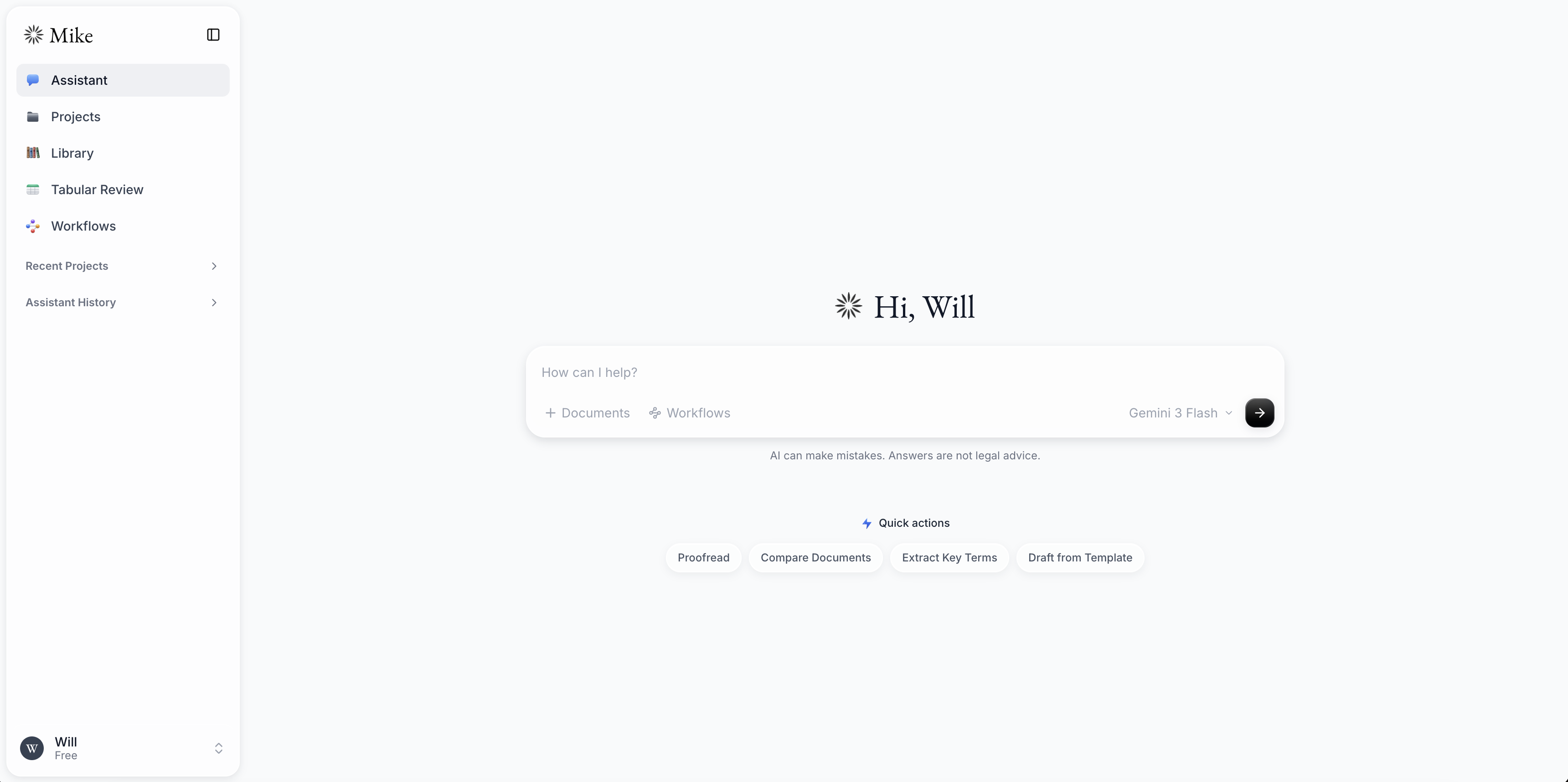
- Chat with legal documents and open matters
- Review documents and apply suggested edits
- Run reusable assistant and tabular-review workflows
- Organize projects, folders, and a document library
- Verify citations and research US case law with CourtListener
- Work from Microsoft Word with the beta task-pane add-in
- Run supported language models locally through Ollama
Quick start
The included Docker Compose stack runs Mike, Supabase, RustFS object storage,
and local email capture without requiring managed infrastructure.
Copy the local environment templates:
cp .env.example .env
cp backend/.env.example backend/.env
In backend/.env, set DOWNLOAD_SIGNING_SECRET and
USER_API_KEYS_ENCRYPTION_SECRET to separate values generated with:
openssl rand -hex 32
Add an Anthropic, Gemini, or OpenAI API key to backend/.env, unless you
plan to use Ollama exclusively.
Start the stack:
docker compose up --build
Open http://localhost:3000 and create an account.
The bundled credentials and infrastructure are intended for local development
only. See Local development for service endpoints,
authentication behavior, Ollama setup, and first-run guidance.
Repository
Documentation
System workflows
Mike's system assistant and tabular-review workflows are maintained in the
Open-Legal-Products/mike-workflows
repository. See Contributing for how they are
packaged and synchronized with this application.
License
Mike is available under the GNU Affero General Public License v3.0.