World Monitor is an open-source, real-time global intelligence dashboard in TypeScript that aggregates news with AI, monitors geopolitics and infrastructure, and unifies all of it into a single situational awareness interface for analysts, journalists, researchers, and operations teams who need cross-domain awareness they can self-host.
What it is
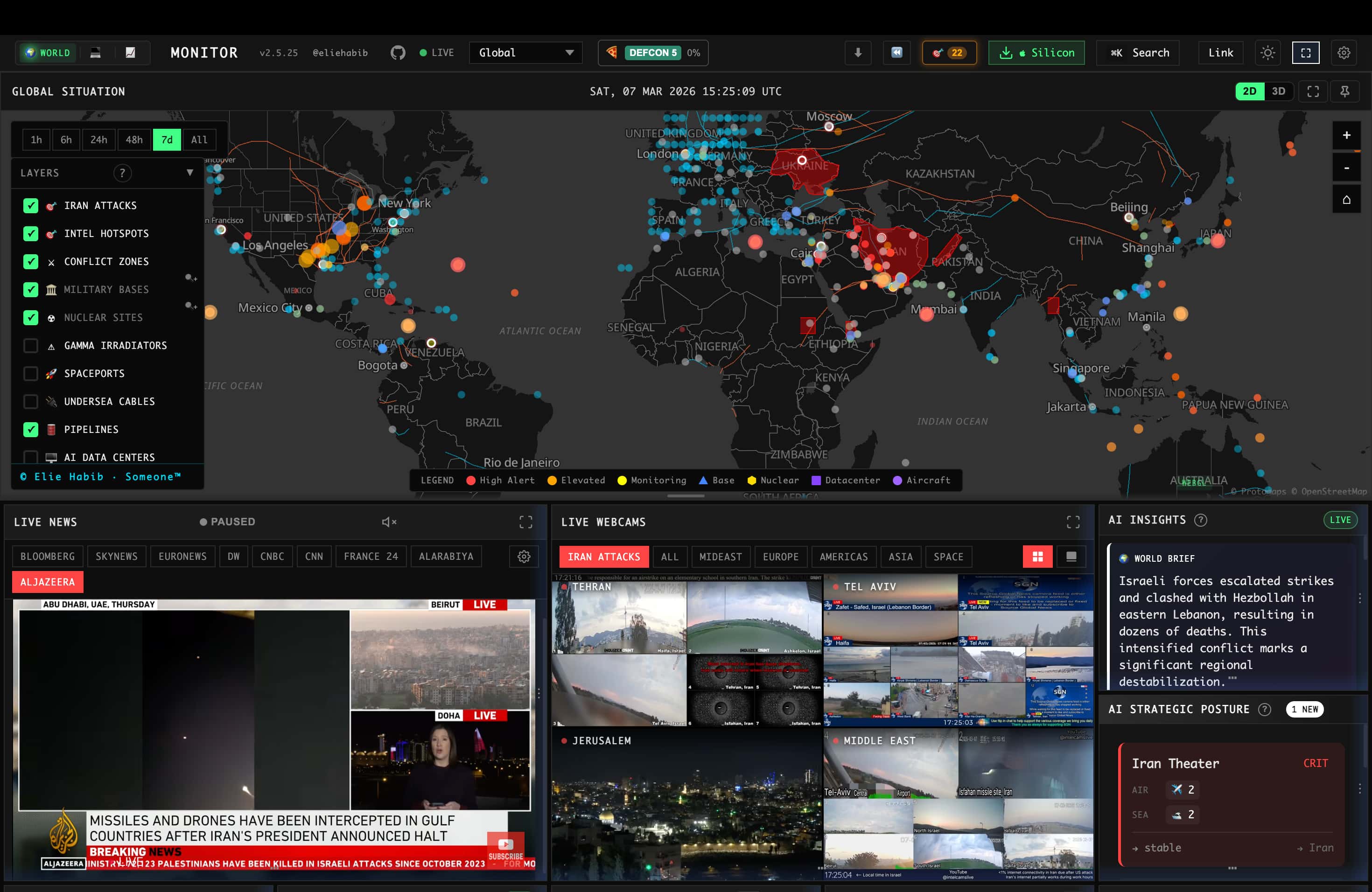
World Monitor is a real-time global intelligence dashboard built in TypeScript and distributed as the worldmonitor package on npm, with a native desktop build produced through Tauri 2 for macOS, Windows, and Linux. It combines AI-synthesized news aggregation, geopolitical monitoring, and infrastructure tracking into one situational awareness interface rather than leaving those streams in separate tools. The repository also publishes localized README files in Simplified Chinese and Japanese, and the interface ships with multilingual support, native-language feeds, and RTL handling.
The concrete problem it solves is fragmentation across monitoring domains. Curated news feeds from global and regional categories are synthesized into briefs, a dual map engine renders geography, and cross-stream correlation surfaces convergence between military, economic, disaster, and escalation signals that would otherwise be noticed only by reading several unrelated sources side by side. The Country Instability Index and the finance radar extend that same surface to country-level stability scoring and market movement, so a single deployment covers news, geography, risk, and markets.
Key capabilities
- Curated news feeds across global and regional categories, AI-synthesized into briefs.
- Dual map engine with a 3D globe built on
globe.gl and a WebGL flat map built on deck.gl, both driven by a shared map-layer catalog.
- Country Instability Index (CII) with live CII v8 scores, bands, and approximate 24-hour movement across 31 Tier-1 countries.
- Finance radar covering stock exchanges, commodities, crypto, and a market composite.
- Cross-stream correlation across military, economic, disaster, and escalation signals.
- Local AI operation through Ollama, requiring no API keys.
- Site variants generated from one codebase: world, tech, finance, commodity, happy, and energy.
- Native desktop app built on Tauri 2, shipping one binary that switches between variants in-app rather than a per-variant download.
Who uses it and how
- Analysts and OSINT practitioners who need geopolitical and infrastructure signals correlated in one interface instead of across multiple tabs and tools.
- Newsrooms and research groups running the public deployments at
worldmonitor.app and the tech., finance., commodity., happy., and energy. subdomains.
- Desktop users on Windows, macOS Apple Silicon, macOS Intel, or Linux AppImage who install the single Tauri binary and switch variants inside the application.
- Air-gapped or privacy-sensitive environments that run inference locally through Ollama with no API keys.
- Self-hosters working from a clone of the repository, where the app runs with no environment variables and only feature-specific data sources may require credentials.
Getting started
Clone the repository, then run npm install followed by npm run dev, and open localhost:3000; the port can be overridden with DEV_PORT in .env.local. Variant-specific development uses scripts such as npm run dev:tech, npm run dev:finance, npm run dev:commodity, npm run dev:happy, and npm run dev:energy, with deployment covered by the self-hosting guide and a fuller .env.example listing optional credentials.
How it compares
The provided facts name no comparable or competing product, so World Monitor stands alone in this registry. Topics such as osint, geopolitics, and palantir indicate the problem space it targets, but no specific alternative tool is identified for a direct comparison.
When to use it — and when not to
World Monitor is a strong fit for teams willing to run and maintain their own deployment, provided they can accept the copyleft obligations of the AGPL-3.0 licence and are comfortable operating a Node and npm toolchain plus any credentials the feature-specific data sources require. Organizations that need a commercial platform with a vendor support contract, or that cannot accept AGPL-3.0 terms, should look elsewhere. The repository's own README is partly a pointer: the full feature list, architecture, data sources, and algorithms live in external documentation, and the open issue count sits at 313, so adopters should expect to read the linked docs and issues board before depending on any surface.
project readme (upstream, from github) — read inline
World Monitor
简体中文 | 日本語
Real-time global intelligence dashboard — AI-powered news aggregation, geopolitical monitoring, and infrastructure tracking in a unified situational awareness interface.


















-0078D4?style=for-the-badge&logo=windows&logoColor=white)


-FCC624?style=for-the-badge&logo=linux&logoColor=black)
Documentation ·
Releases ·
Contributing
What It Does
- Curated news feeds across global and regional categories, AI-synthesized into briefs
- Dual map engine — 3D globe (globe.gl) and WebGL flat map (deck.gl) with a shared map-layer catalog
- Panel inventory — concrete panel implementations across specialized variants
- Cross-stream correlation — military, economic, disaster, and escalation signal convergence
- Country Instability Index (CII) — live CII v8 scores, bands, and approximate 24-hour movement for 31 Tier-1 countries
- Finance radar — stock exchanges, commodities, crypto, and a market composite
- Local AI — run everything with Ollama, no API keys required
- Site variants from a single codebase (world, tech, finance, commodity, happy, energy)
- Native desktop app (Tauri 2) for macOS, Windows, and Linux
- Multilingual UI with native-language feeds and RTL support
For the full feature list, architecture, data sources, and algorithms, see the documentation.
Support Status
All site variants and desktop binaries are built from a single codebase and ship from the same release process. The table below clarifies maintenance status so you know which surfaces are safe to depend on.
Issues filed against any of the above are triaged from the same backlog — see the issues board for currently-open work.
Quick Start
git clone https://github.com/koala73/worldmonitor.git
cd worldmonitor
npm install
npm run dev
Open localhost:3000 (override the port with DEV_PORT in .env.local). The app runs with no environment variables.
Feature-specific data sources may require credentials. See .env.example for the full list.
For variant-specific development:
npm run dev:tech       # tech.worldmonitor.app
npm run dev:finance    # finance.worldmonitor.app
npm run dev:commodity  # commodity.worldmonitor.app
npm run dev:happy      # happy.worldmonitor.app
npm run dev:energy     # energy.worldmonitor.app
See the self-hosting guide for deployment options (Vercel, Docker, static).
Tech Stack
Full stack details in the architecture docs.
Programmatic Access
World Monitor is built for agents and scripts as well as browsers:
- MCP server —
https://worldmonitor.app/mcp (Streamable HTTP). Public tools/list; tools/call authenticates with a X-WorldMonitor-Key header or OAuth.
The server also publishes its Agent Skills through the draft io.modelcontextprotocol/skills extension (skills/list, skills/get, and skill://… resource reads).
- REST API — base
https://api.worldmonitor.app, described by the [Op