
Wisp Science
The open-source, local-first AI research workbench.
WISP — Workspace for Intelligent Scientific Practice








English · 简体中文 · Website · Releases
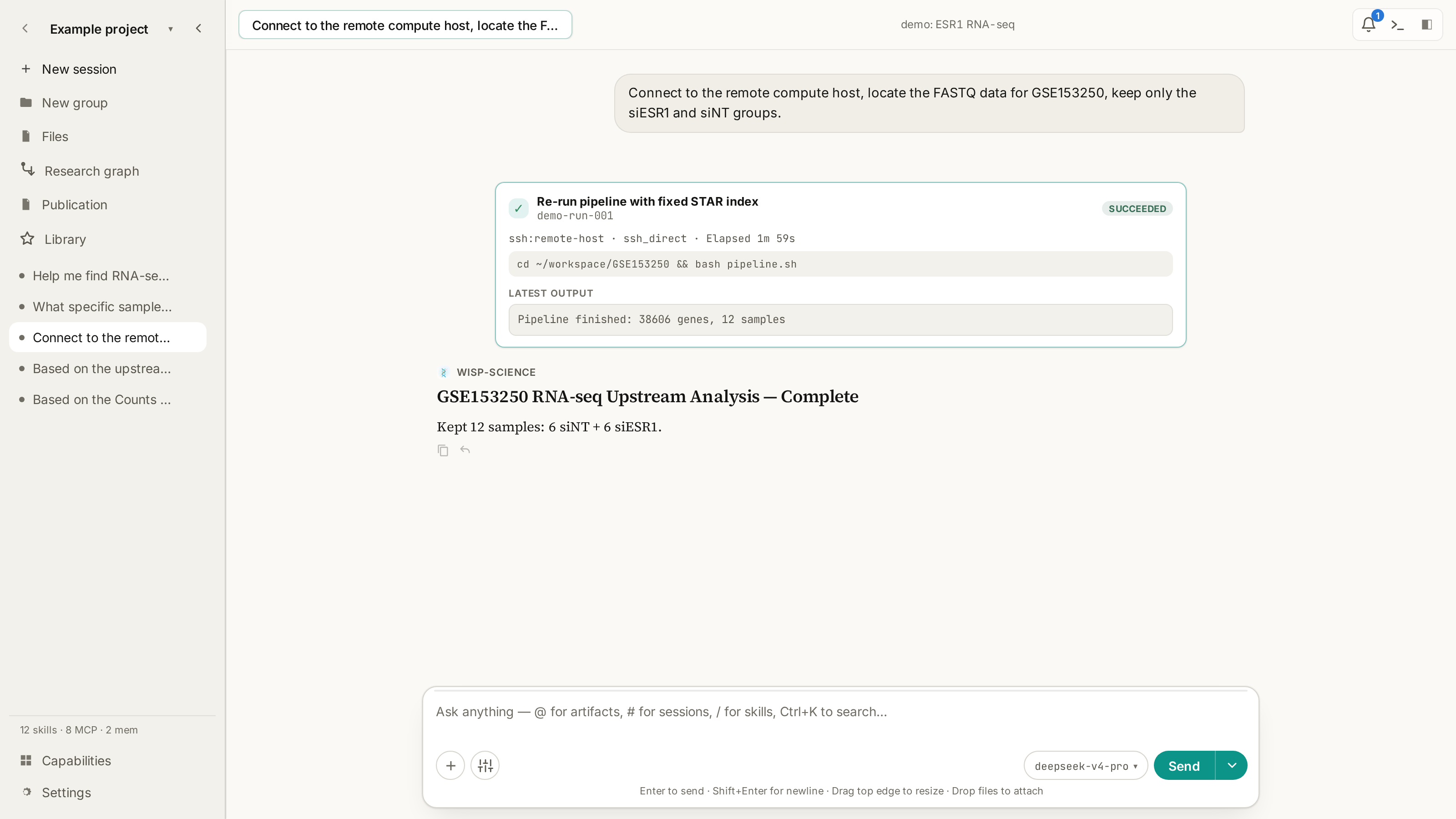
Search the literature, run Python and R, query ~80 scientific databases, and keep the trail — figures, runs, decisions, and drafts — in one project. Your data, conversations, and credentials stay on your machines.
Bring your own model. Keep your science.
What you can do
An agent that does the work
Bring OpenAI-compatible or Anthropic models, or drive Codex / Claude Code over
ACP. The agent reads and writes project files, runs shell, and loads reusable
Skills (SKILL.md) without flooding the prompt. Approval gates stay on unless
you opt into Full Permission.
Compute from laptop to remote servers
Persistent Python and R kernels keep variables across cells and turns; each conversation gets its own isolated kernel, so parallel sessions never share state. Register local, WSL, and SSH hosts once; probe hardware; submit long Runs with live logs. Keys live in the OS keyring, never in SQLite.
Built for science
PubMed, GEO, and ~80 other databases through bundled MCP servers. Offline previews for notebooks, PDFs, Office files, and images. Isolated explorations to try a direction without touching the mainline. A Publication Workspace that freezes manuscript revisions into verifiable Evidence Capsules.
A workbench that remembers
Restart and the full history is back. Undo a turn's file edits. Attach
artifacts, files, and runtimes with @; search saved sessions with #; apply
a skill with /. Encrypted manual sync and
project transfer — nothing syncs in the background.
Get started
- Open the download page, choose your operating system and processor, and download via Cloudflare. GitHub Releases is also available.
- Open a bundled demo — no API key needed — to see a full RNA-seq trajectory.
- Add a model in Settings → Models and start a project.
| Platform | Package |
|---|---|
| Windows | Signed MSI / NSIS |
| macOS | Signed, notarized .dmg (Apple Silicon + Intel) |
| Linux | .deb / AppImage (x86_64 + aarch64) |
Setup walkthrough: Quick Start · basic configuration · model profiles · ACP agents
Build from source, CLI, and architecture: development.
Documentation
| Start | Basic setup · Models · ACP agents |
| Research | Explorations · Evidence capsules · Case studies |
| Projects | Transfer · Sync · Global library |
| Compute | Terminals · Remote files · Transfers |
| Extend | Skills · Plugins · Delegation · Channels · Browser |
| Develop | Development · Headless eval |
Community
Thanks to everyone who filed issues, sent PRs, and used Wisp on real projects. Special thanks to SpicyChicken6 for the molecular wordmark and three-wisp desktop icon designs.


