Uptime Kuma is a free, open source monitoring & observability project written in JavaScript and released under MIT. It has 91,477 GitHub stars, 8,426 forks and 805 open issues, and was last pushed 7 hours ago. On this registry it ranks #1 of 97 tracked projects in Monitoring & Observability, with 5 head-to-head comparisons available. It gained 167 stars over the last 6 tracked days.

What is Uptime Kuma?

Uptime Kuma is a free, MIT-licensed, self-hosted monitoring tool with a reactive web dashboard, built for operators and teams that want to watch their own HTTP, TCP, and DNS endpoints and keep the resulting data on their own infrastructure.

What it is

Uptime Kuma is a JavaScript application, distributed as a Docker image and as source, that probes services on a schedule and reports their state in a single-page web app. It sits in the self-hosted infrastructure and operations space, under monitoring and observability, and the README calls it "a fancy self-hosted monitoring tool." Its author built it while learning Vue 3, vite.js, and Bootstrap 5, and to try using WebSocket with a single-page app instead of a REST API.

The concrete problem it solves is the gap left by hosted uptime services and by abandoned self-hosted ones. The README's motivation section states that the author wanted a self-hosted monitor comparable to Uptime Robot, that the closest option was statping, and that statping was not stable and no longer maintained. Uptime Kuma occupies that space: one instance, one persistent data volume under /app/data, and notification credentials that never leave the operator's own server.

Key capabilities

  • Monitors HTTP(s), TCP, HTTP(s) Keyword, HTTP(s) Json Query, Websocket, Ping, DNS Record, Push, Steam Game Server, and Docker Containers.
  • Sends notifications through Telegram, Discord, Gotify, Slack, Pushover, and Email (SMTP), with a further 90+ notification services available.
  • Checks on 20-second intervals, with a ping chart and certificate information per monitor.
  • Publishes multiple status pages, each of which can be mapped to a specific domain.
  • Supports 2FA and proxy use, and ships a UI translated into multiple languages.
  • Serves a reactive single-page interface over WebSocket (socket-io) rather than a REST API.

Who uses it and how

  • Self-hosters running louislam/uptime-kuma:2 on a VPS or home server, publishing port 3001 and mounting a named volume at /app/data.
  • Teams moving off hosted uptime services so monitor definitions and notification tokens stay on infrastructure they control.
  • Operators who publish several public status pages and point separate domains at each one.
  • Non-Docker users on Debian, Ubuntu, Fedora, or ArchLinux, or on Windows 10 x64 / Windows Server 2012 R2 x64 and above, running server/server.js under pm2.
  • Applications and cron jobs that report inward using the Push monitor type instead of being polled from outside.

Getting started

Install with the published compose.yaml via docker compose up -d, or run louislam/uptime-kuma:2 directly with port 3001 published and a volume at /app/data. The UI is then available at http://localhost:3001 or http://your-ip:3001.

How it compares

Uptime Kuma was written as a self-hosted answer to Uptime Robot, so the trade is a hosted account and a vendor bill against running an instance and holding the data yourself. The README names statping as the closest prior self-hosted tool and records that it was unstable and unmaintained, which is the gap this project was built to fill.

When to use it — and when not to

A self-hoster must operate a Node.js process or a Docker container, keep a persistent local volume, and supply their own SMTP credentials or third-party notification tokens. Do not choose it on FreeBSD, OpenBSD, NetBSD, Replit, or Heroku, all listed as unsupported, and note that NFS mounts are explicitly not supported for its data directory. The project also carries 805 open issues, and its README defers updating and reverse-proxy setup to external documents rather than spelling them out.

project readme (upstream, from github) — read inline

Uptime Kuma

Uptime Kuma is an easy-to-use self-hosted monitoring tool.

GitHub Sponsors Translation status

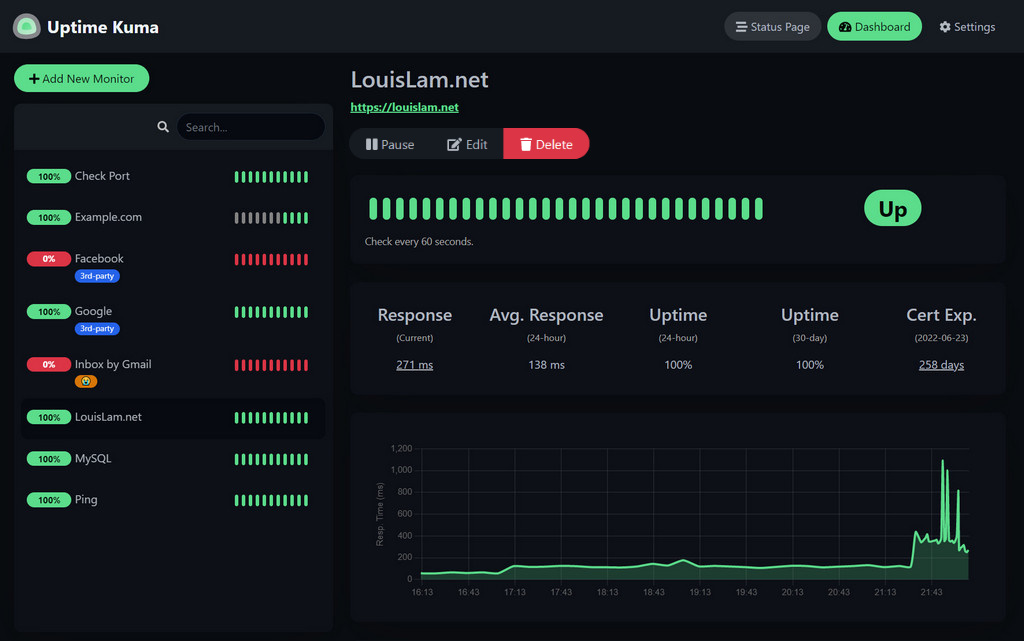
Uptime Kuma Dashboard Screenshot

🥔 Live Demo

Try it!

Demo Server (Location: Frankfurt - Germany):

It is a temporary live demo, all data will be deleted after 10 minutes. Sponsored by Uptime Kuma Sponsors.

⭐ Features

  • Monitoring uptime for HTTP(s) / TCP / HTTP(s) Keyword / HTTP(s) Json Query / Websocket / Ping / DNS Record / Push / Steam Game Server / Docker Containers
  • Fancy, Reactive, Fast UI/UX
  • Notifications via Telegram, Discord, Gotify, Slack, Pushover, Email (SMTP), and 90+ notification services, click here for the full list
  • 20-second intervals
  • Multi Languages
  • Multiple status pages
  • Map status pages to specific domains
  • Ping chart
  • Certificate info
  • Proxy support
  • 2FA support

🔧 How to Install

🐳 Docker Compose

mkdir uptime-kuma
cd uptime-kuma
curl -o compose.yaml https://raw.githubusercontent.com/louislam/uptime-kuma/master/compose.yaml
docker compose up -d

Uptime Kuma is now running on all network interfaces (e.g. http://localhost:3001 or http://your-ip:3001).

[!WARNING] File Systems like NFS (Network File System) are NOT supported. Please map to a local directory or volume.

🐳 Docker Command

docker run -d --restart=always -p 3001:3001 -v uptime-kuma:/app/data --name uptime-kuma louislam/uptime-kuma:2

Uptime Kuma is now running on all network interfaces (e.g. http://localhost:3001 or http://your-ip:3001).

If you want to limit exposure to localhost only:

docker run ... -p 127.0.0.1:3001:3001 ...

💪🏻 Non-Docker

Requirements:

  • Platform
    • ✅ Major Linux distros such as Debian, Ubuntu, Fedora and ArchLinux etc.
    • ✅ Windows 10 (x64), Windows Server 2012 R2 (x64) or higher
    • ❌ FreeBSD / OpenBSD / NetBSD
    • ❌ Replit / Heroku
  • Node.js >= 20.4
  • Git
  • pm2 - For running Uptime Kuma in the background
git clone https://github.com/louislam/uptime-kuma.git
cd uptime-kuma
npm run setup

# Option 1. Try it
node server/server.js

# (Recommended) Option 2. Run in the background using PM2
# Install PM2 if you don't have it:
npm install pm2 -g && pm2 install pm2-logrotate

# Start Server
pm2 start server/server.js --name uptime-kuma

Uptime Kuma is now running on all network interfaces (e.g. http://localhost:3001 or http://your-ip:3001).

More useful PM2 Commands

# If you want to see the current console output
pm2 monit

# If you want to add it to startup
pm2 startup && pm2 save

Advanced Installation

If you need more options or need to browse via a reverse proxy, please read:

🆙 How to Update

Please read:

🆕 What's Next?

I will assign requests/issues to the next milestone.

❤️ Sponsors

Thank you so much! (GitHub Sponsors will be updated manually. OpenCollective sponsors will be updated automatically, the list will be cached by GitHub though. It may need some time to be updated)

Uptime Kuma Sponsors

🖼 More Screenshots

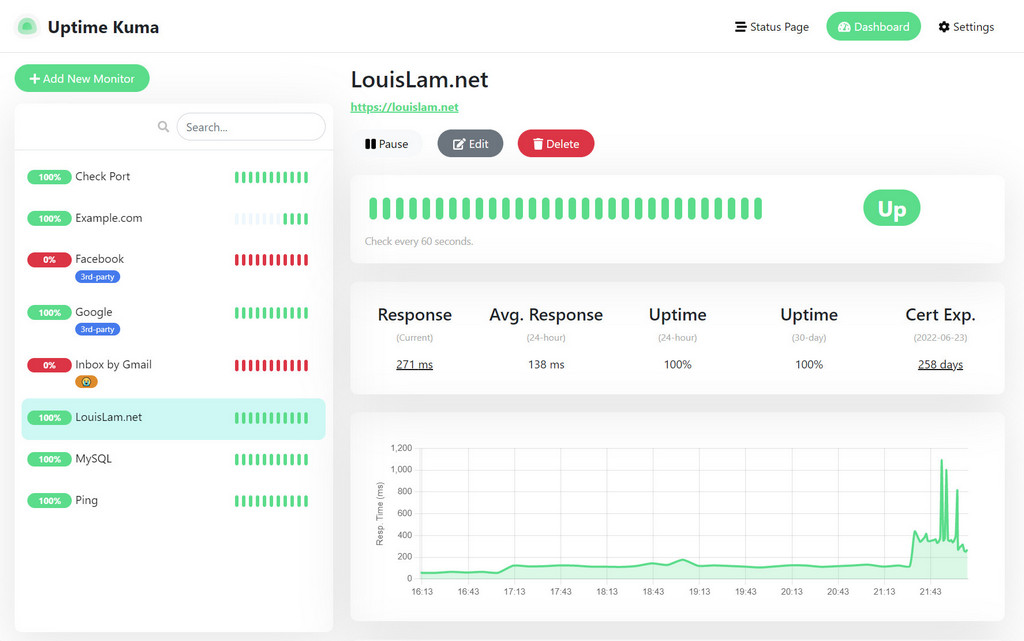
Light Mode:

Uptime Kuma Light Mode Screenshot of how the Dashboard looks

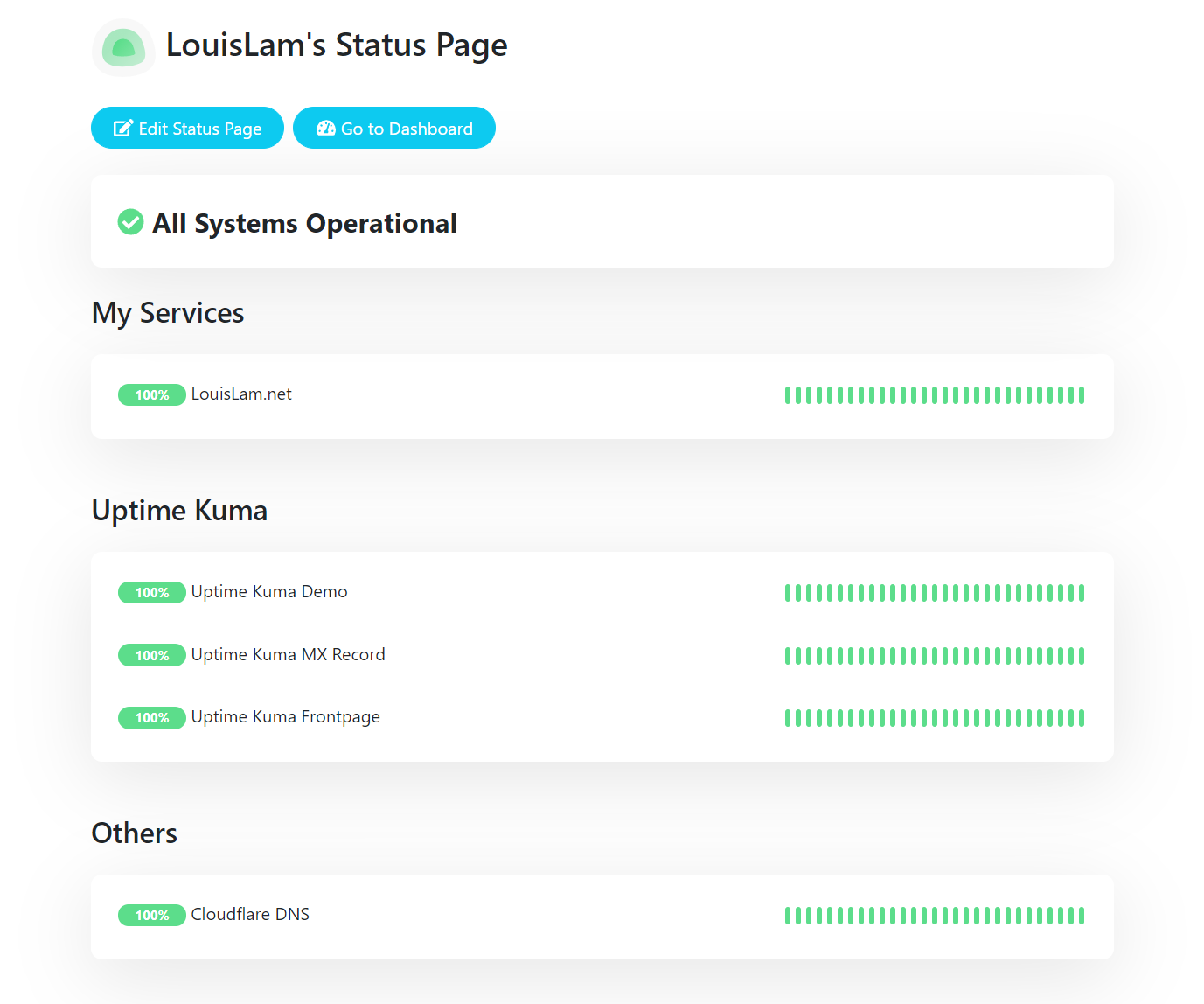
Status Page:

Uptime Kuma Status Page Screenshot

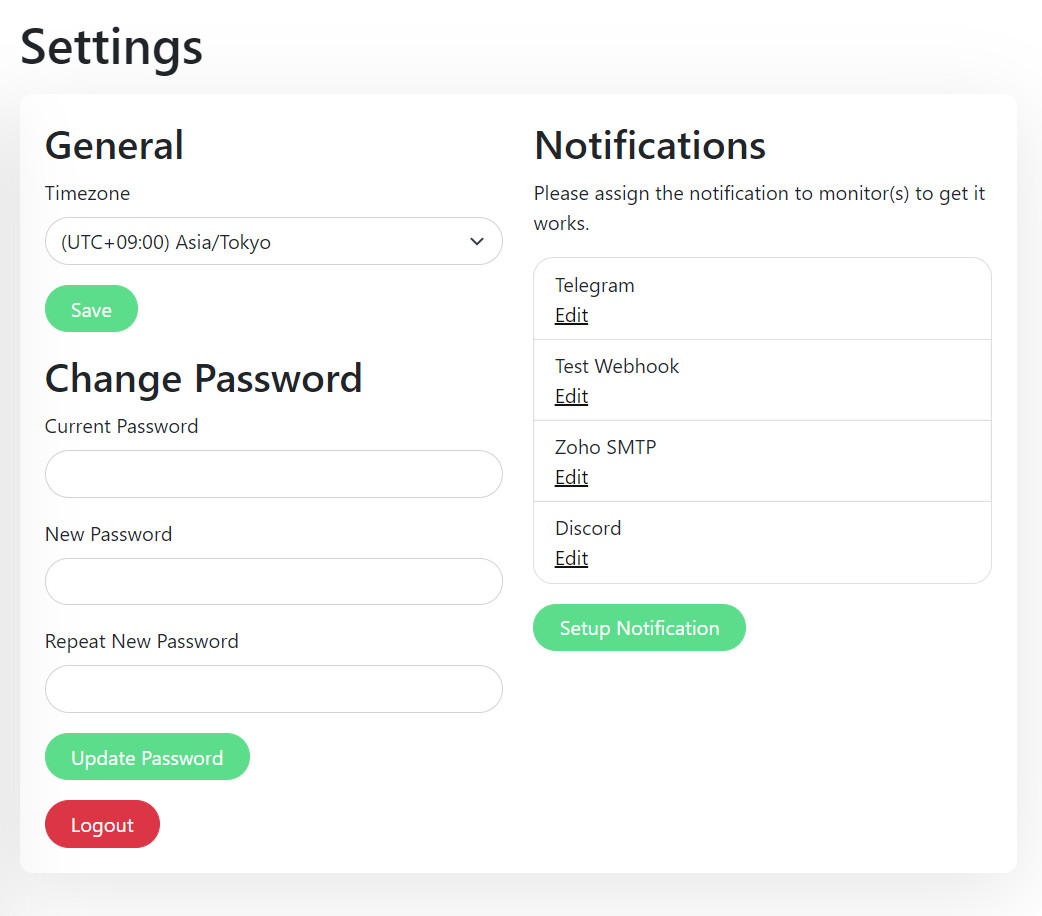
Settings Page:

Uptime Kuma Settings Page Screenshot

Telegram Notification Sample:

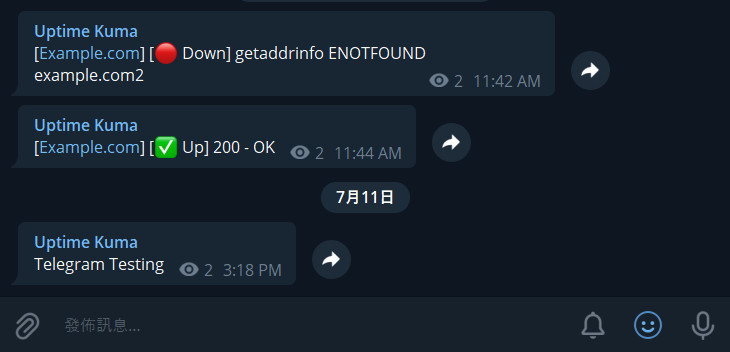
Uptime Kuma Telegram Notification Sample Screenshot

Motivation

  • I was looking for a self-hosted monitoring tool like "Uptime Robot", but it is hard to find a suitable one. One of the closest ones is statping. Unfortunately, it is not stable and no longer maintained.
  • Wanted to build a fancy UI.
  • Learn Vue 3 and vite.js.
  • Show the power of Bootstrap 5.
  • Try to use WebSocket with SPA instead of a REST API.
  • Deploy my first Docker image to Docker Hub.

If you love this project, please consider giving it a ⭐.

🗣️ Discussion / Ask for Help

⚠️ For any general or technical questions, please don't send me an email, as I am unable to provide support in that manner. I will not respond if you ask questions there.

I recommend using Google, GitHub Issues, or Uptime Kuma's subreddit for finding answers to your question. If you cannot find the information you need, feel free to ask:

My Reddit account: u/louislamlam You can mention me if you ask a question on the subreddit.

Contributions

Create Pull Requests

Pull requests are awesome. To keep reviews fast and effective, please make sure you’ve read our pull request guidelines.

Test Pull Requests

There are a lot of pull requests right now, but I don't have time to test them all.

If you want to help, you can check this:

Test Beta Version

Check out the latest beta release here:

Bug Reports / Feature Requests

If you want to report a bug or request a new feature, feel free to open a new issue.

Translations

If you want to translate Uptime Kuma into your language, please visit Weblate Readme.

Spelling & Grammar

Feel free to correct the grammar in the documentation or code. My mother language is not English and my grammar is not that great.

Frequently asked questions

Is Uptime Kuma free to use?

Uptime Kuma is open source under the MIT licence. There is no licence fee and no seat count — you can self-host it or, where the project offers one, pay a vendor for a managed version instead.

What does Uptime Kuma do?

Self-hosted uptime monitoring with a clean dashboard

What is Uptime Kuma written in?

Uptime Kuma is primarily written in JavaScript. Its source is publicly available at https://github.com/louislam/uptime-kuma, and it has 91,477 GitHub stars.