
Less Code, Lower Barrier, Faster Deployment




简体中文 | English
Latest News 🔥
- [2026.01.23] 🎉 UltraRAG 3.0 Released: Say no to "black box" development—make every line of reasoning logic clearly visible 👉 📖 Blog
- [2026.01.20] 🎉 AgentCPM-Report Model Released! DeepResearch is finally localized: 8B on-device writing agent AgentCPM-Report is open-sourced 👉 🤗 Model
Previous News
- [2025.11.11] 🎉 UltraRAG 2.1 Released: Enhanced knowledge ingestion & multimodal support, with a more complete unified evaluation system!
- [2025.09.23] New daily RAG paper digest, updated every day 👉 📖 Papers
- [2025.09.09] Released a Lightweight DeepResearch Pipeline local setup tutorial 👉 📺 bilibili · 📖 Blog
- [2025.09.01] Released a step-by-step UltraRAG installation and full RAG walkthrough video 👉 📺 bilibili · 📖 Blog
- [2025.08.28] 🎉 UltraRAG 2.0 Released! UltraRAG 2.0 is fully upgraded: build a high-performance RAG with just a few dozen lines of code, empowering researchers to focus on ideas and innovation! We have preserved the UltraRAG v2 code, which can be viewed at v2.
- [2025.01.23] UltraRAG Released! Enabling large models to better comprehend and utilize knowledge bases. The UltraRAG 1.0 code is still available at v1.
💡 About UltraRAG
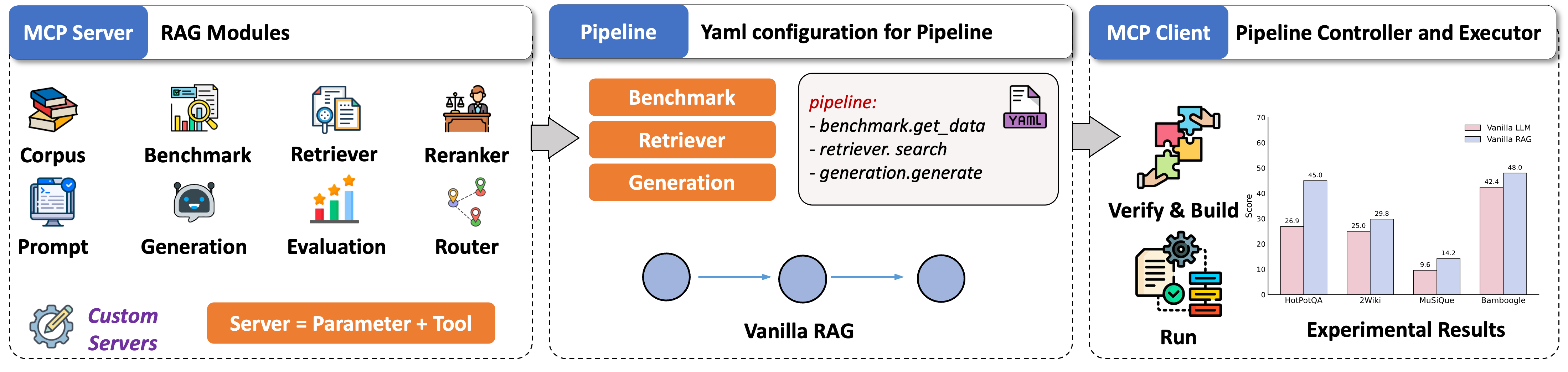
UltraRAG is the first lightweight RAG development framework based on the Model Context Protocol (MCP) architecture design, jointly launched by THUNLP at Tsinghua University, NEUIR at Northeastern University, OpenBMB, and AI9stars.
Designed for research exploration and industrial prototyping, UltraRAG standardizes core RAG components (Retriever, Generation, etc.) as independent MCP Servers, combined with the powerful workflow orchestration capabilities of the MCP Client. Developers can achieve precise orchestration of complex control structures such as conditional branches and loops simply through YAML configuration.
🖥️ UltraRAG UI
UltraRAG UI transcends the boundaries of traditional chat interfaces, evolving into a visual RAG Integrated Development Environment (IDE) that combines orchestration, debugging, and demonstration.
The system features a powerful built-in Pipeline Builder that supports bidirectional real-time synchronization between "Canvas Construction" and "Code Editing," allowing for granular online adjustments of pipeline parameters and prompts. Furthermore, it introduces an Intelligent AI Assistant to empower the entire development lifecycle, from pipeline structural design to parameter tuning and prompt generation. Once constructed, logic flows can be converted into interactive dialogue systems with a single click. The system seamlessly integrates Knowledge Base Management components, enabling users to build custom knowledge bases for document Q&A. This truly realizes a one-stop closed loop, spanning from underlying logic construction and data governance to final application deployment.
https://github.com/user-attachments/assets/fcf437b7-8b79-42f2-bf4e-e3b7c2a896b9
✨ Key Highlights
🚀 Low-Code Orchestration of Complex Workflows Inference Orchestration: Natively supports control structures such as sequential, loop, and conditional branches. Developers only need to write YAML configuration files to implement complex iterative RAG logic in dozens of lines of code. |
⚡ Modular Extension and Reproduction Atomic Servers: Based on the MCP architecture, functions are decoupled into independent Servers. New features only need to be registered as function-level Tools to seamlessly integrate into workflows, achieving extremely high reusability. |
📊 Unified Evaluation and Benchmark Comparison Research Efficiency: Built-in standardized evaluation workflows, ready-to-use mainstream research benchmarks. Through unified metric management and baseline integration, significantly improves experiment reproducibility and comparison efficiency. |
🎯 Rapid Interactive Prototype Generation One-Click Delivery: Say goodbye to tedious UI development. With just one command, Pipeline logic can be instantly converted into an interactive conversational Web UI, shortening the distance from algorithm to demonstration. |
📦 Installation
We provide two installation methods: local source code installation (recommended using uv for package management) and Docker container deployment.
Method 1: Source Code Installation
We strongly recommend using uv to manage Python environments and dependencies, as it can greatly improve installation speed.
Prepare Environment
If you haven't installed uv yet, please execute:
## Direct installation
pip install uv==0.12.0
## Download
curl -LsSf https://astral.sh/uv/0.12.0/install.sh | sh
Download Source Code
git clone https://github.com/OpenBMB/UltraRAG.git --depth 1
cd UltraRAG
Install Dependencies
Choose one of the following modes to install dependencies based on your use case:
A: Create a New Environment Use uv sync to automatically create a virtual environment and synchronize dependencies:
Core dependencies: If you only need to run basic core functions, such as only using UltraRAG UI:
uv syncFull installation: If you want to fully experience UltraRAG's retrieval, generation, corpus processing, and evaluation functions, please run:
uv sync --all-extrasThis is the recommended team setup: every MCP server shares the same
.venvanduv.lock. Linux GPU dependencies are locked to CUDA 12.9, including the official vLLM cu129 wheel.On-demand installation: If you only need to run specific modules, keep the corresponding
--extraas needed, for example:uv sync --extra retriever # Retrieval module only uv sync --extra generation # Generation module only
Once installed, activate the virtual environment:
# Windows CMD
.venv\Scripts\activate.bat

# Windows Powershell
.venv\Scripts\Activate.ps1

# macOS / Linux
source .venv/bin/activate
B: Install into an Existing Environment To install UltraRAG into your currently active Python enviro