




Getting Started | Use Cases | API Reference | OWM Framework | Limitations | 中文版
Project status (August 2026): Feature-complete, in maintenance mode — bug and security reports are still reviewed; no new features or hosted service are planned. For paid work, see Trading Record Analysis.
Your trading AI has amnesia. And regulators are starting to notice.
It makes the same mistakes every session. It can't explain why it traded. It forgets everything when the context window ends. Meanwhile, MiFID II is raising the bar for algorithmic decision documentation (Article 17). The EU AI Act demands systematic logging of AI actions (Article 14). Your competitors' agents are learning from every trade.
The AI trading stack is missing a layer. Every MCP server handles execution — placing orders, fetching prices, reading charts. None handle memory.
Your agent can buy 100 shares of AAPL but can't answer: "What happened last time I bought AAPL in this condition?"
TradeMemory is the memory layer. One pip install, and your AI agent remembers every trade, every outcome, every mistake — with a SHA-256 tamper-evident audit trail.
Used by an independent trader running a pre-flight checklist before every position, and first-party against an MT5 account that logs blocked signals as well as executed ones. See USE_CASES.md for which is which.
What it does
- Before trading: ask your memory — what happened last time in this market condition? How did it end?
- After trading: one call records everything — five memory layers update automatically
- Safety rails: confidence tracking, drawdown alerts, losing streak detection — the system tells you when to stop
Works with any market (stocks, forex, crypto, futures), any broker, any AI platform. TradeMemory doesn't execute trades or touch your money — it only records and recalls.
See the interface
tradememory-dashboard.onrender.com — the dashboard running on an illustrative demo dataset. Nothing to install.
It is an interface preview, not a track record: the trades are synthetic and every figure on it is labelled as such. For what the memory layer actually does in a terminal, pip install tradememory-protocol && tradememory demo --fast replays 30 trades and shows the recall and parameter adjustment it derives from them.
Quick Start
pip install tradememory-protocol
Add to Claude Desktop (claude_desktop_config.json):
{
  "mcpServers": {
    "tradememory": {
      "command": "uvx",
      "args": ["tradememory-protocol"]
    }
  }
}
Then tell Claude: "Record my AAPL long at $195 — earnings beat, institutional buying, high confidence."
Claude Code / Cursor / Docker
# Claude Code
claude mcp add tradememory -- uvx tradememory-protocol

# From source
git clone https://github.com/mnemox-ai/tradememory-protocol.git
cd tradememory-protocol && pip install -e . && python -m tradememory

# Docker
docker compose up -d
Full walkthrough: Getting Started (Trader Track + Developer Track)
Who uses TradeMemory
| US Equity Trader | Forex EA System | Compliance Team | |
|---|---|---|---|
| Market | Stocks (AAPL, TSLA, ...) | XAUUSD (Gold) | Multi-asset |
| How | Pre-flight checklist before every trade | Automated sync from MT5 | Full decision audit trail |
| Key value | Discipline system — memory before every decision | Record why signals were blocked, not just executed | SHA-256 tamper-evident records for regulators |
| Details | Read more → | Read more → | Read more → |
How it works
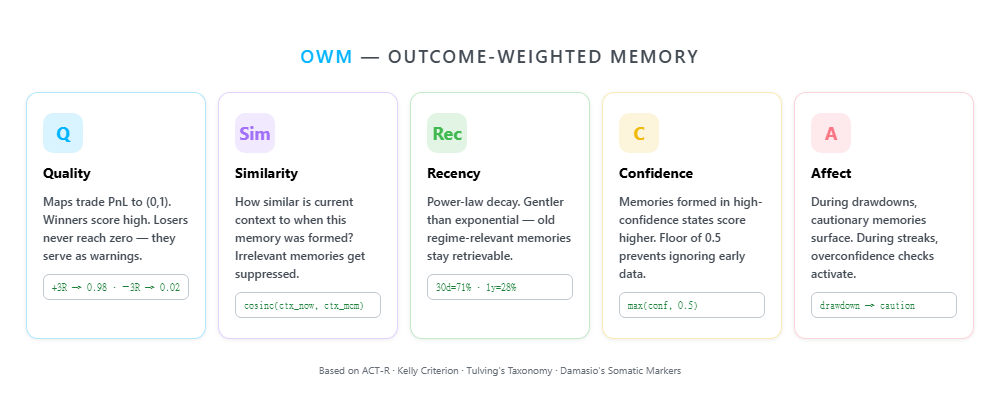
- Recall — Before trading, retrieve past trades weighted by outcome quality, context similarity, recency, confidence, and emotional state (OWM Framework)
- Record — After trading, one call to
remember_tradewrites to five memory layers: episodic, semantic, procedural, affective, and trade records - Reflect — Daily/weekly/monthly reviews detect behavioral drift, strategy decay, and trading mistakes
- Audit — Every decision is SHA-256 hashed at creation. Export anytime for review or regulatory submission
MCP Tools
| Category | Tools | Description |
|---|---|---|
| Memory | remember_trade · recall_memories |
Record and recall trades with outcome-weighted scoring |
| State | get_agent_state · get_behavioral_analysis |
Confidence, drawdown, streaks, behavioral patterns |
| Planning | create_trading_plan · check_active_plans |
Prospective plans with conditional triggers |
| Risk | check_trade_legitimacy |
5-factor pre-trade gate (full / reduced / skip) |
| Audit | export_audit_trail · verify_audit_hash |
SHA-256 tamper detection + bulk export |
All 20 MCP tools + REST API
| Category | Tools |
|---|---|
| Core Memory | get_strategy_performance · get_trade_reflection |
| OWM Cognitive | remember_trade · recall_memories · get_behavioral_analysis · get_agent_state · create_trading_plan · check_active_plans |
| Risk & Governance | check_trade_legitimacy · validate_strategy · compute_dqs |
| Evolution | evolution_fetch_market_data · evolution_discover_patterns · evolution_run_backtest · evolution_evolve_strategy · evolution_get_log |
| Audit | export_audit_trail · verify_audit_hash · verify_audit_chain · get_daily_root |
REST API: 35+ endpoints for trade recording, reflections, risk, MT5 sync, OWM, evolution, and audit. Full reference →
Trading Record Analysis
TradeMemory itself is free and self-hosted. What the maintainer offers as a paid service is statistical analysis of your own trading records: export your MT4/MT5 history and get a descriptive-statistics report — where your losses concentrate, how your position sizing changes after losses, forced-liquidation structure, and the actual risk you took per trade — followed by a walkthrough call.
Descriptive statistics of past trades only: no trade signals, no investment advice, no performance promises. Your files are deleted after delivery.
[email protected] | Book a call
Enterprise & Compliance
Every trading decision your agent makes — including decisions not to trade — is recorded as a Trading Decision Record (TDR). Per-record SHA-256 content hashes are linked into a forward-chained audit ledger; every UTC day is summarised by a Merkle root which itself chains across days. Tampering with any historical record invalidates every subsequent link.
| Regulation | Requirement | TradeMemory Coverage |
|---|---|---|
| MiFID II Article 17 | Record every algorithmic trading decision factor | Full decision chain: conditions, filters, indicators, execution |
| EU AI Act Article 14 | Human oversight of high-risk AI systems | Explainable reasoning + memory context for every decision |
| EU AI Act Article 12 | Automatic, tamper-resistant logs over system lifetime | Linked SHA-256 chain + daily Merkle roots (RFC 3161 TSA in Phase 1.5) |
## Verify a single record hasn't been tampered with
verify_audit_hash(trade_)
## → {"verified": true, "chain_entry": {"sequence_num": 42, ...}}

## Walk the entir