
TiDB is a free, open source databases project written in Go and released under Apache-2.0. It has 40,541 GitHub stars, 6,242 forks and 6,976 open issues, and was last pushed 3 hours ago. On this registry it ranks #8 of 81 tracked projects in Databases, with 5 head-to-head comparisons available. It gained 21 stars over the last 6 tracked days.

TiDB — Scale-out SQL database for real-time analytics

What is TiDB?

TiDB is an open-source, cloud-native, distributed SQL database written in Go and licensed under Apache-2.0, aimed at teams that need ACID transactions, real-time analytics, and vector search at scale without data silos.

What it is

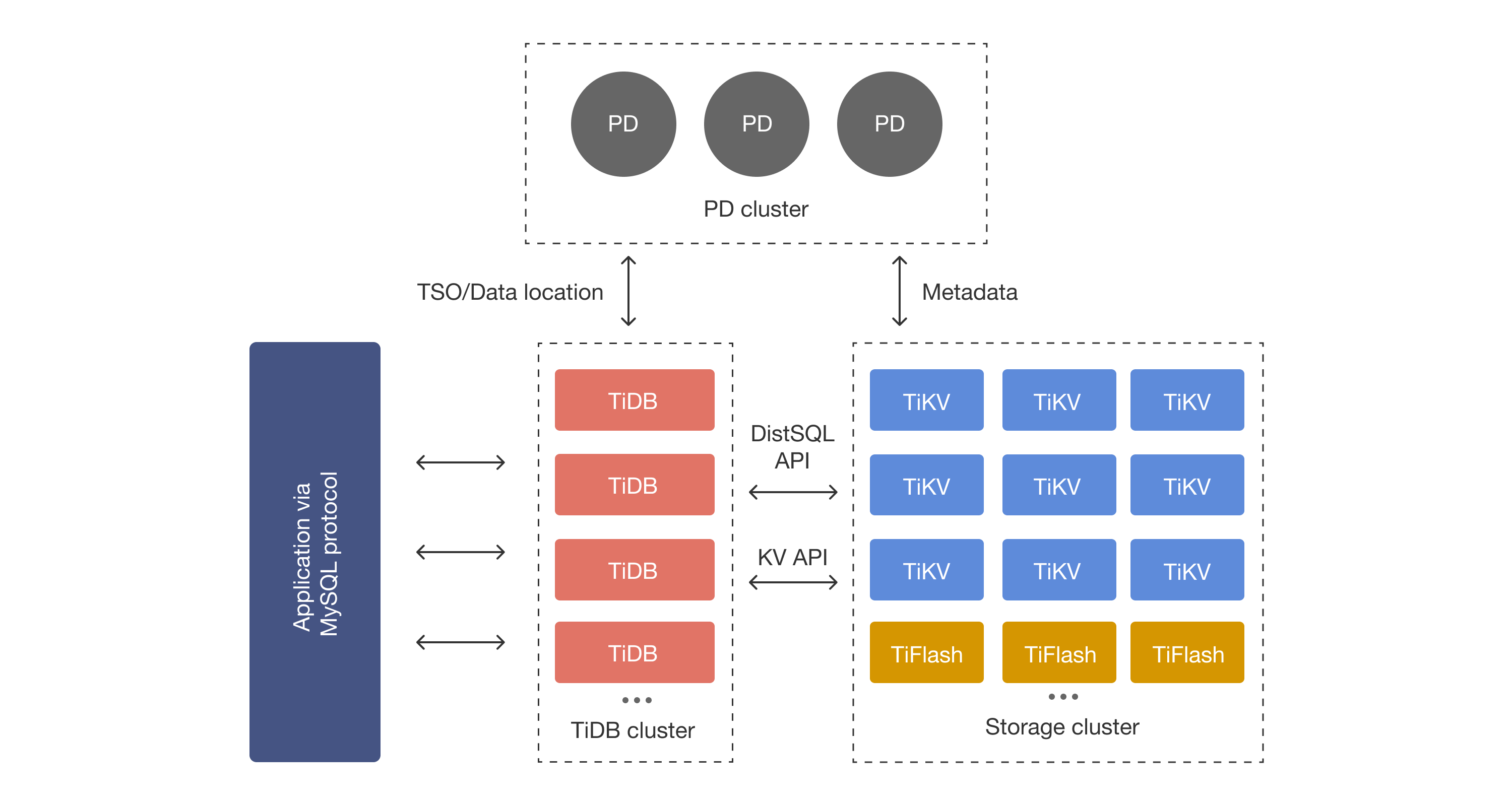
TiDB (/’taɪdiːbi:/, where "Ti" stands for Titanium) is a distributed SQL database built for high availability, horizontal and vertical scalability, strong consistency, and high performance. It lives in the cloud-native Go ecosystem and deploys in public clouds, on-premises, or natively in Kubernetes. The architecture separates computing from storage: the TiDB Server coordinates query execution, TiKV provides row-based storage, and TiFlash provides columnar storage. Repository topics include cloud-native, distributed-database, distributed-transactions, htap, agent, agent-context, agent-memory, agentic, ai, and hacktoberfest.

The concrete problem is scale and separation. TiDB is designed for deployments that outgrow a stand-alone MySQL 8.0 instance, and it is positioned for agentic workloads that grow unpredictably. Hybrid Transactional/Analytical Processing (HTAP) collapses transactional and analytical processing into one system rather than separate engines, so data does not sit in silos and workloads do not become noisy neighbors. MySQL 8.0 compatibility means applications migrate without code changes or with minimal modifications, using familiar protocols, frameworks, and tools, with a suite of data migration tools to move application data in.

Key capabilities

  • Distributed transactions use a two-phase commit protocol for ACID compliance, spanning multiple nodes and preserving correctness under network partitions or node failures.
  • Horizontal and vertical scalability add nodes or increase resources of existing nodes without downtime, with computing and storage adjusted independently.
  • High availability uses the Raft consensus protocol for reliability and automated failover, storing data in multiple replicas and committing transactions only after writing to the majority of replicas, with geographic replica placement for disaster tolerance.
  • HTAP pairs the TiKV row-based storage engine with the TiFlash columnar storage engine; TiFlash replicates data from TiKV in real time using the Multi-Raft Learner protocol, and the TiDB Server coordinates query execution across both.
  • MySQL 8.0 compatibility lets existing applications use familiar protocols, frameworks, and tools, and migrate without code changes or with minimal modifications.
  • Cloud-native deployment runs in public clouds, on-premises, or natively in Kubernetes, where TiDB Operator automates cluster operations, and TiDB Cloud provides a fully managed service.
  • Native support covers transactions, analytics, and vector search for agentic workloads, with topics for agent, agent-context, and agent-memory.

Who uses it and how

  • Teams building agentic workloads with unpredictable growth use TiDB for transactions, analytics, and vector search in one system, per the project description.
  • Platform teams on Kubernetes run self-managed clusters through TiDB Operator, which automates cluster operations.
  • Groups that prefer managed operations use TiDB Cloud, the fully managed service that provisions clusters in a few clicks.
  • Organizations with mixed transactional and analytical queries run HTAP on one system, with TiKV serving row-based work and TiFlash serving columnar work.
  • Deployments needing multi-AZ high availability and geographic replica placement use Raft consensus across public cloud or on-premises infrastructure.
  • Teams migrating from MySQL 8.0 use the compatibility layer and data migration tools to move application data with no code changes or minimal modifications.

Getting started

Deploy TiDB with TiDB Operator on Kubernetes for a self-managed cluster, or use TiDB Cloud for a fully managed service that sets up clusters in a few clicks. The README also covers deployment in public clouds and on-premises.

How it compares

The facts name MySQL 8.0 as a compatibility target rather than a competing product, and name no other similar database. On the evidence provided, TiDB stands alone in this registry.

When to use it — and when not to

Self-hosting TiDB means operating the TiDB Server, the TiKV row-based storage engine, the TiFlash columnar storage engine, and Raft consensus, typically on Kubernetes through TiDB Operator, which is a distributed system footprint rather than a single binary. Teams that want a simple single-node MySQL drop-in, or that lack operational capacity for a distributed database, should not pick it. The facts show 6,976 open issues and a last push on 2026-09-17, with no release tag or version identified in the provided excerpt, so the issue backlog is substantial and the README excerpt is truncated.

project readme (upstream, from github) — read inline

License Language

Build Status Go Report Card GitHub release

TiDB

TiDB (/’taɪdiːbi:/, "Ti" stands for Titanium) is an open-source, cloud-native, distributed SQL database designed for high availability, horizontal and vertical scalability, strong consistency, and high performance.

Key Features

  • Distributed Transactions: TiDB uses a two-phase commit protocol to ensure ACID compliance, providing strong consistency. Transactions span multiple nodes, and TiDB's distributed nature ensures data correctness even in the presence of network partitions or node failures.

  • Horizontal and Vertical Scalability: TiDB can be scaled horizontally by adding more nodes or vertically by increasing resources of existing nodes, all without downtime. TiDB's architecture separates computing from storage, enabling you to adjust both independently as needed for flexibility and growth.

  • High Availability: Built-in Raft consensus protocol ensures reliability and automated failover. Data is stored in multiple replicas, and transactions are committed only after writing to the majority of replicas, guaranteeing strong consistency and availability, even if some replicas fail. Geographic placement of replicas can be configured for different disaster tolerance levels.

  • Hybrid Transactional/Analytical Processing (HTAP): TiDB provides two storage engines: TiKV, a row-based storage engine, and TiFlash, a columnar storage engine. TiFlash uses the Multi-Raft Learner protocol to replicate data from TiKV in real time, ensuring consistent data between the TiKV row-based storage engine and the TiFlash columnar storage engine. The TiDB Server coordinates query execution across both TiKV and TiFlash to optimize performance.

  • Cloud-Native: TiDB can be deployed in public clouds, on-premises, or natively in Kubernetes. TiDB Operator helps manage TiDB on Kubernetes, automating cluster operations, while TiDB Cloud provides a fully-managed service for easy and economical deployment, allowing users to set up clusters with just a few clicks.

  • MySQL Compatibility: TiDB is compatible with MySQL 8.0, allowing you to use familiar protocols, frameworks and tools. You can migrate applications to TiDB without changing any code, or with minimal modifications. Additionally, TiDB provides a suite of data migration tools to help easily migrate application data into TiDB.

  • Open Source Commitment: Open source is at the core of TiDB's identity. All source code is available on GitHub under the Apache 2.0 license, including enterprise-grade features. TiDB is built with the belief that open source enables transparency, innovation, and collaboration. We actively encourage contributions from the community to help build a vibrant and inclusive ecosystem, reaffirming our commitment to open development and accessibility for everyone.

Quick Start

  1. Start a TiDB cluster.

    • On local playground. To start a local test cluster, refer to the TiDB quick start guide.

    • On Kubernetes. TiDB can be easily deployed in a self-managed Kubernetes environment or Kubernetes services on public clouds using TiDB Operator. For more details, refer to the TiDB on Kubernetes quick start guide.

    • Using TiDB Cloud (recommended). TiDB Cloud offers a fully managed version of TiDB with a free plan, no credit card required, so you can get a free cluster in seconds and start easily: Sign up for TiDB Cloud.

  2. Learn about TiDB SQL: To explore the SQL capabilities of TiDB, refer to the TiDB SQL documentation.

  3. Use a MySQL driver or an ORM to Build an App with TiDB.

  4. Explore key features, such as data migration, changefeed, vector search, HTAP, disaster recovery, etc.

Need Help?

Architecture

TiDB architecture

Learn more details about TiDB architecture in our Docs.

Contributing

TiDB is built on a commitment to open source, and we welcome contributions from everyone. Whether you are interested in improving documentation, fixing bugs, or developing new features, we invite you to shape the future of TiDB.

readme truncated — read the full docs on github

Frequently asked questions

Is TiDB free to use?

TiDB is open source under the Apache-2.0 licence. There is no licence fee and no seat count — you can self-host it or, where the project offers one, pay a vendor for a managed version instead.

What does TiDB do?

Scale-out SQL database for real-time analytics

What is TiDB written in?

TiDB is primarily written in Go. Its source is publicly available at https://github.com/pingcap/tidb, and it has 40,541 GitHub stars.