tailchat is a free, open source api development & testing project written in TypeScript and released under Apache-2.0. It has 3,644 GitHub stars, 399 forks and 128 open issues, and was last pushed 1 months ago. On this registry it ranks #74 of 187 tracked projects in API Development & Testing, with 5 head-to-head comparisons available. It gained 10 stars over the last 30 tracked days.

What is tailchat?

Tailchat is a self-hosted, plugin-driven instant messaging workspace — TypeScript and React on the front end, microservices on the back, Apache-2.0 licensed — aimed at individuals and teams who want chat as an extensible application platform rather than another Slack, Discord or Rocket.Chat clone.

What it is

Tailchat is an open-source instant messaging application built around the concept of noIM — "Not only IM". It lives in the React and TypeScript ecosystem, with a front-end microkernel architecture matched to a backend microservice structure, and it treats third-party applications as first-class functions inside the chat workspace. A plugin system acts as the glue layer between the core IM and everything attached to it, so external tools appear inside Tailchat rather than beside it.

The concrete problem it solves is integration. Existing IM applications concentrate on chatting itself, and third-party integration tends to be bolted on. Tailchat abstracts its functions and designs the underlying mechanism for expansion from the start, so developers can pull their own applications into the workspace as though they were native features. That is the specific thing it replaces: the traditional integration model of Slack, Discord and Rocket.Chat, where connected apps stay visibly external. Group space customization — building a workspace by dragging and dropping panels — is part of the same idea, and plugins extend it further.

Key capabilities

  • Privacy-first group membership: only invited members can join a group.
  • Friend requests by nickname plus a random numeric string, which blocks strangers from finding and adding accounts directly.
  • Two-level group space that separates different topics by panels.
  • Highly customizable group spaces, assembled by dragging and dropping groupings, with plugins adding further capability.
  • Plugin system (pluginify) that turns favorite external applications into natural parts of Tailchat.
  • Front-end microkernel architecture on React and TypeScript, backed by a microservice backend ready for large-scale deployment.
  • Bot and OpenAPI topics indicating programmatic access and automation entry points.
  • Desktop and Android builds published through dedicated CI workflows, alongside a Vercel nightly deploy.

Who uses it and how

  • Individuals who want a personal workspace where chat is the hub for their other tools, configured through plugins rather than built-in menus.
  • Enterprises that need the same platform assembled differently, using plugin combinations to shape Tailchat for their own scenarios.
  • Teams planning for growth, relying on the microservice backend structure to absorb increases in user count without a rewrite.
  • Developers writing plugins to expose their own applications inside the workspace, treating Tailchat as the integration surface.
  • Operators who want the newest commits, running the nightly build that recompiles on every commit, accepting that data reliability and stability are not guaranteed there.

Getting started

Deploy with the stable Docker image moonrailgun/tailchat (tagged latest semver and published via the docker-publish.yml workflow), or take the build from the GitHub release page. For evaluation without deploying, the nightly version runs online at https://nightly.paw.msgbyte.com/, and the official documentation sits at https://tailchat.msgbyte.com/.

How it compares

Facts name Slack, Discord and Rocket.Chat, and Tailchat positions itself explicitly as more than another one of them. Its stated difference lies in integration freedom: connected applications behave as if they were native functions rather than as external integrations, and the whole platform is self-hosted under Apache-2.0 in the operator's own workspace. Slack, Discord and Rocket.Chat are the reference points it measures that freedom against, not products it claims to match feature for feature.

When to use it — and when not to

Choose Tailchat when the workspace must be self-hosted, plugin-extensible and built for integration depth rather than for out-of-the-box completeness. A self-hoster operates the microservice backend and the Docker deployment, and takes on the accompanying operational work; the nightly build carries no guarantee of data reliability or stability, so production use belongs on the stable image or release. Teams that want zero-operations chat, or that need a formally supported enterprise contract, should look elsewhere. The repository is active, with a recent push, 3,624 stars, 397 forks and 128 open issues, but the public README is broad rather than detailed, so deployment specifics must come from the documentation site.

project readme (upstream, from github) — read inline

Tailchat

Docker Publish Docker Image Version (tag latest semver) Docker Pulls CI Codemagic build status Desktop Build deploy nightly Tailchat Nightly

tailchat

简体中文

Next generation noIM application in your own workspace

Not only another Slack, Discord, Rocket.Chat....

If you are interested in the concept of noIM, welcome to read my blog:

Official Documentation: https://tailchat.msgbyte.com/

Nightly version Try it online: https://nightly.paw.msgbyte.com/

Nightly version is the automatic compile version, that means, every commit code will be automatically compiled. The reliability and stability of the data are not guaranteed, you can deploy with stable version with docker images or github release page

Motivation

At present, the existing IM applications only focus on chatting itself, and IM is naturally a multi-person collaboration method. In my opinion, it should be able to take on more responsibilities, and form its own unique way of forwarding external applications through IM workflow.

Therefore, I bring up the point of noIM, which means Not only IM. Instead, it designed a highly customized application platform for individuals/teams centered on IM, with third-party applications as enhanced functions, and a plugin system as the glue connection layer in the middle.

To this end, the functions were abstracted, and a lot of time was spent designing the underlying mechanism. An instant messaging application such as Tailchat was born for expansion from the beginning of the underlying design. Through Tailchat's plugin system, developers can easily use their favorite applications as part of Tailchat in a very natural way. Different from traditional integration methods such as Slack, the integration of Tailchat is more free, as if it is a native function.

Feature

  • Pay attention to privacy, only invited members can join the group
  • Prevent strangers, add friends only by nickname + a random string of numbers
  • Two-level group space, dividing different topics by panels
  • Highly customized group space, create original group space by grouping with dragging and dropping. At the same time, more plugins can be used to add more capabilities
  • It can be rigorous or fun. Through the combination of plugins, Tailchat can be created for different scenarios. It can be for individuals or for enterprises
  • The backend microservice structure is ready for large-scale deployment. Don't worry about what to do after the number of user growth

Learn more in our website

Performance and Expansion

Tailchat is a modern open source IM application which based on React + Typescript

Front-end microkernel architecture + backend microservice architecture, Tailchat is ready for clustering deployment.

The front end empowers the application through the plugin system, which is very simple and easy to expand for the secondary development of Tailchat.

NOTICE: Although the core functionality of Tailchat is currently in a stable stage, its exposed interface for third-party developers is still being improved. Generally speaking, it is backward compatible, but retains the possibility of Break Change

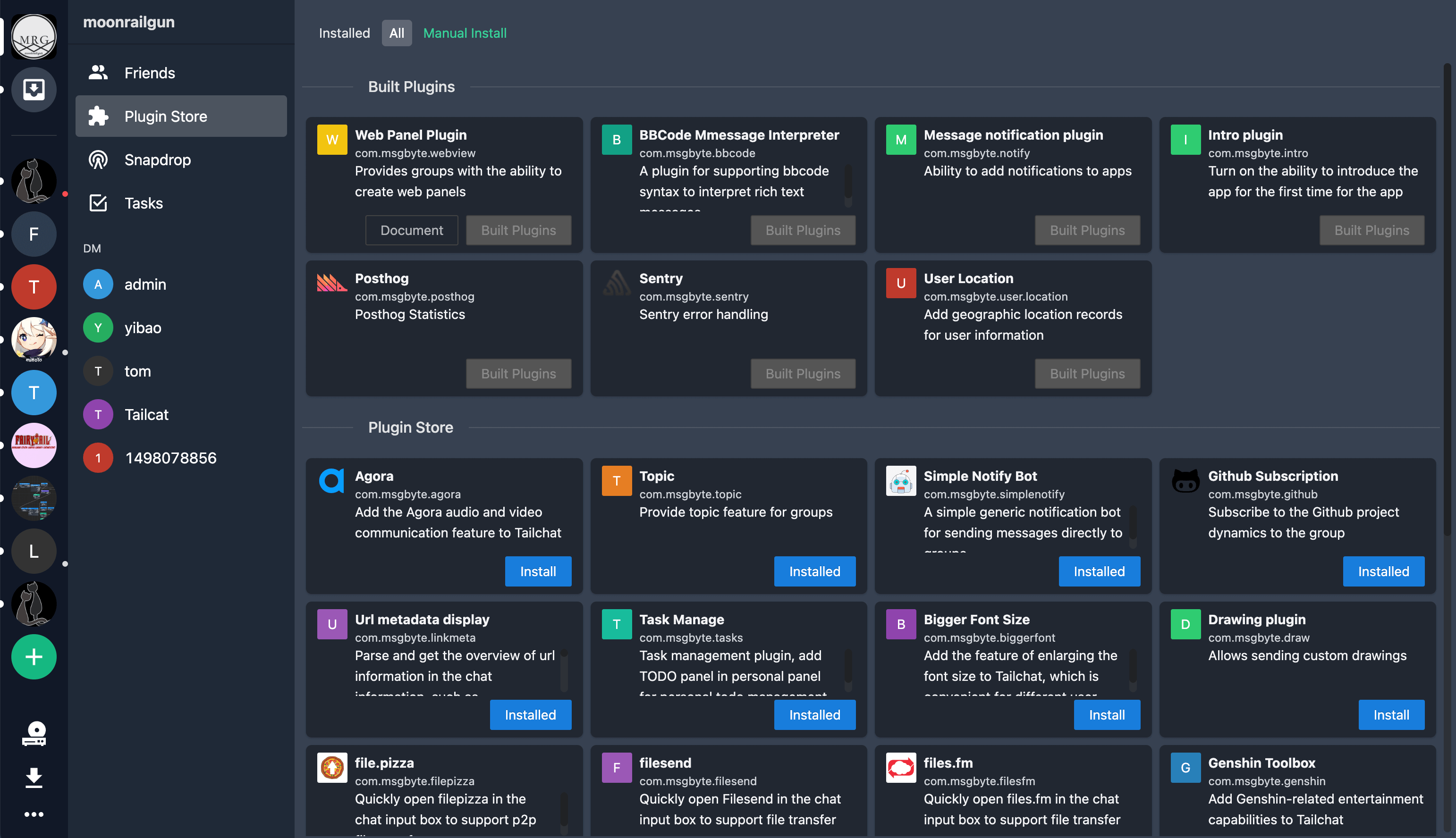
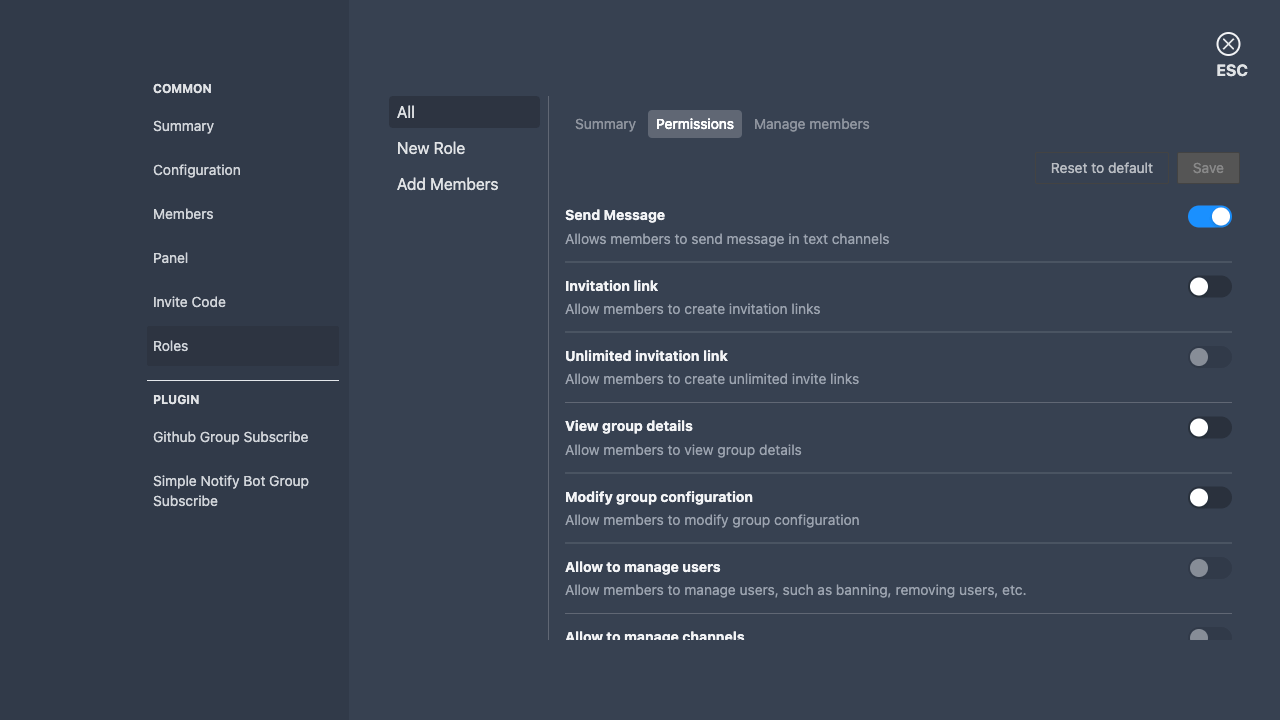
Preview
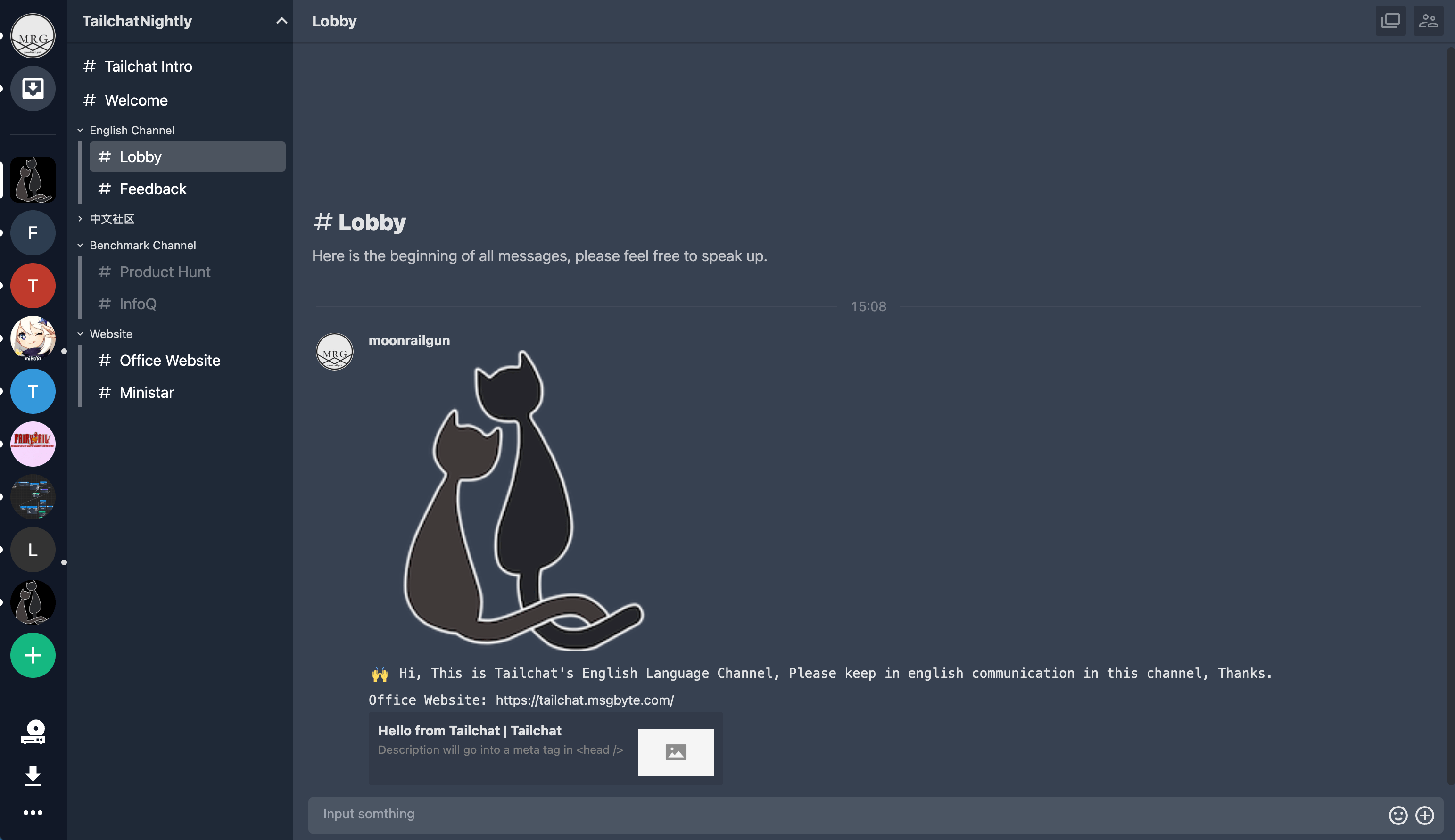
Visit the official website to learn more: https://tailchat.msgbyte.com/

Quick Deploy

Deploy on Sealos

Deploy on Sealos

Deploy on ClawCloud Run

Run on ClawCloud

Communication

If you are interested in Tailchat, welcome to join Tailchat's seed user exchange group, your feedback can help Tailchat grow better

Tailchat

Tailchat Nightly Group

Producthunt

Tailchat - The next-generation noIM Application in your own workspace | Product Hunt

Project Activity

Alt

License

Apache 2.0

Frequently asked questions

Is tailchat free to use?

tailchat is open source under the Apache-2.0 licence. There is no licence fee and no seat count — you can self-host it or, where the project offers one, pay a vendor for a managed version instead.

What does tailchat do?

Next generation noIM application in your own workspace, not only another Slack/Discord/Rocket.chat

What is tailchat written in?

tailchat is primarily written in TypeScript. Its source is publicly available at https://github.com/msgbyte/tailchat, and it has 3,644 GitHub stars.