SwarmClaw


The self-hosted AI agent runtime and multi-agent framework for autonomous agents. Open-source agent swarms with durable agent memory, MCP tools, skills, delegation, schedules, and 23+ LLM providers — a practical Claude Code and LangChain alternative.
SwarmClaw is an open-source, self-hosted AI agent runtime and multi-agent framework. Run autonomous AI agents, agent swarms, and orchestrators with heartbeats, schedules, delegation, agent memory, runtime skills, and reviewed conversation-to-skill learning — across OpenClaw gateways, Claude, GPT, Gemini, OpenRouter, Ollama, and 23+ other providers. Use it as your AI agent dashboard, agent orchestration platform, and home base for self-hosted multi-agent AI workflows.
GitHub: https://github.com/swarmclawai/swarmclaw
Docs: https://swarmclaw.ai/docs
Website: https://swarmclaw.ai
Discord: https://discord.gg/sbEavS8cPV
Extension tutorial: https://swarmclaw.ai/docs/extension-tutorial
Screenshots
|
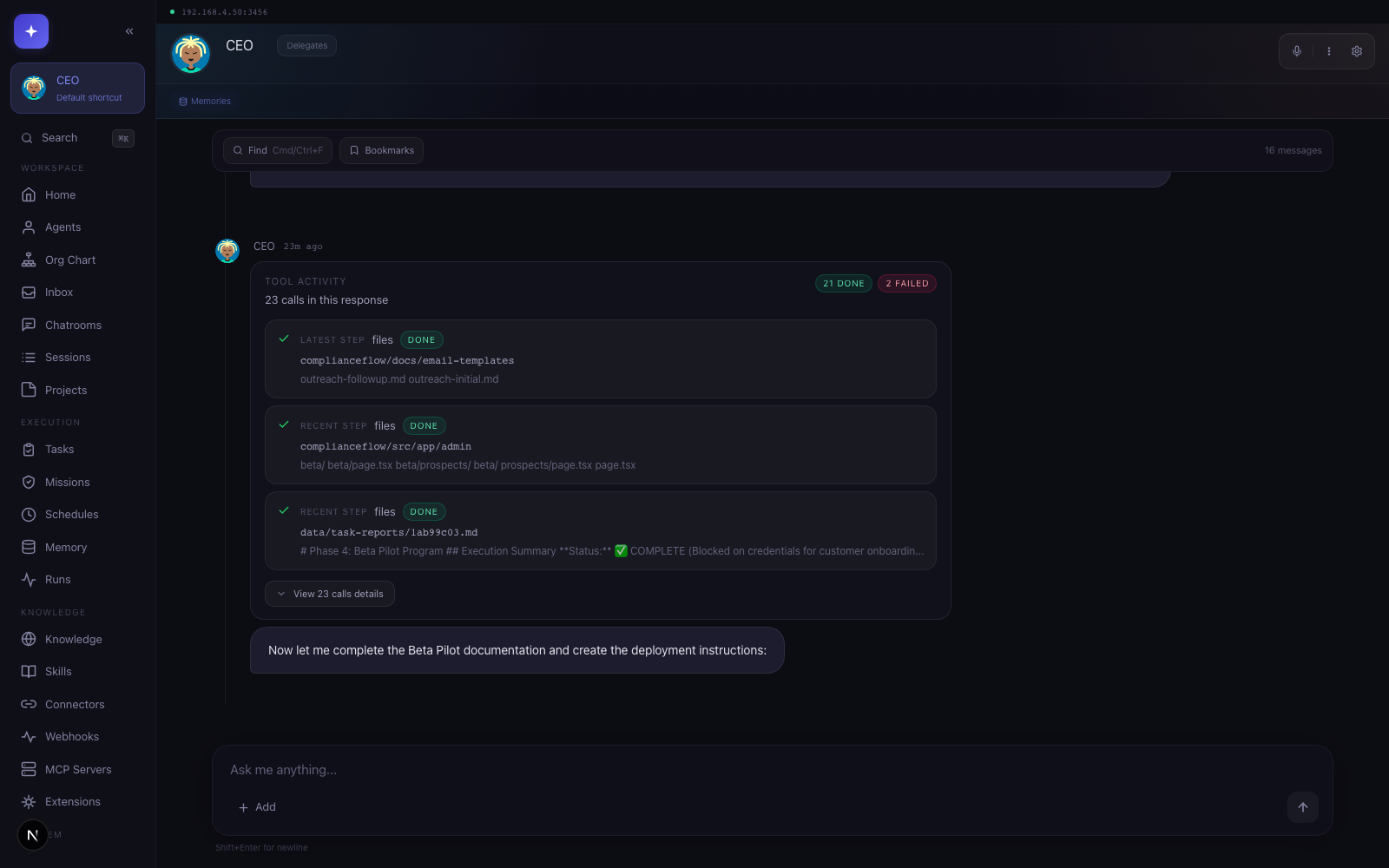 |
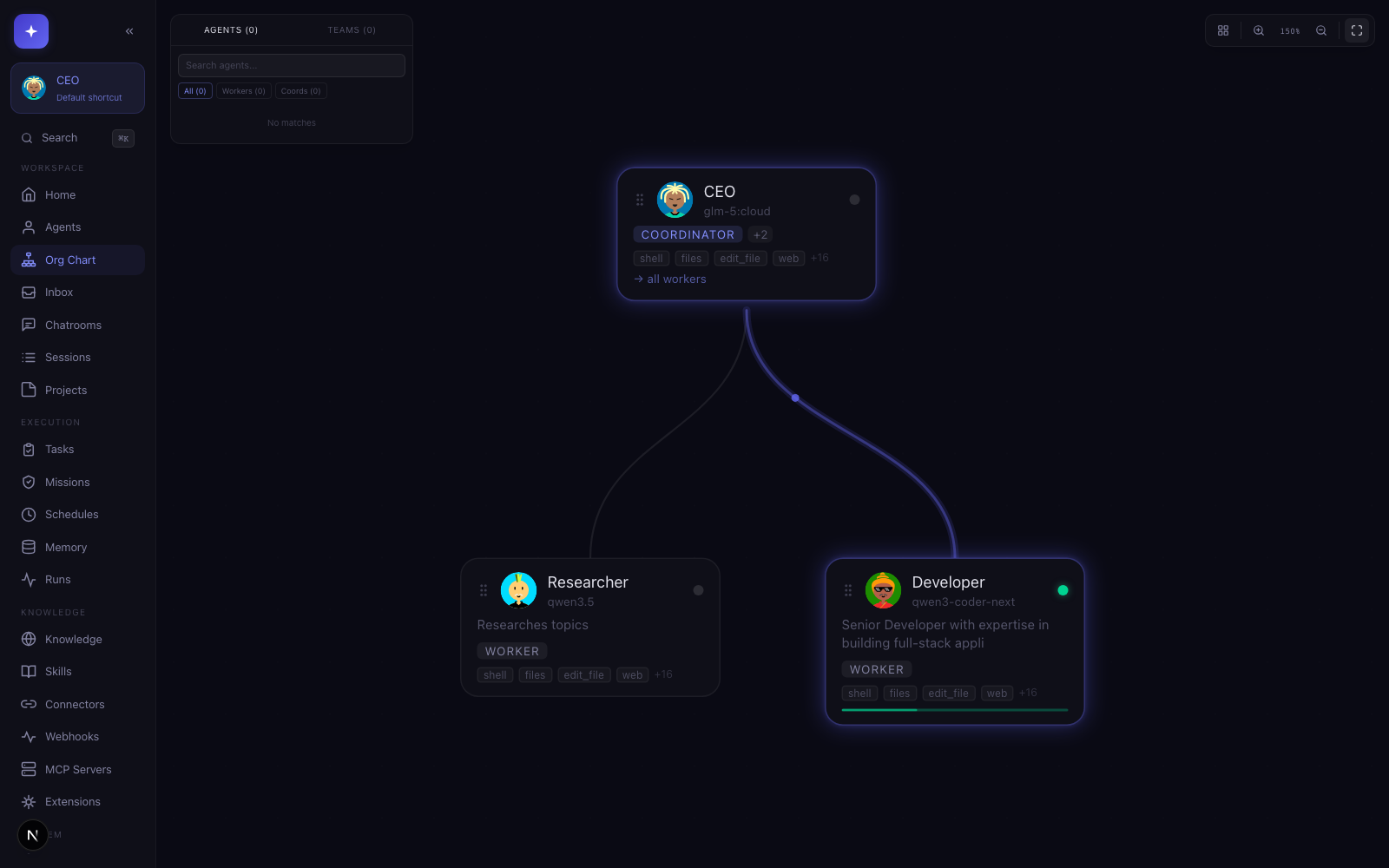
| Org chart for visualizing agent teams, delegation, and live activity. | Agent chat with durable history, tools, and operator controls. |
| Works with |
 OpenClaw |
 Hermes |
 Claude Code |
 Codex |
 Gemini CLI |
 OpenCode |
 Copilot |
 Droid |
 Cursor |
 Qwen Code |
 Goose |
 Anthropic |
 OpenAI |
 OpenRouter |
 Gemini |
 Ollama |
 DeepSeek |
 Groq |
 Together |
 Mistral |
 xAI |
 Fireworks |
 Nebius |
 DeepInfra |
Requirements
- Node.js 22.6+ (
nvm usewill pick up the repo's.nvmrc, which matches CI) - npm 10+ or another supported package manager
- Docker Desktop is recommended for sandbox browser execution
- Optional provider CLIs if you want delegated CLI backends such as Claude Code, Codex, OpenCode, Gemini, Copilot, Factory Droid, Cursor Agent, Qwen Code, or Goose
Quick Start
Desktop app (recommended for non-technical users)
Download the one-click installer from swarmclaw.ai/downloads. Available for macOS (Apple Silicon & Intel), Windows, and Linux (AppImage + .deb).
The release workflow supports Developer ID signing and notarization when Apple credentials are configured. If a macOS build is still ad-hoc signed, first launch may need one manual approval:
- macOS: signed/notarized releases publish both
.dmgand.zip; unsigned fallback releases publish.ziponly to avoid the damaged unsigned DMG path. Right-click the app in Finder → Open → Open to bypass Gatekeeper. If macOS instead reports "SwarmClaw is damaged and can't be opened" (common when a downloaded app was quarantined by Safari), strip the quarantine attribute and relaunch:xattr -dr com.apple.quarantine /Applications/SwarmClaw.app - Windows: if SmartScreen appears, click More info → Run anyway.
- Linux (AppImage):
chmod +xthe downloaded file, then run it.
Data lives in your OS app-data directory (~/Library/Application Support/SwarmClaw,
%APPDATA%\SwarmClaw, or ~/.config/SwarmClaw), separate from any CLI or Docker install.
Global install
npm i -g @swarmclawai/swarmclaw
swarmclaw
yarn global add @swarmclawai/swarmclaw
swarmclaw
pnpm add -g @swarmclawai/swarmclaw
swarmclaw
bun add -g @swarmclawai/swarmclaw
swarmclaw
Running swarmclaw starts the server on http://localhost:3456.
From the repo
git clone https://github.com/swarmclawai/swarmclaw.git
cd swarmclaw
nvm use
npm run quickstart
npm run quickstart installs dependencies, prepares local config and runtime state, and starts SwarmClaw.
Docker
git clone https://github.com/swarmclawai/swarmclaw.git
cd swarmclaw
mkdir -p data
touch .env.local
docker compose up -d --build
Then open http://localhost:3456.
ClawHub Skill
Install the SwarmClaw skill for your OpenClaw agents:
openclaw skills install swarmclaw
v1.9.39 Highlights
Scheduled-run reliability release: stale workspace rebinding, fail-fast credential checks, and durable delivery evidence for schedule-driven sends.
- Legacy workspace cwd migration. Scheduled reruns and reused schedule sessions pinned to a pre-migration workspace root (e.g.
~/.swarmclaw/workspace) are now rebound to the currentWORKSPACE_DIRautomatically; intentional custom working directories are never touched. - Orphan recovery dedup. Startup queue recovery now recovers each orphaned task once instead of re-logging it every tick, and dead-letters tasks that repeatedly return to the queue without starting.
- Schedule delivery status. Every scheduled run now writes
lastDeliveryStatus/lastDeliveryErrorback to its schedule, so failures are visible without digging through task records. - Credential preflight for schedules. Scheduled runs on API-key providers fail fast with an actionable error when no credential resolves, instead of dying on a 401 deep in execution.
- Empty-run classification. Runs that produce no text, no tool calls, and no error now fail with a clear provider-configuration message instead of a gene