

Supabase is a free, open source frameworks & platforms project written in TypeScript and released under Apache-2.0. It has 109,900 GitHub stars, 14,114 forks and 1,128 open issues, and was last pushed 5 hours ago. On this registry it ranks #2 of 28 tracked projects in Frameworks & Platforms, and is listed as an open source replacement for 1 paid product, with 5 head-to-head comparisons available. It gained 815 stars over the last 6 tracked days.

Supabase — Postgres-powered backend platform for production apps

What is Supabase?

Supabase is an open-source, Apache-2.0 licensed Postgres development platform that bundles a dedicated Postgres database with authentication, auto-generated APIs, realtime subscriptions, file storage, and edge functions for developers building web, mobile, and AI applications.

What it is

Supabase is a combination of enterprise-grade open source tools assembled into a single backend platform. The project describes its goal as building the features of Firebase using open source products: where an MIT, Apache 2, or equivalent licence exists in the ecosystem, Supabase adopts and supports that tool, and where one does not exist, the project builds and open sources it. The stack is written primarily in TypeScript and lives in the Postgres and JavaScript ecosystem, with modular client libraries implemented per language.

The concrete problem it solves is backend assembly. Building an application normally means wiring together a REST or GraphQL layer, a JWT-based authentication service with sign-ups, logins, and session management, a websocket channel for database change notifications, and a file storage service with its own permission model. Supabase replaces that assembly work with pre-integrated components that all sit on one Postgres database, so authorization rules and application data live in the same place. The specific thing it replaces is Firebase, which the README names directly as the product whose developer experience Supabase aims to reproduce on open source foundations.

Key capabilities

  • Hosted Postgres database as the single data store, with a web dashboard for administration.
  • Auto-generated APIs, covering REST through PostgREST and GraphQL through the pg_graphql PostgreSQL extension.
  • Authentication and authorization through GoTrue, a JWT-based authentication API for sign-ups, logins, and session management.
  • Realtime subscriptions via the Realtime server, an Elixir service that polls Postgres replication, converts inserts, updates, and deletes to JSON, and broadcasts them over websockets to authorized clients.
  • File storage through a RESTful API that manages files in S3 while Postgres handles permissions.
  • Functions in two forms: database functions inside Postgres and Edge Functions on Deno.
  • AI and vector/embeddings toolkit, supported by the pgvector and Postgis topics listed for the repository.
  • postgres-meta, a RESTful API for managing Postgres that can fetch tables, add roles, and run queries, with Envoy serving as the edge and service proxy.

Who uses it and how

  • Application teams building web and mobile products on Next.js and similar frameworks who want Firebase-style development speed while keeping their data in Postgres.
  • AI application builders who need embeddings and vector search, using the pgvector extension and the AI toolkit alongside the same database that holds application records.
  • Self-hosting teams running the full stack on their own infrastructure rather than the hosted platform.
  • Organizations with production database and infrastructure problems, which the README routes to a dedicated business support channel, while general build questions and database best practices go to the community forum and Discord.
  • Developers who run the whole platform locally during development before deploying.

Getting started

Sign up on the hosted platform at supabase.com/dashboard and start without installing anything, or follow the self-hosting guide and the local development guide to run the stack yourself.

How it compares

The registry positions this project as the open alternative to Supabase (hosted): same platform capabilities, but under Apache-2.0 with the source available, so a team can run it on its own infrastructure and keep control of its data. The hosted offering removes that operational burden and is documented as the path that requires no installation, which makes it the faster route for teams without infrastructure capacity. The trade is between licensing and data ownership on one side and managed convenience on the other.

When to use it — and when not to

Self-hosting means operating a multi-service stack: Postgres, the Realtime Elixir server, GoTrue, the storage API with its S3 dependency, PostgREST, postgres-meta, and Envoy as the proxy, so a team without ops capacity should take the hosted path instead. The repository carries 1,128 open issues, and the README excerpt is thin on in-repo setup, pointing readers to external documentation and a separate developers guide for contribution. Anyone who wants a backend without running or paying for a Postgres-based platform should look elsewhere.

project readme (upstream, from github) — read inline

Supabase

Supabase is the Postgres development platform. We're building the features of Firebase using enterprise-grade open source tools.

  • Hosted Postgres Database. Docs
  • Authentication and Authorization. Docs
  • Auto-generated APIs.
  • Functions.
    • Database Functions. Docs
    • Edge Functions Docs
  • File Storage. Docs
  • AI + Vector/Embeddings Toolkit. Docs
  • Dashboard

Supabase Dashboard

Watch "releases" of this repo to get notified of major updates.
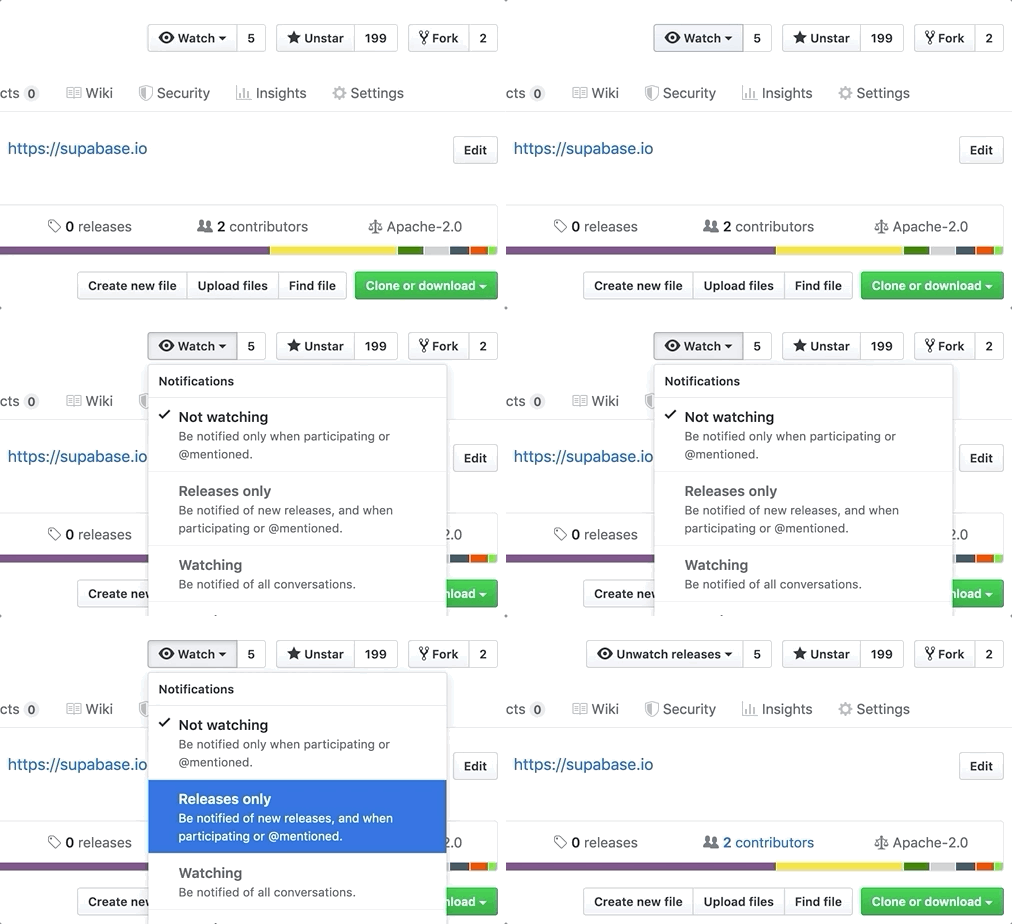
Watch this repo

Documentation

For full documentation, visit supabase.com/docs

To see how to Contribute, visit Getting Started

Community & Support

  • Community Forum. Best for: help with building, discussion about database best practices.
  • GitHub Issues. Best for: bugs and errors you encounter using Supabase.
  • Email Support. Best for: problems with your database or infrastructure.
  • Discord. Best for: sharing your applications and hanging out with the community.

How it works

Supabase is a combination of open source tools. We’re building the features of Firebase using enterprise-grade, open source products. If the tools and communities exist, with an MIT, Apache 2, or equivalent open license, we will use and support that tool. If the tool doesn't exist, we build and open source it ourselves. Supabase is not a 1-to-1 mapping of Firebase. Our aim is to give developers a Firebase-like developer experience using open source tools.

Architecture

Supabase is a hosted platform. You can sign up and start using Supabase without installing anything. You can also self-host and develop locally.
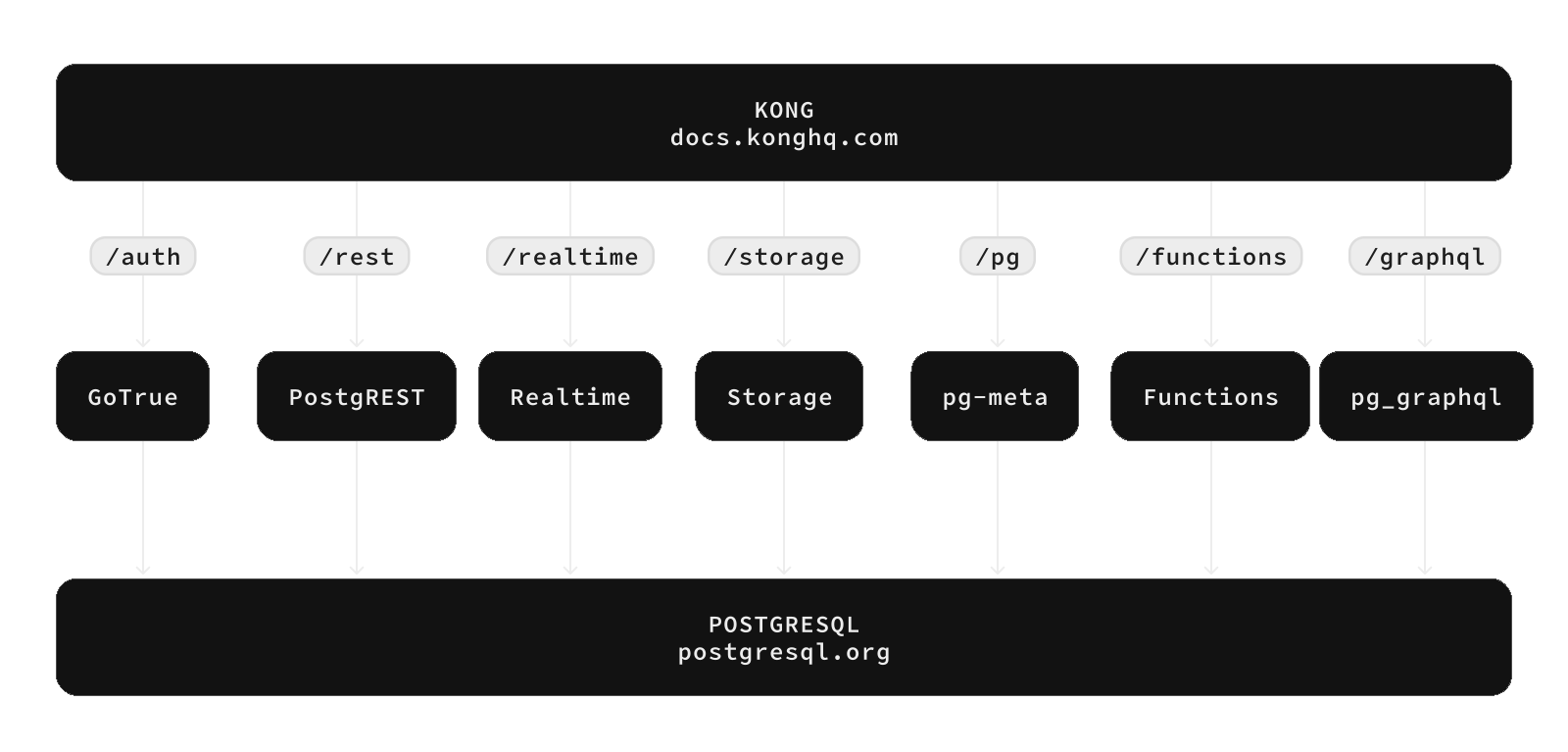
Architecture

  • Postgres is an object-relational database system with over 30 years of active development that has earned it a strong reputation for reliability, feature robustness, and performance.
  • Realtime is an Elixir server that allows you to listen to PostgreSQL inserts, updates, and deletes using websockets. Realtime polls Postgres' built-in replication functionality for database changes, converts changes to JSON, then broadcasts the JSON over websockets to authorized clients.
  • PostgREST is a web server that turns your PostgreSQL database directly into a RESTful API.
  • GoTrue is a JWT-based authentication API that simplifies user sign-ups, logins, and session management in your applications.
  • Storage a RESTful API for managing files in S3, with Postgres handling permissions.
  • pg_graphql a PostgreSQL extension that exposes a GraphQL API.
  • postgres-meta is a RESTful API for managing your Postgres, allowing you to fetch tables, add roles, and run queries, etc.
  • Envoy is a cloud-native, high-performance edge and service proxy.
Client libraries

Our approach for client libraries is modular. Each sub-library is a standalone implementation for a single external system. This is one of the ways we support existing tools.

Language Client Feature-Clients (bundled in Supabase client)
Supabase PostgREST GoTrue Realtime Storage Functions
⚡️ Official ⚡️
JavaScript (TypeScript) supabase-js postgrest-js auth-js realtime-js storage-js functions-js
Flutter supabase-flutter postgrest-dart gotrue-dart realtime-dart storage-dart functions-dart
Swift supabase-swift postgrest-swift auth-swift realtime-swift storage-swift functions-swift
Python readme truncated — read the full docs on github

Frequently asked questions

Is Supabase free to use?

Supabase is open source under the Apache-2.0 licence. There is no licence fee and no seat count — you can self-host it or, where the project offers one, pay a vendor for a managed version instead.

What does Supabase do?

Postgres-powered backend platform for production apps

What is Supabase written in?

Supabase is primarily written in TypeScript. Its source is publicly available at https://github.com/supabase/supabase, and it has 109,900 GitHub stars.

What is a good open source alternative to Supabase (hosted)?

Supabase is one of the open source options listed as an alternative to Supabase (hosted). Compare licences, stars and activity side by side on the Supabase profile.