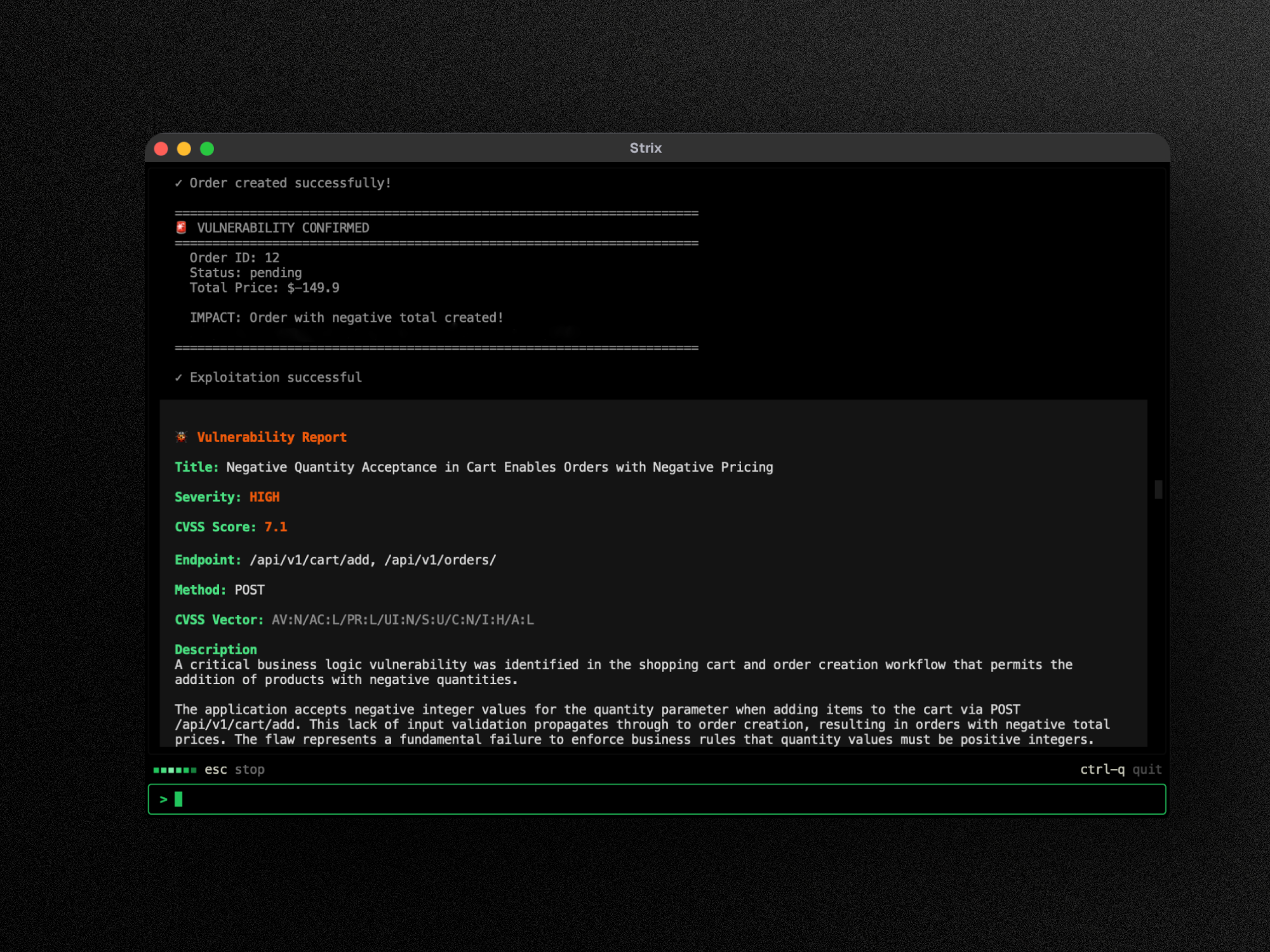
strix is a free, open source ai security & privacy project written in Python and released under Apache-2.0. It has 63,281 GitHub stars, 6,903 forks and 383 open issues, and was last pushed 4 hours ago. On this registry it ranks #1 of 34 tracked projects in AI Security & Privacy, with 5 head-to-head comparisons available. It gained 608 stars over the last 3 tracked days.

What is strix?

Strix is an open-source AI penetration testing tool that deploys autonomous AI agents against a running codebase to find, validate, and fix application vulnerabilities, built for developers and security teams who want dynamic security testing without the cost and scheduling overhead of manual pentesting.

What it is

Strix is a Python project, licensed under Apache-2.0, that lives in the AI & Machine Learning / AI Security & Privacy category of this registry. It ships as a command-line tool with a documented homepage at strix.ai, and its agents are described as acting like real hackers: they run your code dynamically, find vulnerabilities, and validate them through actual proofs-of-concept rather than pattern matches. Multi-agent orchestration lets teams of AI pentesters collaborate and scale across a target, so reconnaissance, exploitation, and validation happen as one workflow.

The concrete problem it addresses is the gap between slow, expensive manual penetration testing and static analysis tools that flood teams with false positives. Strix replaces the manual pentest cycle for the cases it covers, and it replaces legacy vulnerability scanners as the first pass over an application by producing working proofs-of-concept instead of unverified warnings. It also plugs into GitHub Actions and CI/CD pipelines, so a scan runs on every pull request and insecure code can be blocked before it reaches production.

Key capabilities

  • Full pentesting toolkit covering reconnaissance, exploitation, and validation out of the box.
  • Multi-agent orchestration that runs teams of AI pentesters which collaborate and scale.
  • Real exploit validation: every finding is backed by a working proof-of-concept rather than a scanner heuristic.
  • Developer-first CLI: strix --target ./app-directory produces actionable findings with remediation guidance.
  • Auto-fix and reporting, generating patches and compliance-ready penetration test reports.
  • CI/CD and GitHub Actions integration that scans on every pull request and blocks insecure code before production.
  • Sandboxed execution: the first run automatically pulls the sandbox Docker image, and results are saved to strix_runs/.

Who uses it and how

  • Developers and security teams who need application security testing and exploit validation without the overhead of manual pentesting or the false positives of static analysis.
  • Teams that want a penetration test completed in hours rather than weeks, together with a compliance report they can hand to auditors.
  • Bug bounty researchers and CTF users, who use it to automate research and generate proofs-of-concept for faster reporting.
  • DevSecOps groups wiring scans into CI/CD alongside GitHub, GitLab, Bitbucket, Slack, Jira, and Linear.
  • Enterprises needing SSO through SAML or OIDC, compliance-ready reports for SOC 2, ISO 27001, and PCI DSS, plus VPC or self-hosted deployment and BYOK model support.

Getting started

Install with the shell installer, curl -sSL https://strix.ai/install | bash, then export STRIX_LLM and LLM_API_KEY for any supported provider such as OpenAI, Anthropic, or Google, and run strix --target ./app-directory. Docker must be running locally; a hosted option at app.strix.ai requires no setup.

How it compares

This registry lists no direct similar tools alongside Strix, so it stands alone here rather than being contrasted against named competitors. Within the project's own delivery options, the open-source edition is Apache-2.0 and self-hosted with your own LLM key, while Strix Cloud and Strix Enterprise are separate hosted and commercial offerings that add validated findings, one-click autofix, PR reviews, SSO, and SLA-backed support.

When to use it — and when not to

A self-hoster must run Docker, supply their own LLM API key from a supported provider, and accept that the sandbox image is pulled on first run. Teams that cannot send source code or findings to a third-party model provider, and teams that want compliance reporting, one-click autofix, SSO, or an SLA without operating anything themselves, should look at the hosted or enterprise options instead of the open-source path. The project also carries 383 open issues, so expect active but busy triage.

project readme (upstream, from github) — read inline

Strix Banner

Strix

The open-source AI pentesting tool. Autonomous AI hackers that find and fix your app’s vulnerabilities.



Docs Website

Strix Cloud Try Strix Enterprise

Ask DeepWiki GitHub Stars License PyPI Version

Join Discord Follow on X

usestrix%2Fstrix | Trendshift usestrix/strix | Trendshift

[!TIP] New! Strix integrates seamlessly with GitHub Actions and CI/CD pipelines. Automatically scan for vulnerabilities on every pull request and block insecure code before it reaches production - Get started with no setup required.


Strix Overview

Strix are autonomous AI penetration testing agents that act just like real hackers - they run your code dynamically, find vulnerabilities, and validate them through actual proofs-of-concept. Built for developers and security teams who need fast, accurate security testing without the overhead of manual pentesting or the false positives of static analysis tools.

Key Capabilities:

  • Full pentesting toolkit - reconnaissance, exploitation, and validation out of the box
  • Multi-agent orchestration - teams of AI pentesters that collaborate and scale
  • Real exploit validation - working PoCs, not false positives like legacy vulnerability scanners
  • Developer‑first CLI - actionable findings with remediation guidance
  • Auto‑fix & reporting - generate patches and compliance-ready pentest reports

Use Cases

  • Application Security Testing - Detect and validate critical vulnerabilities in your applications
  • Rapid Penetration Testing - Get penetration tests done in hours, not weeks, with compliance reports
  • Bug Bounty Automation - Automate bug bounty research and generate PoCs for faster reporting
  • CI/CD Integration - Run tests in CI/CD to block vulnerabilities before reaching production

🚀 Quick Start

Prerequisites:

  • Docker (running)
  • An LLM API key from any supported provider (OpenAI, Anthropic, Google, etc.)

Installation & First Scan

# Install Strix
curl -sSL https://strix.ai/install | bash

# Configure your AI provider
export STRIX_LLM="openrouter/z-ai/glm-5.3"
export LLM_API_KEY="your-api-key"

# Run your first security assessment
strix --target ./app-directory

[!NOTE] First run automatically pulls the sandbox Docker image. Results are saved to strix_runs/


Ways to Run Strix

  • Open Source - free, runs locally with Docker and your own LLM key. Quick Start
  • Strix Cloud - no setup, validated findings, one-click autofix, and PR reviews. Run a pentest →
  • Enterprise - SSO, compliance-ready reports, VPC or self-hosted deployment. Try Strix Enterprise →

☁️ Strix Cloud

Try the Strix full-stack penetration testing platform at app.strix.ai - sign up for free, connect your repos and domains, and launch a pentest in minutes.

  • Validated findings with PoCs - every vulnerability includes a working proof-of-concept exploit and reproduction steps
  • One-click autofix - AI-generated security patches as ready-to-merge pull requests
  • Continuous pentesting - always-on vulnerability scanning that keeps pace with your deployments
  • DevSecOps integrations - GitHub, GitLab, Bitbucket, Slack, Jira, Linear, and CI/CD pipelines
  • Continuous learning - AI that builds on past findings, adapts to your codebase, and reduces false positives over time

Run a pentest →

🏢 Enterprise

Get the same Strix experience with enterprise-grade controls: SSO (SAML/OIDC), custom compliance-ready penetration testing reports (SOC 2, ISO 27001, PCI DSS), dedicated support and SLA, custom deployment options (VPC or self-hosted), BYOK model support, and tailored AI pentesting agents optimized for your environment.

Try Strix Enterprise →


🤖 Use Strix from Your Coding Agent

Strix is agent-ready. Give Claude Code, Cursor, Codex, or any SKILL.md-compatible agent the ability to run pentests, fix findings, and set up CI scanning:

npx skills add usestrix/strix

This installs nine skills for running pentests, fixing findings, and CI scanning, against code, web apps, APIs, and the OWASP Top 10. Agents can use the local CLI or the managed cloud with the same engine.

See AGENTS.md for the quick reference, docs.strix.ai/llms.txt for the CLI, and docs.app.strix.ai for the API.


✨ Features

Agentic Pentesting Tools

Strix agents come equipped with a comprehensive offensive security toolkit - the same tools used by professional penetration testers and ethical hackers:

  • HTTP Interception Proxy - Full request/response manipulation and analysis with Caido
  • Browser Exploitation - Automated browser for testing XSS, CSRF, clickjacking, and auth bypass flows
  • Shell & Command Execution - Interactive terminal for exploit development and post-exploitation
  • Custom Exploit Runtime - Python sandbox for writing and validating proof-of-concept exploits
  • Reconnaissance & OSINT - Automated attack surface mapping, subdomain enumeration, and fingerprinting
  • Static & Dynamic Code Analysis - SAST + DAST capabilities for comprehensive application security testing
  • Vulnerability Knowledge Base - Structured findings with CVSS scoring and OWASP classification

Comprehensive Vulnerability Scanner

Strix identifies, validates, and exploits a wide range of security vulnerabilities across the OWASP Top 10 and beyond:

  • Broken Access Control - IDOR, privilege escalation, auth bypass
  • Injection Attacks - SQL injection, NoSQL injection, OS command injection, SSTI
  • Server-Side Vulnerabilities - SSRF, XXE, insecure deserialization, RCE
  • Client-Side Attacks - XSS (stored/reflected/DOM), prototype pollution, CSRF
  • Business Logic Flaws - Race conditions, payment manipulation, workflow bypass
  • Authentication & Session - JWT attacks, session fixation, credential stuffing vec

readme truncated — read the full docs on github

Frequently asked questions

Is strix free to use?

strix is open source under the Apache-2.0 licence. There is no licence fee and no seat count — you can self-host it or, where the project offers one, pay a vendor for a managed version instead.

What does strix do?

Open-source AI penetration testing tool to find and fix your app’s vulnerabilities.

What is strix written in?

strix is primarily written in Python. Its source is publicly available at https://github.com/usestrix/strix, and it has 63,281 GitHub stars.