RxDB is a local-first, reactive NoSQL database for JavaScript applications, aimed at developers building offline-capable or realtime user interfaces who want client-side data storage and sync through their own backend rather than a hosted vendor.
What it is
RxDB (short for Reactive DataBase) is a local-first NoSQL database for JavaScript applications, first released in 2018 and written in TypeScript under the Apache-2.0 licence. Reactive means applications can not only query the current state but also subscribe to state changes, such as the result of a query or even a single field of a document. It lives in the JavaScript and TypeScript ecosystem and runs on every runtime that executes JavaScript, including browsers, Node.js, React Native, Capacitor, NativeScript, Flutter and Electron.
The concrete problem it solves is the split between client-side data and backend infrastructure. RxDB replaces the pattern of binding an application to one vendor's hosted database and SDK with a storage interface plus a sync engine. The storage interface lets the underlying storage engine be swapped out, so the same database code runs in different JavaScript environments by changing only the storage settings. The sync engine replicates with existing infrastructure: the protocol works by implementing three HTTP endpoints, and no specific cloud or backend database is required.
Key capabilities
- Reactive queries that subscribe to all state changes, including the result of a query or a single field of a document.
- Pluggable storage layer, with adapters for LocalStorage, IndexedDB, OPFS, LokiJS, Dexie.js, in-memory, SQLite, WebWorker threads, FoundationDB and DenoKV.
- Replication protocol implemented as three HTTP endpoints, plus production-ready plugins for GraphQL, CouchDB, Websocket, WebRTC (P2P), Supabase, Firestore, NATS and Google Drive.
- Schema validation through versioned collection schemas created with
addCollections, using a primaryKey and typed properties.
- Query API in the
find({ selector: { healthpoints: { $gt: 0 } } }).exec() style, returning results once or as a subscription.
- Feature plugin set covering attachments, encryption, compression, migration, ORM, conflict handling, CRDT, backup, replication server, middleware, logging, local documents, population and Signals.
- Database creation through
createRxDatabase imported from rxdb/plugins/core, with storage imported separately from paths such as rxdb/plugins/storage-localstorage.
Who uses it and how
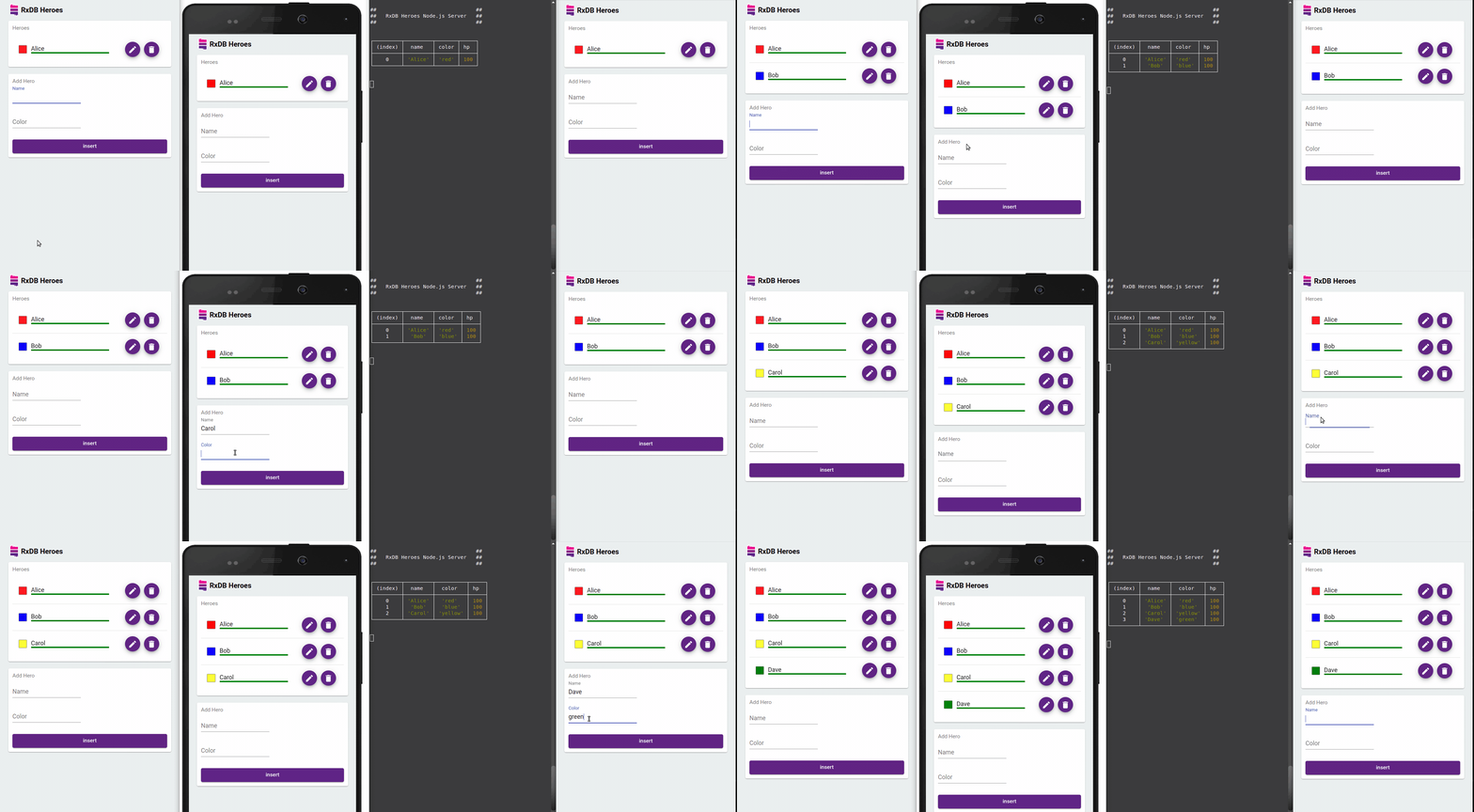
- Realtime multiplayer and collaborative applications that need subscriptions to query results and document fields for live UI updates.
- Offline-first mobile apps built with React Native, Capacitor, NativeScript or Flutter, where the client keeps a local database and syncs when connectivity allows.
- Electron desktop applications using RxDB as an embedded database on the client machine.
- Teams already running CouchDB, GraphQL, Supabase, Firestore or NATS backends that want replication instead of a backend replacement, by implementing the three HTTP endpoints or using an existing plugin.
- Node.js services that reuse the same database code as the client by swapping the storage setting, rather than maintaining separate data access code per runtime.
Getting started
Install with npm install rxdb rxjs --save, then follow the quickstart and install documentation at rxdb.info. No hosted service is required; the database runs against whichever storage adapter is selected for the target runtime.
How it compares
Among the tools named in its own topics and plugin list, Firebase, Firestore and Supabase supply a managed backend and cloud service, while CouchDB supplies a server database with its own replication protocol. RxDB sits on the client instead, storing data locally and replicating to those systems or to plain HTTP endpoints, which is how it avoids vendor and lock-in. The choice is about where data ownership and the sync contract live rather than about feature parity with a hosted backend.
When to use it — and when not to
A self-hoster must operate the replication backend, whether that means implementing and securing the three HTTP endpoints or running an existing CouchDB, NATS, Supabase or GraphQL service, and must also choose and operate one of the supported storage engines. Teams that want a turnkey managed backend with no client database code should not pick it, and projects that only need simple key-value persistence may find the schema, migration and replication machinery heavier than necessary. The README excerpt also defers most operational and scaling detail to the external rxdb.info documentation, so the repository itself is not the place to look for deployment guidance.
Last push to the repository is dated 2026-09-17, with 23,383 stars and 17 open issues.
project readme (upstream, from github) — read inline
A fast, local-first, reactive Database for JavaScript Applications









 What is RxDB?
RxDB (short for Reactive Database) is a local-first, NoSQL-database for JavaScript Applications.
Reactive means that you can not only query the current state, but subscribe to all state changes like the result of a query or even a single field of a document.
This is great for UI-based realtime applications in a way that makes it easy to develop and also has great performance benefits.
Use the quickstart, read the documentation or explore the example projects.
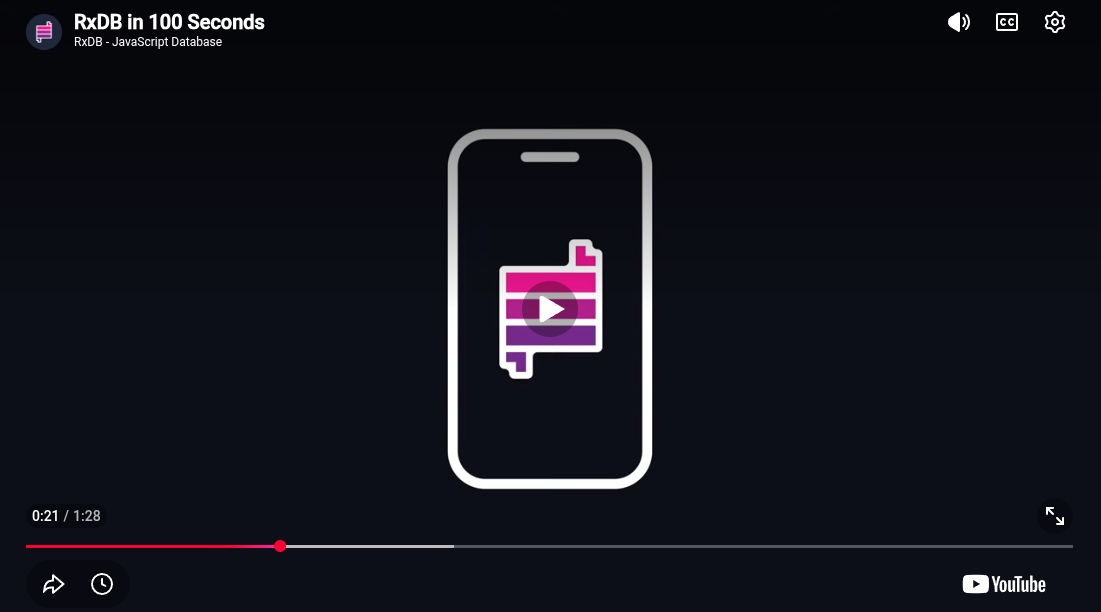
 Used by many
RxDB is a proven technology used by thousands of developers worldwide. With its flexibility, RxDB is used in a diverse range of apps and services.

(add yours)
 Multiplayer realtime applications

 Replicate with your existing infrastructure
RxDB provides an easy to implement, battle-tested Sync Engine for realtime replication with your existing infrastructure.
You do not have to use a specific cloud or backend database. The protocol works by implementing three simple HTTP endpoints.
There are also production-ready plugins to easily replicate with GraphQL, CouchDB, Websocket, WebRTC (P2P), Supabase, Firestore, NATS or Google Drive.
 Flexible storage layer
RxDB is based on a storage interface that enables you to swap out the underlying storage engine. This increases code reuse because the same database code can be used in different JavaScript environments by just switching out the storage settings.
You can use RxDB on top of LocalStorage, IndexedDB, OPFS, LokiJS, Dexie.js, in-memory, SQLite, in a WebWorker thread and even on top of FoundationDB and DenoKV.
No matter what kind of runtime you have, as long as it runs JavaScript, it can run RxDB:
All the features that you need
Since its beginning in 2018, RxDB has gained a huge set of features and plugins which makes it a flexible full solution regardless of which type of application you are building. Every feature that you need now or might need in the future is already there.


 Browsers
 Node.js
 React Native
 Capacitor
 NativeScript
 Flutter
or as an
Flutter
or as an  Electron Database