
Rome
The agentic OS for humans and agents.




Website · Try Rome Cloud · Documentation · App Store
What is Rome?
Most progress in AI comes from scaling models. Rome scales the other axis, the environment: the tools, workflows, memory, and interfaces an agent works within (why this matters).
Rome is a guardrailed environment where human and agent collaborate, and the collaboration compounds. Agents build their own harnesses, design their own SOPs, and orchestrate workflows under your guidance. Proven capabilities stick. Every interaction raises the ceiling for the next.
Rome also works as an open source alternative to Grok Bot and Meta's Muse for persistent agents, scheduled tasks, and custom apps.
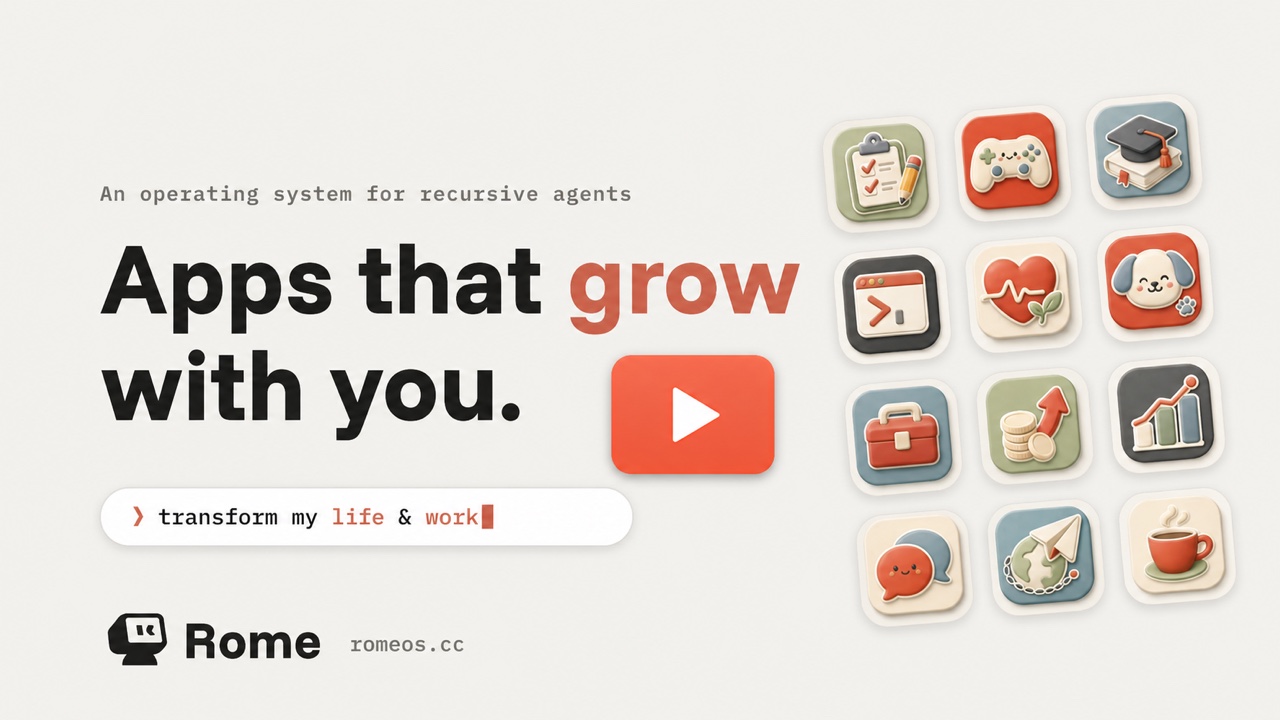
Get started
Rome Cloud
Rome Cloud provisions a private Rome environment for each guardian. It is currently available as a preview.
Run with Docker
One script checks for Docker, pulls the published image, and starts Rome:
curl -fsSL https://raw.githubusercontent.com/rome-os/rome/main/scripts/quickstart-docker.sh | bash
Or clone the repository and run the script from it:
git clone https://github.com/rome-os/rome.git
cd rome
./scripts/quickstart-docker.sh
The dashboard comes up at http://localhost:7663, bound to loopback only.
First-run onboarding is open to whoever reaches it first, so exposing it
beyond the machine takes an explicit --bind. State lives in named Docker
volumes, so re-running the script upgrades the container without losing data.
Telemetry export stays off unless you set OTEL_EXPORTER_OTLP_ENDPOINT. Run
the script with --help for ports, profiles, and the other settings it
forwards.
Run the development environment
To run this repository from source, you need:
- Node.js 24 or newer
- Corepack and pnpm 11.6
- Docker with Docker Compose
From a checkout of this repository:
corepack enable
pnpm install
pnpm dev:all
pnpm dev:all starts the production-shaped local stack: Rome, observability,
routing, and the web development server. It connects to https://romeos.cc by
default; set ROME_DEV_PANTHEON_ORIGIN to use another Rome Cloud deployment.
The script prints the local URLs and development credentials when startup completes.
This is the contributor development path, not the final production self-hosting
distribution. See CLAUDE.md for the complete development loop,
container commands, and validation requirements.
Rome Apps
Rome App is the new way to interact with your agent.
Chat is a good place to ask for something once. Repeated work deserves a place of its own: an inbox that remembers what was triaged, a code review loop you can inspect, a price tracker that keeps watching, or a morning brief that arrives on schedule.
A Rome App combines a purpose-built interface, agent reasoning, reusable workflows, and persistent data into one installable product. It is not a thin wrapper around a prompt. The app remains useful after the conversation ends, after the browser closes, and when the user comes back tomorrow.
| Purpose-built UI & UX | AI-native | Persistent by default | Community-powered |
|---|---|---|---|
| An interface designed for the job | Agents are part of how the product works | Data and workflows carry forward | Install, share, and learn from other builders |
A useful rule of thumb: a workflow is a verb; an app is a noun. Use a workflow to perform a task and return a result. Build an app when the work needs a home of its own, with user-editable data, multiple actions, or a persistent agent.
Rome can build the missing app
When there is not an app for what you need, describe it to Rome in plain language. Rome can turn that request into a short specification, scaffold the app or workflow, build it into your instance, and keep iterating with you in the same conversation.
The result is ordinary, git-tracked source code rather than hidden model state. Keep it private, adapt it as your needs change, or publish it for others to install from the App Store. This creates Rome's self-evolution loop:
Describe a need → Rome builds the capability → the app keeps working
       ↑                                              ↓
       └──────────── refine, reuse, and share ────────┘
Under the hood
A Rome App starts with an app.yaml manifest and can ship any mix of:
| Artifact | Purpose |
|---|---|
| Actions | Typed operations that agents, routines, and app code can invoke |
| Agents | App-owned collaborators with their own instructions and tools |
| Skills | Plain-language procedures loaded when an agent needs them |
| Hooks | Extensions to message, event, and agent-turn lifecycles |
| Web UI & APIs | Purpose-built interfaces and app-owned HTTP surfaces |
| Database & files | Persistent, app-private state that survives across runs |
Together these form a capability: the unit Rome discovers and reuses in later work. The app is that capability's human interface: apps organize human interaction; capabilities organize agent action.
Apps build on two public SDKs:
@rome-os/app-runtimefor backend capabilities.@rome-os/app-web-sdkfor embedded web interfaces and the Rome build CLI.
Browse the Rome App Store, read the building guide, or start with the app quickstart.
What people do with Rome
These are the kinds of requests Rome is designed to follow through on:
| Run the code review loop “Fix all P1 and P2 review comments until there are no merge blockers left. Let me know when you finish.” |
Organize your email “Sort my inbox. Archive the noise, flag anything urgent, and draft replies for messages that need me.” |
| Track a game's price “Track the price of this game and let me know when it drops below $30.” |
Interview your customers “Interview five customers about onboarding. Ask follow-up questions and summarize what we should improve.” |
Rome can handle one-off tasks, scheduled work, long-running follow-through, and purpose-built app experiences without forcing everything into one chat window.
How Rome compares
Rome sits where two product waves meet: persistent agents and personal software. The agent products share Rome's thesis that agents should persist and improve. There the comparison is what accumulates, what runs when work repeats, and where you operate the result. The personal software platforms share Rome's thesis that software should be built per person. There the comparison is who and what stands behind the app.
| What accumulates | What runs repeated work | Where you operate it | Hosting | |
|---|---|---|---|---|
| Rome | Actions, skills, and apps as git-tracked code, plus memory and app-private data | Saved actions, with model calls as needed | A purpose-built app, plus chat channels (Telegram, Discord, WhatsApp) | Self-hosted or Rome Cloud |
| Grok Bot (xAI) | Memory, skills, and files on a shared cloud computer | Bots running skills and routines | Chat, file previews, and computer access | xAI-hosted |
| Muse (Meta) | Memory, goals, files, and interactive artifacts | Scheduled and event-triggered agent work | Muse app, WhatsApp, goals, and artifacts | Meta-hosted |
| Hermes Agent (Nous Research) | Bounded me |