
yet another redundant workflow engine
redun aims to be a more expressive and efficient workflow framework, built on top of the popular Python programming language. It takes the somewhat contrarian view that writing dataflows directly is unnecessarily restrictive, and by doing so we lose abstractions we have come to rely on in most modern high-level languages (control flow, composability, recursion, high order functions, etc). redun's key insight is that workflows can be expressed as lazy expressions, which are then evaluated by a scheduler that performs automatic parallelization, caching, and data provenance logging.
redun's key features are:
- Workflows are defined by lazy expressions that when evaluated emit dynamic directed acyclic graphs (DAGs), enabling complex data flows.
- Incremental computation that is reactive to both data changes as well as code changes.
- Workflow tasks can be executed on a variety of compute backend (threads, processes, AWS batch jobs, Spark jobs, etc).
- Data changes are detected for in-memory values as well as external data sources such as files and object stores using file hashing.
- Code changes are detected by hashing individual Python functions and comparing them against historical call graph recordings.
- Past intermediate results are cached centrally and reused across workflows.
- Past call graphs can be used as a data lineage record and can be queried for debugging and auditing.
To learn more, see our Medium and AWS HPC blog posts, as well as our documentation, tutorial, and influences.
About the name: The name "redun" is self-deprecating (there are A LOT of workflow engines), but it is also a reference to its original inspiration, the redo build system.
Install
pip install redun
See developing for more information on working with the code.
Postgres backend
To use postgres as a recording backend, use
pip install redun[postgres]
The above assumes the following dependencies are installed:
pg_config(in thepostgresql-develpackage; on ubuntu:apt-get install libpq-dev)gcc(on ubuntu or similarsudo apt-get install gcc)
Use cases
redun's general approach to defining workflows makes it a good choice for implementing workflows for a wide-variety of use cases:
Small taste
Here is a quick example of using redun for a familiar workflow, compiling a C program (full example). In general, any kind of data processing could be done within each task (e.g. reading and writing CSVs, DataFrames, databases, APIs).
# make.py

import os
from typing import Dict, List

from redun import task, File


redun_namespace = "redun.examples.compile"


@task()
def compile(c_file: File) -> File:
    """
    Compile one C file into an object file.
    """
    os.system(f"gcc -c {c_file.path}")
    return File(c_file.path.replace(".c", ".o"))


@task()
def link(prog_path: str, o_files: List[File]) -> File:
    """
    Link several object files together into one program.
    """
    o_files=" ".join(o_file.path for o_file in o_files)
    os.system(f"gcc -o {prog_path} {o_files}")
    return File(prog_path)


@task()
def make_prog(prog_path: str, c_files: List[File]) -> File:
    """
    Compile one program from its source C files.
    """
    o_files = [
        compile(c_file)
        for c_file in c_files
    ]
    prog_file = link(prog_path, o_files)
    return prog_file


# Definition of programs and their source C files.
files = {
    "prog": [
        File("prog.c"),
        File("lib.c"),
    ],
    "prog2": [
        File("prog2.c"),
        File("lib.c"),
    ],
}


@task()
def make(files : Dict[str, List[File]] = files) -> List[File]:
    """
    Top-level task for compiling all the programs in the project.
    """
    progs = [
        make_prog(prog_path, c_files)
        for prog_path, c_files in files.items()
    ]
    return progs
Notice, that besides the @task decorator, the code follows typical Python conventions and is organized like a sequential program.
We can run the workflow using the redun run command:
redun run make.py make

[redun] redun :: version 0.4.15
[redun] config dir: /Users/rasmus/projects/redun/examples/compile/.redun
[redun] Upgrading db from version -1.0 to 2.0...
[redun] Start Execution 69c40fe5-c081-4ca6-b232-e56a0a679d42:  redun run make.py make
[redun] Run    Job 72bdb973:  redun.examples.compile.make(files={'prog': [File(path=prog.c, hash=dfa3aba7), File(path=lib.c, hash=a2e6cbd9)], 'prog2': [File(path=prog2.c, hash=c748e4c7), File(path=lib.c, hash=a2e6cbd9)]}) on default
[redun] Run    Job 096be12b:  redun.examples.compile.make_prog(prog_path='prog', c_files=[File(path=prog.c, hash=dfa3aba7), File(path=lib.c, hash=a2e6cbd9)]) on default
[redun] Run    Job 32ed5cf8:  redun.examples.compile.make_prog(prog_path='prog2', c_files=[File(path=prog2.c, hash=c748e4c7), File(path=lib.c, hash=a2e6cbd9)]) on default
[redun] Run    Job dfdd2ee2:  redun.examples.compile.compile(c_file=File(path=prog.c, hash=dfa3aba7)) on default
[redun] Run    Job 225f924d:  redun.examples.compile.compile(c_file=File(path=lib.c, hash=a2e6cbd9)) on default
[redun] Run    Job 3f9ea7ae:  redun.examples.compile.compile(c_file=File(path=prog2.c, hash=c748e4c7)) on default
[redun] Run    Job a8b21ec0:  redun.examples.compile.link(prog_path='prog', o_files=[File(path=prog.o, hash=4934098e), File(path=lib.o, hash=7caa7f9c)]) on default
[redun] Run    Job 5707a358:  redun.examples.compile.link(prog_path='prog2', o_files=[File(path=prog2.o, hash=cd0b6b7e), File(path=lib.o, hash=7caa7f9c)]) on default
[redun]
[redun] | JOB STATUS 2021/06/18 10:34:29
[redun] | TASK                             PENDING RUNNING  FAILED  CACHED    DONE   TOTAL
[redun] |
[redun] | ALL                                    0       0       0       0       8       8
[redun] | redun.examples.compile.compile         0       0       0       0       3       3
[redun] | redun.examples.compile.link            0       0       0       0       2       2
[redun] | redun.examples.compile.make            0       0       0       0       1       1
[redun] | redun.examples.compile.make_prog       0       0       0       0       2       2
[redun]
[File(path=prog, hash=a8d14a5e), File(path=prog2, hash=04bfff2f)]
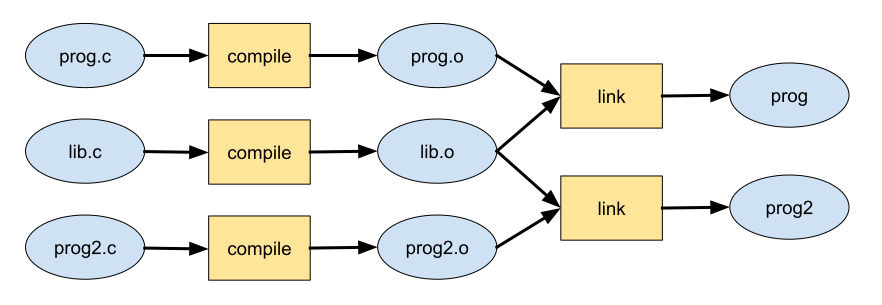
This should have taken three C source files (lib.c, prog.c, and prog2.c), compiled them to three object files (lib.o, prog.o, prog2.o), and then linked them into two binaries (prog and prog2). Specifically, redun automatically determined the following dataflow DAG and performed the compiling and linking steps in separate threads:
Using the redun log command, we can see the full job tree of the most recent execution (denoted -):
redun log -

Exec 69c40fe5-c081-4ca6-b232-e56a0a679d42 [ DONE ] 2021-06-18 10:34:28:  run make.py make
Duration: 0:00:01.47

Jobs: 8 (DONE: 8, CACHED: 0, FAILED: 0)
--------------------------------------------------------------------------------
Job 72bdb973 [ DONE ] 2021-06-18 10:34:28:  redun.examples.compile.make(files={'prog': [File(path=prog.c, hash=dfa3aba7), File(path=lib.c, hash=a2e6cbd9)], 'prog2': [File(path=prog2.c, hash=c748e4c7), Fil
  Job 096be12b [ DONE ] 2021-06-18 10:34:28:  redun.examples.compile.make_prog('prog', [File(path=prog.c, hash=dfa3aba7), File(path=lib.c, hash=a2e6cbd9)])
    Job dfdd2ee2 [ DONE ] 2021-06-18 10:34:28:  redun.examples.compile.compile(File(path=prog.c, hash=dfa3aba7))
    Job 225f924d [ DONE ] 2021-06-18 10:34:28:  redun.examples.compile.compile(File(path=lib.c, hash=a2e6cbd9))
    Job a8b21ec0 [ DONE ] 2021-06-18 10:34:28:  redun.examples.compile.link('prog', [File(path=prog.o, hash=4934098e), File(path=lib.o, hash=7caa7f9c)])
  Job 32ed5cf8 [ DONE ] 2021-06-18 10:34:28:  redun.examples.compile.make_prog('prog2', [File(path=prog2.c, hash=c748e4c7), File(path=lib.c, hash=a2e6cbd9)])
    Job 3f9ea7ae [ DONE ] 2021-06-18 10:34:28:  redun.examples.compile.compile(File(path=prog2.c, hash=c748e4c7))
    Job 5707a358 [ DONE ] 2021-06-18 10:34:29:  redun.examples.compile.link('prog2', [File(path=p