Redocly CLI
@Redocly CLI is your all-in-one API documentation utility. It builds, manages, improves, and quality-checks your API descriptions, all of which comes in handy for various phases of the API Lifecycle. Create your own rulesets to make API governance easy, publish beautiful API reference documentation, and more. Supports OpenAPI 3.x and 2.0 (legacy Swagger), AsyncAPI 3.x and 2.6, Arazzo 1.x, and more.



Migration
Migrating from Redocly CLI v1 to v2? Here's the guide to make the transition smoother.
Usage
Node
npx @redocly/cli@latest lint path-to-root-file.yaml
Alternatively, install it globally with npm:
npm install @redocly/cli -g
Then you can use it as redocly [command] [options], for example:
redocly lint path-to-root-file.yaml
The minimum required versions of Node.js and NPM are 22.12.0 and 10.9.2 respectively.
Docker
To give the Docker container access to the OpenAPI description files, you need to mount the containing directory as a volume. Assuming the API description is rooted in the current working directory, you need the following command:
docker run --rm -v $PWD:/spec redocly/cli lint path-to-root-file.yaml
To build and run with a local image, run the following from the project root:
docker build -t redocly/cli .
docker run --rm -v $PWD:/spec redocly/cli lint path-to-root-file.yaml
Use with AI assistants
Redocly CLI ships agent skills that teach AI coding assistants how to work with the CLI. Install them into your project:
npx skills add https://redocly.com
redocly-cli— day-to-day usage: lint, bundle, decorate, build docs, test, and generate a client.redocly-lint-rules— turn a check written in plain language into a built-in rule, a configurable rule, or a custom plugin. It also covers migrating rules from other linters, such as Spectral.
Common tasks
Generate API reference documentation
Redocly CLI is a great way to render API reference documentation. It uses open source Redoc to build your documentation. Use a command like this:
redocly build-docs openapi.yaml
Your API reference docs are in redoc-static.html by default.
You can customize this in many ways.
Read the main docs for more information.
:bulb: Redocly also has hosted API management solution, a (commercial) alternative to Redoc. Redoc, Revel, Reef, and Realm can be worked on locally using the
previewcommand.
Bundle multiple OpenAPI documents
Having one massive OpenAPI description can be annoying, so most people split them up into multiple documents via $ref, only to later find out some tools don't support $ref or don't support multiple documents.
Redocly CLI to the rescue! It has a bundle command you can use to recombine all of those documents back into one single document.
The bundled output that Redocly CLI provides is clean, tidy, and looks like a human made it.
Automate API guidelines with Linting
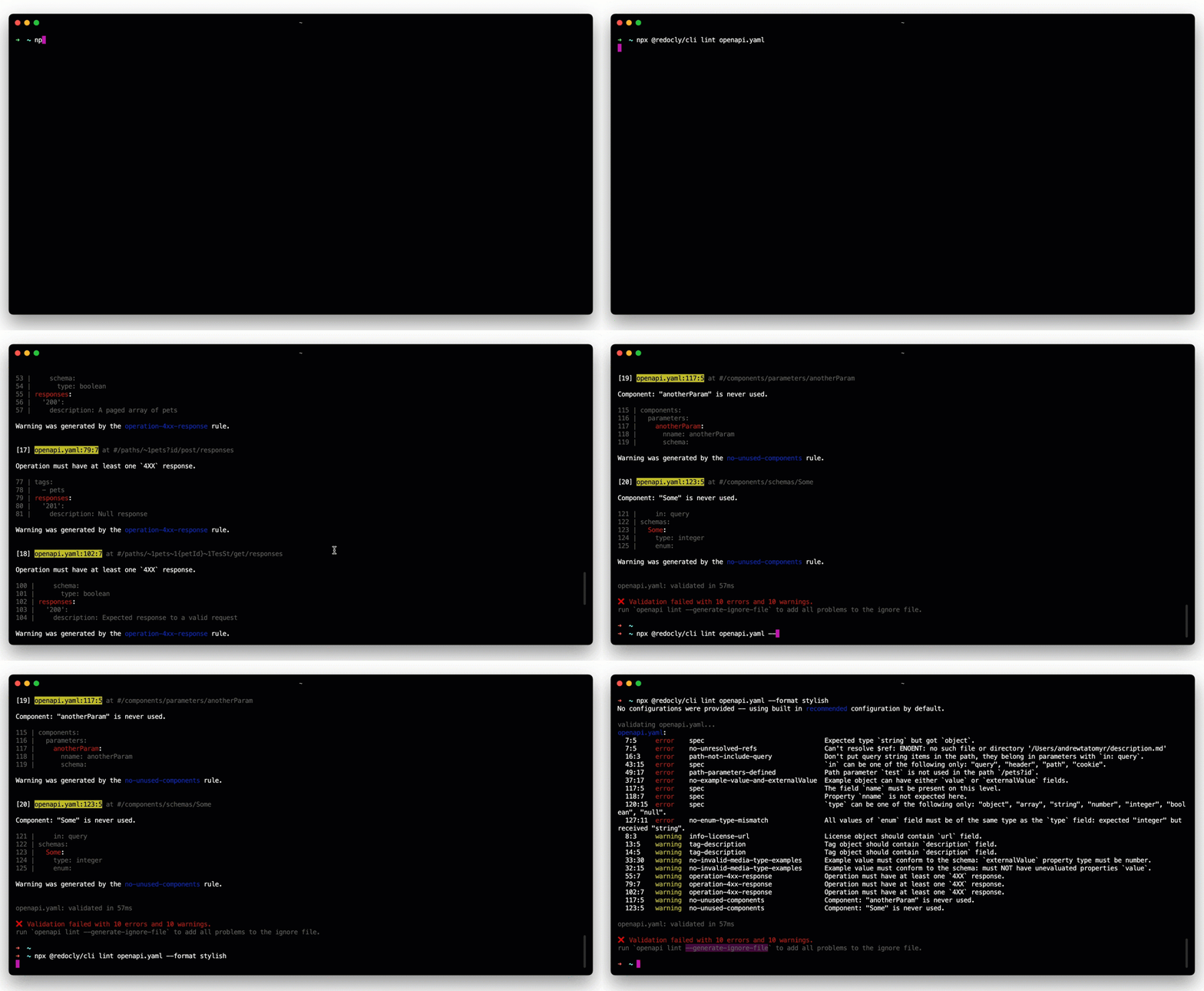
Check that your API matches the expected API guidelines by using the lint command.
API guidelines are an important piece of API governance. They help to keep APIs consistent by enforcing the same standards and naming conventions, and they can also guide API teams through potential security hazards and other pitfalls.
Automating API guidelines means you can keep APIs consistent and secure throughout their lifecycle.
Even better, you can shape the design of the API before it even exists by combining API linting with a design-first API workflow.
Our API linter is designed for speed on even large documents, and it's easy to run locally, in CI, or anywhere you need it. It's also designed for humans, with meaningful error messages to help you get your API right every time.
Try it like this:
redocly lint openapi.yaml
Configure the rules as you wish. Other API Linters use complicated identifiers like JSONPath, but Redocly makes life easy with simple expressions that understand the API specification structure. You can either use the built-in rules to mix-and-match your ideal API guidelines, or break out the tools to build your own.
Format the output in whatever way you need.
The stylish output is as good as it sounds, but if you need JSON, Markdown, Checkstyle and other outputs to integrate with other tools, the lint command can output those too.
Multiple files supported so you don't need to bundle your API description to lint it; just point Redocly CLI at the "entry point" (e.g.: openapi.yaml) and it handles the rest.
Learn more about API standards and configuring Redocly rules.
Looking for more examples? Check out our Cookbook.
API contract testing with Respect
Ensure your APIs match their OpenAPI descriptions with Respect, Redocly's API contract testing system. Respect sends real HTTP requests to your API server and validates that responses match the expectations defined in your OpenAPI description and Arazzo workflows.
- Verify API responses match your OpenAPI schema
- Test complex API sequences using OpenAPI Arazzo format
- Catch API drift early in development and CI/CD
- Ensure external APIs you depend on behave as expected
- Track response times and detect anomalies
Quick start
# Generate test workflows from your OpenAPI spec
redocly generate-arazzo openapi.yaml

# Run contract tests against your API
redocly respect auto-generated.arazzo.yaml --verbose
Respect vs. Respect Monitoring
Respect is Redocly's community-edition product. Looking for something more? We also offer continuous API monitoring with additional features including:
- Real-time insights
- Automated alerts via email or Slack
- Automated API checks
- Proactive API quality assurance
Learn more about Respect and get started with API contract testing.
Generate a TypeScript client
⚠️ Experimental — flags, output, and configuration may change in any minor release until declared stable.
Turn an OpenAPI description (3.0/3.1/3.2 or Swagger 2.0) into a typed TypeScript client with the generate-client command.
The emitted client has zero runtime dependencies and runs in browsers, Node, Bun, Deno, and edge runtimes.
redocly generate-client openapi.yaml --output src/client.ts
Inline types plus a typed client instance and one async function per operation, with auth, opt-in abort-aware retries, middleware, and typed Server-Sent Events.
The same command can also emit Zod schemas, TanStack Query / SWR hooks, MSW mocks, and more via --generator.
For detailed information, read the generate-client docs.
Transform an OpenAPI description
If your OpenAPI description isn't everything you hoped it would be, enhance it with the Redocly decorators feature. This allows you to:
- Publish reference docs with a subset of endpoints for public use
- Improve the docs by adding examples and descriptions
- Adapt an existing OpenAPI description, and replace details like URLs for use on staging platforms
Data collection
This tool collects data to help Redocly improve our products and services.
You can opt out by setting the REDOCLY_TELEMETRY environment variable to off.
Update notifications
Redocly CLI checks for updates on startup.
You can disable this by setting the REDOCLY_SUPPRESS_UPDATE_NOTICE environment variable to true.
More resources
Credits
Thanks to graphql-js and eslint for inspiration of the API description traversal approach and to Swagger, Spectral, and OAS-Kit for inspiring the recommended ruleset.
Development
Contributions are welcome! All the information you need is in CONTRIBUTING.md.