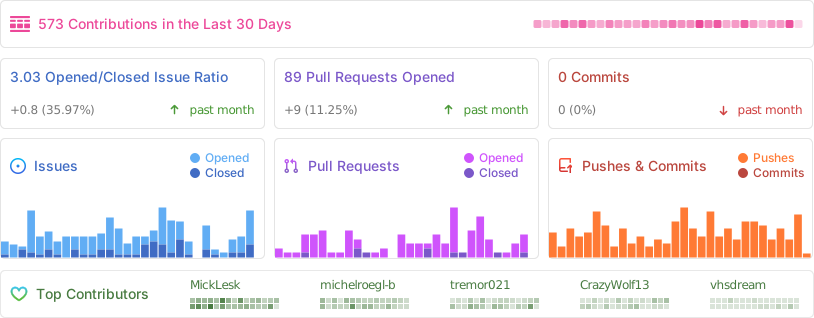
ProxmoxVE is a free, open source automation project written in Shell and released under MIT. It has 29,607 GitHub stars, 2,887 forks and 27 open issues, and was last pushed 9 hours ago. On this registry it ranks #5 of 54 tracked projects in Automation, with 5 head-to-head comparisons available. It gained 10 stars over the last 3 tracked days.

What is ProxmoxVE?

What it is

Proxmox VE Helper-Scripts (Community Edition) is a collection of Shell scripts that install and configure self-hosted services as containers or virtual machines on Proxmox VE. It is a community project built on the foundation of @tteck's original work, distributed under the MIT license, and it lives in the Proxmox VE and homelab ecosystem alongside LXC, Docker, Debian, Ubuntu, and Alpine tooling. The scripts cover hundreds of services across home automation, media, networking, monitoring, databases, security, and developer tooling.

The concrete problem it solves is the manual labor of standing up a self-hosted service on a Proxmox host. Instead of hunting for packages, resolving dependencies, and editing configuration files by hand, an operator pastes a single command into the Proxmox shell, answers a few prompts, and receives a working container or VM. Each script page documents what the container includes, its default resource allocation, and post-install notes, so the operator knows what was provisioned without reverse-engineering it afterward.

Key capabilities

  • One-command installation of services as LXC containers or VMs directly from the Proxmox shell.
  • Default mode that selects sensible CPU, RAM, and storage defaults and asks only the minimum required questions, with most installs finishing in under five minutes.
  • Advanced mode that exposes full control over container settings, networking, storage backends, and application-level configuration before installation begins.
  • A post-install helper shipped inside each container, reachable from the Proxmox shell, for applying service updates, changing application settings without editing config files, and accessing logs for basic troubleshooting.
  • Coverage of hundreds of services across home automation, media, networking, monitoring, databases, security, and developer tools.
  • A browsable catalog at community-scripts.org with per-script pages and a categories index, updated as new scripts are added.

Who uses it and how

  • Homelab operators running Proxmox VE who want Home Assistant, Zigbee2MQTT, ESPHome, or Node-RED deployed without manual setup.
  • Media server administrators installing Jellyfin, Plex, Radarr, Sonarr, or Immich as containers on an existing Proxmox host.
  • Network and infrastructure users deploying AdGuard Home, Nginx Proxy Manager, Pi-hole, or Traefik to handle DNS, proxying, and filtering.
  • Monitoring and observability users standing up Grafana, Prometheus, Uptime Kuma, or Netdata alongside PostgreSQL, MariaDB, Redis, or InfluxDB.
  • Security-conscious self-hosters running Vaultwarden, CrowdSec, or Authentik, and developers using Gitea, Portainer, VS Code Server, or
project readme (upstream, from github) — read inline
Proxmox VE Helper-Scripts Logo

Proxmox VE Helper-Scripts

One-command installations for services, containers, and VMs on Proxmox VE
A community project — built on the foundation of @tteck's original work


What is this?

Simplify your Proxmox VE setup with community-driven automation scripts.

Install and configure popular self-hosted services with a single command — no manual package hunting, no config file archaeology. Paste a command into your Proxmox shell, answer a few prompts, and your container or VM is up and running.

The collection covers hundreds of services across categories like home automation, media servers, networking tools, databases, monitoring stacks, and more.


Requirements

Component Details
Proxmox VE Version 8.4, 9.0, 9.1, or 9.2
Host OS Proxmox VE (Debian-based)
Access Root shell access on the Proxmox host
Network Internet connection required during installation

Getting Started

The fastest way to find and run scripts:

  1. Go to community-scripts.org
  2. Search for the service you want (e.g. "Home Assistant", "Nginx Proxy Manager", "Jellyfin")
  3. Copy the one-line install command from the script page
  4. Open your Proxmox Shell and paste it
  5. Choose between Default or Advanced setup and follow the prompts

Each script page documents what the container includes, default resource allocation, and post-install notes.


How Scripts Work

Every script follows the same pattern:

Default mode — Picks sensible resource defaults (CPU, RAM, storage) and asks only the minimum required questions. Most installs finish in under five minutes.

Advanced mode — Gives you full control over container settings, networking, storage backends, and application-level configuration before anything is installed.

After installation, each container ships with a post-install helper accessible from the Proxmox shell. It handles common tasks like:

  • Applying updates to the installed service
  • Changing application settings without manually editing config files
  • Basic troubleshooting and log access

What's Included

The repository covers a wide range of categories. A few examples:

Category Examples
Home Automation Home Assistant, Zigbee2MQTT, ESPHome, Node-RED
Media Jellyfin, Plex, Radarr, Sonarr, Immich
Networking AdGuard Home, Nginx Proxy Manager, Pi-hole, Traefik
Monitoring Grafana, Prometheus, Uptime Kuma, Netdata
Databases PostgreSQL, MariaDB, Redis, InfluxDB
Security Vaultwarden, CrowdSec, Authentik
Dev & Tools Gitea, Portainer, VS Code Server, n8n

Browse the full list at community-scripts.org/categories — new scripts are added regularly.


Contributing

This project runs on community contributions. Whether you want to write new scripts, improve existing ones, or just report a bug — every bit helps.

Where to start

I want to… Go here
Add a new script ProxmoxVED — new scripts are tested here first
Fix or improve an existing script Contributing Guidelines — open a PR in this repo
Report a bug or broken script Issues
Request a new script or feature Discussions
Report a security vulnerability Security Policy
Get help or chat with other users Discord

Before you open a PR

  • New scripts go to ProxmoxVED, not here. PRs with new scripts opened directly against this repo will be closed.
  • Bug fixes and improvements to existing scripts belong in this repo — read the Contributing Guidelines first.
  • Keep PRs focused. One fix or feature per PR.
  • Document what your script installs and any non-obvious decisions in the corresponding JSON metadata file.

Core Team

MickLesk
MickLesk
michelroegl-brunner
michelroegl-brunner
BramSuurdje
BramSuurdje
CrazyWolf13
CrazyWolf13
tremor021
tremor021
vhsdream
vhsdream
asylumexp
asylumexp

Project Activity

Repository activity />

  <source
    media="(prefers-color-scheme: light)"
    srcset="https://api.star-history.com/chart?repos=community-scripts/ProxmoxVE&type=date&legend=top-left&sealed_token=-lUy2KH6pJryUyLCbiWRwFz3ilXMDFVFHm0lJcqh-Hl5e0QNNKjINNcXzULhaZVpBugN_TDaxOawEAuzwBc5Sjqa2mCRw9K6TdCioKRDsS_qXUw

readme truncated — read the full docs on github

Frequently asked questions

Is ProxmoxVE free to use?

ProxmoxVE is open source under the MIT licence. There is no licence fee and no seat count — you can self-host it or, where the project offers one, pay a vendor for a managed version instead.

What does ProxmoxVE do?

Proxmox VE Helper-Scripts (Community Edition)

What is ProxmoxVE written in?

ProxmoxVE is primarily written in Shell. Its source is publicly available at https://github.com/community-scripts/ProxmoxVE, and it has 29,607 GitHub stars.