


Payload is a free, open source content management systems (cms) project written in TypeScript and released under MIT. It has 44,793 GitHub stars, 4,164 forks and 1,127 open issues, and was last pushed 7 hours ago. On this registry it ranks #3 of 47 tracked projects in Content Management Systems (CMS), with 5 head-to-head comparisons available. It gained 83 stars over the last 6 tracked days.

Payload — Headless CMS for developers, built with Node.js

What is Payload?

Payload is an open-source, MIT-licensed headless CMS and fullstack framework, written in TypeScript and built to run natively inside a Next.js /app folder, aimed at developers who want a TypeScript backend and admin panel without signing up for another SaaS.

What it is

Payload is a headless CMS that doubles as an application framework. It installs directly into an existing /app folder in a Next.js project, making it a Next.js native CMS rather than a separate service that has to be deployed, wired up, and kept in sync with a front end. The backend and the admin panel are both fully TypeScript, with automatic types generated for your data, and the admin UI is a customizable React application. The project is licensed under MIT and lives in the JavaScript and TypeScript ecosystem, with topics covering cms, headless-cms, jamstack, nextjs, express, graphql, and mongodb.

The concrete problem it solves is duplication and lock-in. Instead of running a hosted CMS in one place and a front end in another, Payload lets a team combine front and back end in the same /app folder, query the database directly in React Server Components without going through REST or GraphQL, and deploy anywhere, including serverless targets. It replaces the pattern of subscribing to yet another SaaS CMS, and the README positions it against traditional content management systems by stating that developers never need to touch legacy WP code again.

Key capabilities

  • Next.js native: installs inside your own /app folder and lets server components extend the Payload UI.
  • Direct database queries from React Server Components, so REST and GraphQL endpoints are not required for reads.
  • Fully TypeScript, with automatic types generated for your data.
  • Authentication out of the box, with HTTP-only cookies and CSRF protection.
  • Versions and drafts, plus localization for multi-locale content.
  • Block-based layout builder, a Lexical rich text editor, and conditional field logic.
  • Granular access control, with document- and field-level hooks for every action Payload provides.

Who uses it and how

  • Next.js teams building websites, ecommerce stores, blogs, or portfolios from production-ready templates, which ship with React Server Components and Tailwind front ends.
  • Serverless teams deploying one-click on Vercel with a Next.js front end, a Neon database, and Vercel Blob for media storage.
  • Cloudflare teams deploying one-click with Workers, R2 for uploads, and D1 as a globally replicated database.
  • Application developers who want the front end and the backend in a single /app folder rather than two projects.
  • Template authors who publish reusable starter kits under the payload-template topic for community discovery.

Getting started

Scaffold a project with pnpx create-payload-app@latest; new users are directed to the website template via pnpx create-payload-app@latest -t website. One-click deploy options are also provided for Vercel and Cloudflare.

How it compares

No list of paid products being replaced is provided in the facts, so the nearest named comparison is WordPress, which the README contrasts by promising that developers never touch legacy WP code again, and the broader category of regular CMS products. Among the tools named in the facts, Payload is distinctive because it is both the CMS and the application framework, sitting alongside the Express, GraphQL, MongoDB, and Next.js pieces that its topics reference rather than replacing them with a hosted service.

When to use it — and when not to

Choose Payload when the team writes Next.js and TypeScript and wants the content backend, admin panel, and front end in one repository, accepting responsibility for the database and file storage that your chosen deploy target provides, such as MongoDB, Neon, D1, R2, or Vercel Blob. A self-hoster must operate that database and storage layer, and the project currently carries over a thousand open issues, so teams wanting a fully managed, zero-ops CMS should not pick it. Developers without Next.js experience will also face a real learning curve, because the CMS assumes it lives inside a Next.js application.

project readme (upstream, from github) — read inline

Payload headless CMS Admin panel built with React

GitHub Workflow Status   Discord   npm   npm   npm   Payload Twitter


Explore the Docs · Community Help · Roadmap · View G2 Reviews


[!IMPORTANT] Star this repo or keep an eye on it to follow along.

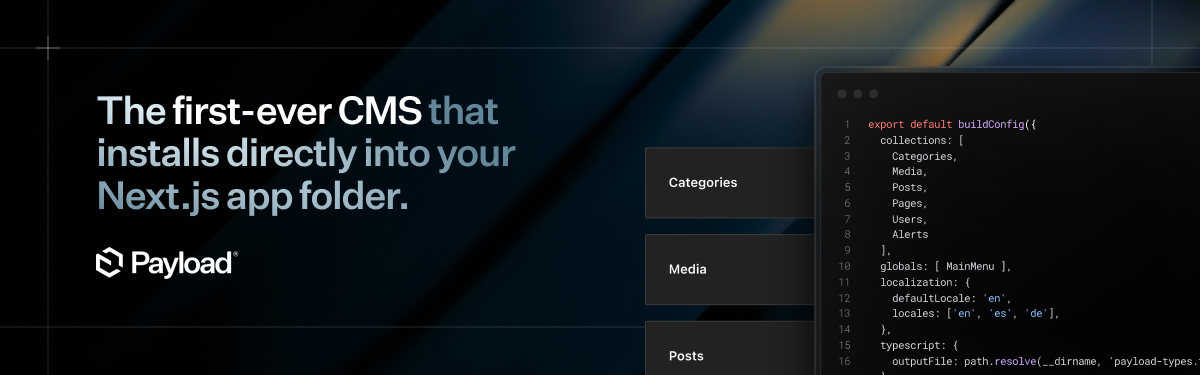
Payload is the first-ever Next.js native CMS that can install directly in your existing /app folder. It's the start of a new era for headless CMS.

Benefits over a regular CMS

  • It's both an app framework & headless CMS
  • Deploy anywhere, including serverless on Vercel for free
  • Combine your front+backend in the same /app folder if you want
  • Don't sign up for yet another SaaS - Payload is open source
  • Query your database in React Server Components
  • Both admin and backend are 100% extensible
  • No vendor lock-in
  • Never touch ancient WP code again
  • Build faster, never hit a roadblock

Quickstart

Before beginning to work with Payload, make sure you have all of the required software.

pnpx create-payload-app@latest

If you're new to Payload, you should start with the website template (pnpx create-payload-app@latest -t website). It shows how to do everything - including custom Rich Text blocks, on-demand revalidation, live preview, and more. It comes with a frontend built with Tailwind all in one /app folder.

One-click deployment options

You can deploy Payload serverlessly in one-click via Vercel and Cloudflare—giving everything you need without the hassle of the plumbing.

Deploy on Cloudflare

Fully self-contained — one click to deploy Payload with Workers, R2 for uploads, and D1 for a globally replicated database.

Deploy to Cloudflare

Deploy on Vercel

All-in-one on Vercel — one click to deploy Payload with a Next.js front end, Neon database, and Vercel Blob for media storage.

Deploy with Vercel

One-click templates

Jumpstart your next project with a ready-to-go template. These are production-ready, end-to-end solutions designed to get you to market fast. Build any kind of website, ecommerce store, blog, or portfolio — complete with a modern front end built using React Server Components and Tailwind.

🌐 Website
🛍️ Ecommerce 🎉 NEW 🎉

We're constantly adding more templates to our Templates Directory. If you maintain your own, add the payload-template topic to your GitHub repo so others can discover it.

🔗 Explore more:

✨ Payload Features

Request Feature

🗒️ Documentation

Check out the Payload website to find in-depth documentation for everything that Payload offers.

Migrating from v2 to v3? Check out the 3.0 Migration Guide on how to do it.

🙋 Contributing

If you want to add contributions to this repository, please follow the instructions in contributing.md.

📚 Examples

The Examples Directory is a great resource for learning how to setup Payload in a variety of different ways, but you can also find great examples in our blog and throughout our social media.

If you'd like to run the examples, you can use create-payload-app to create a project from one:

npx create-payload-app --example example_name

You can see more examples at:

🔌 Plugins

Payload is highly extensible and allows you to install or distribute plugins that add or remove functionality. There are both officially-supported and community-supported plugins available. If you maintain your own plugin, consider adding the payload-plugin topic to your GitHub repository for others to find.

🚨 Need help?

There are lots of good conversations and resources in our Github Discussions board and our Discord Server. If you're struggling with something, chances are, someone's already solved what you're up against. :point_down:

⭐ Like what we're doing? Give us a star

👏 Thanks to all our contributors

Frequently asked questions

Is Payload free to use?

Payload is open source under the MIT licence. There is no licence fee and no seat count — you can self-host it or, where the project offers one, pay a vendor for a managed version instead.

What does Payload do?

Headless CMS for developers, built with Node.js

What is Payload written in?

Payload is primarily written in TypeScript. Its source is publicly available at https://github.com/payloadcms/payload, and it has 44,793 GitHub stars.