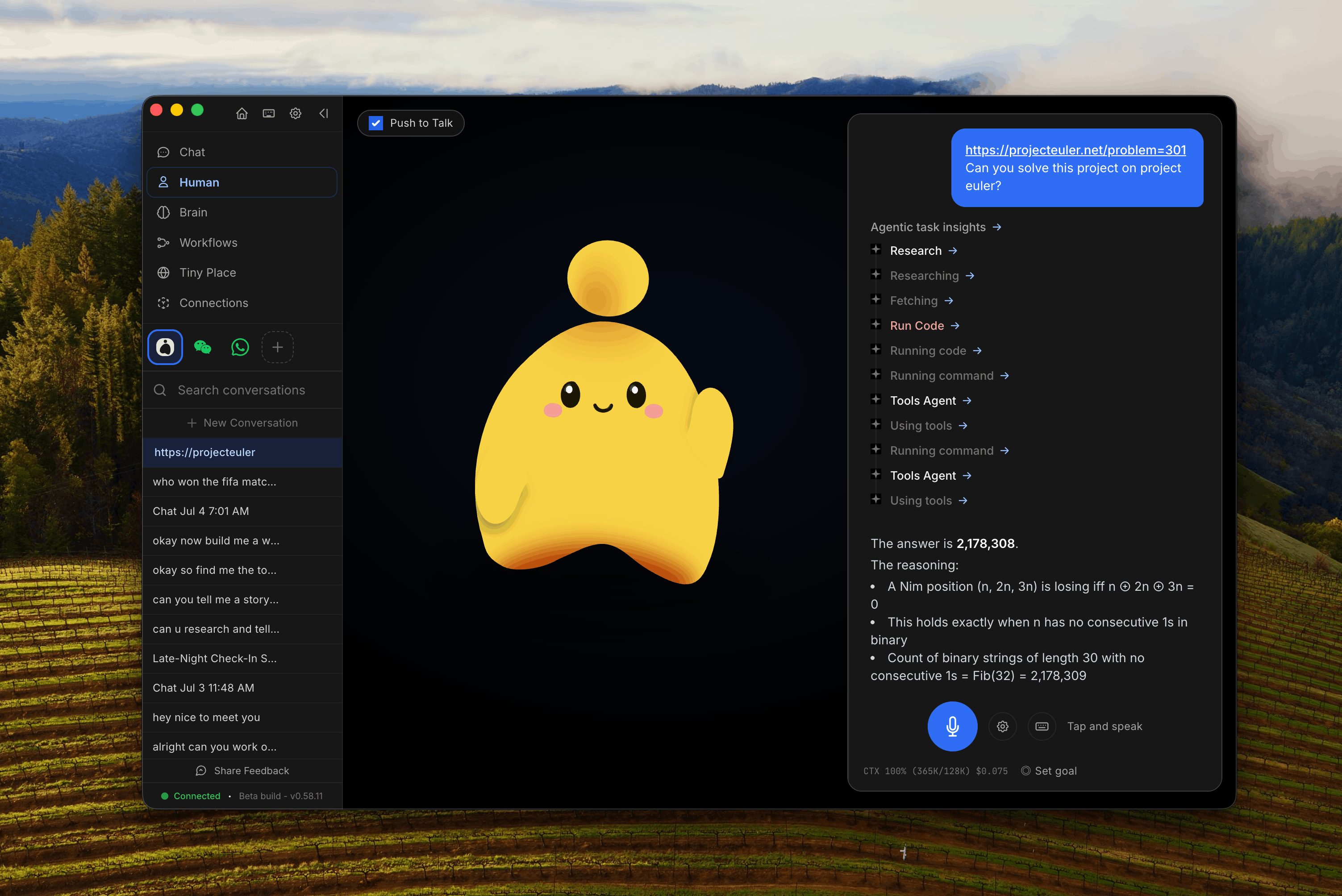


openhuman is a free, open source ai interaction & interfaces project written in Rust and released under GPL-3.0. It has 39,838 GitHub stars, 3,928 forks and 189 open issues, and was last pushed 14 hours ago. On this registry it ranks #12 of 76 tracked projects in AI Interaction & Interfaces, with 5 head-to-head comparisons available. It gained 30 stars over the last 3 tracked days.

What is openhuman?

OpenHuman is an open source, GPL-3.0-licensed agent harness written in Rust and shipped as a Tauri desktop application, aimed at individuals who want a personal AI assistant whose memory, orchestration, and research tooling run local-first on their own machine.

What it is

OpenHuman is a desktop agent harness that the README describes as three things at once: a brain that builds a persistent, local memory of your world, an orchestrator that runs fleets of agents on durable graphs, and a deep researcher that sweeps your data and the web before you finish asking. It is written in Rust, licensed GPL-3.0, and packaged as a Tauri desktop application. Its memory layer, the Memory Tree, compresses personal data into scored Markdown trees stored in SQLite on the local machine and mirrors them as an Obsidian vault that can be opened and edited by hand. The project is currently labelled an Early Beta and states plainly that it is under active development and that rough edges should be expected.

The concrete problem it addresses is the opacity and impermanence of assistant memory, together with the difficulty of steering long-running multi-agent work. The specific thing the README positions it against is vector-database memory, which it calls a "vector-soup black box"; OpenHuman instead keeps a human-readable Markdown and SQLite record that the user owns and can edit. On the orchestration side, agent work runs as checkpointed graphs on the project's own open-source tinyagents library, with trigger-driven, approval-gated workflows on tinyflows, so a run that stalls can be steered, a run that halts reports a root cause, and past runs replay with real per-call costs. It lives in the MCP and LLM agent ecosystem, connecting to 5,000+ MCP servers and 100+ OAuth providers rather than operating as a closed tool.

Key capabilities

  • Memory Tree and Obsidian Wiki: personal data compressed into scored Markdown trees in local SQLite, mirrored as an editable Obsidian vault, offered as the alternative to a "vector-soup black box".
  • TokenJuice compression: tool output is compressed before it reaches the model, which the README states delivers the same information with up to 80% fewer tokens.
  • Integrations: 100+ OAuth integrations including Gmail, Notion, GitHub, and Slack, plus 5,000+ MCP servers and 90,000+ Skills, with Auto-fetch feeding the brain every 20 minutes.
  • Workflows: the agent proposes an automation, the user reviews it on a canvas, and saved automations run as durable, trigger-driven, approval-gated runs on tinyflows.
  • Agent harness and split-brain orchestration: checkpointed graph runs on tinyagents where stuck agents are steered and halted ones return a root cause, while a fast reflex agent triages inbound traffic and a deep reasoning core delegates to worker fleets.
  • Goals and Todos: long-term goals, durable per-thread goals, and a shared kanban board per conversation.
  • Batteries included: managed Exa-powered web search with no API key, scraper, coder toolset, browser, native voice with in-process Whisper, and model routing that picks an LLM per workload on one subscription, which can also be pointed at your own provider key or a fully local model.

Who uses it and how

  • Individuals building a private second brain over their own mail, notes, and code, who want the memory written to disk as Markdown rather than held in a hosted vector store.
  • Obsidian users who want agent memory to land in a vault they already open and edit, with Auto-fetch refreshing context every 20 minutes.
  • Privacy-focused desktop users who route every workload to their own provider key or to a fully local model instead of relying on the bundled subscription.
  • Automation builders who need fleets of agents running durable graphs with approval gates, per-call cost accounting, and replayable runs.
  • Developers who want to reach their existing tooling through MCP servers and the Skills catalogue rather than writing bespoke connectors.

Getting started

Installers are downloaded from tinyhumans.ai/openhuman or from the GitHub Releases page. Terminal installs are documented in INSTALL.md and cover Homebrew, a Debian/Ubuntu .deb package, AUR, and install scripts, with platform notes.

How it compares

The facts provided name no comparable tools or paid products that OpenHuman replaces, so as far as this registry entry is concerned it stands alone in its category. Its distinguishing characteristics are therefore internal to the description: a GPL-3.0 licence, a local-first SQLite and Markdown memory store, and a desktop Tauri application rather than a hosted service.

When to use it — and when not to

A self-hoster takes on the local SQLite memory store, the Obsidian vault mirror, MCP and OAuth integration credentials, and either the bundled subscription or separate provider keys. The project is an Early Beta with 189 open issues and an explicit warning about rough edges, so it is not a fit for anyone who needs a stable, production-critical assistant today, and the desktop form factor does not suit headless or server-side deployment. Check the GPL-3.0 terms before building derivative or redistributed work on it.

project readme (upstream, from github) — read inline

OpenHuman

tinyhumansai%2Fopenhuman | Trendshift OpenHuman - An open source AI harness built with the human in mind | Product Hunt OpenHuman - An open source AI harness built with the human in mind | Product Hunt

OpenHuman - An open source AI harness built with the human in mind | Product Hunt OpenHuman - An open source AI harness built with the human in mind | Product Hunt

OpenHuman is your personal AI super intelligence: a brain that remembers everything, a fantastic orchestrator, a deep researcher. Local-first, simple, powerful.

DiscussionsDiscordRedditX/TwitterDocsFollow @senamakel (Creator)

🇺🇸 English | 🇨🇳 简体中文 | 🇯🇵 日本語 | 🇰🇷 한국어 | 🇩🇪 Deutsch | 🇵🇰 اردو

Early Beta Latest Release GitHub Stars License

Early Beta: Under active development. Expect rough edges.

OpenHuman is not AGI. But it is a meaningful architectural step closer, with better memory, better orchestration, and better tooling.

🎉 Within one week of launch, OpenHuman became the number one trending repository on GitHub for nine days in a row.

Install

Download installers from tinyhumans.ai/openhuman or from the GitHub Releases page.

For terminal installs (Homebrew, Debian/Ubuntu .deb, AUR, install scripts, and platform notes), see INSTALL.md.

What is OpenHuman?

OpenHuman is three things most assistants aren't: a brain that builds a persistent, local memory of your world; a fantastic orchestrator that runs fleets of agents on durable graphs; and a deep researcher that sweeps your data and the web before you finish asking. Every bullet links to the deeper writeup in the docs.

🧠 The brain

  • Memory Tree + Obsidian Wiki: your data compressed into scored Markdown trees in SQLite on your machine, mirrored as an Obsidian vault you can open and edit. No vector-soup black box.
  • 100+ OAuth integrations, 5,000+ MCP servers, 90,000+ Skills: one click into Gmail, Notion, GitHub, Slack and the rest of your stack. Auto-fetch feeds the brain every 20 minutes, so it has tomorrow's context this morning.
  • Goals & Todos: long-term goals, durable per-thread goals, and a shared kanban board per conversation.
  • TokenJuice: tool output compressed before it hits the model: same information, up to 80% fewer tokens. A brain this big would be unaffordable without it.

🕸️ The orchestrator

  • Workflows: the agent proposes the automation; you review it on a canvas and save. Durable, trigger-driven, approval-gated runs on open-source tinyflows.
  • A harness that finishes the job: checkpointed graph runs on open-source tinyagents. Stuck agents get steered, halted ones return a root cause, and every run replays with real per-call costs.
  • A split brain, always on: a fast reflex agent triages inbound traffic while a deep reasoning core delegates to worker fleets, steered by the subconscious.

🔬 The deep researcher & doer

  • Batteries included: managed web search, powered by Exa, is included with your OpenHuman subscription and needs no API key; bring your own Exa key to search directly on your own Exa account and billing. Plus scraper, coder toolset, a real browser, and native voice with in-process Whisper. Model routing picks the right LLM per workload on one subscription. That subscription is a default, not a lock-in: point any workload at your own provider key or a fully local Ollama model, and mix the three however you like.
  • Image & video generation: Seedream/SeedEdit images and Seedance/Veo video, straight into your workspace on the same subscription.
  • 17 messaging channels: Telegram, Discord, Slack, WhatsApp, Signal, iMessage… plus native email (IMAP IDLE + SMTP). Your agent reaches you where you already are.

🧍 Human, private, yours

  • Simple, UI-first & Human: install to working agent in a few clicks, with no config files and no terminal. And it has a face: a mascot that speaks, reacts, and remembers you.
  • Privacy & security: on-device encrypted data, approval gate, OS-keyring secrets, and opt-in sandboxing. There is also **[Privacy Mode](https://tinyhumans.gitbook.io/ope

readme truncated — read the full docs on github

Frequently asked questions

Is openhuman free to use?

openhuman is open source under the GPL-3.0 licence. There is no licence fee and no seat count — you can self-host it or, where the project offers one, pay a vendor for a managed version instead.

What does openhuman do?

OpenHuman is an open source agent harness with local-first memory, agent orchestration, and workflows

What is openhuman written in?

openhuman is primarily written in Rust. Its source is publicly available at https://github.com/tinyhumansai/openhuman, and it has 39,838 GitHub stars.