 Omnigent
The open-source meta-harness for all your AI agents.
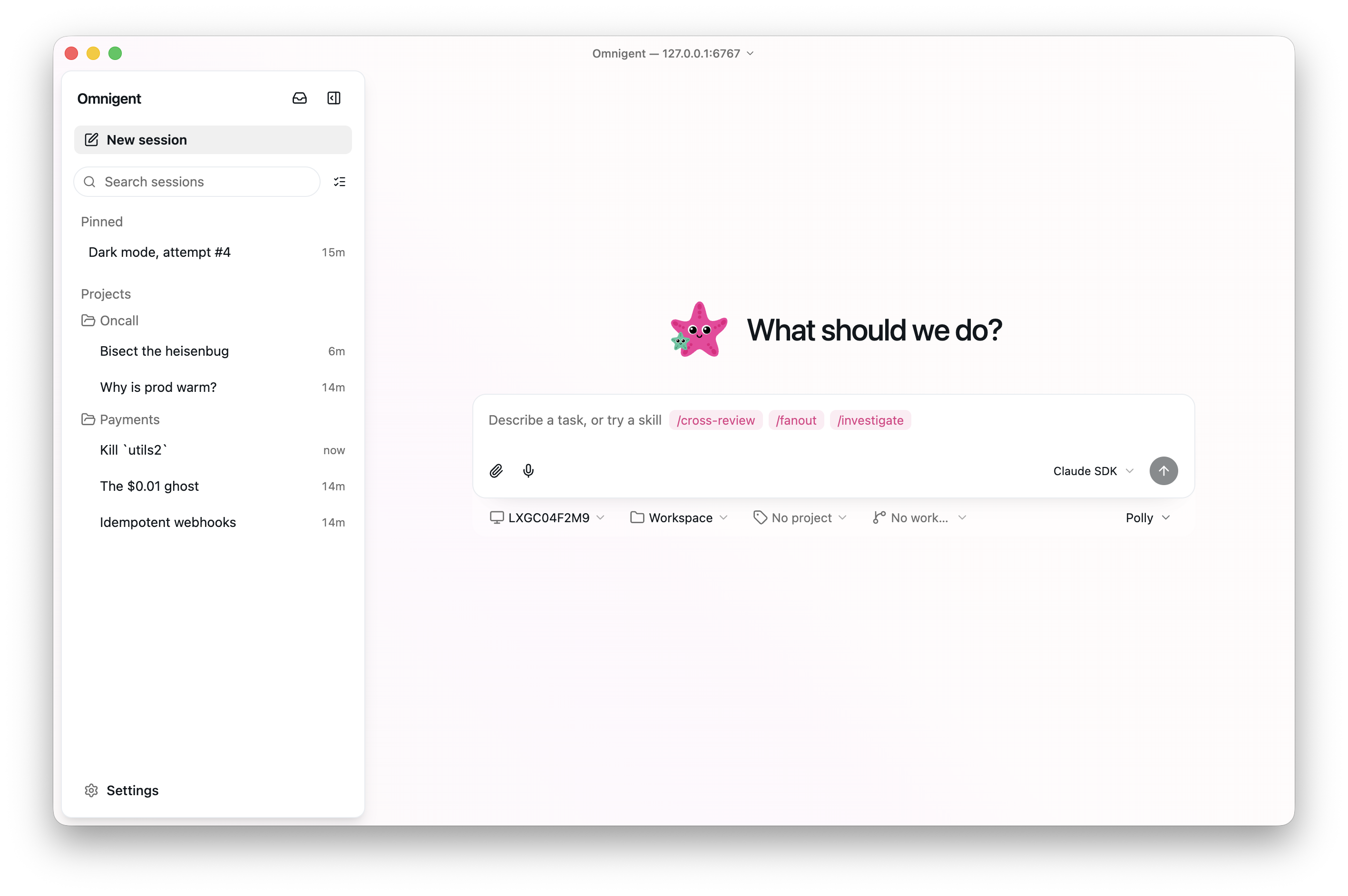
Omnigent is an open-source meta-harness that gives you a common orchestration layer over Claude Code, Codex, Cursor, OpenCode, Hermes, Pi, and the agents you write yourself: swap or combine harnesses without rewriting, enforce policies and sandboxing, and collaborate in real time from any device — terminal, browser, phone, or the native desktop app.




omnigent.ai · ⬇️ Download the macOS desktop app
Why Omnigent?
Omnigent lets you:
📱 Work with agents from any device, including your phone. Sessions follow you: start in your terminal, continue in the browser, pick it up on your phone. Messages, sub-agents, terminals, and files stay in sync.
🤖 Supervise multiple agents. Mix Claude Code, Codex, Cursor, OpenCode, Hermes, Pi, and custom agents (defined in YAML) together in the same session. Ask one agent to review another's work, or split a task across agents that are each good at different things.
🔌 Use any model. A first-party API key, a Claude/ChatGPT subscription, or any compatible gateway. All first-class.
🤝 Collaborate. Share a session so teammates can chat with your agent and watch it work live, co-drive it on your machine, or fork the conversation to continue on their own.
☁️ Run agents in cloud sandboxes. No laptop required: run sessions in disposable Modal, Daytona, Blaxel, Islo, E2B, CoreWeave, Kubernetes, OpenShell, Boxlite, microsandbox, or Databricks sandboxes, launched from the CLI or provisioned by the server per session (managed hosts).
🛡️ Govern your agents. Create policies to pause for your approval before risky actions, cap spend, or limit which tools an agent reaches. They apply to the whole server, one agent, or a single chat.
Quick start
1. Install
One command installs Omnigent and everything it needs:
curl -fsSL https://raw.githubusercontent.com/omnigent-ai/omnigent/main/scripts/install_oss.sh | sh
Optional integrations and extras
Need an optional integration? Pass one or more extras to the installer:
curl -fsSL https://raw.githubusercontent.com/omnigent-ai/omnigent/main/scripts/install_oss.sh | sh -s -- --extra databricks
curl -fsSL https://raw.githubusercontent.com/omnigent-ai/omnigent/main/scripts/install_oss.sh | sh -s -- --extra modal,e2b
Available user-facing extras include:
- Model providers:
databricks,bedrock,vertex - Sandbox providers:
modal,daytona,blaxel,boxlite,microsandbox,cwsandbox,e2b,openshell,kubernetes - SDK harnesses:
antigravity,copilot,cursor,agents-sdk - Storage and memory:
s3,hindsight
Prefer to install manually?
Omnigent needs Python 3.12+. Install the omnigent package:
uv tool install omnigent # or: pip install "omnigent"
Manual installs use the same extras syntax, for example:
uv tool install "omnigent[databricks,modal]"
Or with Homebrew:
brew install omnigent-ai/tap/omnigent
Or install straight from the repo:
uv tool install -q --python 3.12 git+https://github.com/omnigent-ai/omnigent.git
Toolchain and prerequisites (if the installer reports a missing tool)
uv(required). https://docs.astral.sh/uv/getting-started/installation/ The installer offers to set this up for you.git(required).- Node.js 22 LTS or newer with
npm(for the coding-harness CLIs installed byomnigent run) andpnpm(for the web UI). You can get both from a single Node install; pnpm is available viacorepack enableornpm install -g pnpm. - Kiro CLI (optional), for
omnigent kiro: install withcurl -fsSL https://cli.kiro.dev/install | bash, then sign in with Kiro. Kiro tool approvals stay answerable in the embedded Terminal; supported one-time approvals also appear as Chat cards. Seedocs/kiro-native-elicitation.md. tmux, required by the nativeomnigentterminal wrappers (claude,codex,cursor,hermes,kiro,pi) (brew install tmux/apt install tmux; the installer offers to install it for you).bubblewrap(bwrap), Linux only. The nativeomnigentterminal wrappers and thepiharness wrap each agent terminal in abwrapOS-sandbox; on Linux that isolation is mandatory, so a missingbwrapbinary makes those terminals fail to start (apt install bubblewrap; the installer offers to install it for you). macOS uses the built-inseatbeltsandbox and needs nothing extra.- Databricks (optional). To use a Databricks workspace as your model
provider, install Omnigent with the
databricksextra:uv tool install "omnigent[databricks]"— or pass it to the bootstrap installer with... | sh -s -- --extra databricks. Signing in to the workspace also uses the Databricks CLI.
Windows (native)
Omnigent runs natively on Windows in a degraded mode. The install_oss.sh
bootstrap is POSIX-only, so install with uv directly:
uv tool install --python 3.12 omnigent
# or from the repo:
uv tool install --python 3.12 git+https://github.com/omnigent-ai/omnigent.git
What works on Windows: omnigent server, the web UI, and the SDK-based
harnesses (omnigent run with the claude-sdk / cursor / codex
harnesses). Agents run under a Windows Job Object for process-tree
containment.
What is not available on Windows (use Linux/macOS, or WSL, for these):
- the native
omnigent claude/omnigent codex/omnigent cursortmux/PTY terminal wrappers (run an SDK harness or the web UI instead); bwrap/seatbeltfilesystem & network sandboxing and the L7 egress proxy — the Job Object backend contains the process tree and enforces resource limits but does not isolate the filesystem or network.
Updating to a new release
When a newer release is on PyPI, Omnigent shows a one-line notice (once per release) pointing here. To update:
omni upgrade            # detects how you installed, drains & stops the local
                        # server, then runs the matching upgrade command
omni upgrade --check    # just report whether a newer release is available
omni upgrade waits for in-flight agent sessions to finish before stopping the
local server (pass --force to stop them immediately); the next omni command
brings the server back up on the new version. Source checkouts update with
git pull instead. Silence the notice with OMNIGENT_NO_UPDATE_CHECK=1.
The check queries your configured package index — honoring UV_INDEX_URL /
PIP_INDEX_URL and your uv.toml / pip.conf (default PyPI), so private
mirrors work out of the box; override with OMNIGENT_INDEX_URL if needed.
Uninstalling Omnigent
Preview the CLI/profile cleanup that would run by default:
omnigent uninstall
Remove the CLI and installer-managed PATH entries while keeping your local history, credentials, and projects:
omnigent uninstall --yes
To also remove Omnigent state under ~/.omnigent, pass --purge; Omnigent
backs it up outside the target before deletion. Your ~/omnigent workspace is
kept unless you explicitly add --purge-workspace.
omnigent u