LoopX
The open, provider-neutral, stateful control plane for long-horizon agents.
Runs on top of Codex, Claude Code, Cursor, and other agent harnesses. LoopX preserves objectives, gates, todos, evidence, quota, and handoffs across turns; the harness executes bounded work.





Public website · Blog · Docs · Developer Book · Try LoopX · See real loops · How it works · 简体中文
Open and provider-neutral, LoopX is a lightweight state kernel and local-first control plane for loop engineering. It runs on top of different agent harnesses rather than replacing them, providing the long-horizon state, semantic decisions about what happens next, governance, recovery, and human-agent collaboration that keep long-running work reviewable, restartable, and easier to hand off across turns, tools, and agents.
Loop engineering for long-horizon AI agents and peer agent teams.
Keep the loop moving. Keep the judgment human.
Learn LoopX
- Developer Book - the curated bilingual path from control-plane foundations to project onboarding and developer contributions. 中文版 · English
- Getting started - install, connect a project, and run your first governed loop. Guide
- Docs - the full reference and operations site. LoopX Docs
Meet the Personal Agent Workspace
Keep long-horizon goals in one local-first workspace. Goals, attention, conversations, tasks, files, schedules, and recovery stay durable across days, restarts, and harnesses. Reopen a project, inspect the previous turn’s state and evidence, and continue the next permitted action.
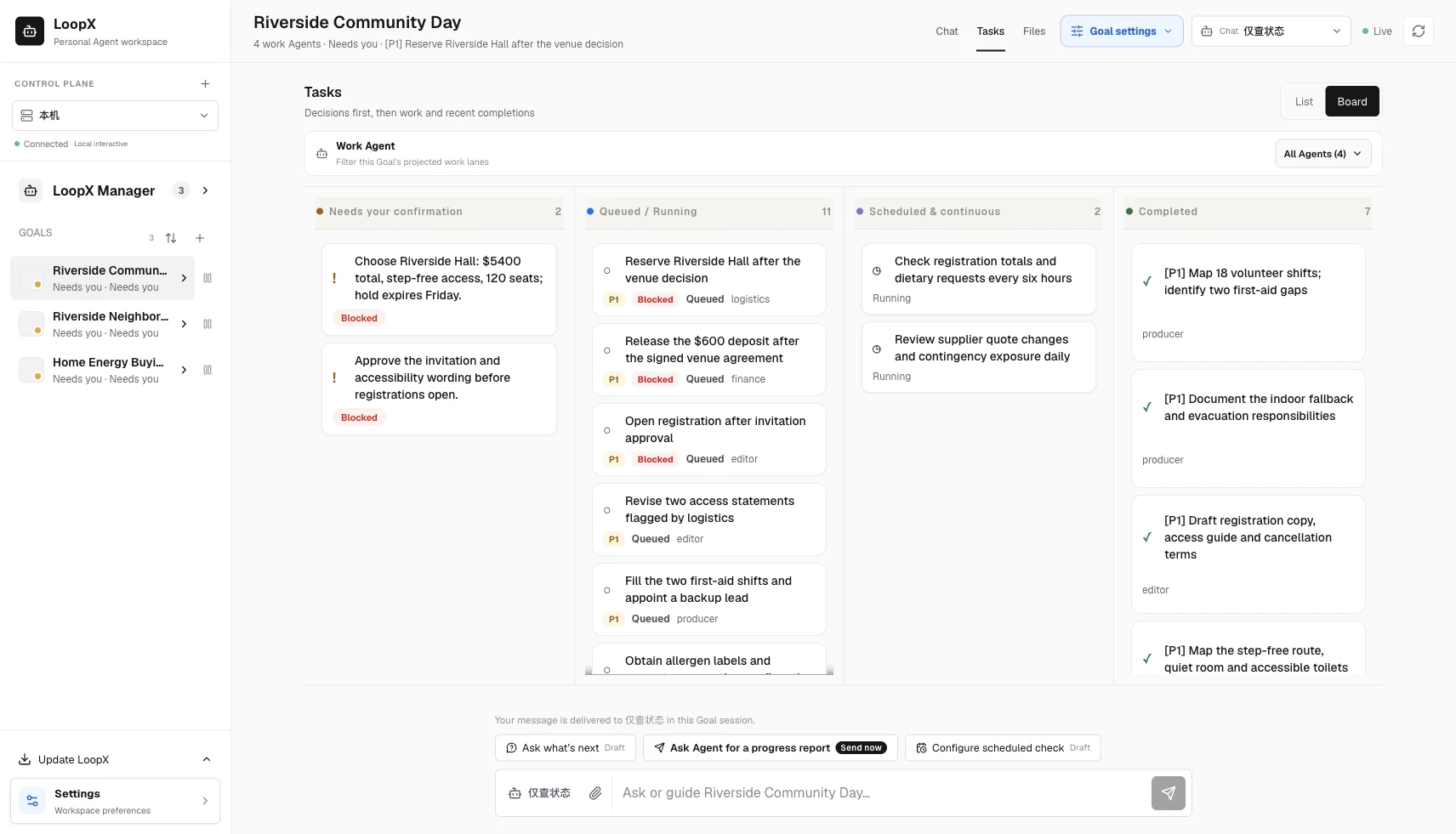
LoopX 1.0 brings these long-horizon control states into the Personal Workspace. It gives you one place to:
- see what needs you, what is running, what is being watched, and what is scheduled or stopped;
- configure Goal capabilities, distinguish machine defaults from Goal overrides, and preview changes before applying them;
- steer a live turn, queue a message, or use the async inbox from a connected Lark conversation with explicit Goal/Agent/session routing;
- inspect deliverable files, periodic reports, and their supporting evidence;
- continue across Codex, Claude Code, direct-model, and other registered Agent sessions without losing Goal state or evidence;
- review protected changes through typed preview, explicit confirmation, and receipts while LoopX state—not the browser—remains authoritative.
For Manager group conversations, LoopX keeps message visibility separate from Turn authority; see the bilingual Lark Manager context and authority contract.
loopx dashboard
loopx dashboard is the supported browser/PWA launch path. You can also download
native desktop previews from the 1.0 release;
they reuse the same loopback services and Goal state. Apple Silicon macOS supports
signed App updates that pair the shell with its bundled runtime, plus repair and
recovery. Python 3.11+ is required; the App is ad-hoc signed, not notarized.
Windows preview installers currently use manual updates and a separately installed CLI.
Desktop installation, updates, and source development.

From a source checkout, run python -m demo.workspace serve to explore a community
event, a home-energy comparison, and a neighborhood website release. Each has four
work roles, 18 tasks, two decisions, and two watches. The screenshot above comes
from this reproducible workspace. Scenarios and replay instructions.
Watch the full 32-second walkthrough · Read the workspace guide · Try the five-minute tour
Why LoopX
An agent can finish a task in one session. Long-running work is harder: objectives change, owner decisions appear, evidence goes stale, agents hand work to peers, and a scheduler can keep spending after no useful transition remains. Chat memory and a timer are not enough to govern that.
LoopX keeps the durable control state in one compact layer:
objective / issue / project
   │
   ▼
LoopX state: objective + gates + todos + scope + evidence + quota
   │
   ├─ human judgment needed? ── yes ─▶ ask a concrete question and wait
   │
   ├─ safe fallback available? ──────▶ run one bounded agent slice
   │
   ▼
Codex / Claude Code / Cursor / shell agent executes one turn
   │
   ▼
write evidence + handoff + next todo ─▶ quota decides the next tick
Agent runtimes execute the work. LoopX governs the state that lets engineering, research, discovery, and operations loops continue across runs. It is not another agent framework or a provider-specific orchestration runtime.
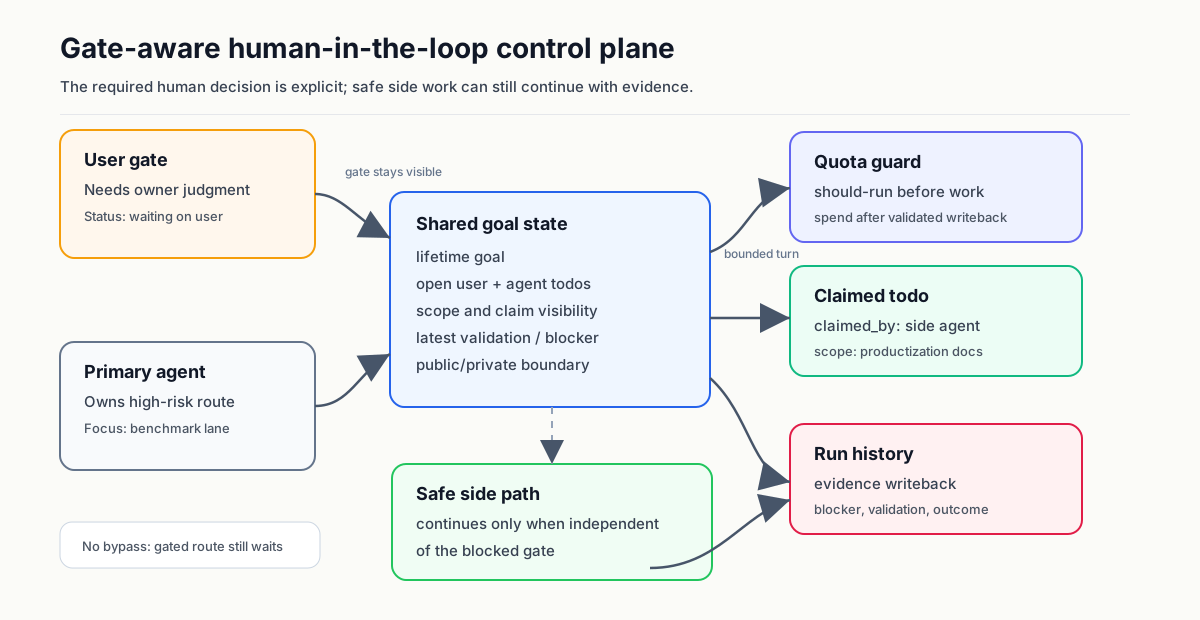
A useful mental model is an agent-native Kanban for long-running work. Cards carry identity, authority, evidence, and continuation. Moves are validated operators such as claim, gate, monitor, and writeback. The board is a projection; LoopX state remains the source of truth.
Registered agents are peers. Claims, leases, task boundaries, capabilities, and typed continuation decide who acts next; no durable leader identity is required.
LoopX is useful when you run:
- multi-day engineering, research, benchmark, or experiment objectives;
- issue and PR loops that must preserve scope, evidence, and review state;
- recurring heartbeat or monitor work;
- projects with owner, safety, publication, or private-data gates;
- peer-agent teams where ownership, leases, and handoff matter;
- creator, research, or operations workflows whose progress must remain legible to a non-engineering operator.
LoopX is not an autonomous production controller. Dangerous permissions, publishing, production writes, and final ownership stay with the human.
Evidence
The public OpenViking contribution sequence and the redacted, owner-run Auto ML showcase each span 200+ hours of elapsed loop lifetime, preserving bounded turns, decisions, and evidence updates. This measures wall-clock project time, not continuous model execution or unattended production autonomy. Open each visual to inspect the public-safe task graph, evidence branches, and cross-turn decisions; each case states its source and reproducibility boundary.
Open-Source Issue Fix
200+ hour public contribution arc: PR delivery and reusable fix knowledge evolve together.

LoopX's creator uses this path as an [OpenViking