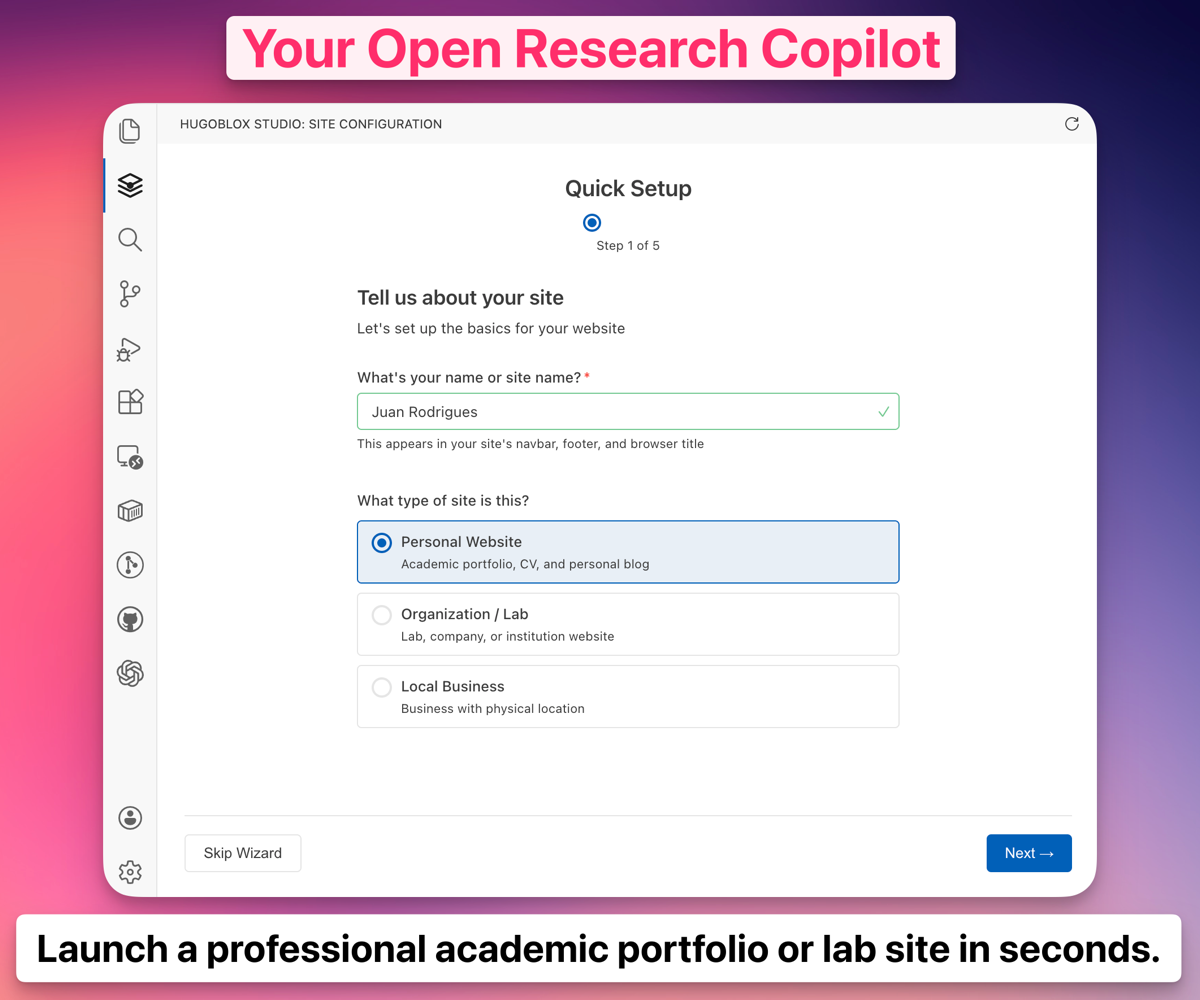
kit is a free, open source blogging & personal sites project written in HTML and released under MIT. It has 9,721 GitHub stars, 2,954 forks and 26 open issues, and was last pushed 1 months ago. On this registry it ranks #8 of 25 tracked projects in Blogging & Personal Sites, with 5 head-to-head comparisons available. It gained 2 stars over the last 3 tracked days.

What is kit?

HugoBlox (listed in this registry as kit) is a free, MIT-licensed static site framework that turns a plain-English description into AI-generated pages while keeping every page as Markdown you own, built for academics, researchers, developers, and small teams who need professional landing pages, portfolios, blogs, publications, and documentation without a database or a paid site builder.

What it is

HugoBlox is an open-source framework for building professional sites from structured Markdown, running on the Hugo static site generator with a Tailwind-based block system. You pick a template or scaffold a site with the CLI, describe the pages you want to Hugo Chat, and the generated output is plain Markdown with correct front matter, shortcodes, and blocks. It ships 20+ structured content types covering landing pages, portfolios, blogs, publications, docs, team profiles, event pages, slide decks, resumes, and notebook or LaTeX content, and everything is pushed to a static host as HTML with no runtime server and no database.

The concrete problem it solves is the trade-off imposed by the two dominant alternatives. AI site builders such as Lovable, v0, and Bolt generate React code that is hard to maintain by hand, and CMS platforms such as WordPress and Webflow lock content inside a database you cannot leave. HugoBlox produces readable Markdown files on a Tailwind and Hugo stack, so a site stays portable, human-editable after generation, and deployable as static HTML on GitHub, Netlify, Vercel, Cloudflare, or any static host.

Key capabilities

  • 20+ built-in structured content types with proper front matter, metadata, and layouts, so publications, projects, team pages, and events are first-class rather than freeform posts.
  • A Tailwind block system for landing pages, covering hero, features, pricing, testimonials, and call-to-action sections.
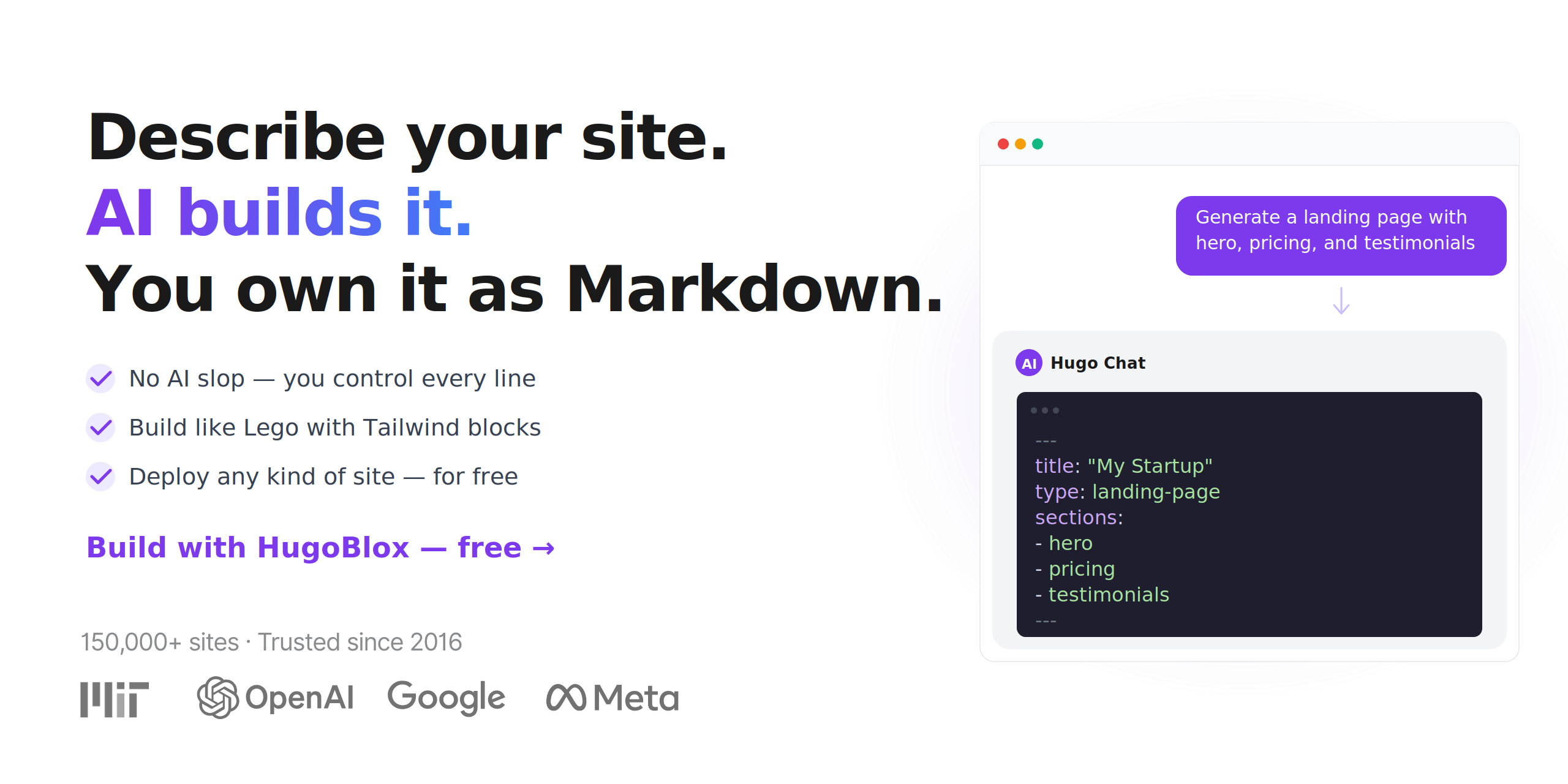
  • AI page generation through Hugo Chat, which writes structured Hugo pages with the right front matter, shortcodes, and HugoBlox blocks from a plain-English prompt.
  • Academic publication pages with BibTeX and DOI citation workflows.
  • Searchable documentation with sidebar navigation and versioning.
  • Slide decks rendered with reveal.js, plus native rendering of Jupyter .ipynb notebooks and math-heavy LaTeX pages.
  • CLI scaffolding with npm install -g hugoblox followed by hugoblox create site, requiring Hugo Extended and Node.js.

Who uses it and how

  • Academic researchers build publication pages with BibTeX and DOI workflows alongside team and author profiles carrying bios, avatars, social links, and publication lists.
  • Documentation teams run searchable, versioned docs sites on a static host, avoiding a runtime CMS entirely.
  • Individuals and small teams launch landing pages, portfolios, and blogs from a template in the browser, then edit the generated Markdown directly.
  • Career-focused users produce structured resumes and CVs exportable to PDF from the same content model.
  • Adoption spans 150,000+ sites, with teams at NVIDIA Research, MIT, and King's College London named in the README, alongside Meta, Stanford, and NVIDIA among users, and 4.9/5 from an official user survey since 2016.

Getting started

The fastest path is browsing the hosted templates and launching one in the browser, which the README describes as roughly a 60-second start. For full control, install the CLI with npm install -g hugoblox and run hugoblox create site, which requires Hugo Extended and Node.js.

How it compares

Against paid AI site builders such as Lovable, v0, and Bolt, HugoBlox is MIT licensed and open source rather than proprietary, and its output is plain Markdown instead of React code. Against CMS platforms such as WordPress and Webflow, it produces static HTML that runs without a runtime server and keeps content in files you control rather than a database you cannot export. Hosting is free on static providers, removing the recurring platform fee those products charge.

When to use it β€” and when not to

Choose it when the goal is a content-led site β€” landing page, blog, portfolio, docs, or publications β€” that must stay cheap to host and portable across static providers, and when a Markdown-plus-Git workflow suits the team. A self-hoster still runs the build toolchain (Hugo Extended and Node.js), a Git repository, and deploys through a static host, and AI generation depends on the hosted Hugo Chat service rather than a local model. It is not the right pick for database-backed dynamic applications, and readers should weigh the fact that the README reads largely as marketing, which makes it harder to judge operational detail than a sparse or purely technical document would.

project readme (upstream, from github) β€” read inline

δΈ­ζ–‡

Describe your site. AI builds it. You own it as Markdown.

HugoBlox is the open-source framework for building professional sites from structured Markdown β€” landing pages, portfolios, blogs, publications, docs, and more.
Pick a template, let Hugo Chat AI generate your pages, and deploy anywhere. Every file is plain Markdown you can read, edit, and own forever.

Generate Pages with AI   |   Browse Templates   |   Ownable CMS for VS Code

GitHub Stars Discord VS Code Installs VS Code Rating Follow on X

Trusted since 2016 Β· 150,000+ sites (Meta, Stanford, NVIDIA) Β· Rated 4.9/5 by users (official survey) Β· Used by teams at NVIDIA Research, MIT, and King's College London Β· Featured by GitHub Release Radar


⚑ How it works

1. 🎨 Pick a template

Choose a template or scaffold with the CLI.

Landing pages, portfolios, blogs, research sites, docs β€” ready in seconds.

2. ✨ Generate pages with AI

Open Hugo Chat and describe what you need.

"Create a landing page with hero, pricing, and testimonials" β€” done.

3. πŸš€ Deploy anywhere

Push to GitHub. Deploy on Netlify, Vercel, Cloudflare β€” or any static host.

No database. No runtime. Free hosting.


πŸ† Why HugoBlox

Every other tool makes you choose. HugoBlox doesn't.

AI site builders (Lovable, v0, Bolt) CMS platforms (WordPress, Webflow) HugoBlox
AI generates your pages Yes No Yes
You own the output as readable files No β€” React code No β€” locked in a database Yes β€” plain Markdown
Works without a runtime server Sometimes No Yes β€” static HTML
Structured content types (publications, projects, team pages) No Partial Yes β€” 20+ built-in types
Human-editable after AI generates it Barely Through the CMS only Yes β€” it's Markdown
Free to host forever No No Yes
Open source No No Yes β€” MIT licensed

[!IMPORTANT] The pitch: other tools generate code you can't maintain or lock your content in a database you can't leave. HugoBlox gives you AI-generated pages as plain Markdown on a Tailwind + Hugo stack β€” readable, portable, and yours.


🧱 What you can build
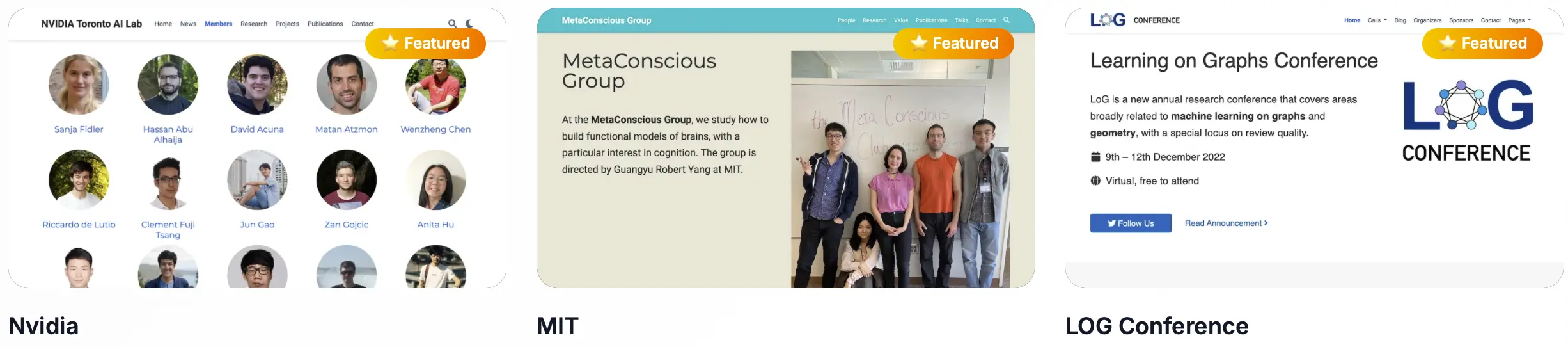
HugoBlox includes 20+ structured content types with proper front matter, metadata, and layouts. Tell Hugo Chat what you need and it generates the right one:

  • πŸš€ Landing pages β€” hero, features, pricing, testimonials, CTA sections via the block system
  • πŸ“ Blogs & articles β€” posts with tags, categories, authors, and SEO metadata
  • πŸ’Ό Portfolios & project pages β€” showcase your work with descriptions, tech stacks, and images
  • πŸ“š Publication pages β€” academic papers with BibTeX/DOI citation workflows
  • πŸ“– Documentation β€” searchable docs with sidebar navigation and versioning
  • πŸ‘₯ Team & author profiles β€” bio, avatar, social links, publication lists
  • 🎀 Event & talk pages β€” conferences, workshops, presentations with slides
  • 🎞️ Slide decks β€” Markdown-powered presentations using reveal.js
  • πŸ“„ Resumes & CVs β€” structured career pages, exportable to PDF
  • πŸ”¬ Jupyter notebooks & LaTeX β€” render .ipynb and math-heavy pages natively

Browse all templates


πŸ› οΈ Get started

Step 1: Create your site

Option A: Start from a template (fastest)

[!TIP] Pick a template and launch in your browser in 60 seconds: Browse templates

Option B: Use the CLI (full control)

# Requires Hugo Extended & Node.js
npm install -g hugoblox
hugoblox create site

Step 2: Customize with AI + visual editing

Hugo Chat β€” AI page generation

Describe what you need in plain English. Hugo Chat generates structured Hugo pages with correct front matter, shortcodes, and HugoBlox blocks.

"Generate a landing page for my consulting firm with services, testimonials, and a contact form"

Try Hugo Chat β€” free

Ownable CMS β€” visual editing in VS Code

Drag-and-drop blocks, live preview, and YAML validation without leaving your editor. The power of a visual website builder inside VS Code.

  1. Install Ownable CMS from the Marketplace
  2. Open your HugoBlox project
  3. Click the Ownable icon to start editing

[!NOTE] Need docs? See docs.ownable.dev for guides, configuration reference, and best practices.


πŸ”“ Open source. No lock-in. No catch.

  • βœ… MIT licensed. The framework is and will always be open source.
  • βœ… Plain Markdown files. Your content is never locked in a database or proprietary format. Take it anywhere.
  • βœ… Static output. No server to maintain, no database to patch, no vendor to depend on.
  • βœ… Free hosting. Deploy to Netlify, Vercel, GitHub Pages, Cloudflare Pages β€” all free tier.
  • βœ… AI is free to start. Hugo Chat includes free messages every day. No credit card needed.
  • βœ… Future-proof. Markdown has been readable since 2004. Your content will outlast any platform.

[!IMPORTANT] "Every AI website builder generates React code you'll throw away in six months. Every CMS locks your content in a database you'll never migrate. HugoBlox is the gap between them."

Want more? Upgrade to Pro for visual editing, AI automations, BibTeX import, and priority support. Compare plans β†’


🌍 Who uses HugoBlox

HugoBlox powers sites for **researchers, consultants, founders, developer advocates, an

readme truncated β€” read the full docs on github

Frequently asked questions

Is kit free to use?

kit is open source under the MIT licence. There is no licence fee and no seat count β€” you can self-host it or, where the project offers one, pay a vendor for a managed version instead.

What does kit do?

🧱 Describe your site, AI builds it, you own it as Markdown. Snap together Tailwind blocks like Lego β€” landing pages, blogs, portfolios, docs & more. No AI slop

What is kit written in?

kit is primarily written in HTML. Its source is publicly available at https://github.com/HugoBlox/kit, and it has 9,721 GitHub stars.