
A next-generation crawling and spidering framework




Features • Installation • Usage • Scope • Config • Filters • Join Discord
Features
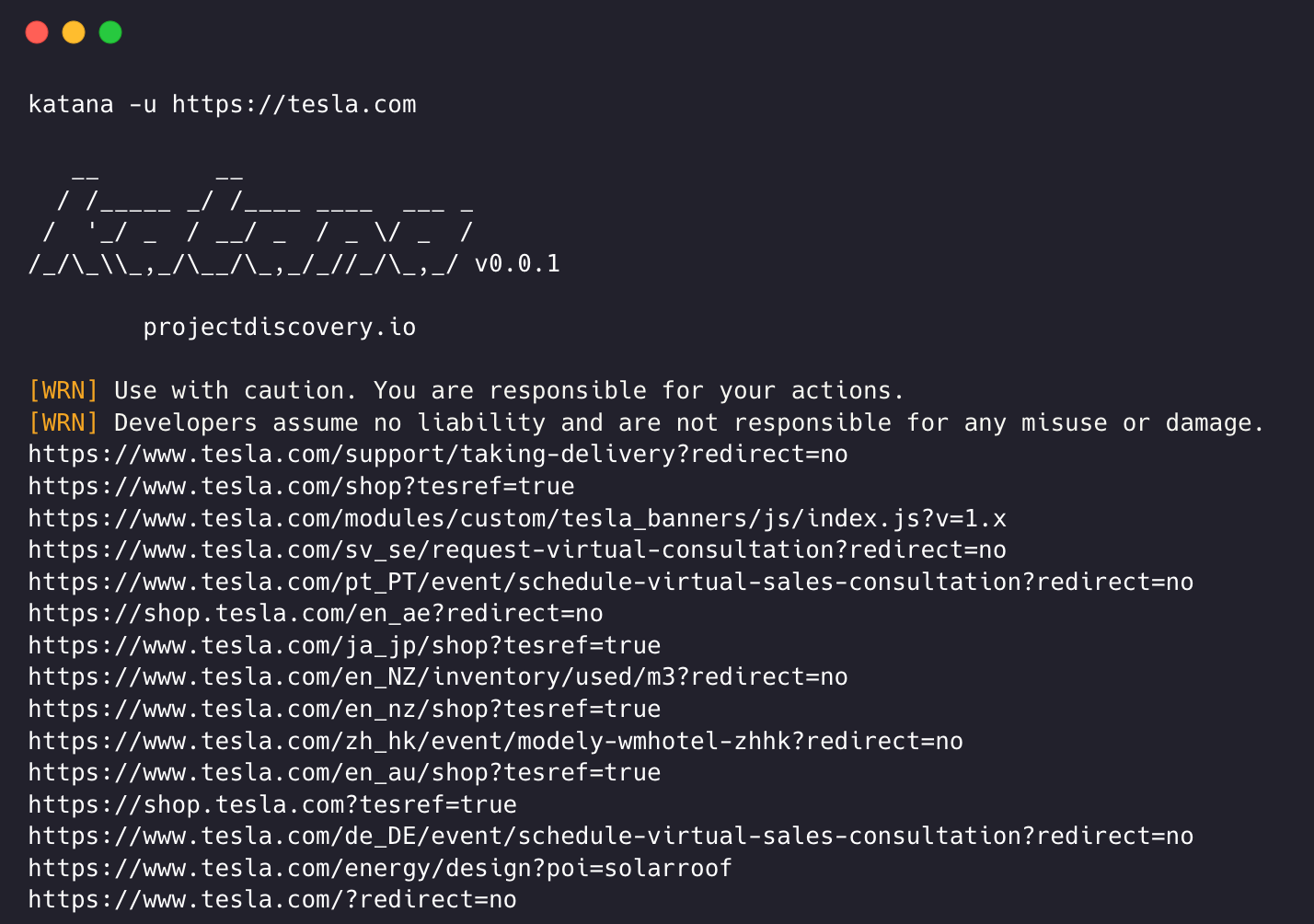
- Fast And fully configurable web crawling
- Standard and Headless mode
- JavaScript parsing / crawling
- Customizable automatic form filling
- Scope control - Preconfigured field / Regex
- Knowledge base - ML page-type / form classification (auto-downloaded model)
- Customizable output - Preconfigured fields
- INPUT - STDIN, URL and LIST
- OUTPUT - STDOUT, FILE and JSON
Installation
katana requires Go 1.26+ to install successfully. If you encounter any installation issues, we recommend trying with the latest available version of Go, as the minimum required version may have changed. Run the command below or download a pre-compiled binary from the release page.
CGO_ENABLED=1 go install github.com/projectdiscovery/katana/cmd/katana@latest
More options to install / run katana-
Docker
To install / update docker to latest tag -
docker pull projectdiscovery/katana:latest
To run katana in standard mode using docker -
docker run projectdiscovery/katana:latest -u https://tesla.com
To run katana in headless mode using docker -
docker run projectdiscovery/katana:latest -u https://tesla.com -system-chrome -headless
Ubuntu
It's recommended to install the following prerequisites -
sudo apt update
sudo apt install zip curl wget git snapd
sudo snap refresh
sudo snap install golang --classic

sudo install -d -m 0755 /etc/apt/keyrings
curl -fsSL https://dl.google.com/linux/linux_signing_key.pub \
  | sudo gpg --dearmor -o /etc/apt/keyrings/google-chrome.gpg

echo "deb [arch=amd64 signed-by=/etc/apt/keyrings/google-chrome.gpg] \
  http://dl.google.com/linux/chrome/deb/ stable main" \
  | sudo tee /etc/apt/sources.list.d/google-chrome.list > /dev/null

sudo apt update
sudo apt install google-chrome-stable
install katana -
go install github.com/projectdiscovery/katana/cmd/katana@latest
Usage
katana -h
This will display help for the tool. Here are all the switches it supports.
Katana is a fast crawler focused on execution in automation
pipelines offering both headless and non-headless crawling.

Usage:
  ./katana [flags]

Flags:
INPUT:
   -u, -list string[]     target url / list to crawl
   -resume string         resume scan using resume.cfg
   -e, -exclude string[]  exclude host matching specified filter ('cdn', 'private-ips', cidr, ip, regex)

CONFIGURATION:
   -r, -resolvers string[]       list of custom resolver (file or comma separated)
   -d, -depth int                maximum depth to crawl (default 3)
   -jc, -js-crawl                enable endpoint parsing / crawling in javascript file
   -jsl, -jsluice                enable jsluice parsing in javascript file (memory intensive)
   -ct, -crawl-duration value    maximum duration to crawl the target for (s, m, h, d) (default s)
   -kf, -known-files string      enable crawling of known files (all,robotstxt,sitemapxml), a minimum depth of 3 is required to ensure all known files are properly crawled.
   -mrs, -max-response-size int  maximum response size to read (default 4194304)
   -timeout int                  time to wait for request in seconds (default 10)
   -aff, -automatic-form-fill    enable automatic form filling (experimental)
   -fx, -form-extraction         extract form, input, textarea & select elements in jsonl output
   -retry int                    number of times to retry the request (default 1)
   -proxy string                 http/socks5 proxy to use
   -td, -tech-detect             enable technology detection
   -H, -headers string[]         custom header/cookie to include in all http request in header:value format (file)
   -config string                path to the katana configuration file
   -fc, -form-config string      path to custom form configuration file
   -flc, -field-config string    path to custom field configuration file
   -s, -strategy string          Visit strategy (depth-first, breadth-first) (default "depth-first")
   -iqp, -ignore-query-params    Ignore crawling same path with different query-param values
   -fsu, -filter-similar         filter crawling of similar looking URLs (e.g., /users/123 and /users/456)
   -fst, -filter-similar-threshold int  number of distinct values before a path position is treated as parameter (default 10)
   -tlsi, -tls-impersonate       enable experimental client hello (ja3) tls randomization
   -dr, -disable-redirects       disable following redirects (default false)
   -pcs, -page-content-similar   enable page content similarity filtering (simhash|tfidf|bm25)
   -pcsm, -page-content-similar-mode string  similarity mode: simhash, tfidf, or bm25 (default simhash)
   -pcsd, -page-content-similar-distance int  simhash max hamming distance (default 3)
   -pcst, -page-content-similar-threshold float  tfidf/bm25 min score 0-1 (default 0.85)
   -pcsn, -page-content-similar-budget int  pages to fully process per similarity cluster (default 1)
   -sdd, -similarity-deduplication  alias for -pcs
   -kb, -knowledge-base          enable knowledge base classification
   -kb-secrets                   enable secrets extractor in the knowledge base
   -kb-validate-secrets          validate detected secrets against their provider (sends live API calls)
   -kb-endpoints                 enable endpoints extractor (classifies REST/GraphQL/SOAP/XHR requests)
   -mdp, -max-domain-pages int   maximum number of pages to crawl per domain (default unlimited)

DEBUG:
   -health-check, -hc        run diagnostic check up
   -elog, -error-log string  file to write sent requests error log
   -pprof-server             enable pprof server

HEADLESS:
   -hl, -headless                    enable headless hybrid crawling (experimental)
   -sc, -system-chrome               use local installed chrome browser instead of katana installed
   -sb, -show-browser                show the browser on the screen with headless mode
   -ho, -headless-options string[]   start headless chrome with additional options
   -nos, -no-sandbox                 start headless chrome in --no-sandbox mode
   -cdd, -chrome-data-dir string     path to store chrome browser data
   -scp, -system-chrome-path string  use specified chrome browser for headless crawling
   -noi, -no-incognito               start headless chrome without incognito mode
   -cwu, -chrome-ws-url string       use chrome browser instance launched elsewhere with the debugger listening at this URL
   -xhr, -xhr-extraction             extract xhr request url,method in jsonl output
   -pls, -page-load-strategy string  page load strategy (heuristic, load, domcontentloaded, networkidle, none) (default "heuristic")
   -dwt, -dom-wait-time int          time in seconds to wait after page load when using domcontentloaded strategy (default 5)
   -csp, -captcha-solver-provider string  captcha solver provider (e.g. capsolver)
   -csk, -captcha-solver-key string       captcha solver provider api key

SCOPE:
   -cs, -crawl-scope string[]       in scope url regex to be followed by crawler
   -cos, -crawl-out-scope string[]  out of scope url regex to be excluded by crawler
   -fs, -field-scope string         pre-defined scope field (dn,rdn,fqdn) or custom regex (e.g., '(company-staging.io|company.com)') (default "rdn")
   -ns, -no-scope                   disables host based default scope
   -do, -display