




JuiceFS is a high-performance POSIX file system released under Apache License 2.0, particularly designed for the cloud-native environment. The data, stored via JuiceFS, will be persisted in Object Storage (e.g. Amazon S3), and the corresponding metadata can be persisted in various compatible database engines such as Redis, MySQL, and TiKV based on the scenarios and requirements.
With JuiceFS, massive cloud storage can be directly connected to big data, machine learning, artificial intelligence, and various application platforms in production environments. Without modifying code, the massive cloud storage can be used as efficiently as local storage.
📖 Document: Quick Start Guide
Highlighted Features
- Fully POSIX-compatible: Use as a local file system, seamlessly docking with existing applications without breaking business workflow.
- Fully Hadoop-compatible: JuiceFS' Hadoop Java SDK is compatible with Hadoop 2.x and Hadoop 3.x as well as a variety of components in the Hadoop ecosystems.
- S3-compatible: JuiceFS' S3 Gateway provides an S3-compatible interface.
- Cloud Native: A Kubernetes CSI Driver is provided for easily using JuiceFS in Kubernetes.
- Shareable: JuiceFS is a shared file storage that can be read and written by thousands of clients.
- Strong Consistency: The confirmed modification will be immediately visible on all the servers mounted with the same file system.
- Outstanding Performance: The latency can be as low as a few milliseconds, and the throughput can be expanded nearly unlimitedly (depending on the size of the Object Storage). Test results
- Data Encryption: Supports data encryption in transit and at rest (please refer to the guide for more information).
- Global File Locks: JuiceFS supports both BSD locks (flock) and POSIX record locks (fcntl).
- Data Compression: JuiceFS supports LZ4 or Zstandard to compress all your data.
Architecture | Getting Started | Advanced Topics | POSIX Compatibility | Performance Benchmark | Supported Object Storage | Who is using | Roadmap | Reporting Issues | Contributing | Community | Usage Tracking | License | Credits | FAQ
Architecture
JuiceFS consists of three parts:
- JuiceFS Client: Coordinates Object Storage and metadata storage engine as well as implementation of file system interfaces such as POSIX, Hadoop, Kubernetes, and S3 gateway.
- Data Storage: Stores data, with supports of a variety of data storage media, e.g., local disk, public or private cloud Object Storage, and HDFS.
- Metadata Engine: Stores the corresponding metadata that contains information of file name, file size, permission group, creation and modification time and directory structure, etc., with supports of different metadata engines, e.g., Redis, MySQL, SQLite and TiKV.
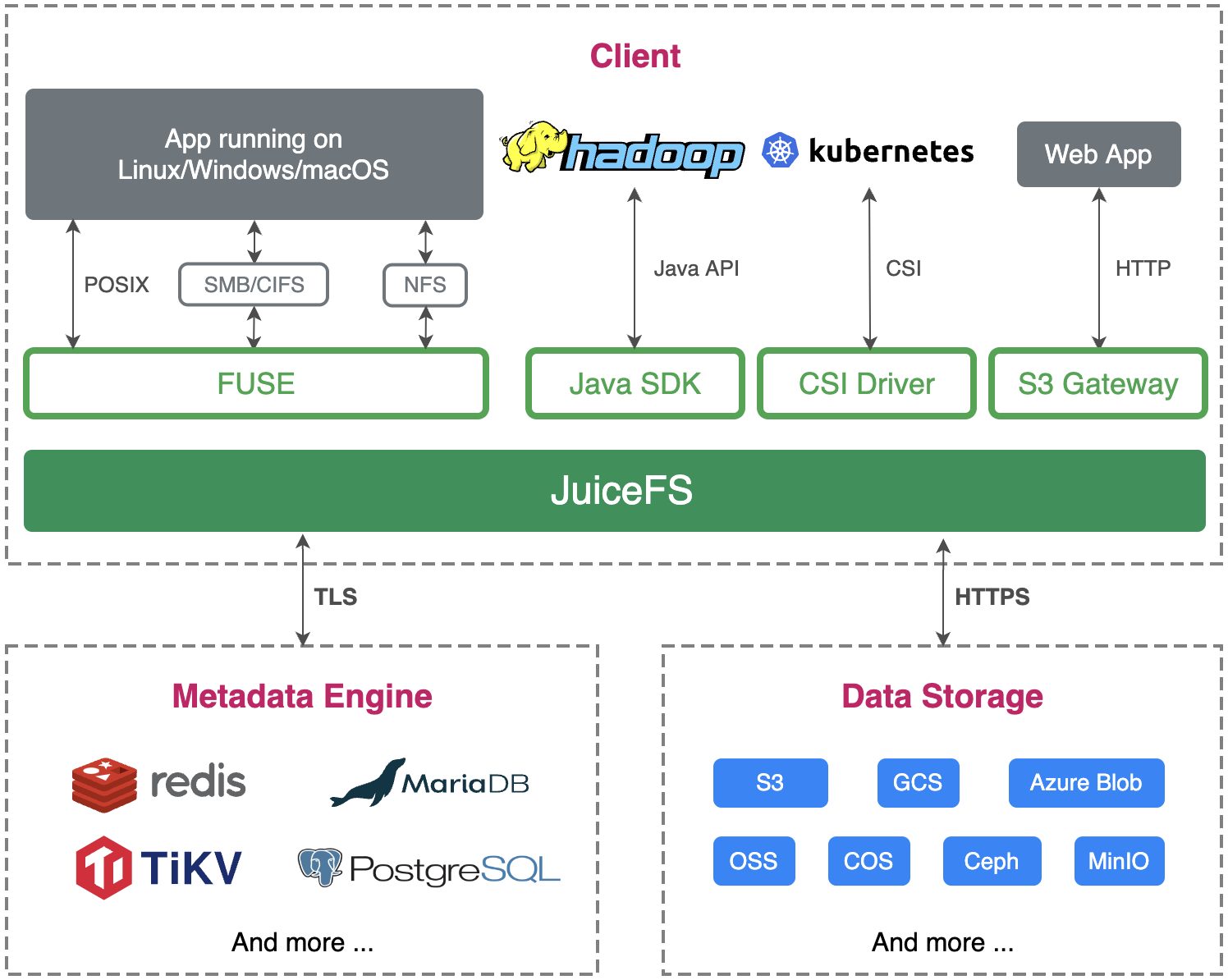
JuiceFS can store the metadata of file system on different metadata engines, like Redis, which is a fast, open-source, in-memory key-value data storage, particularly suitable for storing metadata; meanwhile, all the data will be stored in Object Storage through JuiceFS client. Learn more

Each file stored in JuiceFS is split into "Chunk" s at a fixed size with the default upper limit of 64 MiB. Each Chunk is composed of one or more "Slice"(s), and the length of the slice varies depending on how the file is written. Each slice is composed of size-fixed "Block" s, which are 4 MiB by default. These blocks will be stored in Object Storage in the end; at the same time, the metadata information of the file and its Chunks, Slices, and Blocks will be stored in metadata engines via JuiceFS. Learn more

When using JuiceFS, files will eventually be split into Chunks, Slices and Blocks and stored in Object Storage. Therefore, the source files stored in JuiceFS cannot be found in the file browser of the Object Storage platform; instead, there are only a chunks directory and a bunch of digitally numbered directories and files in the bucket. Don't panic! This is just the secret of the high-performance operation of JuiceFS!
Getting Started
Before you begin, make sure you have:
- One supported metadata engine, see How to Set Up Metadata Engine
- One supported Object Storage for storing data blocks, see Supported Object Storage
- JuiceFS Client downloaded and installed
Please refer to Quick Start Guide to start using JuiceFS right away!
Command Reference
Check out all the command line options in command reference.
Containers
JuiceFS can be used as a persistent volume for Docker and Podman, please check here for details.
Kubernetes
It is also very easy to use JuiceFS on Kubernetes. Please find more information here.
Hadoop Java SDK
If you wanna use JuiceFS in Hadoop, check Hadoop Java SDK.
Advanced Topics
- Redis Best Practices
- How to Setup Object Storage
- Cache
- Fault Diagnosis and Analysis
- FUSE Mount Options
- Using JuiceFS on Windows
- S3 Gateway
Please refer to JuiceFS Document Center for more information.
POSIX Compatibility
JuiceFS has passed all of the compatibility tests (8813 in total) in the latest pjdfstest .
All tests successful.

Test Summary Report
-------------------
/root/soft/pjdfstest/tests/chown/00.t          (Wstat: 0 Tests: 1323 Failed: 0)
  TODO passed:   693, 697, 708-709, 714-715, 729, 733
Files=235, Tests=8813, 233 wallclock secs ( 2.77 usr  0.38 sys +  2.57 cusr  3.93 csys =  9.65 CPU)
Result: PASS
Aside from the POSIX features covered by pjdfstest, JuiceFS also provides:
- Close-to-open consistency. Once a file is written and closed, it is guaranteed to view the written data in