
infrahub is a free, open source databases project written in Python and released under Apache-2.0. It has 545 GitHub stars, 69 forks and 552 open issues, and was last pushed 8 hours ago. On this registry it ranks #204 of 206 tracked projects in Databases, with 5 head-to-head comparisons available. It gained 17 stars over the last 30 tracked days.

What is infrahub?

Infrahub is a graph-based data management platform for teams that run networks, data centres, and cloud infrastructure, and it gives them versioned, validated infrastructure data instead of fragmented records and one-off scripts.

What it is

Infrahub is an Apache-2.0 licensed, Python-based platform that acts as the data foundation for infrastructure automation. It keeps devices, services, IPs, VLANs, circuits, and the business context attached to them in a single graph-backed source of truth, with schema, data, and generated artifacts all stored, queried, and changed through one system. The platform is assembled from open-source foundations named in its own documentation: Neo4j as the graph database, Git for version control concepts, Prefect for workflow execution, GraphQL for query, and Python for extension.

The concrete problem it solves is the split between where infrastructure data lives and how automation consumes it. Teams typically hold inventory in spreadsheets or separate tools, then write scripts that read that data once and break when it drifts. Infrahub replaces that pattern with a schema-first model that enforces validation, first-class relationships, and full change history, so automation runs against data that is reviewed and consistent. It also federates rather than only replaces: Infrahub Sync pulls data from NetBox, Nautobot, and IP Fabric into the same graph.

Key capabilities

  • Schema-first, graph-backed data models for devices, services, topologies, and business context, enforced with validation and queried through relationships on Neo4j.
  • Version control applied to data, not only configuration: branches, peer review, and a queryable history of who changed what, when, and why across schema, data, and generated artifacts.
  • Generators and transforms that render configuration and other artifacts from Infrahub data using Jinja2 or Python, stored version-controlled next to the data.
  • A production change flow of branch, CI, review, merge, with idempotent re-runs that surface and correct deviations instead of forcing a full rebuild.
  • Integrations and federation: connectors for Git, Ansible, and Nornir, plus Infrahub Sync for NetBox, Nautobot, and IP Fabric.
  • GraphQL, REST, and a web UI for service catalogs, so internal teams and customers can request infrastructure resources directly.
  • An MCP server and Infrahub Skills that expose validated, relationship-rich data to Claude, Cursor, and other AI agents.
  • A Python SDK and the infrahubctl CLI from the infrahub-sdk-python project for building integrations and managing the platform.

Who uses it and how

  • Network and data centre engineering teams that need one source of truth spanning devices, services, IP addressing, VLANs, circuits, and the business context tied to them.
  • Platform and operations teams that publish a self-service catalog over GraphQL, REST, or the web UI, letting application teams request resources without manual ticketing.
  • Automation teams that generate, validate, and deploy configurations across multiple vendors and sites, and that need full lifecycle workflows for provisioning, upgrade, and decommission.
  • Teams building an AIOps knowledge graph, modelling dependencies across infrastructure to feed AI-driven reasoning, troubleshooting, and predictive operations.
  • Organizations running production deployments on Kubernetes, using the opsmill/infrahub-helm chart and the installation guide rather than a single host install.

Getting started

Three paths are documented: a hosted sandbox at sandbox.infrahub.app with sample data and no installation, a guided browser lab on Instruqt covering branches, schemas, and unified storage, or the Quick Start guide at docs.infrahub.app/overview/quickstart for a local instance. Production deployments on Kubernetes use the opsmill/infrahub-helm chart alongside the installation guide.

How it compares

The facts provided do not list paid products that Infrahub replaces, but they do name adjacent tools: NetBox, Nautobot, and IP Fabric appear as data sources that Infrahub Sync federates from, which places Infrahub as a layer above those systems rather than a straight swap for them. Its distinguishing combination is native version control of the data itself plus a graph store, sitting on open foundations such as Neo4j, Git, Prefect, GraphQL, and Python.

When to use it — and when not to

A self-hoster takes on operating the platform and its Neo4j graph database, and production use on Kubernetes assumes Helm and cluster management capacity, so a small team without infrastructure operations experience should weigh that before adopting it. The repository shows 519 stars against 552 open issues, which suggests an active but heavy issue backlog, and the README excerpt ends mid-list for the ecosystem projects, so anyone evaluating it should read the full documentation rather than the summary. It is a poor fit for teams that only need a static inventory record and have no automation, validation, or review workflow to feed.

project readme (upstream, from github) — read inline

Infrahub

The data foundation for modern automation

Latest release License Contributors Discord LinkedIn

Infrahub Community | Infrahub Enterprise | Sandbox

Infrahub is the data foundation for modern infrastructure automation, for teams managing networks, data centers, and cloud infrastructure. It moves them from fragmented data and one-off scripts to repeatable, validated workflows — delivering infrastructure as a reliable service to the rest of the business and the AI agents that consume it.
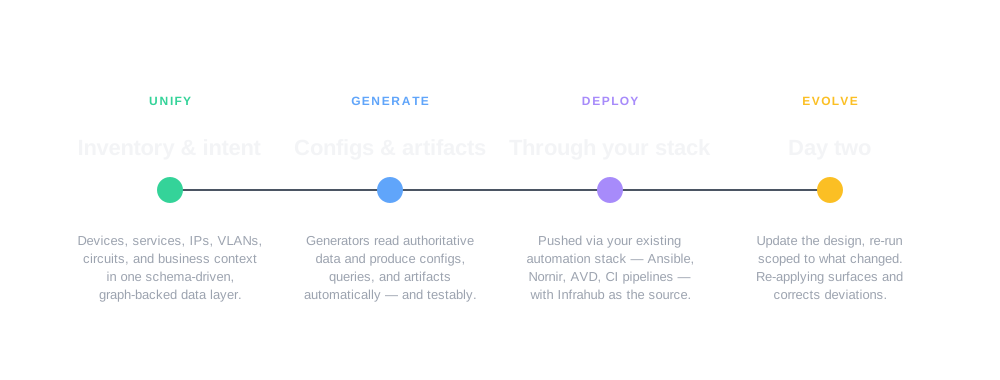
Infrahub lifecycle: Unify, Generate, Deploy, Evolve

Key capabilities

  • Schema-first, graph-backed data model. Define your own data models for devices, services, topologies, and business context — enforced with validation and queried with first-class relationships on a Neo4j graph database.
  • Version control for data, not just configs. Branches, peer review, and a complete queryable history of who changed what, when, and why — applied to schema, data, and generated artifacts.
  • Generators and transforms. Render configurations and other artifacts from Infrahub data using Jinja2 or Python — composable, reusable, and version-controlled alongside the data.
  • Built for production. Templates and generators are unit-and-integration testable. Every change moves through branch → CI → review → merge — and idempotent re-runs surface and correct deviations without a full rebuild.
  • Integrations and self-service. Connectors for Git, Ansible, and Nornir. Infrahub Sync federates data from Netbox, Nautobot, and IP Fabric. GraphQL, REST, and a web UI back service catalogs so internal teams and customers can self-serve.
  • AI-ready by design. An MCP server and Infrahub Skills make Infrahub's validated, relationship-rich data directly usable to Claude, Cursor, and other AI agents.

Where Infrahub fits

  • Unify infrastructure data — one source of truth across devices, services, IPs, VLANs, circuits, and the business context tied to them.
  • Automate at scale — generate, validate, and deploy configurations across vendors and sites; support full lifecycle workflows for provisioning, upgrade, and decommission.
  • Enable self-service — let app, platform, and ops teams request infrastructure resources through APIs and a UI backed by authoritative data.
  • Build an AIOps knowledge graph — model dependencies and relationships across infrastructure to provide the data foundation for AI-driven reasoning, troubleshooting, and predictive operations.

What makes Infrahub different

Infrahub is purpose-built for network and infrastructure automation. It combines an extensible schema language, native version control of the data, a graph data store, and open-source foundations — Neo4j, Git, Prefect, GraphQL, and Python — in a single platform. For a side-by-side comparison with common alternatives, see How Infrahub compares.

Getting started

Three ways to try Infrahub:

  • Sandbox — a hosted demo of the Infrahub UI with sample data — explore the interface without installing anything.
  • Getting Started Lab — a guided browser tutorial covering branches, schemas, and unified storage.
  • Quick Start guide — set up a local Infrahub instance and walk through the basics in your own environment.

For production deployments on Kubernetes, see opsmill/infrahub-helm and the installation guide.

Documentation

The Infrahub ecosystem

OpsMill maintains a set of officially supported projects that help teams develop with Infrahub, run it in production, and integrate it with the rest of their automation stack.

Develop with Infrahub

Project Purpose
infrahub-sdk-python Python SDK and the infrahubctl CLI — build integrations and manage Infrahub from code
infrahub-vscode VS Code extension with schema validation, GraphQL query support, and schema visualization
schema-library Reusable schemas for common infrastructure patterns — a starting point for modeling
infrahub-mcp MCP server exposing Infrahub data to Claude, Cursor, and other AI agents
infrahub-skills AI skills that give coding assistants knowledge of Infrahub conventions and data models

Run Infrahub in production

Project Purpose
infrahub-helm Helm charts for deploying Infrahub on Kubernetes
infrahub-backup Backup and restore CLI for Infrahub instances

Integrate with your automation stack

Project Purpose
infrahub-ansible Ansible Collection — use Infrahub as the source of truth for Ansible playbooks
nornir-infrahub Nornir inventory plugin for Python network automation
infrahub-sync Federate data from Netbox, Nautobot, IP Fabric, and other systems into Infrahub

The full set of OpsMill projects is at github.com/opsmill.

Screenshots

Infrahub UI
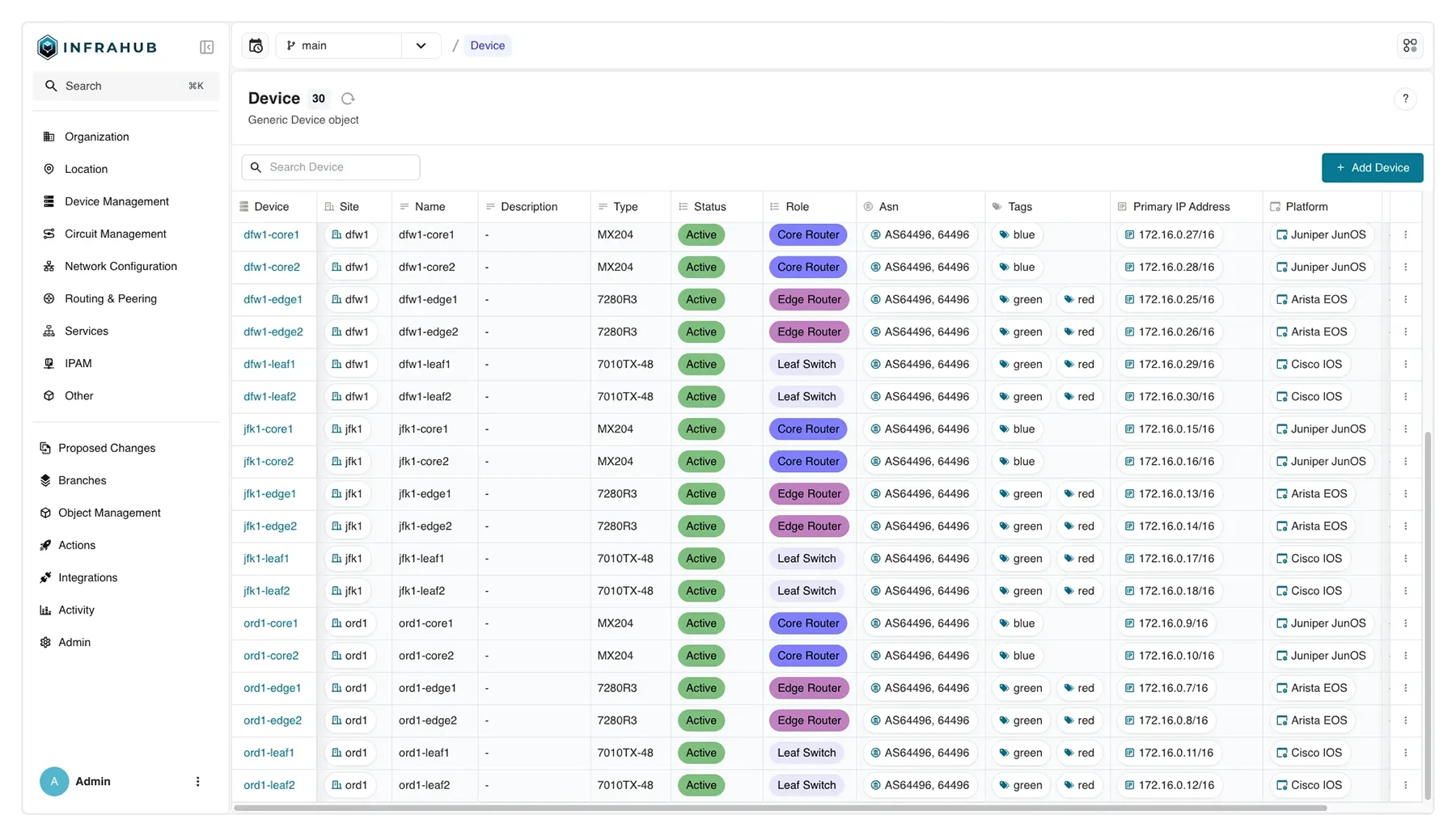
Infrahub main dashboard view

Branching and diff view — every change tracked, comparable, and queryable
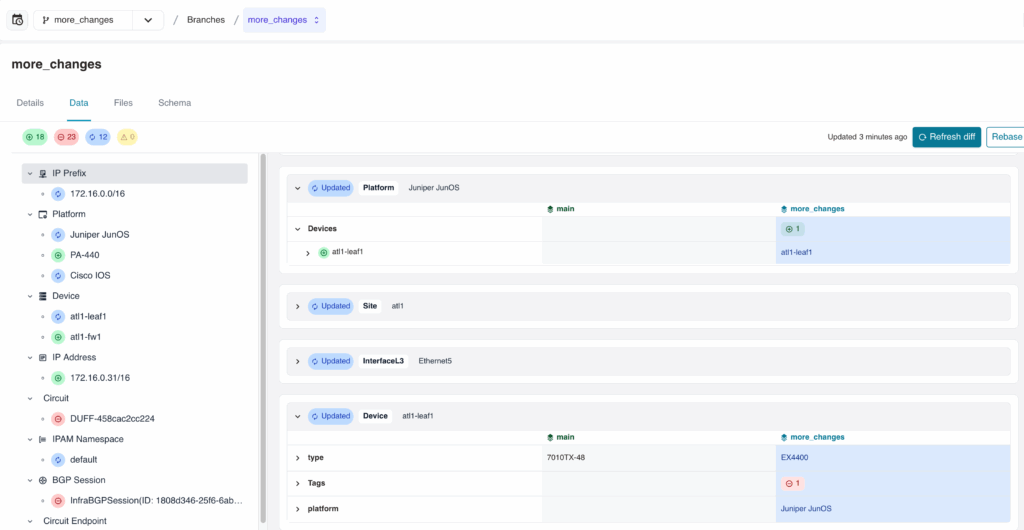
Infrahub branch diff view showing additions, deletions, and updates across multiple objects

Proposed change — peer review and approve before merge
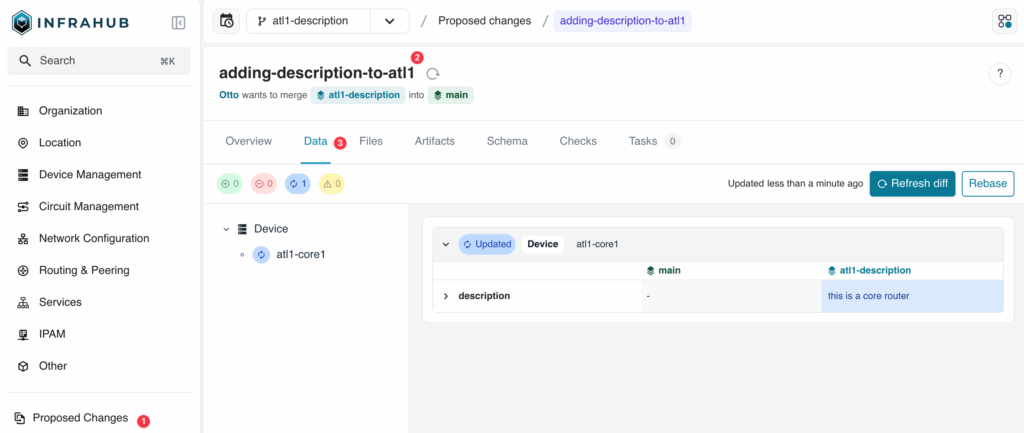
Infrahub proposed change interface with reviewers, comments, and merge controls

CI checks — validation runs on every proposed change; merge blocked when checks fail
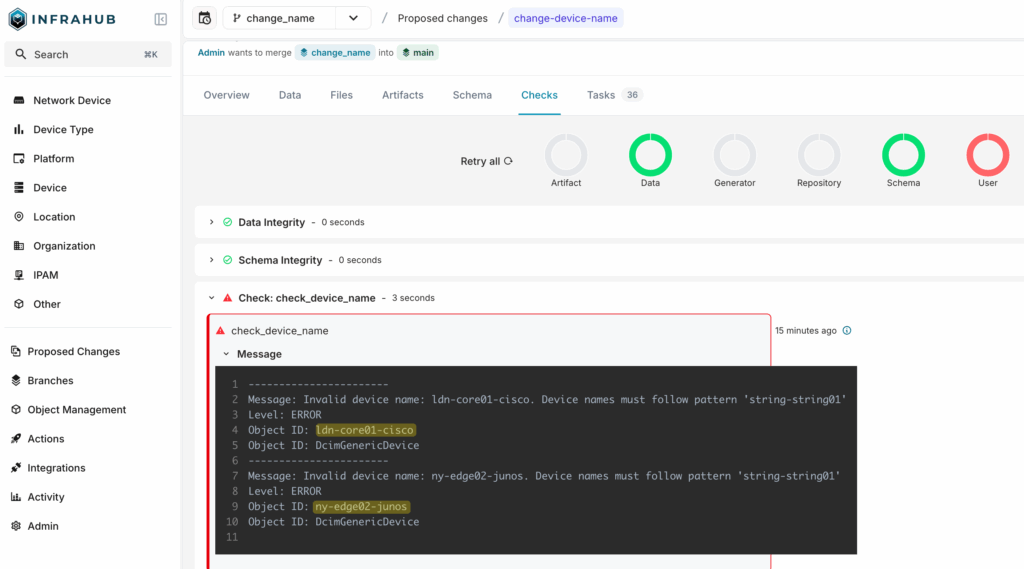
Infrahub CI check failure message inside a proposed change

Community and support

The Infrahub Community edition is open source and free. For deployments that need high availability, advanced RBAC, performance enhancements, and SLA-backed support, Infrahub Enterprise is available.

Contributing

Contributions of all sizes are welcome — bug fixes, schema accelerators, integrations, documentation, and core features. See CONTRIBUTING.md to get started.

Contributors

Security

See our security policy for supported versions and disclosure procedures.

License

Infrahub is released under the Apache 2.0 License.

Frequently asked questions

Is infrahub free to use?

infrahub is open source under the Apache-2.0 licence. There is no licence fee and no seat count — you can self-host it or, where the project offers one, pay a vendor for a managed version instead.

What does infrahub do?

Infrahub is a graph-based data management platform with built-in version control, CI workflows, peer review, and API access. It’s purpose-built to power reliabl

What is infrahub written in?

infrahub is primarily written in Python. Its source is publicly available at https://github.com/opsmill/infrahub, and it has 545 GitHub stars.