Hoodik



Hoodik is a lightweight, self-hosted, end-to-end encrypted cloud storage server. All encryption and decryption happens in your browser — the server never sees your plaintext data. Built with Rust (Actix-web) on the backend and Vue 3 on the frontend.
🌐 hoodik.io — Website | ☁️ Hoodik Cloud | 📱 Android App | 🍎 iOS & macOS App | ⚡ Self-Hosting Guide
Features
- End-to-end encryption — files are encrypted in the browser with AEGIS-128L before upload and decrypted after download; file keys are wrapped with a quantum-resistant X25519 + ML-KEM-768 hybrid (RSA on legacy accounts)
- Secure search — file metadata is tokenized and tagged with a key the server never sees, so it can match a query without being able to read the index
- Encrypted notes — create and edit rich markdown notes with a WYSIWYG editor; content is encrypted, auto-saved, and searchable just like uploaded files
- Public sharing links — share files via a link; the recipient decrypts everything in their browser with the key in the URL fragment, and the server never decrypts a public link
- Two-factor authentication — optional TOTP-based 2FA per user
- Admin dashboard — manage users, sessions, invitations, and application settings
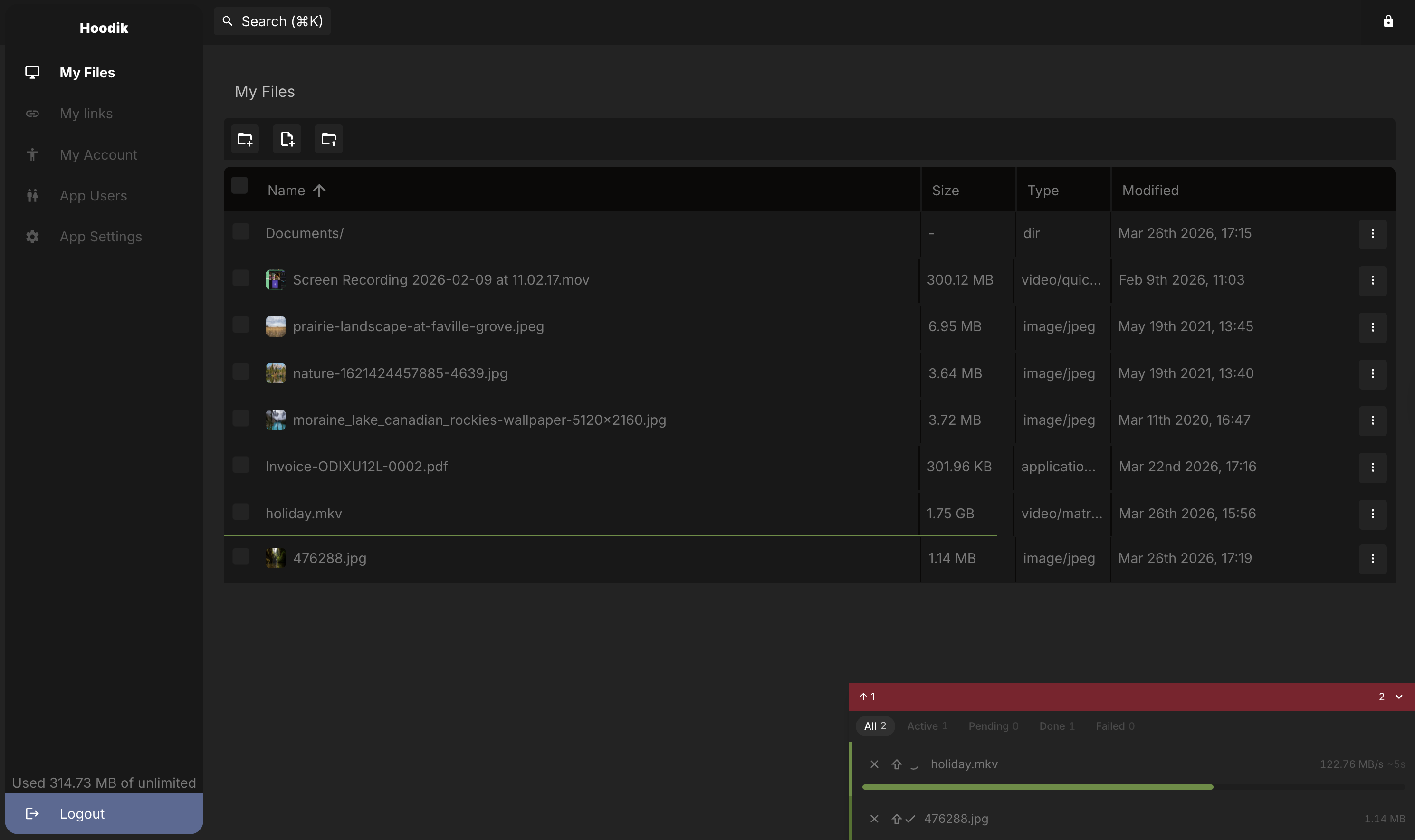
- Chunked transfers — files are split into encrypted chunks for concurrent upload/download
- SQLite or PostgreSQL — SQLite out of the box, PostgreSQL via a single environment variable
- S3-compatible storage — store encrypted chunks on any S3-compatible service (AWS, MinIO, Backblaze B2, Wasabi) instead of local disk
- Docker-first — single container deployment; multi-arch images (amd64, armv6, armv7, arm64)
How encryption works
File storage
Each user gets an Ed25519 identity key pair (for signing) and an X25519 + ML-KEM-768 wrapping key pair (for wrapping file keys) on registration. File keys are wrapped under both algorithms at once — a hybrid that stays secure even if a future quantum computer breaks the elliptic-curve half. Login uses OPAQUE, so your password never leaves the device; the private keys are stored envelope-encrypted under a key derived from the OPAQUE export_key, which only your password can produce — the server cannot read them. Accounts created before this scheme used an RSA-2048 key pair and are still supported; they migrate to the new keys automatically on the next login.
⚠️ Store your private key somewhere safe (e.g. a password manager). If you forget your password, the private key is the only way to recover your account and decrypt your files.
When you upload a file:
- A random symmetric key is generated for the file (key size depends on the cipher).
- The file is encrypted chunk-by-chunk with that key using the file's cipher (AEGIS-128L unless the admin picks a different default in the settings).
- The cipher identifier and the encrypted key are stored in the database alongside the file, so old files can always be decrypted with the correct algorithm even after the default cipher changes.
Chunks move over one of two HTTP endpoints, both client-side encrypted:
POST /api/storage/{file_id}?chunk=N&checksum=...— upload one encrypted chunk; the server verifies the CRC16 per chunk and stores it.POST /api/storage/{file_id}?format=tar— upload many chunks in one request as an uncompressed tar archive whose entries are named{index:06}.enc. Fewer HTTP round-trips on slow networks; the per-chunk integrity check is skipped (TLS + the file-level hash still cover transport and content).
Download mirrors the same split: GET /api/storage/{file_id}?chunk=N streams a single chunk, while GET /api/storage/{file_id}?format=tar streams every chunk as a single tar archive.
Search
Searchable metadata (file names, and the contents of notes) is tokenized in the browser and each token is tagged with HMAC under a key derived from your private key. Only those tags are stored. When you search, the same tagging is applied to your query and the tags are matched server-side. No plaintext leaves the browser, and the key never does either, so the index cannot be read back into words by anyone holding the database.
Public links
When you share a file:
- A random link key is generated.
- The file metadata and file key are encrypted with the link key.
- The link key itself is wrapped under your own current key type (the X25519 + ML-KEM-768 hybrid on current accounts, RSA on legacy accounts) so only you can recover it.
- The link key is appended to the share URL as a fragment:
https://…/links/{id}#link-key.
The recipient's browser uses the fragment to decrypt the metadata and file key locally and does all decryption itself — the link key in the fragment never reaches the server. The server only ever serves encrypted bytes and never decrypts anything for a public link.
Cryptographic primitives
| Primitive | Algorithm |
|---|---|
| Identity / signing | Ed25519 (legacy accounts: RSA-2048 PKCS#1) |
| Key wrapping | hybrid X25519 + ML-KEM-768 (post-quantum) — HKDF-SHA256 combiner, AEGIS-256 wrap AEAD (legacy accounts: RSA-2048) |
| Symmetric (default) | AEGIS-128L — hardware-accelerated AEAD via WASM SIMD128/relaxed-simd |
| Symmetric (supported) | AEGIS-256, Ascon-128a, ChaCha20-Poly1305 |
| Login | OPAQUE (RFC 9807, ristretto255-SHA512), Argon2id KSF — password never crosses the wire |
| Private-key wrap | envelope encryption under a KEK derived (HKDF-SHA512) from the OPAQUE export_key |
The cipher used to encrypt each file is stored in the database (files.cipher), so the correct algorithm is always used for decryption regardless of what the current default is.
Hoodik Cloud
If you'd rather not run a server, Hoodik Cloud is the managed version, run by us on the same publicly auditable code. The encryption is identical — files are encrypted in the browser and the server only ever stores ciphertext. There is no lock-in: you can export your whole instance at any time and get a runnable copy of Hoodik with your encrypted data inside, ready to self-host with Docker.
Getting started
Docker (quickstart)
docker run --name hoodik -d \
  -e DATA_DIR='/data' \
  -e APP_URL='https://my-app.example.com' \
  --volume "$(pwd)/data:/data" \
  -p 5443:5443 \
  hudik/hoodik:latest
This runs with a self-signed TLS certificate generated automatically in DATA_DIR. For production, provide your own certificate (see Configuration) or put Hoodik behind a reverse proxy such as Nginx Proxy Manager.
Docker with email and custom TLS
docker run --name hoodik -d \
  -e DATA_DIR='/data' \
  -e APP_URL='https://my-app.example.com' \
  -e SSL_CERT_FILE='/data/my-cert.crt.pem' \
  -e SSL_KEY_FILE='/data/my-key.key.pem' \
  -e MAILER_TYPE='smtp' \
  -e SMTP_ADDRESS='smtp.gmail.com' \
  -e SMTP_USERNAME='[email protected]' \
  -e SMTP_PASSWORD='your-app-password' \
  -e SMTP_PORT='465' \
  -e SMTP_DEFAULT_FROM_EMAIL='[email protected]' \
  -e SMTP_DEFAULT_FROM_NAME='Hoodik Drive' \
  --volume "$(pwd)/data:/data" \
  -p 5443:5443 \
  hudik/hoodik:latest
Tip: Set
JWT_SECRETto a stable random string so sessions survive container restarts.
Configuration
All configuration is done through environment variables. A full reference is in .env.example.
Core
| Variable | Default | Description |
|---|---|---|
DATA_DIR |
(required) | Directory for the database and stored files |
DATABASE_URL |
(SQLite) | PostgreSQL connection string — omit to use SQLite |
APP_URL |
https://localhost:5443 |
Public URL of the application |
APP_CLIENT_URL |
APP_URL |
URL of the frontend (set to Vite dev server during development) |
HTTP_PORT |
5443 |
Port the server listens on |
HTTP_ADDRESS |
localhost |
Bind address (0.0.0.0 in Docker) |
Database note: SQLite and PostgreSQL databases are not interchangeable. Switching after data has been writt