gptme is a free and open-source, provider-agnostic AI agent that runs in any terminal — on a laptop, over SSH, in tmux, on headless servers, or in CI pipelines — and is aimed at developers and knowledge workers who want a local-first coding and automation assistant they can extend into persistent autonomous agents.
What it is
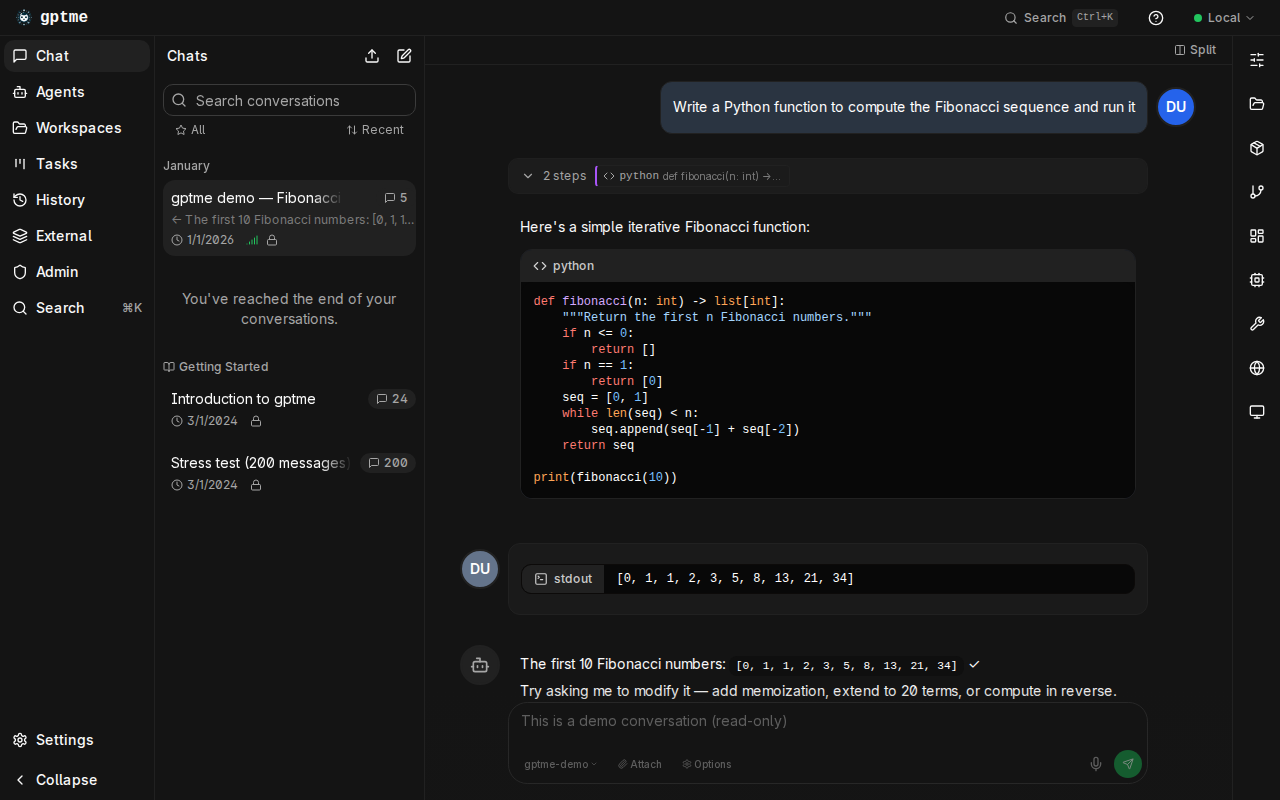
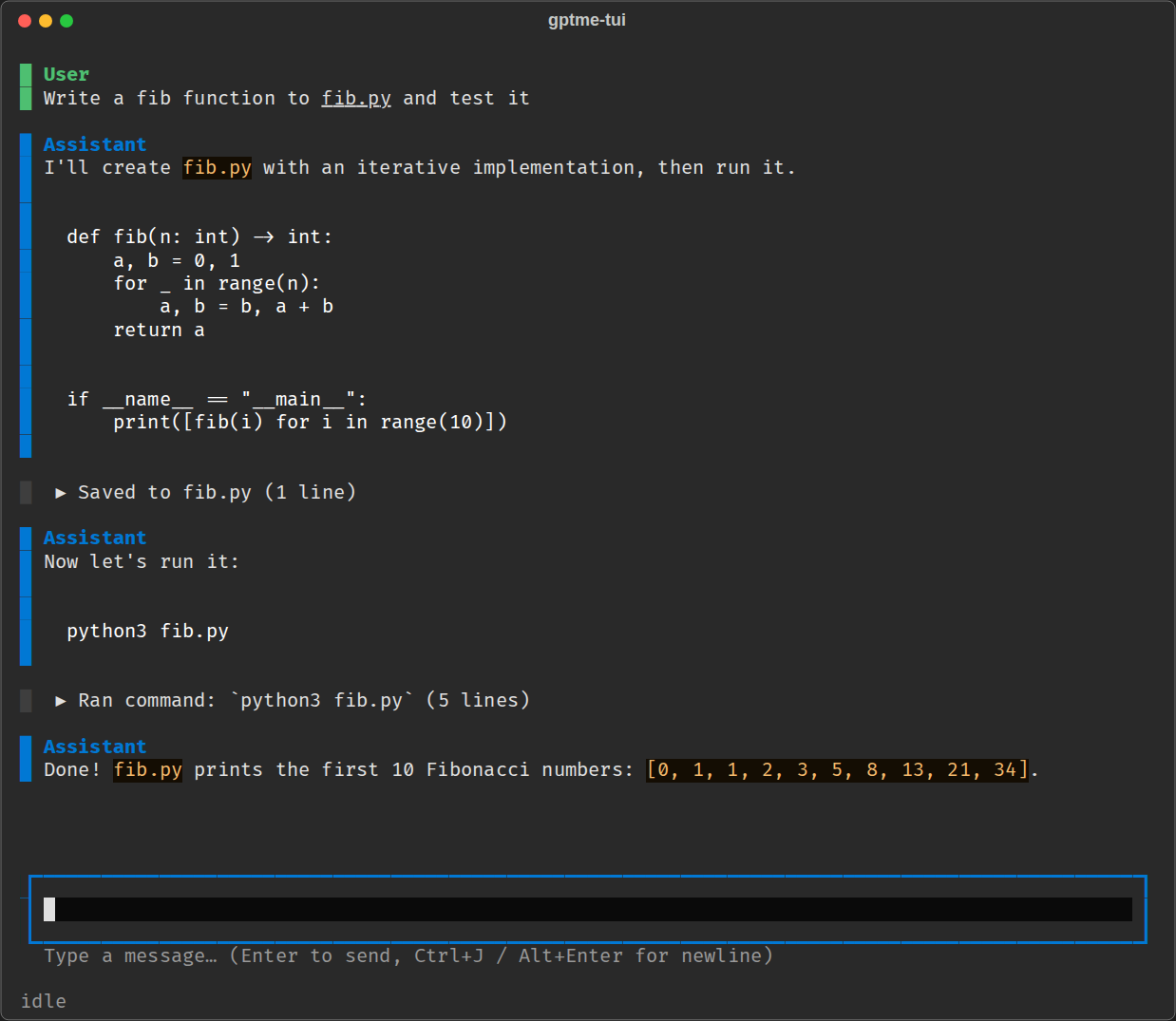
gptme is a personal AI agent CLI written in Python and released under the MIT license. It sits in the AI & Machine Learning / AI Interaction & Interfaces category, describes itself as one of the first agent CLIs from spring 2023, and continues active development; the registry shows 4,416 stars, 431 forks, 18 open issues, and a last push on 17 September 2026. The README says it ships with shell, Python, web, and vision tools and runs anywhere a terminal runs. It is provider-agnostic across Anthropic, OpenAI, Google, xAI, DeepSeek, OpenRouter, or local llama.cpp. Desktop apps exist for Linux, macOS, and Windows, alongside a Textual TUI and the gptme.ai cloud service.
The problem gptme solves is vendor and environment lock-in for terminal AI assistance. It names Claude Code, Codex, Cursor, and Warp as alternatives and presents itself as a capable replacement that keeps data, models, and terminal environment under the user's control. Rather than forcing a single provider or graphical IDE, it runs where work already happens: a shell, tmux session, SSH connection, or CI pipeline. It also supports persistent autonomous agents through gptme-agent-template, with the Bob example running in loops with GitHub monitoring and enhanced context generation.
Key capabilities
- Terminal-native agent with local tools for shell, Python, web, and vision, per the README feature list.
- Provider-agnostic model support: Anthropic, OpenAI, Google, xAI, DeepSeek, OpenRouter, or fully local via llama.cpp.
- Extensibility through plugins, skills, and lessons; plugin system in v0.30.0, lessons system in v0.29.0, and gptme-plugin-registry for plugin discovery.
- MCP and ACP integrations; MCP support in v0.28.0, MCP server and ACP support in v0.32.0.
- Autonomous agents via gptme-agent-template v0.4 with autonomous run loops and enhanced context generation.
- Sandboxed Python and shell execution using Docker and Wasmtime, introduced in v0.33.0 with the Hashline edit format and non-interactive exit taxonomy.
- Desktop and hosted paths: Linux AppImage, macOS, and Windows app with auto-updates since v0.32.1, plus gptme.ai cloud.
Who uses it and how
- Developers over SSH, in tmux, on headless servers, or in CI, because it runs anywhere a terminal runs.
- CI and automation users needing non-interactive operation, supported by the non-interactive exit taxonomy in v0.33.0 and background jobs in v0.31.0.
- Coders and knowledge workers who want a general-purpose assistant; README calls it a great coding agent also useful for all kinds of knowledge-work.
- Teams building persistent autonomous agents with gptme-agent-template v0.4 and gptme-contrib community plugins such as Twitter/X, Discord bot, email tools, and consortium multi-agent.
- Users needing local model execution via llama.cpp or a desktop build for Linux, macOS, or Windows.
Getting started
Install and usage instructions are in the README's Getting Started and Usage sections, with documentation at https://gptme.org/docs/. Desktop builds for Linux (AppImage), macOS, and Windows are on the latest release, and gptme.ai offers a hosted cloud service.
How it compares
The README positions gptme as a capable alternative to Claude Code, Codex, Cursor, and Warp. On the axes the facts support, gptme is free and open-source under the MIT license, local-first, and provider-agnostic, letting users keep data and model selection in their own environment. The named alternatives are commercial products, while gptme has no vendor licence fee and runs inside the user's terminal.
When to use it — and when not to
Self-hosters must supply model credentials or a local llama.cpp setup, and sandboxed execution needs Docker or Wasmtime available. Teams requiring a fully managed, zero-configuration service or vendor SLA should consider gptme.ai cloud or another product, and users who want an IDE-integrated graphical experience rather than a terminal-first agent may not be the target audience. The README excerpt does not specify database, storage, or SMTP dependencies, so confirm those operational details in the full documentation before deployment.
project readme (upstream, from github) — read inline

gptme
/ʤiː piː tiː miː/
what does it stand for?
Getting Started
•
Downloads
•
Website
•
Documentation







📜 A personal AI agent that runs anywhere a terminal runs — your laptop,
ssh sessions, tmux, headless servers, CI pipelines.
Provider-agnostic, local-first, and unconstrained: ships with shell, Python, web,
vision, and everything else an agent needs.
A great coding agent, but general-purpose enough to assist in all kinds of knowledge-work.
Free and open-source. Works with Anthropic, OpenAI, Google, xAI, DeepSeek, OpenRouter,
or fully local via llama.cpp — your data, your models, your terminal.
A capable alternative to Claude Code,
Codex, Cursor, and Warp — one of the first agent CLIs (Spring 2023), still in very
active development.
📚 Table of Contents
📢 News
- 2026-08 - v0.33.0: Hashline edit format, sandboxed Python/shell execution (Docker, Wasmtime), non-interactive exit taxonomy,
gptme explain, server auth hardening
- 2026-07 - v0.32.0 & v0.32.1: Desktop app for Linux (AppImage), macOS, and Windows, with auto-updates since v0.32.1 — download here; ACP support, MCP server, Textual TUI; gptme.ai cloud service
- 2026-05 - gptme-plugin-registry created: central registry for plugin discovery
- 2026-02 - Scheduled dev pre-releases begin
- 2026-01 - gptme-agent-template v0.4: Bob has run extensively as an autonomous agent, autonomous run loops, enhanced context generation
- 2025-12 - v0.31.0: Background jobs, form tool, cost tracking, content-addressable storage
- 2025-11 - v0.30.0: Plugin system, context compression, subagent planner mode
- 2025-10 - v0.29.0: Lessons system for contextual guidance, MCP discovery & dynamic loading, token awareness; Bob begins autonomous runs with GitHub monitoring
- 2025-08 - v0.28.0: MCP support, morph tool for fast edits, auto-commit, redesigned server API
- 2025-03 - v0.27.0: Pre-commit integration, macOS computer use, Claude 3.7 Sonnet, DeepSeek R1, local TTS with Kokoro
- 2025-01 - gptme-contrib created: community plugins including Twitter/X, Discord bot, email tools, consortium (multi-agent)
- 2024-12 - gptme-agent-template v0.3: Template for persistent agents
- 2024-11 - Ecosystem expansion: gptme-webui, gptme-rag, gptme.vim, Bob created (first autonomous agent)
- 2024-10 - First viral tweet bringing widespread attention
- 2024-08 - Show HN, Anthropic Claude support, tmux tool
- 2023-09 - Initial public release on HN, Reddit, Twitter
- 2023-03 - Initial commit - one of the first agent CLIs
For more history, see the Timeline and Changelog.
🎥 Demos
[!NOTE]
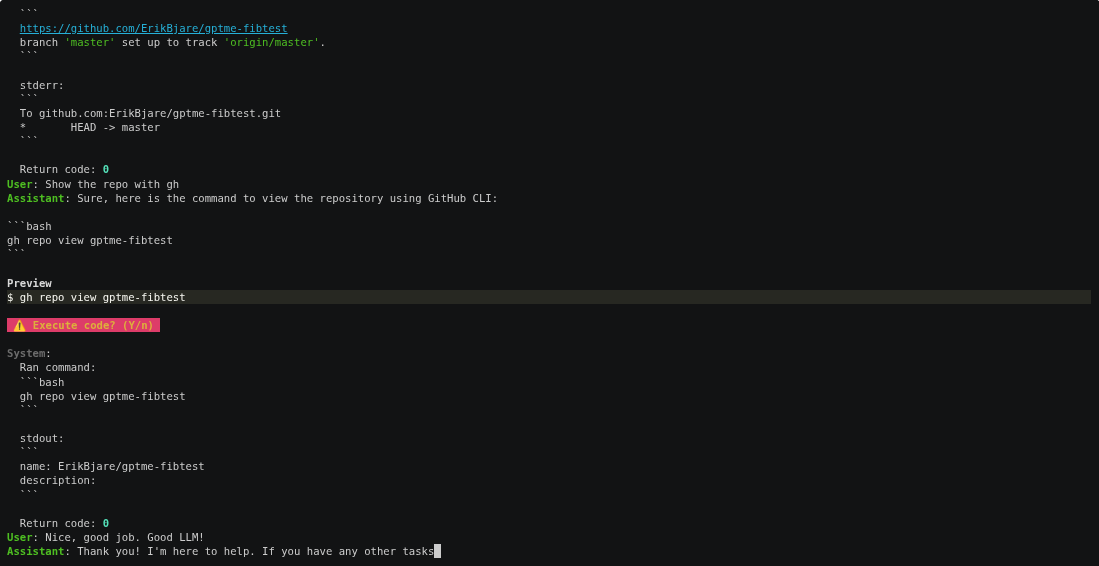
The terminal recordings above are from 2023 and show the classic CLI. More recordings are kept in the [Demo archive][docs-demos], and more up-to-date walkthroughs are in the [Examples][docs-examples].
🌟 Features
 ][docs-tui]