
GoNavi
Navigate every data source — native speed, agent-ready, zero Electron bloat.
A high-performance cross-platform database client built with Wails (Go) + React. Desktop-first. MCP-ready. ~20–26MB class installers.






Language: English · 简体中文 · 🌐 Website · ⬇ Download · ⚡ Quick Start · ✨ Features · 🤖 MCP
Sponsored by APISmart · HuaLongAI
Why GoNavi?
Most database GUIs are Electron shells with megabytes of tax. GoNavi takes a different path — and “lightweight” only makes sense if you separate three numbers:
| Number | What it means | GoNavi (v0.9.8) |
|---|---|---|
| Installer size | What you download | ~20–26 MB class (Win / macOS / Linux release assets) |
| Steady-state RSS | What RAM the running UI holds | Linux WebKit build, idle empty workbench: main ≈ 429 MB; with WebKit helpers ≈ 765 MB (method below) |
| UI stack | Chromium tax or not | Go + system WebView (Wails) — not Electron |
| Typical Electron client | GoNavi | |
|---|---|---|
| Runtime | Chromium + Node | Go + native WebView |
| Installer | Hundreds of MB common | ~20–26 MB class |
| Startup | Heavy | Fast |
| Memory claim | Often mixed with installer size | Measure RSS separately (see note) |
| AI / Agents | Bolt-on or absent | First-class MCP + multi-provider AI (draft SQL; GUI still owns schema / edits / EXPLAIN) |
| Data sources | Mostly RDBMS | SQL · Cache · Vector · MQ · Search · Time-series · Domestic DBs |
Installer MB ≠ RAM. The RSS figures above are one Linux cloud run of the v0.9.8 WebKit41 build (empty workbench, no DB connections, remote display, ~30–40 s steady). Do not compare them to installer size, or to unverified “native ~80 MB” marketing. Windows / macOS laptop numbers may differ — treat them as a labeled sample, not a leaderboard score.
One cockpit for MySQL, Postgres, Redis, Kafka, Milvus, OceanBase, ClickHouse…
Query, edit, audit, sync — and hand structured context to coding agents without leaking passwords off-host.
At a Glance
┌──────────────────────────────────────────────────────────────────────┐
│  GoNavi Workbench                                                    │
│  ┌─────────────┐  ┌──────────────────┐  ┌─────────────────────────┐  │
│  │ Connections │  │ Monaco SQL + AI  │  │ Virtualized DataGrid    │  │
│  │ SSH / Proxy │  │ Schema context   │  │ Batch edit · Export     │  │
│  │ Drivers     │  │ Slash commands   │  │ Txn submit / rollback   │  │
│  └─────────────┘  └────────┬─────────┘  └─────────────────────────┘  │
│                            │                                         │
│              ┌─────────────▼─────────────┐                           │
│              │  Go core · Audit · Sync   │                           │
│              │  MCP HTTP · Web Server    │                           │
│              └───────────────────────────┘                           │
└──────────────────────────────────────────────────────────────────────┘
Product screenshots
Each image is a full GoNavi application window, scaled proportionally for README display.
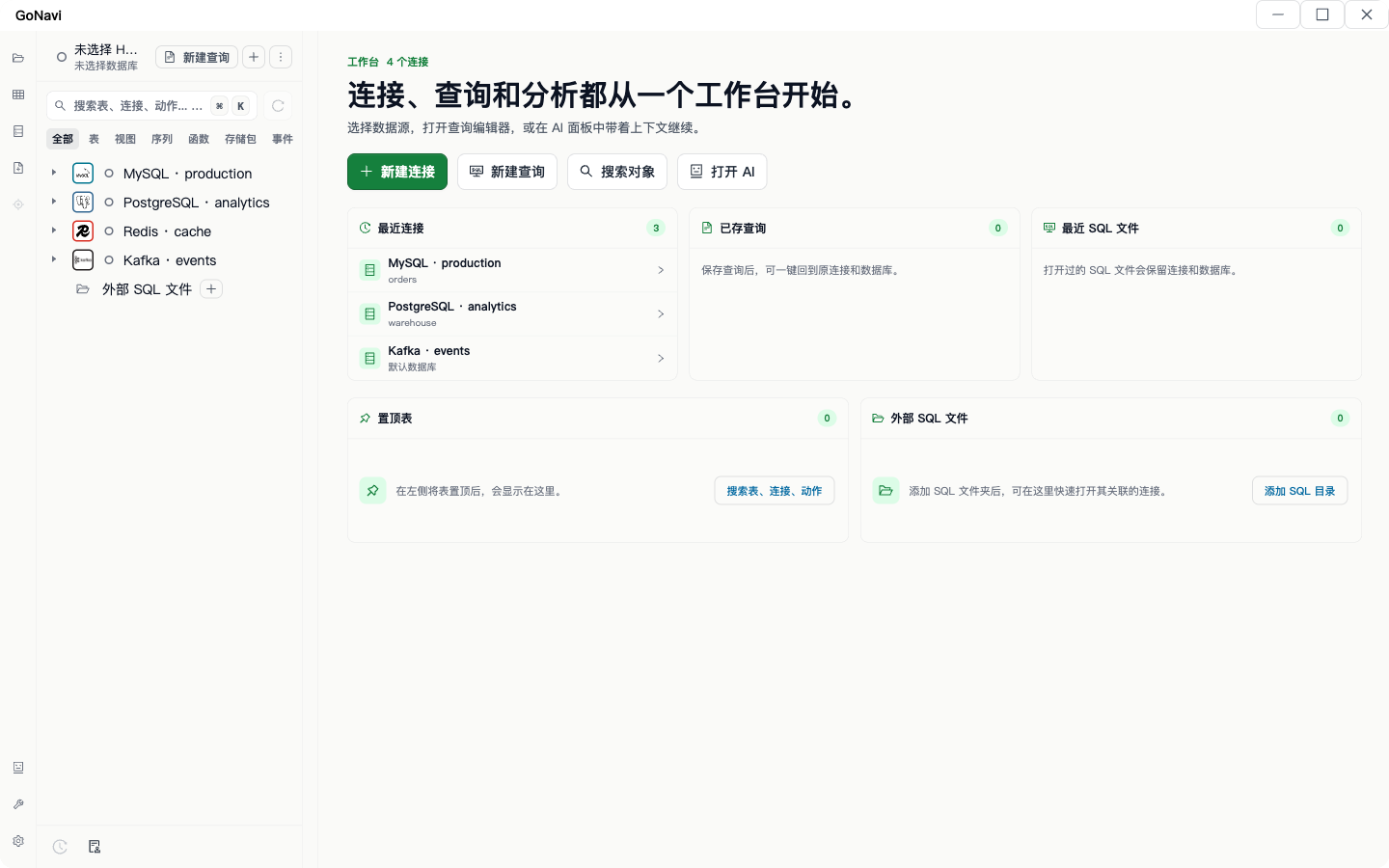
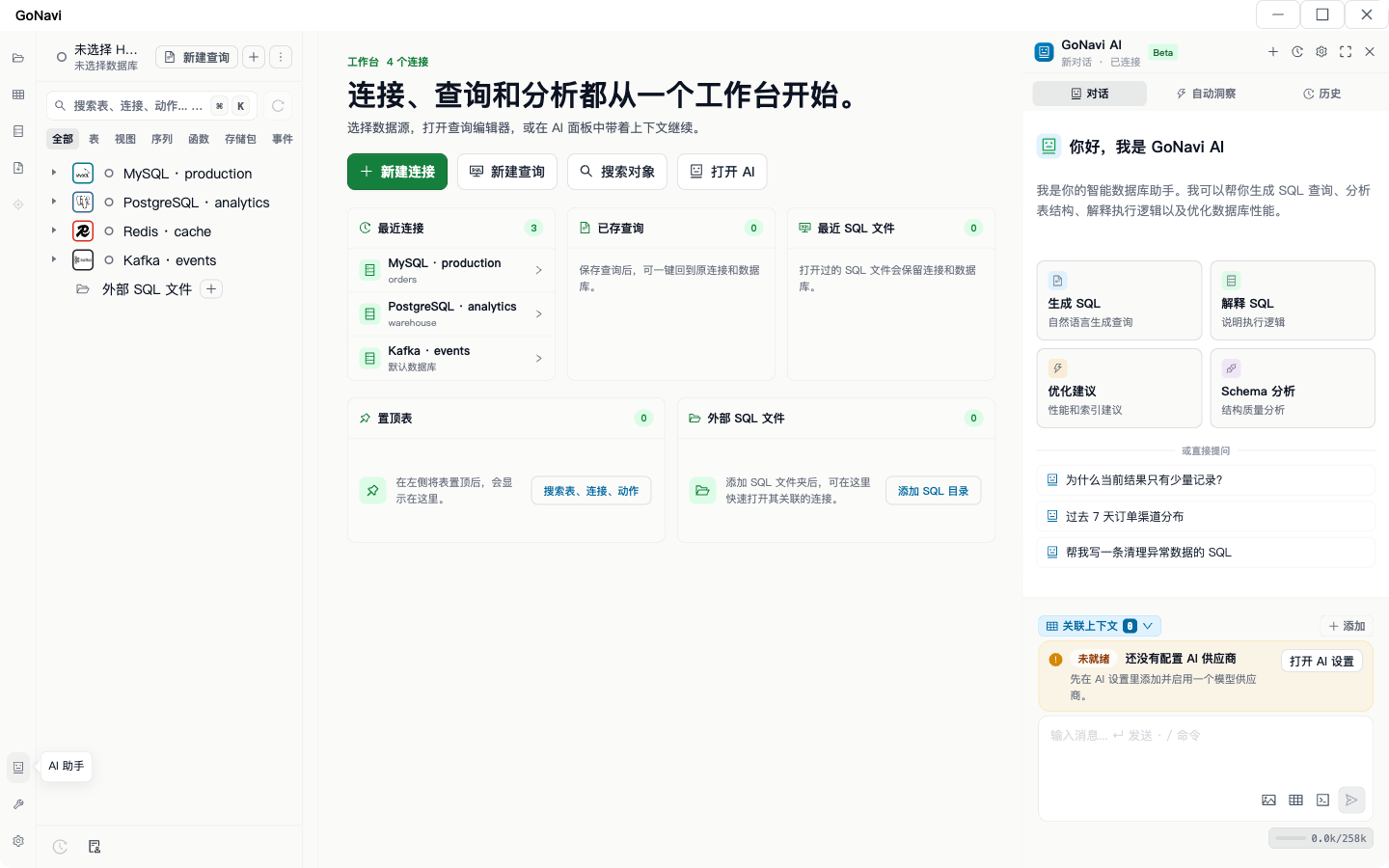
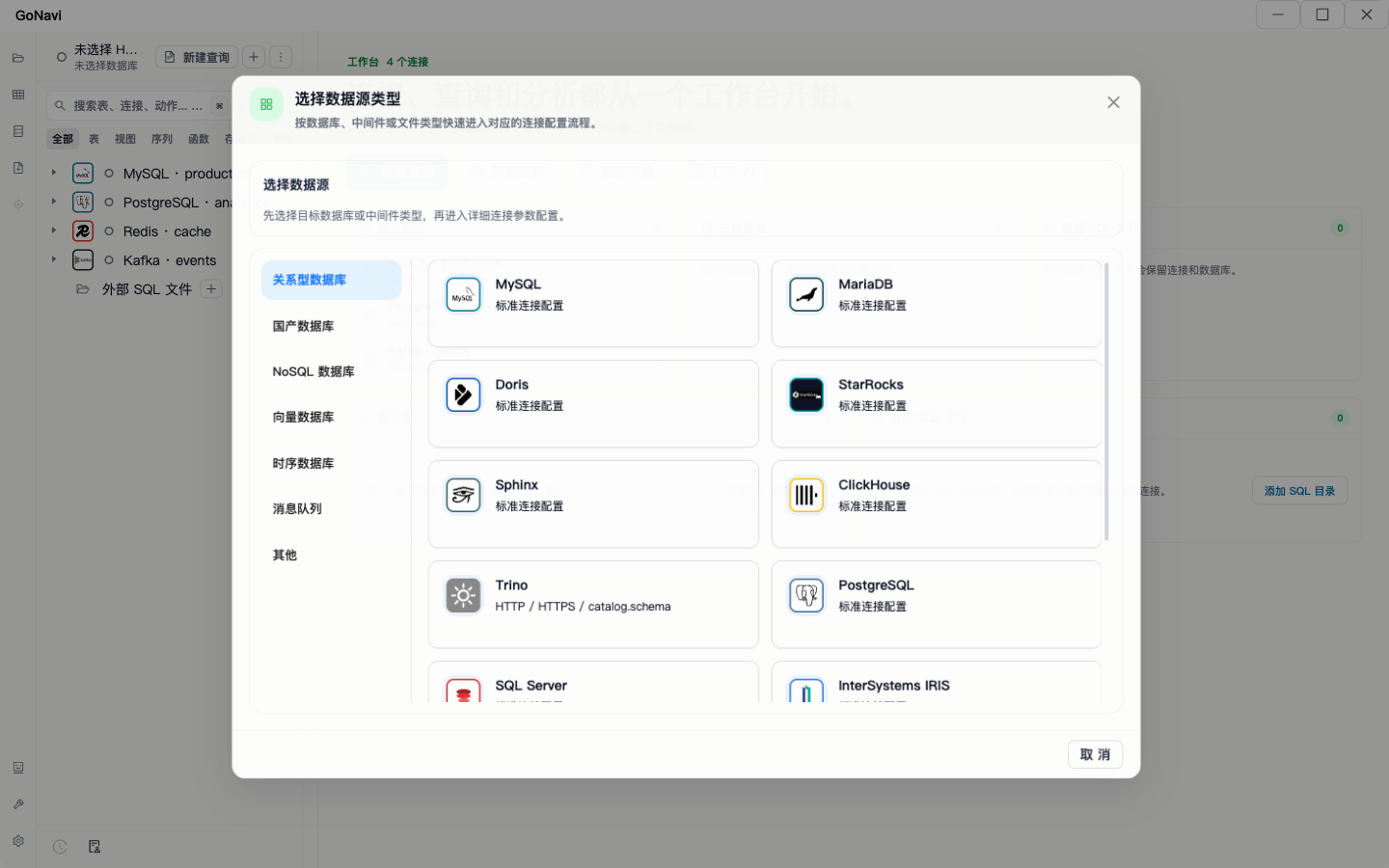
Real desktop captures · full window
💖 Sponsors
Want to sponsor GoNavi? We welcome sponsorships and partnerships that help sustain its open-source development. Contact the maintainer on WeChat:
ygf1140302783(note “GoNavi”) to start a conversation.
APISmart Unified AI model API · OpenAI-compatible |

HuaLongAI AI API Gateway · multi-model routing · domestic high-speed endpoint |
Special thanks to APISmart and HuaLongAI for sponsoring GoNavi open-source development.
| Sponsor | What they offer | Why it fits GoNavi |
|---|---|---|
| APISmart | APISmart provides unified access to leading AI models through a single API. Developers can connect to LLM, image, and video models using one API key and an OpenAI-compatible interface. This eliminates the need to manage multiple providers separately. Intelligent routing and automatic failover help improve reliability, while centralized billing makes usage easier to manage. With APISmart, developers can build and scale AI applications faster through one streamlined platform. | Lets developers and agent workflows use multiple AI capabilities without separately integrating each provider. |
| HuaLongAI | HuaLongAI is a premium model API relay provider for power AI developers, focused on official direct connectivity. It primarily offers Codex-series models supplied directly from official sources, with no substitutions or dilution, and invites verification. Billing is transparent, with token-level itemized records available for review. It supports enterprise-grade high concurrency and provides enterprise customers with a professional management platform, formal contracts, and invoices; visit the website for contact details. GPT-series models start at a 0.08 rate, with a stable Pro group at 0.15, two-way referral gifts, and uncapped referral rewards. | Stable model access is core infrastructure for GoNavi's schema-aware assistants, MCP, and day-to-day development. |
- APISmart: https://www.apismart.ai/ — unified AI model API with an OpenAI-compatible interface.
- HuaLongAI: https://api.hualong.online/ — console, docs, and the domestic high-spe