Godot Engine is a free, MIT-licensed, cross-platform 2D and 3D game engine that ships an editor, a class reference, export templates, and one-click deployment to desktop, mobile, web and console targets, aimed at game developers who want to own their toolchain and their games without royalties.
What it is
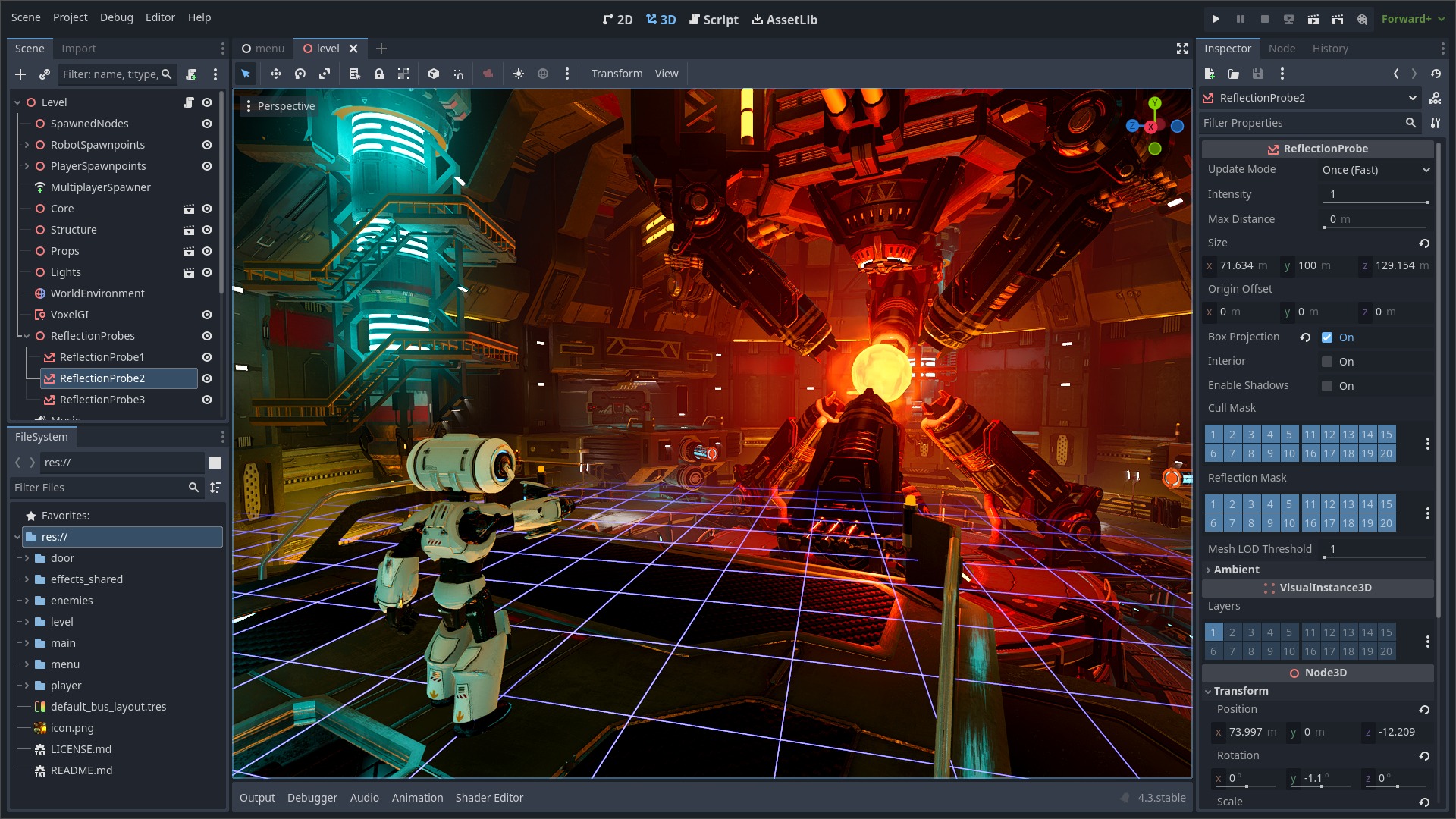
Godot is a complete game engine built around a unified interface for both 2D and 3D projects. The README describes it as a feature-packed, cross-platform engine that supplies a comprehensive set of common tools so that developers can focus on making games rather than reinventing standard systems. It lives in the open-source game development ecosystem, with primary development in C++ under the MIT license and a repository history that predates its public release: the engine was developed for several years as an in-house tool by Juan Linietsky and Ariel Manzur, who used it to publish work-for-hire titles before it was open sourced in February 2014.
The concrete problem it solves is toolchain lock-in and royalty accounting. Rather than licensing a proprietary engine and paying a percentage of revenue, a team downloads the editor, builds its game, and exports it to its target platforms. The README states the position plainly: Godot is completely free, with no strings attached and no royalties, and the users' games are theirs down to the last line of engine code. Development is fully independent and community-driven, supported by the Godot Foundation, a not-for-profit organisation, which means the roadmap is shaped by contributors rather than a commercial vendor.
Key capabilities
- Unified 2D and 3D editing interface, so both project types are authored in one tool rather than two separate pipelines.
- One-click export to Linux, macOS, Windows, Android, iOS, web-based platforms, and consoles, with console support documented separately at godotengine.org/consoles.
- MIT licensing with no royalties, and explicit ownership of the resulting game including any modified engine source.
- Built-in class reference accessible directly from the Godot editor, backed by the documentation hosted on Read the Docs at docs.godotengine.org.
- Official demo projects maintained at the godot-demo-projects repository, plus an Asset Store at store.godotengine.org.
- Community contribution infrastructure including the CONTRIBUTING.md guide with bug reporting guidelines, the Godot Contributors Chat at chat.godotengine.org, and translation work coordinated through Weblate.
- Compilation from source for every supported platform, documented under the engine development compilation guide.
Who uses it and how
- Solo developers and small teams targeting desktop and web builds, using the one-click export path to produce Linux, macOS, Windows, or web deliverables from a single project.
- Studios distributing commercially on mobile, exporting to Android and iOS without paying revenue share back to an engine vendor.
- Teams shipping to consoles, which the README routes through the dedicated console page rather than treating as a standard export target.
- Contributors to the engine itself, who join the Godot Contributors Chat to reach core developers, file bugs through the guidelines in CONTRIBUTING.md, and translate the editor through Weblate.
- Learners and educators working from the official documentation, the class reference inside the editor, and the demo project repository.
Getting started
Download the official Godot editor binary and export templates from godotengine.org/download, or compile the engine from source using the per-platform instructions in the official documentation.
How it compares
No list of paid products that this project replaces is provided in the facts, and no comparable engines are named alongside it. On the facts available, it stands alone in this registry.
When to use it — and when not to
Godot is a self-managed toolchain: there is no hosted or managed service described in the README, so a team must handle its own editor installs, export templates, and platform builds, and those compiling from source must maintain a working C++ build environment for each target platform. It is a poor fit for teams that want vendor support contracts, a managed pipeline, or console deployment handled entirely inside the editor, since the console path is documented separately from the standard exports. The README is also a pointer document rather than a reference: version information, release history, and engine specifics live on the website and in the docs, and the repository carries a large open issue count, so evaluating it properly means reading outside the repository.
project readme (upstream, from github) — read inline
Godot Engine
2D and 3D cross-platform game engine
Godot Engine is a feature-packed, cross-platform
game engine to create 2D and 3D games from a unified interface. It provides a
comprehensive set of common tools, so that
users can focus on making games without having to reinvent the wheel. Games can
be exported with one click to a number of platforms, including the major desktop
platforms (Linux, macOS, Windows), mobile platforms (Android, iOS), as well as
Web-based platforms and consoles.
Free, open source and community-driven
Godot is completely free and open source under the very permissive MIT license.
No strings attached, no royalties, nothing. The users' games are theirs, down
to the last line of engine code. Godot's development is fully independent and
community-driven, empowering users to help shape their engine to match their
expectations. It is supported by the Godot Foundation
not-for-profit.
Before being open sourced in February 2014,
Godot had been developed by Juan Linietsky and
Ariel Manzur for several years as an in-house
engine, used to publish several work-for-hire titles.
Getting the engine
Binary downloads
Official binaries for the Godot editor and the export templates can be found
on the Godot website.
Compiling from source
See the official docs
for compilation instructions for every supported platform.
Community and contributing
Godot is not only an engine but an ever-growing community of users and engine
developers. The main community channels are listed on the homepage.
The best way to get in touch with the core engine developers is to join the
Godot Contributors Chat.
To get started contributing to the project, see the contributing guide.
This document also includes guidelines for reporting bugs.
Documentation and demos
The official documentation is hosted on Read the Docs.
It is maintained by the Godot community in its own GitHub repository.
The class reference
is also accessible from the Godot editor.
We also maintain official demos in their own GitHub repository
as well as the Asset Store.
There are also a number of other
learning resources
provided by the community, such as text and video tutorials, demos, etc.
Consult the community channels
for more information.


