FLUJO is a free, open source ai interaction & interfaces project written in TypeScript and released under MIT. It has 629 GitHub stars, 88 forks and 26 open issues, and was last pushed 27 hours ago. On this registry it ranks #74 of 76 tracked projects in AI Interaction & Interfaces, with 5 head-to-head comparisons available. It gained 1 stars over the last 3 tracked days.

What is FLUJO?

FLUJO is an open-source, local-first visual builder for multi-agent AI workflows that lets you connect models and apps, build agents as step-by-step recipes or expert visual flows, inspect every run, and expose those same agents through OpenAI-compatible and MCP endpoints, aimed at developers, automation builders, and technical teams that want their keys and data to stay under their own control.

What it is

FLUJO is a TypeScript application, licensed under MIT, that runs as a private workspace for building and operating AI agents. It is powered by the PocketFlow Framework and was built with Cline and Claude Code. The project lives in the agentic-AI and AI-interaction space: its topic list covers agentic-ai, agentic-framework, agentic-workflow, ai-chat, automation, autonomous-agents, llm-agents, mcp and mcp-client, and it is distributed as a local application with an installer, an npm package, and a hosted trial at try.flujo.com.co. The current version carried in the repository is 3.45.2, and the default posture is local-first: FLUJO stays on localhost unless it is deliberately opened to a private network or configured for public deployment.

The concrete problem it solves is the wiring work that sits between a model provider and a usable agent. Instead of hand-assembling provider connections, MCP servers, and scripted orchestration, and instead of handing API keys to a hosted agent platform, FLUJO provides visual builders for the flow, a guided setup, a run inspector, and endpoint exposure so the finished agent can be talked to, automated, or called from other software. Secrets are encrypted at rest in local storage, they never reach the browser, and the frontend only sees a masked placeholder even in DevTools, which means the working state of the agent and the credentials that drive it remain on infrastructure the operator controls.

Key capabilities

  • Two builder modes: simple step-by-step recipes for straightforward agents, and expert visual flows for more involved orchestration.
  • MCP-native operation as an MCP client, with MCP servers receiving their runtimes during installation.
  • Multi-model configuration covering OpenAI, Azure OpenAI, Anthropic (native or OpenAI-compatible), Google Gemini, X.ai (Grok), OpenRouter, and Codex.
  • Agents exposed through OpenAI-compatible and MCP endpoints so external software can call them.
  • Built-in debugger that lets every run be inspected step by step.
  • Secrets encrypted at rest with an optional custom encryption password, kept server-side and never sent to the browser.
  • Reusable global variables that bind a key once and reuse it across AI and connected-app configurations, plus encrypted workspace backup and restore from Settings.
  • Adjustable network access spanning localhost, private-network devices, and public deployment.

Who uses it and how

  • Individual developers running FLUJO on localhost who want a private AI workspace without sending keys to a third-party service.
  • Small teams that allow devices on a private network to reach a shared FLUJO instance while keeping the encrypted workspace under their own administration.
  • Automation builders who publish an agent through OpenAI-compatible or MCP endpoints and call it from other software rather than driving it by hand.
  • Operators who need a public deployment of the same agents and who configure network access accordingly.
  • Privacy-sensitive setups where secrets must stay server-side, including the masked placeholder behaviour that hides them from the frontend.

Getting started

The recommended path is the Windows installer flujo-setup.exe from the latest release, or the install script — irm https://raw.githubusercontent.com/mario-andreschak/FLUJO/main/scripts/install.ps1 | iex on PowerShell and curl -fsSL https://raw.githubusercontent.com/mario-andreschak/FLUJO/main/scripts/install.sh | bash on Linux and macOS. If Node.js is already present, npx flujo-ai runs a prebuilt FLUJO without installation, and try.flujo.com.co offers an online option.

How it compares

The material available for FLUJO names no comparable tools and no list of paid products it displaces, so on the evidence here it stands alone in this registry. The comparison axes the project does establish for itself are licence, hosting and cost model: it is MIT-licensed, local-first by default, and installable from source, npm, or an installer rather than sold as a subscription service.

When to use it — and when not to

Choose FLUJO when agent logic and credentials need to stay on hardware you administer, and when the same agent must be usable interactively, on a schedule, and from other software through OpenAI-compatible or MCP endpoints. A self-hoster should expect to operate a Node.js runtime, and to keep git, python and uv available on the PATH for MCP servers, since the npm route does not guarantee those runtimes; the encryption password for the workspace is also the operator's responsibility to hold. Anyone who wants a fully managed cloud agent platform with no local maintenance should look elsewhere, and the repository's 26 open issues suggest the project is still actively settling rather than finished.

project readme (upstream, from github) — read inline

FLUJO

Build private AI agents visually. Run them your way.

Connect your AIs and apps, build an agent, then talk to it, automate it, or call it from other software.

FLUJO is open-source and local-first. Start with the guided setup, build agents as simple step-by-step recipes or expert visual flows, inspect every run, and expose the same agents through OpenAI-compatible and MCP endpoints — while your keys and data stay under your control.

Simple + visual builders · MCP-native · Multi-model · Built-in debugger · Automation

Visit flujo.com.co → · Watch the 2:28 product film → · Install FLUJO ↓ · Explore features ↓ · Try FLUJO online →

MIT License Version

FLUJO is too complicated? You are missing a feature or are stuck on something? Hop into the Discord, or create an Issue on Github! We can only improve if we know what's wrong. It really helps a lot!

Watch FLUJO — Your AI. In Flow.

Click the preview to see FLUJO in motion.

image

⚡ Quick Install (recommended)

The installer sets up everything FLUJO needs (Git, Node.js, Python, uv, ripgrep), clones FLUJO, builds it, and creates a global flujo command. This is the recommended way to run FLUJO — MCP servers get all their runtimes too.

Windows installer (recommended) — click below to download the latest flujo-setup.exe:
Download Setup.exe — Windows Installer

Windows PowerShell — alternatively, press Start, type powershell, press Enter, copy & paste the command below and press Enter again:

irm https://raw.githubusercontent.com/mario-andreschak/FLUJO/main/scripts/install.ps1 | iex

Linux / macOS — paste into a terminal:

curl -fsSL https://raw.githubusercontent.com/mario-andreschak/FLUJO/main/scripts/install.sh | bash

Already have Node.js? You can also skip installation entirely and run a prebuilt FLUJO straight from npm — fastest start, but MCP servers may still need git / python / uv on your PATH (see Run via npx):

npx flujo-ai

Prefer to set it up manually? See Getting Started. To remove FLUJO later, see Uninstalling.

[!TIP] Stuck on MCP installation, the app, or anything else? Open a GitHub issue or join the Discord. I read every message and will do my best to get back to you within a day.
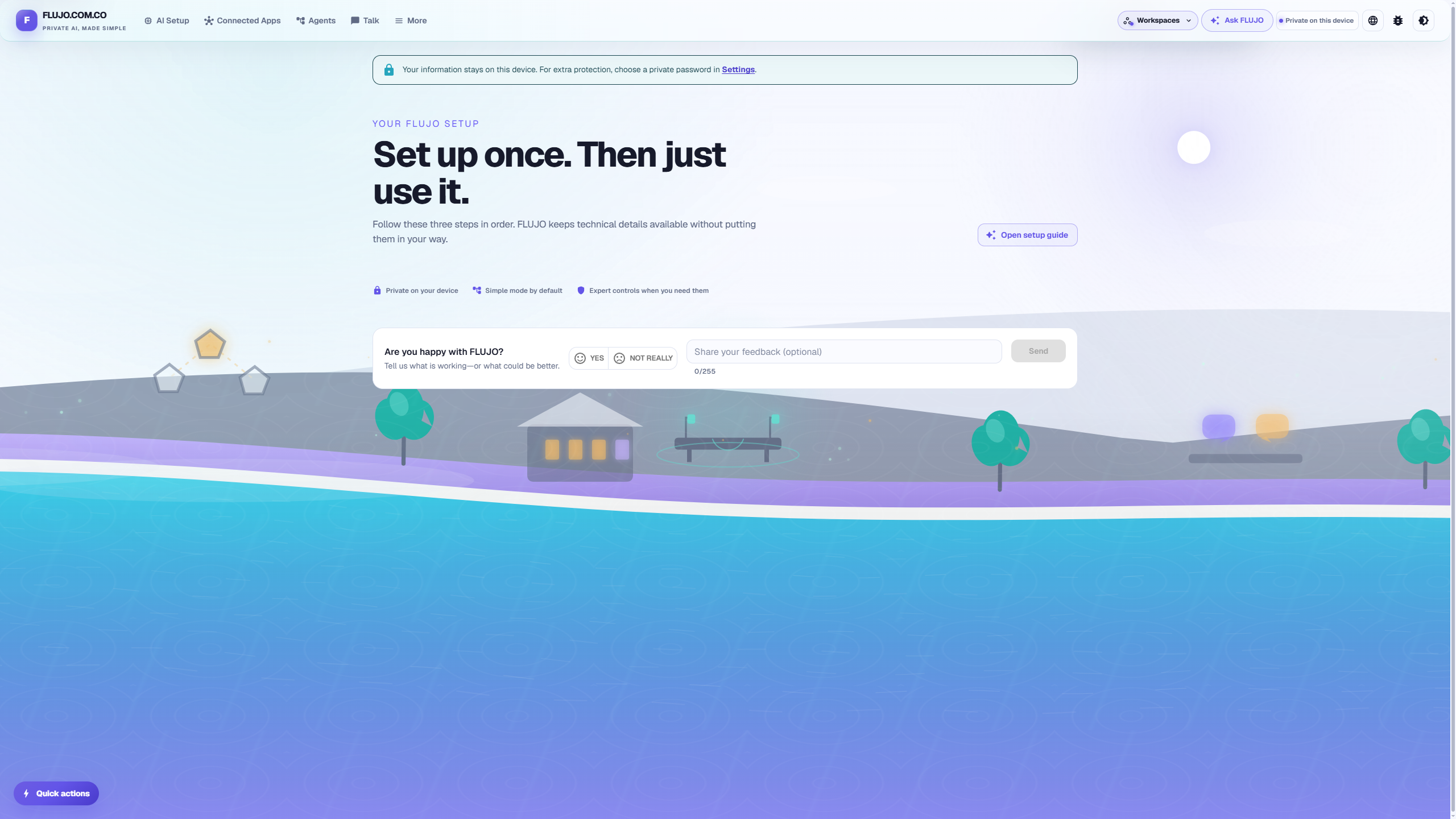
FLUJO Overview

The FLUJO home screen: connect once, then use your private AI workspace.

FLUJO is powered by the PocketFlow Framework and built with Cline, Claude Code, and a lot of love.

🌟 Key Features

🔐 Local-first Security & Workspace Controls

  • Local-first by default: keep FLUJO on localhost, allow devices on your private network, or configure it for a public deployment
  • Encrypted at rest: API keys and other secrets are encrypted in local storage, with an optional custom encryption password for extra protection
  • Never sent to the browser: secrets stay server-side — the frontend only ever sees a masked placeholder, even in your own DevTools
  • Reusable global variables: define a key once and bind it into any AI or connected-app configuration instead of pasting it repeatedly
  • Backup & restore your encrypted workspace from Settings
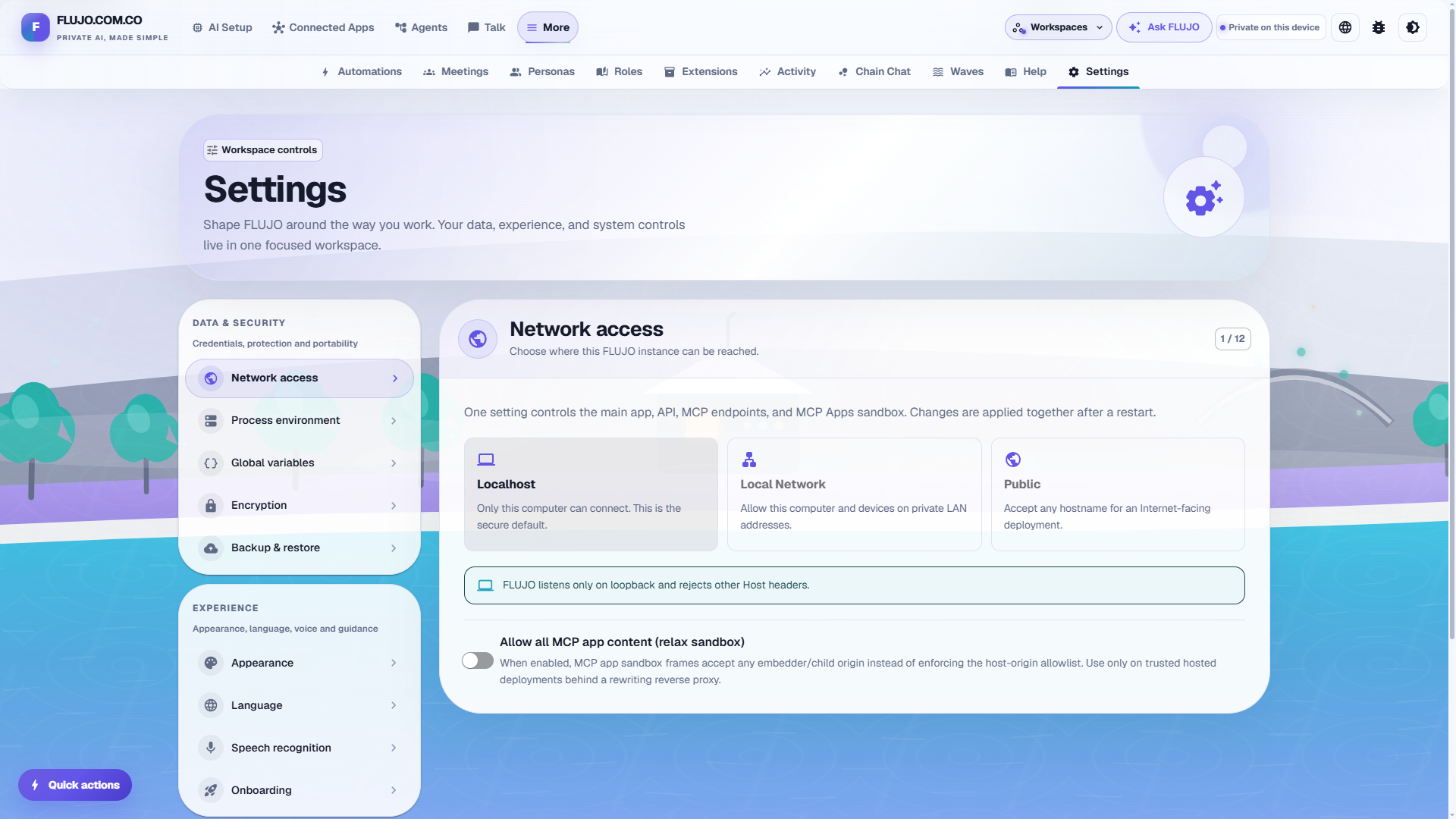
Settings — Network Access

🤖 AI Setup

  • Multiple providers: OpenAI, Azure OpenAI, Anthropic (native or OpenAI-compatible), Google Gemini, X.ai (Grok), OpenRouter, Codex, and local models via Ollama
  • Guided or expert setup: choose a gentle walkthrough, a faster guided path, or the complete configuration form
  • Claude Subscription: use your Claude Pro/Max plan directly (via the Claude Agent SDK) instead of a metered API key
  • Reusable connections: organize configured AIs into folders, mark favorites, and reuse them across agents and conversations
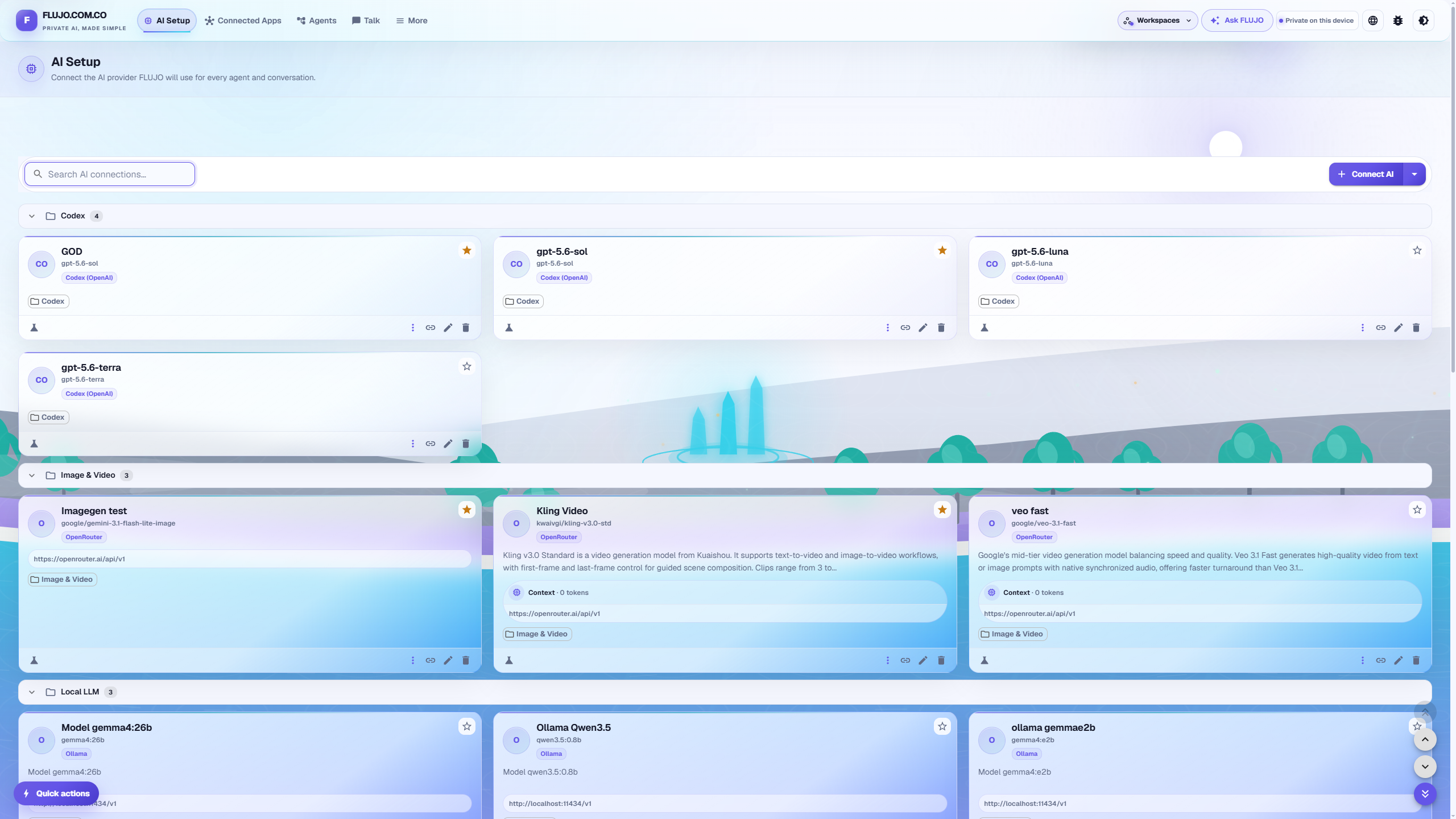
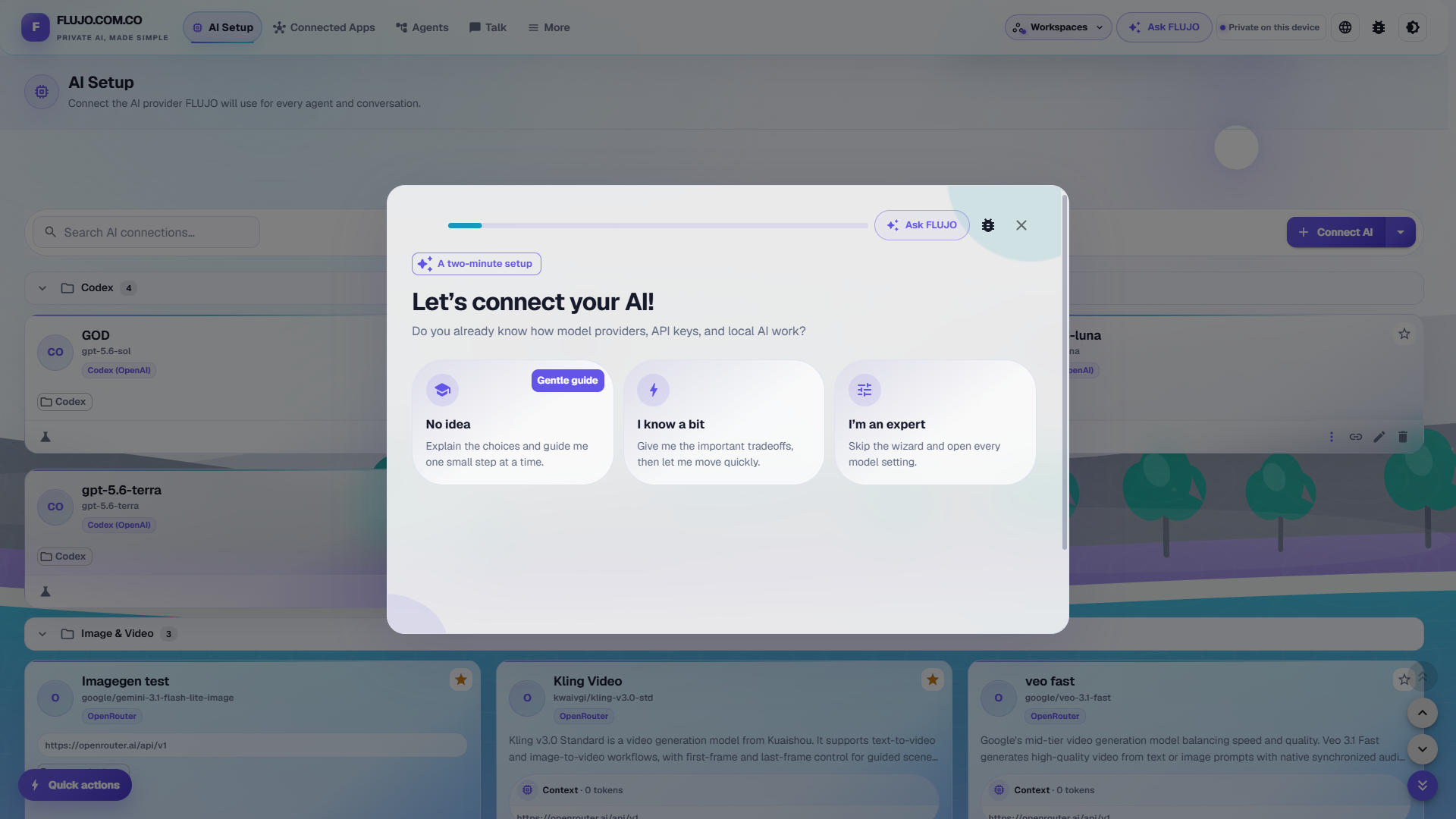
AI Setup — Configured AI Connections AI Setup — Guided Connection Wizard

🔌 Connected Apps (MCP)

  • Guided connection: let FLUJO research an app, choose from curated options, or enter a remote URL, GitHub repository, or local command yourself
  • Install from anywhere: search the official MCP Registry, use curated servers verified with FLUJO, or install manually from a GitHub repo / local folder
  • Full MCP capability support: tools, resources, prompts, roots (workspace folders), and sampling (let a server borrow one of your models under a trust policy you control)
  • Tool inspection & testing: browse and call a server's tools, resources, and prompts straight from its detail view
  • FLUJO as an MCP proxy: re-expose any server you've configured in FLUJO to other MCP clients (Claude Desktop, Cursor, Cline, …) over Streamable HTTP — configure a server once, use it everywhere
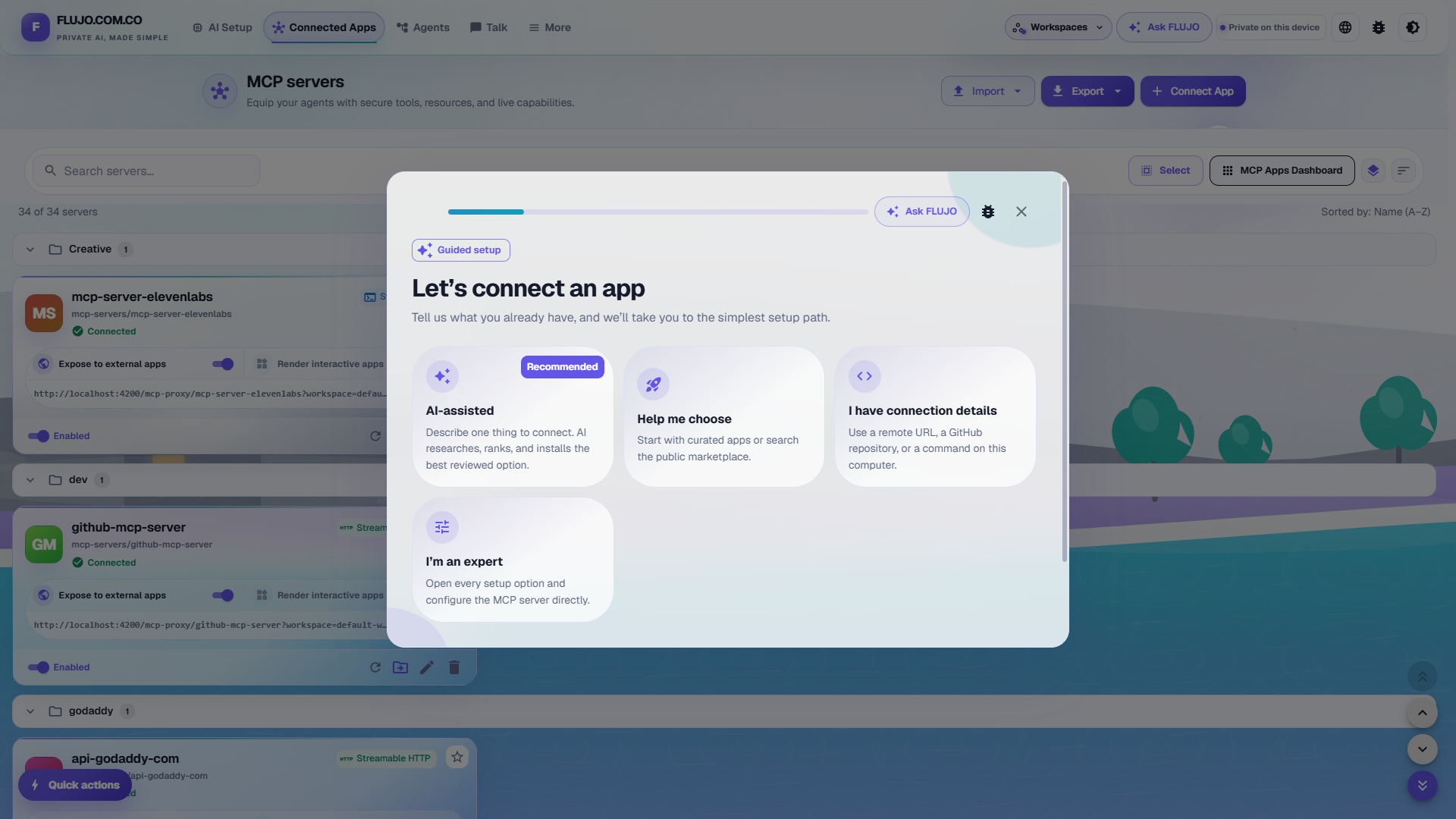
Connected Apps — Guided Setup

Configuring a server is a guided, three-step form (define it → install & build → define how to run it) with a one-click connection test before you save:
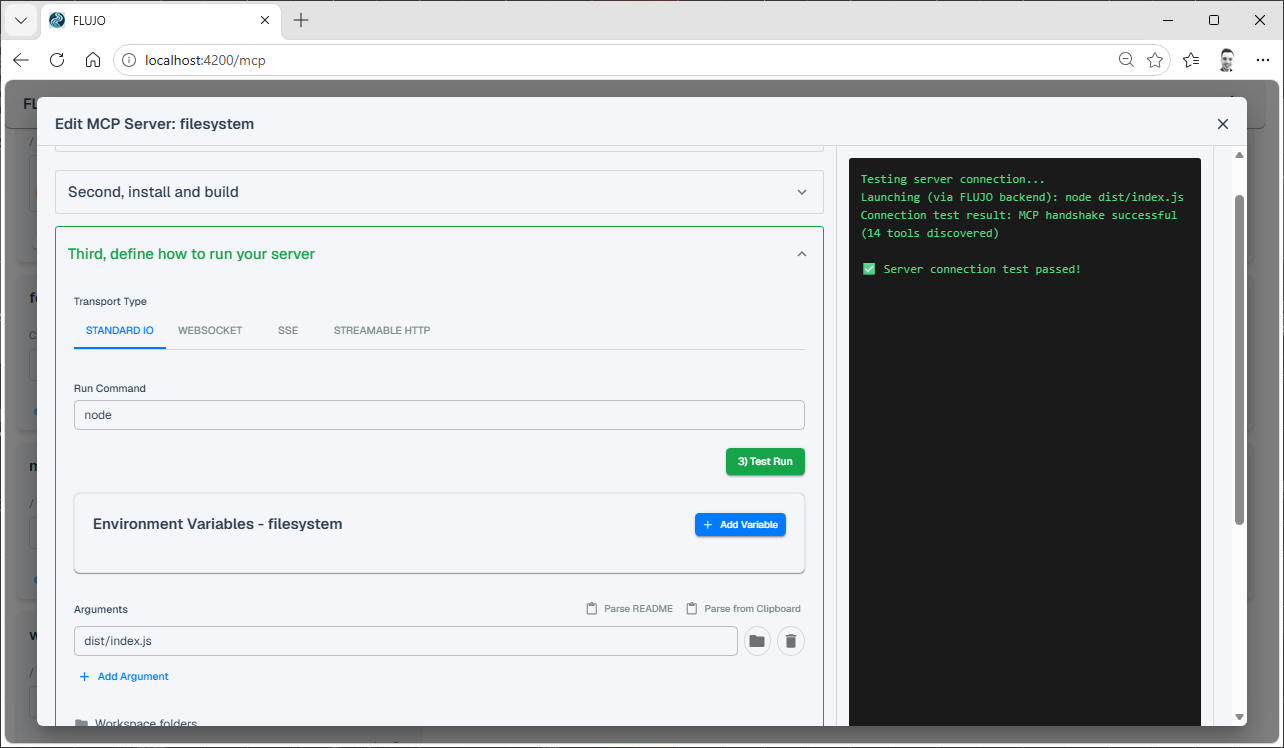
MCP Server Configuration

Every connected server gets a detail view to browse and test its tools, resources, and prompts directly:
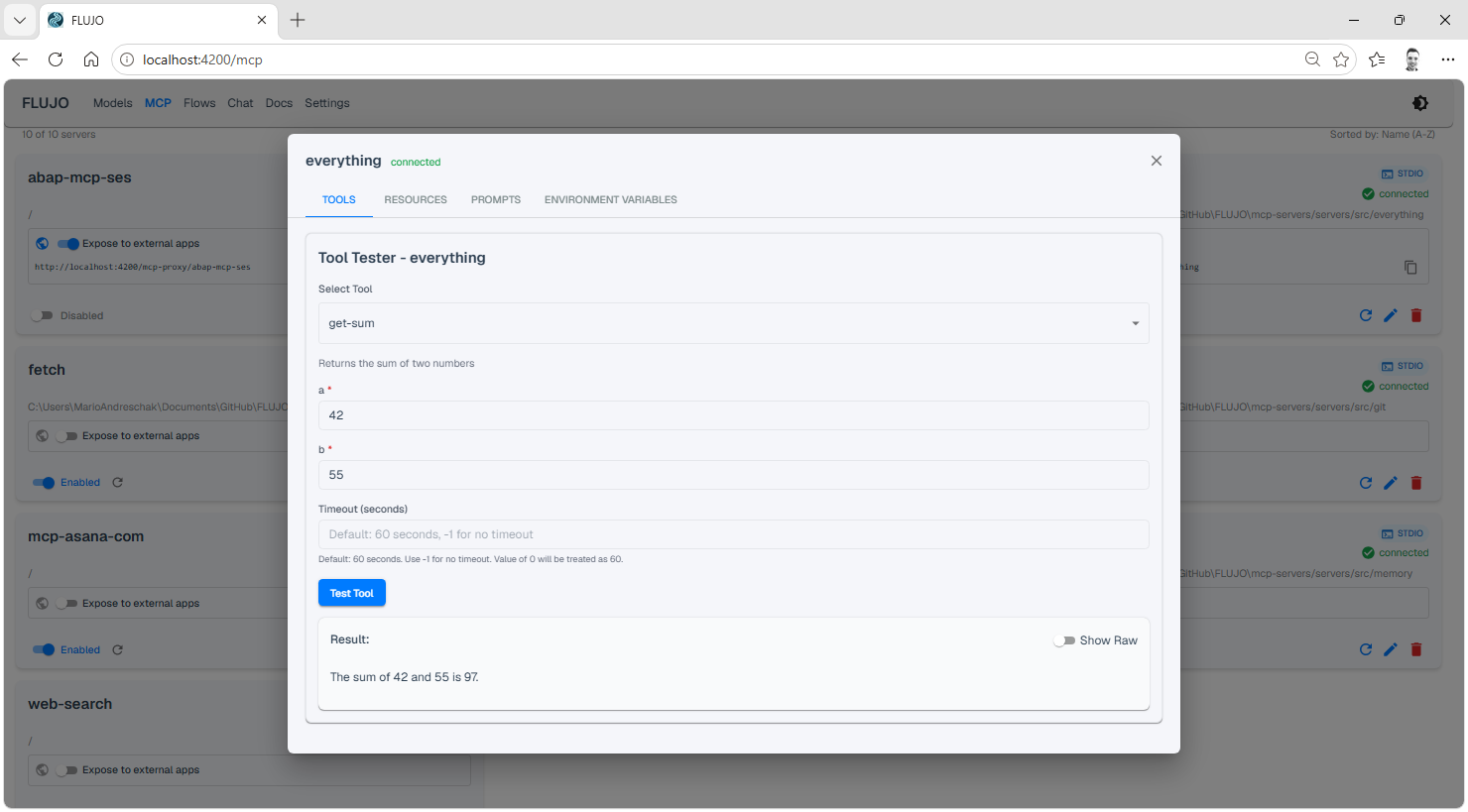
MCP Tool Tester

🧩 Agent Builder

  • Simple mode: build an agent like a recipe, one plain-language step at a time, without touching a diagram
  • Expert visual mode: connect Start, AI, connected-app, subflow, and Finish nodes in a drag-and-drop graph
  • Branching & handoff: let a model hand off to another node/agent based on the conversation, build loops, or fan out into multiple specialists
  • Subflows: call another flow as a single step, with its own isolated state — reuse a flow like a function
  • Per-node tool & prompt scoping: decide exactly which tools, resources, and system-prompt fragments each node can see
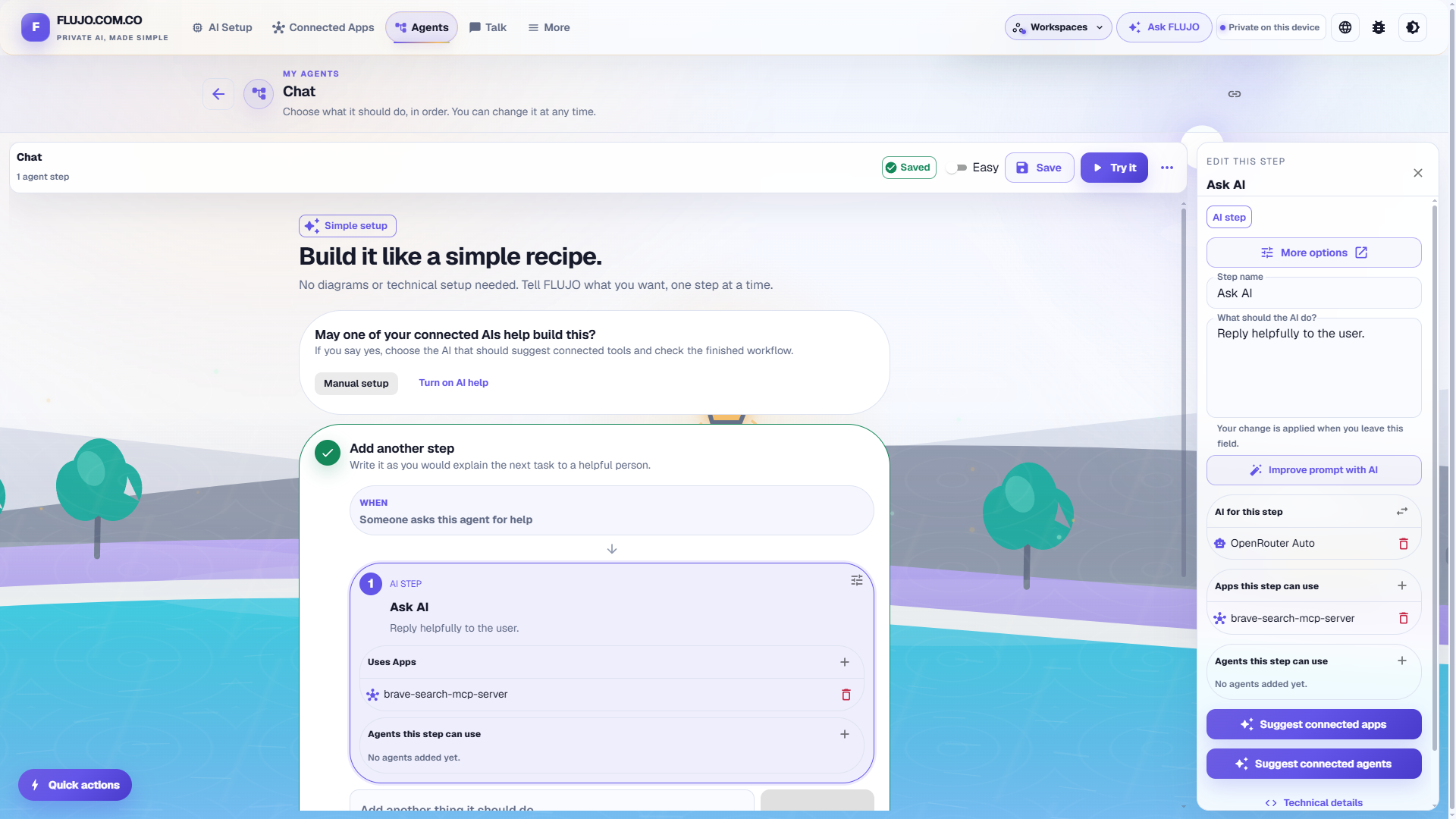
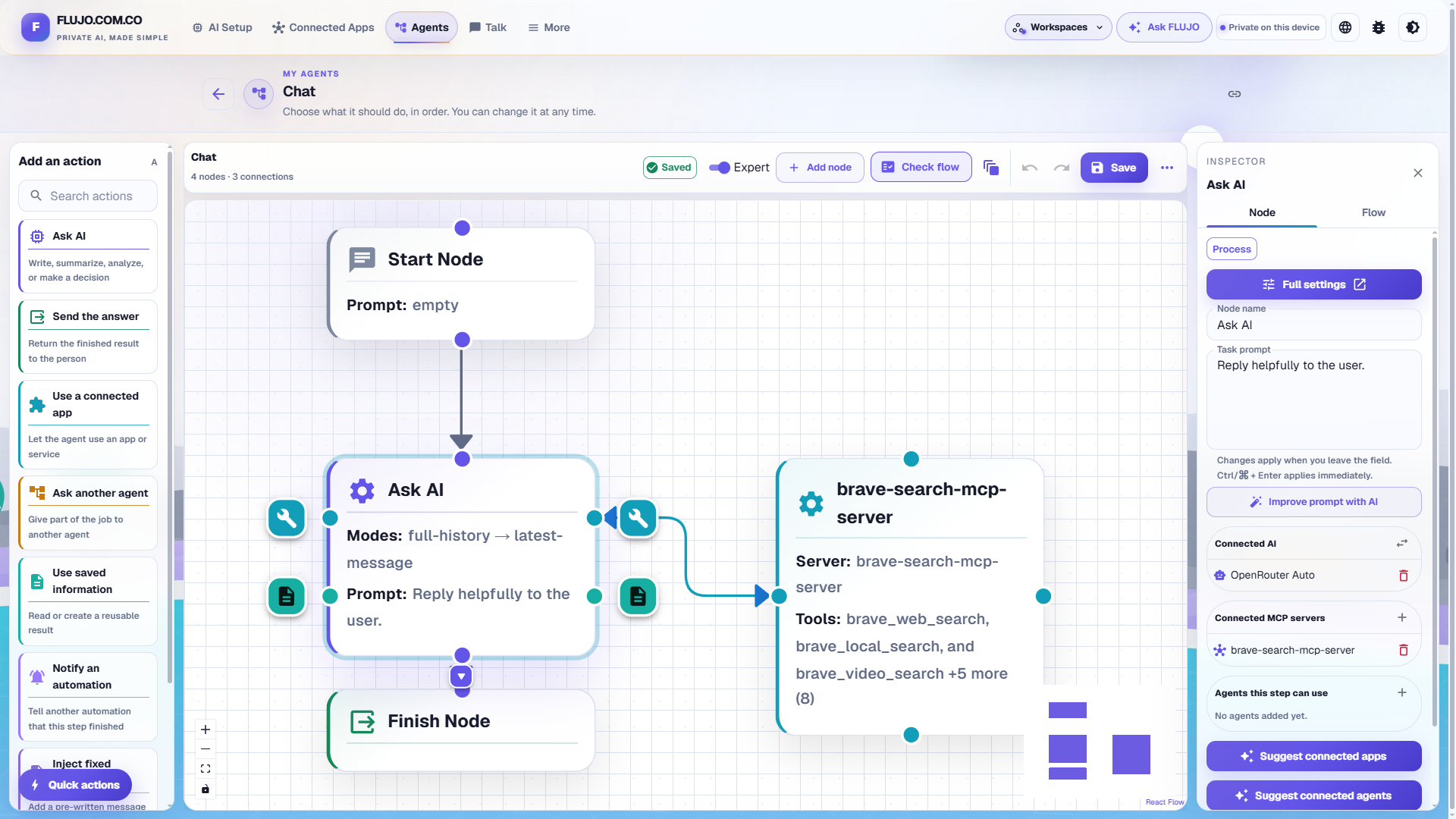
Agent Builder — Simple Setup Agent Builder — Expert Visual Mode

Branching & handoff

Connect one node to several successors, then tell the model when to use each handoff tool from the "Agent Tools" tab of its Process Node:

Branching Branching handoff tools

Loops

Connect a node back to a previous one the same way to build a loop:

Loops

Orchestration & Subflows

Combine multiple handoffs and loops to build an orchestrator, or drop in a Subflow node to run another flow as a single, reusable step with its own isolated state:
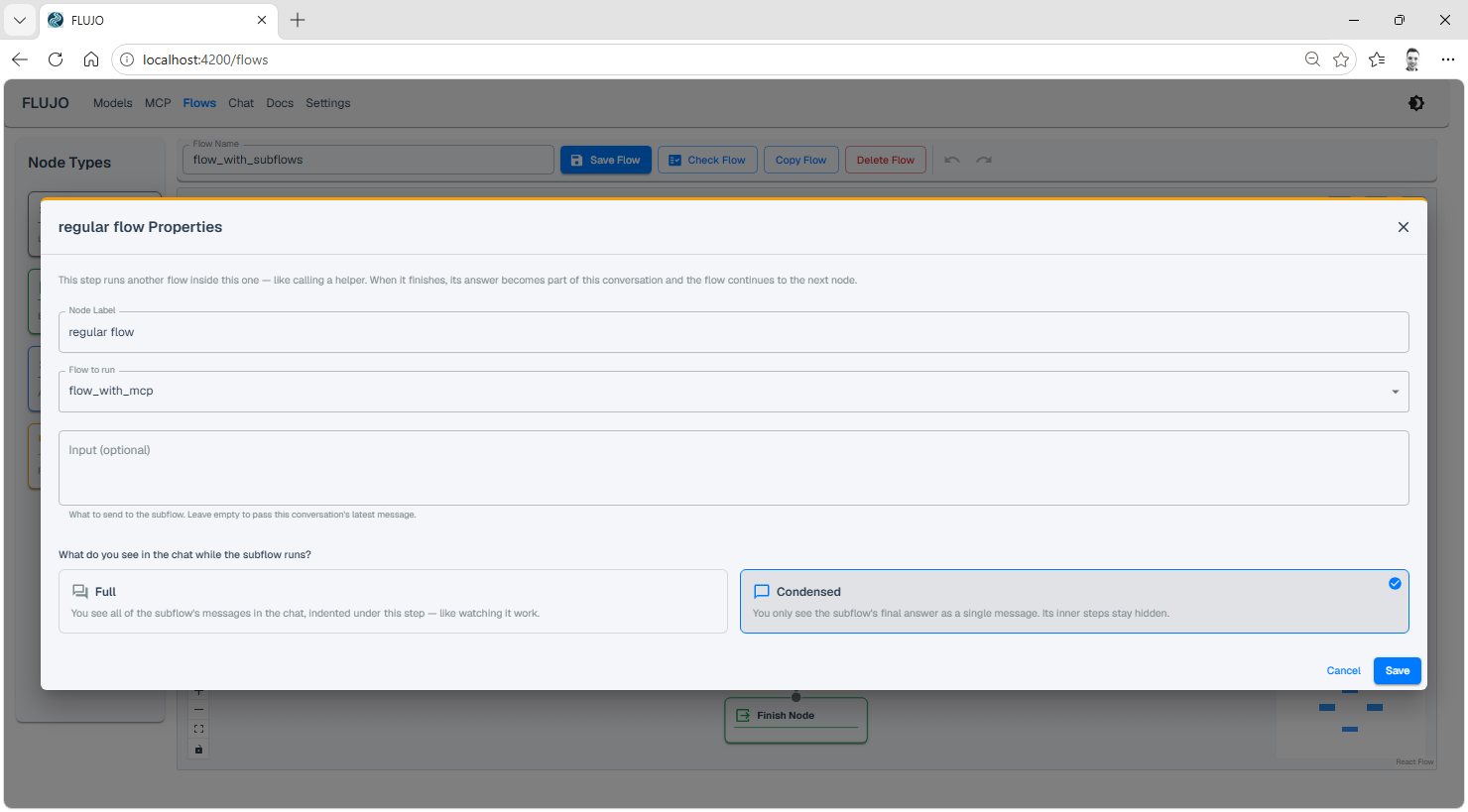
Orchestration Subflow configuration

💬 Talk

  • One place to talk to every agent: select an agent and start a conversation from the Talk page
  • Live execution view: watch a run progress step-by-step in real time, with token usage and a context-window meter per conversation
  • Visual debugger: set breakpoints, step through a run node-by-node, and inspect state before/after each step
  • Human-in-the-loop tool approval: optionally require approval before any tool call executes, for any provider (including Claude Subscription's agentic tool use)
  • File & audio attachments, message editing, and conversation branching

Talk Interface

Step through a run node-by-node with the visual debugger, inspecting prep/exec state at every stop:
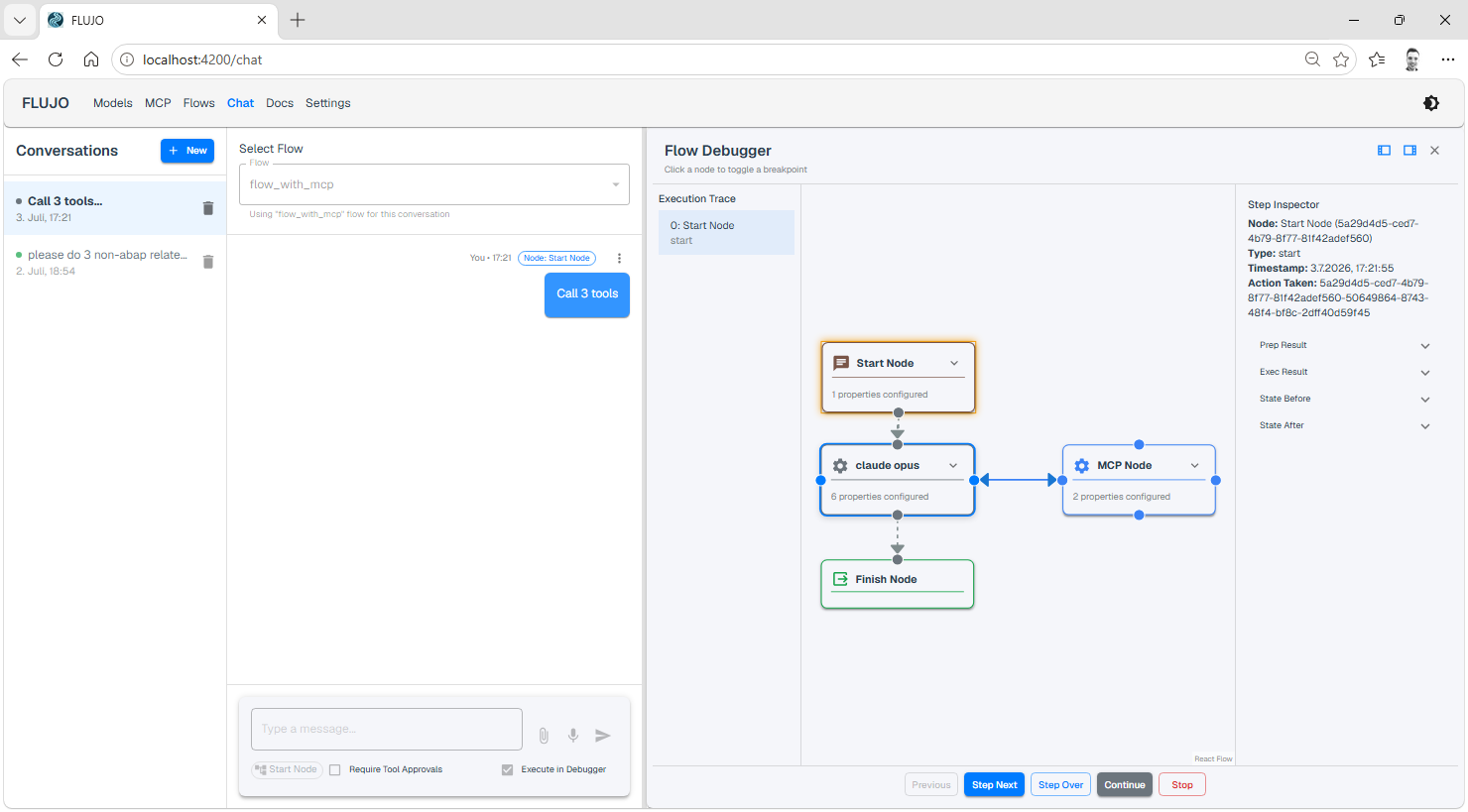
Visual Debugger

⏱️ Automations — Triggers

Run your flows automatically — on a schedule or when something happens — without opening the chat. FLUJO just needs to be running for

readme truncated — read the full docs on github

Frequently asked questions

Is FLUJO free to use?

FLUJO is open source under the MIT licence. There is no licence fee and no seat count — you can self-host it or, where the project offers one, pay a vendor for a managed version instead.

What does FLUJO do?

Multi-Agent + Automation: Workflows, Automation, Self-Improving Agents

What is FLUJO written in?

FLUJO is primarily written in TypeScript. Its source is publicly available at https://github.com/mario-andreschak/FLUJO, and it has 629 GitHub stars.